Bad Biology (2008) [31 Days of Gore]

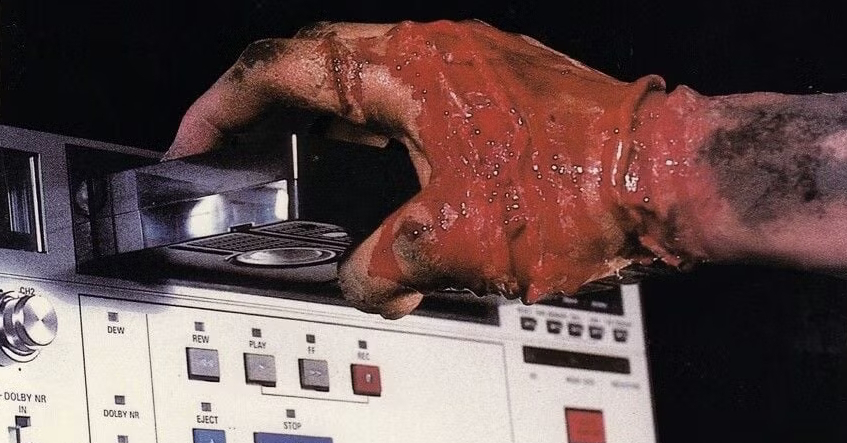
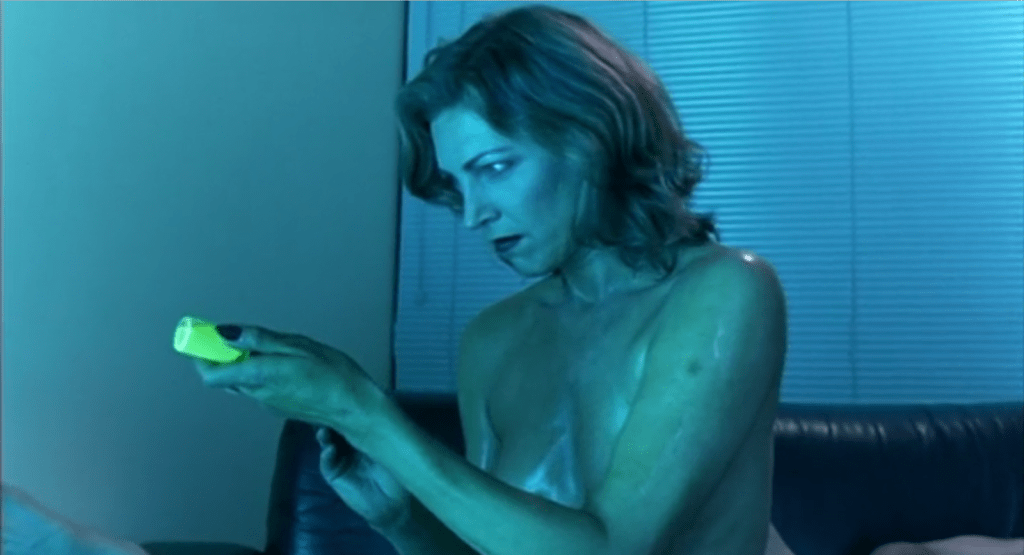
Director Frank Henenlotter insists he makes exploitation films, not horror. The line is blurry in Basket Case and Brain Damage, but Frankenhooker made the distinction a little bit clearer. With his fifth and final film, Bad Biology, Henenlotter goes all the way. The paradox of Bad Biology is A) you should see it without knowing anything about it and B) you really ought to know what you’re getting yourself into. It’s easily the most offensive movie I’ve featured all month. For most viewers, the offending material will probably be the rampant psychosexuality and violence toward mutant babies.

The main character, Jennifer, is a sex addict with an abnormal vagina. Not only is she helplessly compelled to sleep with strangers every night, she murders them before giving birth to a baby merely two hours after its conception. In a concurrent subplot, there’s a guy nicknamed Batz on account of him being bat-shit insane. His penis was accidentally severed at birth; although the doctors were able to reattach it, it never worked right. In an effort to rejuvenate his beloved member, he began experimenting with steroids and other drugs. Now his penis has developed a drug deficiency and a mind of its own.

You remember the phallic rocket gag in the Austin Powers movies? There’s a scene like that near the end of Bad Biology. It’s much funnier because it doesn’t require cheap cameos to sell it (only cheap effects). Just when you think the sequence is over, it starts all over again, and the sheer stupidity of it makes you snicker. A lot of R-rated Hollywood comedies certainly try to be as outlandish as Bad Biology in a safe, MPAA-approved way, but Henenlotter pulls off the real deal effortlessly.

Henenlotter’s done this shot from baskets, zippers, and now: the holiest of holies

Obviously Jennifer and Batz are made for each other, but they don’t meet until the second half of the movie. That may sound like the movie plods, but it doesn’t. It’s actually one of the best contemporary exploitation films I’ve ever seen. It’s also one of the shittiest-looking. No, it’s not quite as shitty-looking as yesterday’s Video Violence, but movies like that get a pass because a bonafide film shouldn’t look as bad as Bad Biology does.

Despite the gore and the bizarre subject matter, it’s a cute little picture. Now it’s time for Basket Case 4, Frank. We all want to see it, buddy.

Video Violence (1987) [31 Days of Gore]

A New Yorker opens a video store in a small town. One day a homemade snuff film finds its way into the overnight return box. Naturally, the cops don’t believe his “crazy story” because the movie would be over as soon as they do their job. Or maybe they’re in on it… maybe. (I’m not just being flippant here. It really is kind of hard to tell.)

I began snickering almost as soon as Video Violence began. In the opening scene, a couple of sports store clerks wait for an unsuspecting shopper to go to the dressing room before bursting in and beating her to death with a baseball bat. That isn’t the funny part. What’s funny is these aren’t actors, just people the director probably talked into being in his little horror movie. I imagine the writing process was like this: “Hey, I know a guy who owns a sporting goods store, so let’s set a scene there!”

In 1985, United Home Video gave us Blood Cult, which was billed as the first straight-to-video horror movie. Whether or not that claim is true is debatable, but I cherish the VHS copy I found in the clearance bin because it was shot in and around my hometown. (United’s follow-up, The Ripper, has scenes shot about two or three blocks from my current address.) Video Violence references Blood Cult twice and there’s something oddly pointed about it.

According to Wikipedia, Video Violence is an angry response to the cheap horror films which were infiltrating the relatively new video market. The director, who worked in a video store himself, claims he was disheartened by the fact so many people were into these sick types of movies. So what did he do as a response? He created one of the sickest of the bunch. At least one section is as uncomfortably brutal as the scene in A Clockwork Orange, complete with the instigators using scissors to reveal the victim’s nipples.

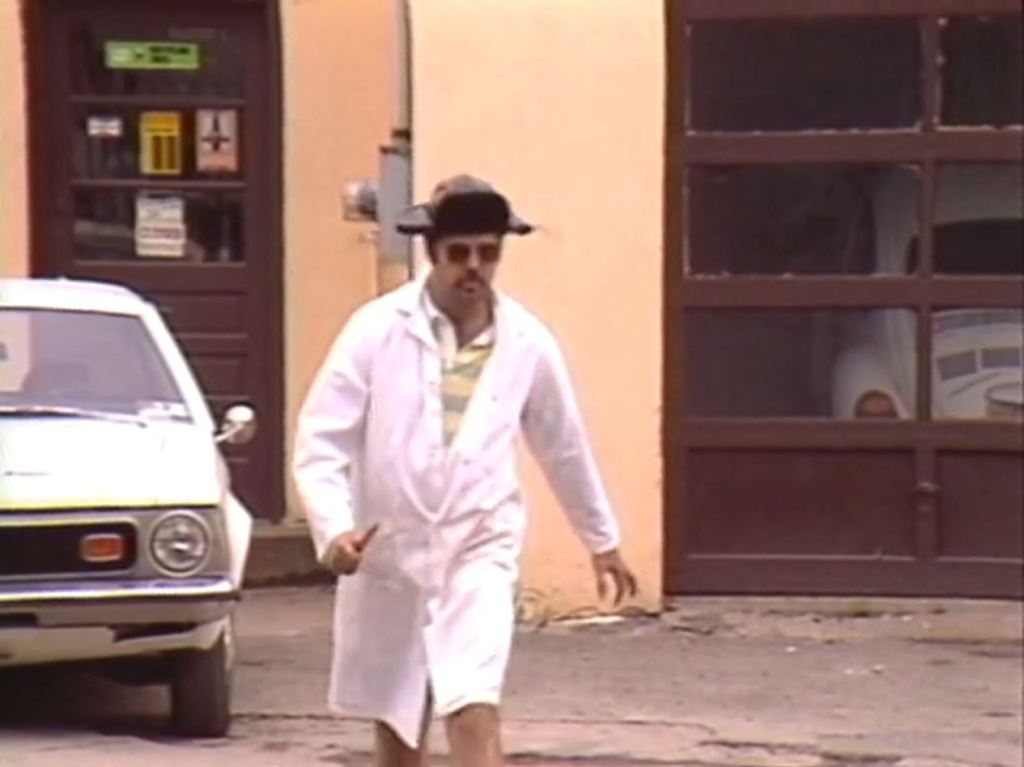
So it’s remarkable that out of Blood Cult, The Ripper, and Redneck Zombies, Video Violence is the most watchable. The other movies were boring more often than not, but even though it’s longer, Video Violence has that certain undefinable trait found in Neil Breen films and Tommy Wiseau’s The Room. The actors probably have no business being in a movie, but what they lack in talent they make up with charm. Imagine driving through a small town and seeing this guy on the sidewalk:

I always loved the idea of everyday people picking up a camera and making a movie. Youtube has kind of ruined the novelty of ultra-low budget filmmaking, but back then it was great to think an impromptu horror movie was the talk of a small town in a Waiting for Guffman kind of way. Video Violence drags a little towards the end, but atones for its slip-up soon enough.

Angel Heart (1987) [31 Days of Gore]

Why does black magic, devil-worshiping, and detective noir go together so well? There are few genre mashups I like more than hard-boiled horror. This one reminds me of Jacob’s Ladder, The Ninth Gate, and Lord of Illusions, all three of which draw me back for repeat viewings. If those aren’t your cup of tea, neither is Angel Heart.

Mickey Rourke plays Harry Angel, a morally ambiguous private detective in 1950s New York. He’s just been hired by Louis (Robert De Niro) to track down a missing person by the name of Johnny Favorite. Louis’s motivation is vague at best, but he’s offering Angel five thousand bucks to do it. So even when some of Angel’s leads turn up dead, he needs the money too bad to quit.

Here’s something I’ve been thinking about this a lot lately: What’s the difference between a trope and a cliché, anyway? The simple answer: we like tropes. They’re the elemental building blocks—or perhaps the shorthand—of mood. Like Jacob’s Ladder, Angel Heart is a master of mood, but more than anything it’s a master of imagery. Watch it a second time and those nightmarish images will make a little more sense. Somehow, though, the film becomes even more unsettling with coherence.

Angel Heart is darkly funny at times, too. When his investigation leads him to New Orleans, Angel falls under the scrutiny of a couple of homicide detectives who’re trying to finger him for the murder of a musician who choked to death on his own severed genitalia. Later, they harass Angel for the murder of a woman who, they claim, “Died under similar circumstances.” Angel squints at them before asking, “She choke on her dick, too?”

If the movie breaks down anywhere, it’s in the end when Angel starts piecing together the puzzle. I’m sure it was new territory at the time of its release, but nowadays it’s so old hat you might figure it out by the end of the first reel. Doesn’t matter. Angel Heart is one of the best horror films ever made.

Witchboard 2: The Devil’s Doorway (1993) [31 Days of Gore]

Cinemax was kind to me in the 90s. I recorded Witchboard 2 on the same VHS as 976-Evil 2 and Amityville 6, the latter of which taught me that if you take the cable of a guitar amp and plug it into an attacker’s mouth, you can make them explode (but only after turning the volume knob up). I’ve just seen Witchboard 2 again, thanks to r/badmovies’ latest movie marathon. I suspect I’ve now seen the movie more than anyone else, including the people who made it.

Sure, it’s marginally fun with the right crowd (attendees developed a drinking game with rules such as “drink every time you see mom jeans”), but this marks the first time I’ve fallen asleep during this year’s 31 Days of Gore. I was out for about twenty minutes and somehow didn’t miss a thing.

The leading female, who we’ll call Dullsville, moves into an apartment and decides she’s going to be a hotshot painter. Her landlady (Laraine Newman from SNL) is crazy and believes it’s still 1969 for no other reason than the filmmakers thought it would be funny. (Nothing in this movie is intentionally funny and it’s painful whenever it tries.) Dullsville’s love interest is a snarky photographer who helps her investigate the strange happenings that occur after the previous tenant’s Ouija board is found in a closet. Then nothing interesting whatsoever happens for a gruelingly long time.

Here’s a movie that attempts to make use of the camera techniques Sam Raimi pioneered in Evil Dead films, but the shots are used nonsensically. The camera pushes through a moving car, down a chimney, and sometimes flies all over the damn place, but there’s rarely a reason for it. It’s as if the filmmakers are mimicking things they’ve seen in better movies, but didn’t understand why they were effective.

Calling the characters one-dimensional would be an insult to doodles. As for redeeming qualities? There are none. The most exciting thing in the movie was given away by the box art (see above). It turns out that was a dream anyway. How lame.

The Lords of Salem (2013) [31 Days of Gore]

Dawn of the Dead and Rosemary’s Baby are two of my favorite horror movies of all time. The former’s Ken Foree appears in The Lords of Salem, while the latter was obviously a huge influence on director Rob Zombie. Intellectually, I can tell you this film is a pretentious mess. That didn’t stop me from loving it. As I’ve said before, I’m a sucker for movies about witchcraft, so it’s hard to remain objective when my heartstrings are being fiddled. This is one of the most glorious, straight-faced, stupid pieces of shit I have ever seen.

Heidi (Sheri Moon Zombie, who else?) is a shock-jock radio personality who plays whatever the hell she wants over Salem’s airwaves. In another segment of the show, she and her co-hosts interview locals who coincidentally specialize in the very subjects relating to the film’s plot. Nifty, huh? During these needlessly chatty scenes, the performers seem so disconnected from each other you begin to wonder if their closeups were filmed in isolation tanks. It’s really weird, but Zombie is no stranger to confusing filmmaking.

What’s weirder is a naked witch (Meg Foster) frequently watches Heidi from the shadows of her curiously empty apartment building. These strange happenings begin when Heidi receives a mysterious record, the music of which makes her feel nauseous and sleepy. When she broadcasts the record from the radio station, several more women across Salem experience the same trance-like effects. Thankfully, a witchcraft historian (Bruce Davison, who gives the best performance in the entire picture) realizes the music is much more than a droning tune and investigates the matter further. All the while, Heidi is falling deeper and deeper under the witch’s spell.

I’m not sure why I feel the need to tread lightly in regards to spoilers. Not much of it makes a lick of sense anyway, so what can possibly be spoiled? I will say I loved Judy Geeson, Patricia Quinn, and Dee Wallace Stone in this movie. The veteran actresses deliver the kind of stuff you rarely see in horror movies, but always want to see.

The usual pop cultural references to Rob Zombie’s childhood are in full effect, while the list of cameos (from Barbara Crampton to Clint Howard) reads like the guest list at a star-studded horror convention. If you’re more of a fan of modern horror, you’re probably not going to like this movie much. Scratch that—if you’re a human being, you’re probably not going to like this movie. I imagine there’s a very small demographic of moviegoers who are going to appreciate it. And you know what? That makes it all the more special.

The Basket Case trilogy [31 Days of Gore]

Basket Case (1982)

Like a horror version of Midnight Cowboy, wide-eyed Duane Bradley arrives in the Big Apple with a wicker basket, curiously padlocked. He checks into the first hotel he sees, the kind of place populated by degenerates and whores. When he’s told his room will be twenty dollars, he reaches into his pocket, produces a giant roll of cash, and thumbs through it before finding such a small denomination. The resident drunk perks up, dollar signs gleaming in his eyes.

Later, Duane gets hammered at a bar and opens up to a hooker with a heart of gold: when he was a child, his hideously deformed Siamese twin, Belial, was separated from his body against his will. (When questioned about the ethics of such an operation, one of the surgeons said, “I’m not even sure that thing is human.”) Following the surgery, Belial was placed in a garbage bag and tossed out. After Duane rescued his brother, they murdered their father for separating them.

Today, the duo is systematically revenge-killing the doctors responsible for their unwanted operation. Despite Duane’s naivety, the plan goes off without a hitch… until he falls for one of the doctor’s receptionists. Enraged with jealousy, Belial trashes their room and goes on a murderous rampage. Things only get bloodier from there. And at this point I’m wondering who names their children Duane and Belial.

Basket Case is among the first three horror moves I ever remember seeing (Creepshow and The Stuff are the other two). I’m surprised how well this sub-million dollar movie from the early 80s holds up. The make-up effects are more hit than miss and the stop-motion miniatures (whenever Belial hops out of his basket and goes for a stroll) are charming and, dare I say it, kind of cute. Amazingly, there’s not much fat to be found anywhere in the movie, the camerawork isn’t lazy, and we’re treated to one money shot after another with perfectly paced swiftness.

Director Frank Hennenlotter, whose filmmaking record is five for five, is perhaps the most potent exploitation director who ever lived. Do not read the rest of this post until you see this movie.

Basket Case 2 (1990)

Henenlotter picks up exactly where he left off: Duane and Belial have taken a nasty tumble from the fire escape of their New York City apartment, which had apparently left them dead. (Didn’t that guy at the end of the first movie check Duane’s pulse and shake his head with finality?) Well, it turns out they’re not dead. News crews show up to the scene, uncovering the Bradley Brothers’ murderous secrets for the world to see.

Meanwhile, Granny Ruth (Annie Ross) and her granddaughter Susan are watching the media fiasco on their living room TV. For reasons we’ll discover later, they decide to hop into their conspicuous van and make their way to the hospital where the boys are being kept under police surveillance. Unfortunately, Belial just woke up on the wrong side of his hospital bed and he’s killing everyone who gets in his way. He even takes psychic possession of his brother to assist his efforts to escape, despite the pair being on the outs.

When they make it to the parking lot, Granny Ruth and Susan swoop in to usher them into their van. It turns out Ruth owns a halfway house which harbors freaks just like Duane and Belial. Once there, Ruth separates the brothers, to minimize their fighting, and introduces Belial to a very special lady who lives in the attic… special in almost the same way Belial is. It’s just about one of the cutest things you’ll ever see.

Henenlotter, who’s obviously a fan of 1932’s Freaks, makes the conventionally attractive the villains while Granny Ruth’s commune of monsters naturally become the heroes of his story. There are wonderful creature effects and I love how each freak’s appearance is a character in and of itself. The only problem is Duane, who anchored the first film, plays second fiddle to the expanded cast. Actor Kevin Van Hentenryck is such a likable screen presence (and a much improved actor this time around) that I can only wish we got more of him. This time his character is alternatively cunning and stupid, depending on what the plot requires, and he doesn’t shine until the last ten minutes of the film, which are twice as exciting as what preceded it.

One thing I loved about the original Basket Case—because Jaws theory isn’t always right—is we get a glimpse of the monster relatively early on. This time we see him a little too soon, a little too often and, worst of all, a little too close up. Belial’s creature effects are technically better than they were in the original (sometimes there’s an actual human beneath that tumorous mass of latex), but the first film’s charm has begun to thin. My favorite thing about Belial in the first movie was his crazed scream. This time it’s simply not the same scream… and it would have been hilarious to hear the original scream whenever Belial makes love.

I love this movie, but it’s probably my least favorite of the bunch. Nothing in this one tickles me half as much as when an unhinged Belial trashed the hotel room in the first movie.

Basket Case 3: The Progeny (1991)

The third in a franchise has typically gone past the point of diminishing returns. Unlike most directors, who typically abandon the horror franchises which made them famous for “real” movies, Henenlotter sticks it out until the bitter end. (He’s talked about making a Basket Case 4. The odds of that happening are probably somewhere between Bubba Nosferatu and House of Re-Animator.) Right out of the gate, Basket Case 3 is better than its predecessor even though it starts with an extended flashback; repackaging the best part from Basket Case 2, Henenlotter sets the bar so high he has no choice but to aim for the stars.

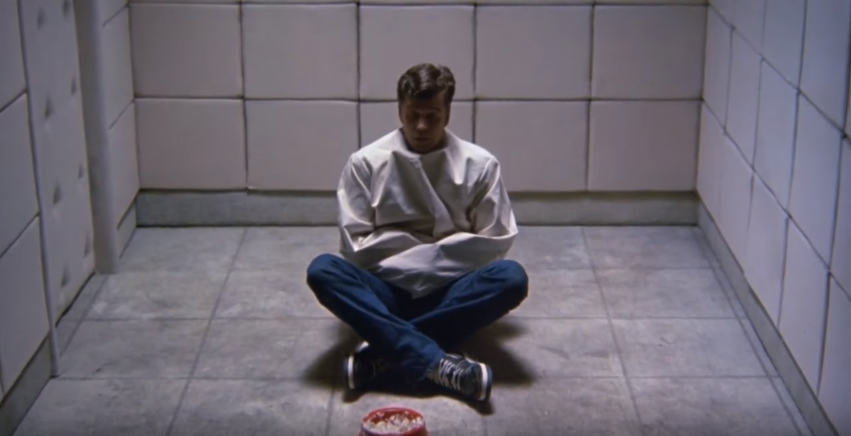
Fast forward a bit and Granny Ruth has been keeping Duane in a padded cell ever since that glorious ending. It turns out Belial and his love interest, Eve, are expecting a child. In response to this glorious news, Granny Ruth giddily packs her merry band of freaks into a school bus so they can all make the trek to her ex-husband’s house, the doctor who will deliver Belial’s baby. Since she can’t very well leave Duane in custody, Ruth begrudgingly drags him along for the ride, refusing to remove his straight jacket.

Duane insists he’s no longer crazy, but we all know better. Either way, Belial refuses to even acknowledge him. Belial is a family man now. He can’t have his crazy brother dragging him down anymore. Once they hit the road, Granny Ruth leads her freaks in an amazing sing-along of Personality. I’m going stop talking about the plot here so I don’t ruin the surprises, which only get more outrageous as the film goes on. I don’t know why Henenlotter shifted focus from Duane to Belial and ultimately to Granny Ruth over the course of the three films, but Annie Ross’s endearing character gets fleshed out a lot more in this one.

As usual, the film that started it all is the best, but the Basket Case trilogy is a remarkable franchise, drawing its strength from actor continuity and consistently creative gags. If Henenlotter ever does make a fourth one, I can only hope he returns his focus to Duane. I just love seeing that guy in movies.

Body Melt (1993) [31 Days of Gore]

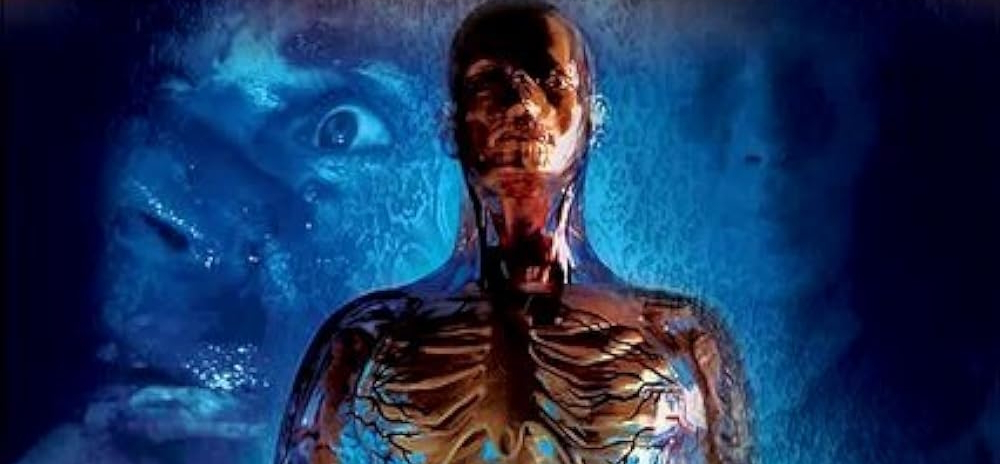
Last year I featured Street Trash. This year I’m featuring the similarly gross Body Melt. Maybe “melt movies” will become a tradition on 31 Days of Gore. The movie’s satirical look at our obsession with dietary supplements is more topical than ever. I’ve seen far too many otherwise intelligent people who trade hard scientific data for celebrity advice and too-good-to-be-true promises. Maddeningly, the problem seems to be growing increasingly worse despite the fact we have better access to education than ever before.

What I’m saying is it’s time for melt movies to make a comeback. Today they could take on the anti-vaxxers, the helpless self-help trolls, and the ridiculous “get motivated” crowd, to name a few. There’s so much humor to be mined from the kind of “concerned” (paranoid) people who are constantly on the lookout for short cuts and disastrously short-lived bursts of feeling actualized. In our quest to never feel bad, we’re letting corporations and social media define what bad is so we always feel it.

Body Melt opens with a sexy commercial for Vimuville, a pill company which promises its customers a better lifestyle. What the product will actually accomplish is vaguely worded, but hey, who wouldn’t want to feel better? An employee for the company plans to blow the whistle, at which point the product’s spokesperson injects him with a lethal dose of their latest concoction. It turns out it’s not the dosage that’s the problem, it’s the stuff itself, and the company has already been feeding it to a test group at the end of a quiet cul-de-sac in Melbourne, Australia. 

These unknowing participants, by the way, are screwed. From Wikipedia’s plot summary:

The pills are consumed by the residents, and produce liquefying flesh, elongated tongues, exploding stomachs, exploding penises, imploding heads, monstrous births, tentacles growing out of the face, living mucus, sentient placentas, and other gruesome mutations.

I was under the impression the whistle blower was the main character. Literally minutes later, he melts down in spectacular fashion before fatally smashing headfirst through the windshield of his car. To say Body Melt is protagonistically challenged (yeah, I’m still trying to coin that phrase) is an understatement. Street Trash was like that, too, but this one is a lot more focused even though its mind is all over the place. It seems there are a lot of non sequiturs for the first 90% of the movie, but it’s mostly wrapped up nicely by the time we get to the splatterific ending.

Body Melt is a fine cult film. You should know by now if it’s your cup of tea or not. Just don’t leak on me, man. 

Ghost in the Machine (1993) [31 Days of Gore]

When you assume a primitive understanding of early internet technology and have characters saying things like, “it’s a mainframe computer company,” I’m in hog heaven. Really. I saw this one on Pay-Per-View as a kid and rediscovered it today. It fits in well with the other 90s-era technophobic thrillers, such as Shocker, The Lawnmower Man, Virtuosity, and Brainscan.

A serial murderer, who the media calls The Address Book Killer, is on the loose. Early on, TWA employee Terry Munroe (Karen Allen) loses her address book. Even more predictable: the killer has acquired her contacts and plans on killing them one by one. On the way to the first address, he loses control of his car and plunges into a cemetery, cackling hysterically. Taken to the hospital in critical condition, a lightning storm strikes just as the killer dies in an MRI scanner, allowing his soul to enter the hospital computer system and the internet itself.

When Munroe realizes her acquaintances are dying in freak “accidents,” she teams up with disgraced computer hacker, Bram Walker (Chris Mulkey). Meanwhile, Munroe’s sex-obsessed son, tries to convince his babysitter to bare her breasts. The kid’s a con artist, a subplot which is forgotten almost as soon as it’s brought up. Arrested Development’s Jessica Walter plays the grandmother, which is pointless, but fun nonetheless.

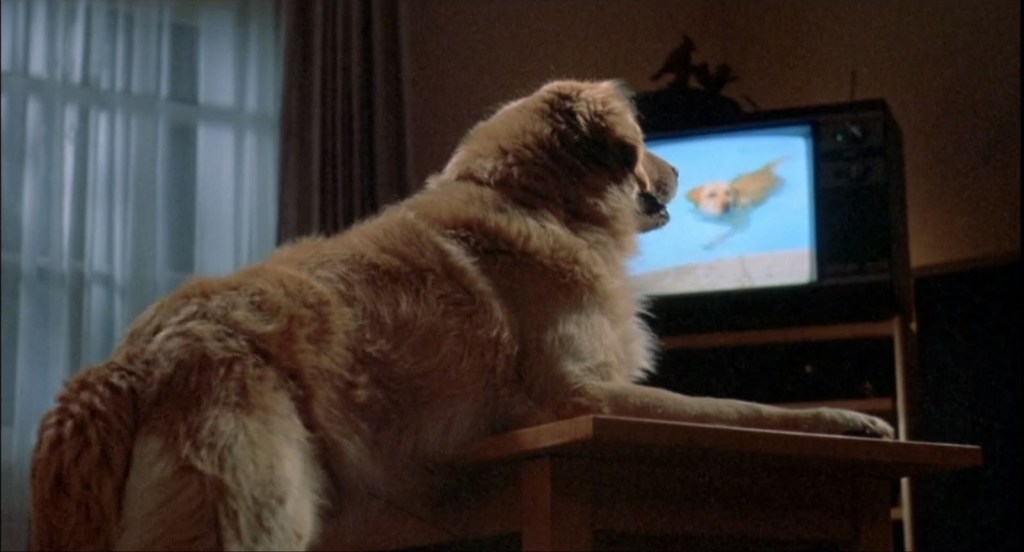
The real fun begins when the movie would have us believe everything in the early 90s was already connected to the “world wide web,” including ATMs, traffic lights, curling irons, and microwave ovens. At one point the killer’s data-geist slips into Munroe’s house and targets the family dog. The dog is just lazing around, as dogs do, when the television plays a program which makes the dog so horny he hunches the coffee table. You don’t have to look too closely to see the string the filmmakers tied around the dog’s hips to accomplish this special effect.

I’m also a fan of director Rachel Talalay’s Freddy’s Dead and Tank Girl, the latter of which appears to have found a cult following. Ghost in the Machine is the film Talalay made between those two, which at first glance seems like a step down in absurdity. Then you get to the strange happenings, filmed Final Destination style, which concoct convoluted ways of putting the characters in danger. About fifty minutes in there’s a brilliant scene in a crash-test facility that’s so wild I laughed uncontrollably for several minutes. Later, there’s a dishwasher with a digital readout so it can notify the audience when it’s entering its “EXPLODE” and “DIE” cycles.

Talalay is clearly in on the joke here, but I’m not so sure her stars got the memo. Okay, I’m sure Allen and Mulkey knew it wasn’t Shakespeare, but there’s no winking at the camera, no hamming it up. I’m going to recommend this to anyone who appreciates fine cheese. My favorite part is when Munroe’s son elbow drops a ghost with reckless abandon.

Slaughterhouse (1987) [31 Days of Gore]

Slaughterhouse begins promising enough. Right off the bat, you get stupid teens doing stupid teen things in the middle of nowhere. A couple of the kids split off to go get themselves killed in the woods. You don’t see much, but it is, after all, only the introductory killin’. It’s enough to make the audience believe (or hope) each money shot will top the last. The cold opening smash-cuts to its credits, which overlay actual footage from a real-life slaughterhouse. This disgusting scene is scored to silly music. It’s at this point you think the movie could very well be a decent dark comedy.

So the killer of the film is Buddy, a giant of a man who doesn’t bother wearing a proper mask until the end of the movie. He’s the dimwitted son of Lester Bacon, an old farmer whose house is being foreclosed. Lester isn’t just aware of Buddy’s killing spree, he encourages it.

The teenagers in the film have nothing to offer other than the promise of deaths. They’re under no threat until the end, when their pointless subplot finally crosses paths with Buddy. In the meantime, Buddy kills the town deputy, dons his uniform, and goes for a joyride in the film’s funnest scene. If only the rest of the movie were so good.

Other than the teen stuff, Slaughterhouse isn’t a maddeningly slow movie. There’s decent acting, dialogue, and an oddly effective pace. You hold out hope the opening set the bar low in order to top itself. It never really does, at least in no spectacular fashion. Yet it’s still kind of likable for reasons that escape me. I guess I just like the concept of Buddy.

I will complain that the final kill shows even less than the first kill did. What a cheat.

Castle Freak (1995) [31 Days of Gore]

Last year’s 31 Days of Gore renewed my interest in Full Moon movies. This one stars B-movie icons Jeffrey Combs and Barbara Crampton, who also appeared together in The Re-Animator and From Beyond. I was barely a teenager the first time I saw Castle Freak and thought it was the weakest of Stuart Gordon’s Lovecraft trilogy. This time I realize it’s not so much worse, just different as it abandons the psycho-humor of those movies and becomes an effectively serious exploitation film.

Combs, Crampton, and their blind daughter inherit a castle. How did they inherit a castle? Doesn’t matter. What matters is there’s a mutilated freak living in a tiny dungeon beneath it. Near the end of the movie, Combs will have a House, M.D. moment in which he pieces together scant clues into the freak’s backstory. Until then, we never really know why the titular monster is living in the bowels of the 150-room castle, but the reveal is a doozy.

In the meantime we’ll learn the daughter wasn’t always blind and there used to be a son in the family. It turns out Combs is an alcoholic who was drinking and driving the kids around a rainy road one evening. The ensuing wreck killed his son and blinded his daughter. Needless to say, Combs’s accident put a strain on his marriage (ya think?). Desperately, he hopes moving into the castle will rekindle things, but Crampton’s character is rightly having none of it. Meanwhile, the castle freak lurks in the shadows, developing a crush on the blind girl.

Crampton said in a recent interview that she and Stuart Gordon found a new appreciation for the film the last time they screened it for an audience. I have, too. The creature effects are perfect from beginning to end while Combs and Crampton give great performances. Okay, so the cops are borderline dumb and the parents take a little too long to believe their daughter when she asserts they’re not alone in the gigantic castle. Other than that, this is a mature film with serious horror.