Sinister isn’t false advertising

Sinister opens in grainy 8mm film. There’s a family of four hooded and bound. There are nooses around their necks, the ropes of which are draped over a tree branch above. A pole saw enters frame and cuts another branch where the other ends of the nooses are tied. As that branch goes down, the family is slowly (gruelingly) strung up. It’s an effective image and by now you should already know if this is a movie you want to see.

Enter Ellison (Ethan Hawke), his wife, and two children. They’re the new family moving into the very house where that murder took place. Ellison is a true crime writer who dreams of becoming the next Capote. He got a taste of fame a few books ago, but proved to be a hack in the meantime. Ridiculously, his wife doesn’t know the history behind the house they’re moving into. Although it’s common for men to surprise their wives with a new house, doing so in real life should be automatic grounds for divorce.

Eventually Hawke’s character stumbles upon a box in the attic containing a bunch of films and a home movie projector. The canisters are labeled innocently enough: Family Hangin’ Out ’11. Pool Party ’66. Sleepy Time ’98. BBQ ’79. My personal favorite is Lawn Work ’86, which takes creative liberties with a lawnmower. I doubt Honda paid for this product placement, by the way.

Ellison calls the police, but when he’s put on hold, he catches sight of his best-selling book on a nearby shelf. Fearing a scoop is about to slip through his fingers, he convinces himself to hang up. Be assured there will be one paper-thin excuse after another to keep him and his entire family in danger. Otherwise, there wouldn’t be a movie.

Things do indeed get sinister. Eventually Ellison gets in touch with an occult expert (Vincent D’Onofrio) who says the symbols seen in each of the home movies reference a child-consuming demon. Demon or not, considering the scorpions and snakes found in Ellison’s attic, I would have moved out of the house on day one. There are also creepy children in the movie. Like creepy clowns, I can’t be the only one who’s getting bored of creepy children in films like this. I’m also getting bored of writers for main characters and creepy home movies.

At the end of the day, it’s a watchable picture, just a little slow. The term the filmmakers would prefer is “suspense-building,” but I don’t think it’s good enough to hold a moviegoer’s attention between the candy bar scenes. The film is certainly sinister, but it isn’t scary. I’m not entirely disappointed I saw it, but it arrives at a predictable ending that has nothing to say.

The Wii U is P.U.

Throughout the day Sunday, I kept hearing reviews of the Wii U and decided to go on the hunt. Two hours and several stores later, I found one at a dark and eerily dead Sears. They informed me had I gotten there any earlier, I wouldn’t have gotten it. Apparently they screwed up an order and the shipment didn’t arrive until shortly before I got there. So, lucky me, I bought the deluxe model for $479 including tax. 

What puzzled me was the lack of an Ethernet port. The exclusion was fine for Wii, as it wasn’t really geared for online games, but wasn’t the Wii U supposed to appeal more to “hardcore” gamers? If so, they’re already doing a bad job of it. I’ve got a router that’s literally two feet away from my TV—it’s a shame I simply can’t plug in. So far, most of my games only offer local multiplayer; the “online features” are social networking options that nobody will ever use.

My next complaint is about something that’s understandable in the modern age of gaming, but it still sucks: the day-one patch that takes an hour to download. If you bought one of these for your kids on Christmas, you probably won’t get to play it until noon. You don’t have to update if you only plan on playing disc games, but you do if you want to do literally anything else. On top of that, every game I’ve tried so far requires an individual update, which can take ten to thirty minutes a piece.

I’m also underwhelmed by the graphics. No, graphics aren’t everything, but I’m sick of people pretending graphics are nothing, too. This lower standard in graphical quality is to be expected from Nintendo, but I didn’t expect the graphics to be this bad. Hair looks PS2 era—sometimes worse—and when you play Assassin’s Creed 3, you’re going to be disappointed by the limited draw distances and the way shadows take on a distracting strobe effect. It’s hard to believe this is a next-gen system just by looking at it, though I expect the games will improve as developers get more experience with the system.

As usual, Nintendo shouldn’t be your first choice for FPS games and action titles. If that’s all you’re into, wait for Microsoft and Sony to release their next consoles (better yet: just beef up your home computer). But if you’re looking for something different, the Wii U might be for you. Although the system feels more like a toy than a gaming unit, it’s a fun throwback for those of us who grew up playing games with friends on the same TV.

The gamepad looks big, stupid, and uncomfortable, but the second you pick it up, you’ll wonder how they crammed so many electronics into such a lightweight device. It fits in your hands nicely and the touchscreen works like a charm, despite the lack of multi-touch controls. It’s just as cool and innovative as the Wiimote was in 2006. It’s especially surprising it didn’t make the package cost more than six hundred bucks.

Even so, I returned the system to Sears. I’ll buy it again in a few years, but right now, it isn’t worth the price for anyone but the most loyal of Nintendo fans. Even a few of them will have buyer’s remorse until the library is significantly bigger.

Smooth launch day for Black Ops 2

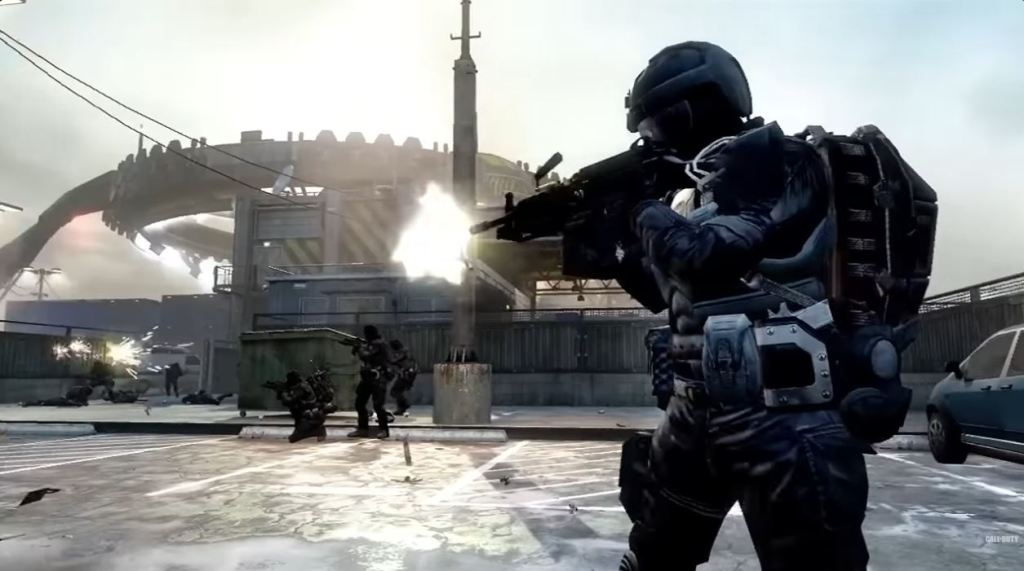
I thought I was done with Call of Duty. As launch day reviews came tumbling in this morning, I found myself excited about the newest installment. In particular, it was footage of the zombie mode additions that got my attention. So I purchased it and downloaded it while I was at work.

It’s good. It’s different. Everything I dislike about COD games has been addressed… well, almost everything. There are a few too many button prompts and quick-time events in the campaign, but there’s plenty of honest action, too. Amazingly enough, it runs better on my system on the day of launch than MW2 and 3 do after months of patches. I’ve yet to encounter any memorable bugs in the three hours I’ve played it. (Knock on wood, right?)

The sound is crisp, but Treyarch’s default mix sounds a little janky on my speakers; your mileage may vary so experiment with settings. Joining games has been a breeze and although I lagged a couple of times, it’s been pretty smooth for the most part. I like the customization. I like the futuristic weapons and tactical gear. Against all odds, I like Call of Duty again, if only briefly.

Looper is Sooper

The year is 2044. It’s thirty years before the invention of time travel. A voiceover tells us that as soon as time travel is invented, it’s outlawed. Naturally, that won’t stop the most powerful crime syndicates from using it. So where’s Timecop when you need him?

Joe (Joseph Gordon-Levitt) is a looper. Loopers are hitmen, but not the type who whack you in Scorsese movies. No, loopers simply wait in a field for a target to appear from the future. When the target arrives, hooded and bound, the looper shoots him. The only benefit of doing it this way is the body won’t be found in the future, when cops have access to higher tech forensic methods.

Before disposing of the body, the looper can find their payment strapped beneath the target’s clothes. The payment usually comes in the form of silver bars, which can be traded for their own timeline’s currency. Every looper knows full well that, one day, they’ll find gold bars strapped to a body instead of silver. The day that happens, the looper has just retired himself, which is so common it’s called “completing the loop.” When we see that Joe lives very well in a future where most live in squalor, we can see the attraction of the job despite its deadly retirement plan. He even admits that people in his line of work aren’t exactly forward-thinkers.

If you’ve seen the trailer, you already know that when Joe’s future self is sent back, young Joe fails to retire him. His future self is played by Bruce Willis, which is far less distracting than having Gordon-Levitt play dual roles—one in old-age makeup. You’re probably expecting a cat-and-mouse game to ensue. It’s actually more like a cat-mouse-dog-and-tiger game in which timelines tangle like pasta.

Does this sound convoluted to you? It’s a movie about time travel—of course it’s convoluted. Whereas so many of these movies try to make an unbelievable premise believable with endless technobabble, Looper leans into the problems of time travel with little explanation, which gives it room to do something fresh in the genre. Its interpretation of the rules leads to one of the most chilling death scenes ever filmed. The scene in question is truly the stuff of nightmares, but if you want to poke holes in it, you’re watching the wrong movie.

The X-Men Rises? (First Class review)

X-Men: First Class opens in a concentration camp. The boy who will one day become Magneto is separated from his parents by Nazis, which causes his mutant powers to unlock. Stricken with grief, he discovers he can bend metal with his mind. And you’re right: we have seen this exact scene before.

Around the same time, young Charles Xavier has learned he can read minds. He demonstrates the ability when he discovers a young and homeless Mystique rummaging in his kitchen. I don’t remember Professor X ever recognizing the shapeshifter in the films set after this one, but just go with it. You’ll have bigger challenges with this film, believe me.

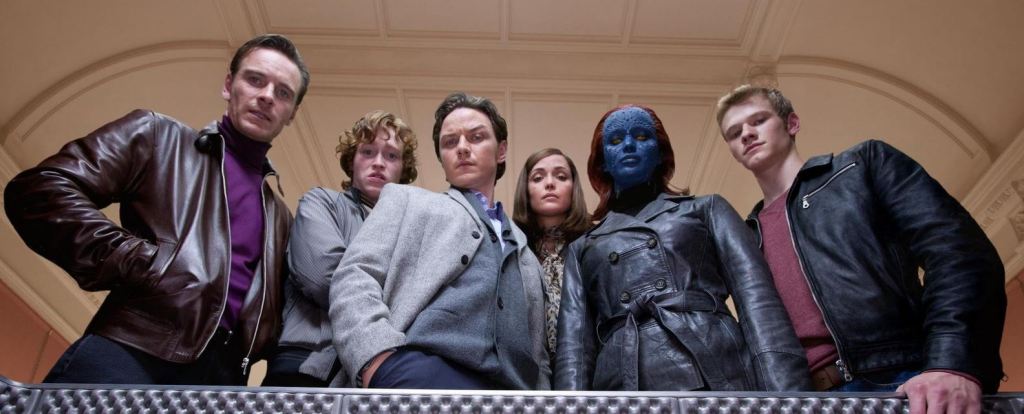
Fast forward a few years later and an adult Magneto (Michael Fassbender) is searching for Dr. Schmidt (Kevin Bacon), who cruelly studied his powers of magnetism and murdered his mother. We learn that adult Charles Xavier (James McAvoy) and adult Mystique (Jennifer Lawrence) have been hiding their mutant powers ever since they met. Mystique is forced to appear in her human form whenever they’re in public; she thinks men are unlikely to find her attractive in her natural blue form (um… sure).

Schmidt has escaped to America under the guise of Sebastian Shaw. During a stakeout, CIA agent Moira MacTaggert (Rose Byrne) learns Shaw is a mutant who plans to incite nuclear war. See, mutants were born of radiation so they will survive the nuclear winter (never mind the blasts). Most humans, on the other hand, will not. When you’ve got mutants as dangerous as Shaw, you can see why the government wants to track them all, but I digress. Again, there will be harder pills to swallow.

Charles and Mystique are recruited by the CIA to go after Shaw. Charles convinces Magneto to join him. They’re going to need a team, of course, so they scrape the absolute bottom of the barrel. See, for much of the original run of Uncanny X-Men, there was a problem: it was kind of a mediocre comic. It wasn’t until Giant-Size X-Men when the team got interesting. Which begs the question: Why bother making a film about the X-Men team no one, including Marvel itself, gave a shit about?

Look, all superhero movies are at least kind of goofy, but First Class takes the cake. Even the recognizable X-men are portrayed by younger actors with roughly half the gravitas of the old ones. Most of their powers are dull and useless. Worse, Magneto seems to exist in his own movie most of the time, a more serious movie, a darker movie, and a better movie. I would have much rather seen Magneto: Origins than this uneven mess.

Tonal shifts aside, it’s a well made movie made by an accomplished director whose first three movies I admired tremendously. It just isn’t exciting subject matter, unfortunately, and I hope he gets a chance to return to the less-Hollywood fare where he originally made a name.

Batman ends (I finally saw The Dark Knight Rises)

Batman and Bane set aside their differences and hold hands.

Most people who give a shit about Batman have probably already seen The Dark Knight Rises. I just feel no urgency to see a movie that’s going to make a billion dollars anyway and I’d rather give my money to Dredd any day of the week. Besides, going to the multiplex fills me with as much dread as getting up for work after a long night at the bar.

Speaking of dread (Have you seen Dredd?), I have a hunch that Nolan was burnt out on the idea of making another Batman movie this soon. If it took him so many years to write Inception (twelve, by his count), I can see how he may have felt pressured wrapping the series up, particularly after the serendipitous forces that made the previous film so unusually good. Nolan does a remarkable job, all things considered, but it’s not even as good as his first Batman picture.

The Dark Knight Rises opens with an airborne heist. We’ve seen that a million times, in a few James Bond films and Cliffhanger. Other than the introduction of Bane, the film’s powerhouse villain, there really isn’t a lot to discuss here. I mean, they’re not hijacking gold bars or anything as tired as like that, so it’s fresh enough and the photography is exceptional. There’s a punk rock energy to Tom Harden’s performance in the sense his version of Bane sounds absolutely ridiculous in the best (least commercial) way possible, as if telling the audience, “This is what I sound like. Don’t like it? Tough shit.”

Cut to a charity event at Wayne Manor. We learn it’s been eight years since Harvey Dent died and Batman disappeared, accused of murder. Gotham is mostly crime-free and Commissioner Gordon comes this close to telling a crowd of people that the district attorney turned into a raging psychopath at the end of the last picture. Bruce Wayne, it turns out, has become a Howard Hughes recluse whose knees are shot. That night, he catches a cat burglar (Anne Hathaway) stealing his mother’s pearls, but gets foiled by his old man cane. (Have you noticed all the franchise heroes are suddenly allowed to age lately? It’s an interesting trend, but a trend nonetheless.)

That’s where the movie lost me. Forget comparing Catwoman’s character to the other films—within the context of this film, the character is too goofy, too Hollywood, and too unbelievable. I’ve seen Schwarzenegger films with fewer one-liners. Catwoman in The Dark Knight Rises is like the ewoks in Return of the Jedi. The piece just doesn’t fit the puzzle. Hathaway is great with what she’s given, and predictably looks hot in the part, but this is one of the many reasons I think Nolan needed a little more time to let this one cook.

My second biggest complaint is Marion Cotillard, Wayne’s love interest, who you’ll remember from Inception. Movies in general could use a lot more Cotillard, as far as I’m concerned, but her character in this movie is pretty pointless until the point abruptly emerges. Then there’s Joseph Gordon-Levitt. I love this guy, but here he’s a little too run-of-the-mill. We all knew it when we saw the trailer, so let’s not even pretend this is a spoiler: he’s Robin, but don’t expect to see him suit up in his trademark underwear and leggings in the Nolanverse.

Then there’s the lighthearted comedy relief. It’s not as bad as, say, Johnny Knoxville in any non-Jackass movie he’s ever been in. It’s not even that bad, really… it’s just not right for this film. I know Rises was designed to be lighter than the last film (alluding to Dent’s speech about the night getting darkest before the dawn), but a second heist, and the ensuing car chase, struck me as a little too routine for Nolan. Meanwhile, the scenes where Batman and Catwoman fight side by side are reminiscent of Batman’s goofier days.

About halfway through the movie, Nolan drops blunt hints to the film’s conclusion. He wants us to know what happens in the end because there’s more to it than what you would expect. The ending is vague and it didn’t necessarily work for me at first. Thinking back on it, though… yeah, it works (I guess). As far as trilogy-caps go, Rises is among the best. That’s a rare honor even if the competition isn’t very thick.

You should give your money to Dredd instead.

Dredd (2012): Don’t Call It a Remake

Olivia Thirlby and Karl Urban

When my mother took me to see Judge Dredd on opening weekend in 1995, there was one other moviegoer in attendance. The guy got so bored he tried to read a book during the middle of the movie. Not that Judge Dredd was entirely without merit; I always thought it was a little better than most people cared to admit, Rob Schneider notwithstanding. While Karl Urban certainly has a better chin for Dredd, Sly had the more accurate body type; I may also slightly prefer the costumes and motorcycles of the 1995 film, too. That’s the only nice things I can say about that.

In Mega City One, one of the few cities left standing after nuclear war, Judges are cops, juries, judges, and executioners rolled into one. Despite its breakneck pace, this new adaptation of the 2000 AD character manages to paint a complete picture of its bleak and ultra-authoritarian setting in deft strokes of worldbuilding. We learn early on that Judges are spread so thin they can only respond to 6% of all crime in a city of 800 million people. With statistics like that, it’s a wonder why everyone doesn’t become criminals.

Batman ’66 vibes

The opening has Judge Dredd engaged in a high-speed pursuit with a street gang who’s stoned on slo-mo, a street drug that makes users perceive time at 1% of its normal speed. Dredd sentences the thugs to death, the last of which is dispensed in gruesome R-rated fashion. In the next scene, Dredd is assigned a new partner, Cassandra Anderson (Olivia Thirlby), who failed her aptitude tests, but may still get recruited for her uncanny psychic abilities… pending Dredd’s assessment, of course.

For her first day on the beat, Dredd lets Anderson pick which call to take. The rookie chooses to respond to a triple homicide in a two-hundred story slum, which happens to house a viscous crime lord known as Ma-Ma (Lena Headey, who’s even crueler in this than she is in HBO’s Game of Thrones). In a brief introduction, we learn Ma-Ma’s an ex-prostitute who “feminized” her former pimp before installing herself as the kingpin manufacturer of slo-mo. When Dredd and Anderson arrest one of her lieutenants, Ma-Ma hacks into the building’s security system, closes the blast doors, and places a bounty on their heads.

Lena Headey

That’s it. That’s the entire setup. The rest of the movie is Dredd and Anderson just trying to survive while they wait for backup. Movies like this are only as good as their villains and Dredd has a great one. She’s a believably nasty mother fucker to put it mildly.

Adults rarely have a good excuse to go see a genre movie, but Dredd’s one of the better ones. In 1995 it would have cleaned house. As of this writing, it hasn’t even recouped half of its modest budget. It’s a shame, too, because this is one of the rare franchises deserving numerous sequels. And that’s coming from someone who typically loathes sequels.

FTL is an instant classic in space sims (FTL review)

I’m not an early bird, but this morning I woke up as giddy as a kid on Christmas morning. I checked FTLgame.com to see if the game had gone on sale early—it had. Maybe it was a glitch, but the price tag was somehow only $9. I tipped them an extra dollar and received my Steam key within seconds. Two minutes later, the game finished downloading. And five minutes after that, I’d finished the tutorial.

So is FTL an easy game? The gameplay is as deep, but picking it up is a helluva lot easier than, say, Microsoft’s Freelancer. This is a game that would be perfect for mobile operating systems like Android and iOS. A comment made by one of the site admins suggests it will eventually make it there.

There are three crewmen available from the start. I name one after myself (he’ll be the captain, of course) and keep the randomly generated names for the other two souls onboard: Sem and Maria, who mostly stick to the engine room and the shield generator respectively. We set sail into the wide unknown, pushing the outer edge of the proverbial final frontier.

After a couple of dogfights, which couldn’t be avoided, a distress call is transmitted from a pirate ship wedged between a couple of space rocks. It’d be easy to blast the wounded ship to oblivion and collect whatever cargo survives, but I remember Captain Picard’s policy of keeping the peace and decide to help. Ironically, the trapped ship is destroyed during by attempt to save it. I shrug and make the jump to the next destination, knowing I did my best.

Soon there’s a decision to be made. While the rebel fleet is hot on my ship’s trail, we can travel through a hostile sector or try to make our way through a nebula, which will shut down certain portions of the system’s electronics. I decide to risk the nebula and, hopefully, avoid a number of space battles in the process.

Traveling through a nebula is eerie despite the simple graphics and cheerful chip tunes. The ship’s sensors shut down and suddenly we’re piloting blind. We encounter a few hostiles along the way, but most of the time we can use the nebula as cover and slip by… most of the time.

Crippled by the nebula, pirates rendezvous with and board my ship. Because the sensors are down, I have no idea what’s going on except for in the rooms that contain crew members. So, blindly, I open all the outer doors and try to flush the hijackers out. Did it work? I assume it did until the door to Maria’s shield room turns red: pirates are breaching it. I command her to escape into an adjacent room and open all the doors between the outside of the ship and the shield room. The hijackers run out of oxygen just in time. Another narrow escape—is there really any other kind?

Scrap is currency in FTL. The longer you survive, the more you earn. I avoid encounters, whenever possible, and help wounded enemies rather than capitalize on their misfortune. I don’t make much scrap as I could. I come across some good deals in the cosmos, but I can rarely afford to partake. Thus is the life of an honest ship captain.

Eventually we get a distress call from a planet on which an infectious disease is spreading. The government there can use our help, but it would be wise for us to keep moving. I send a party down to the planet, anyway. Seriously, though: WWCPD? (What would Captain Picard do?) We successfully help them stop the infection from spreading further, but one of my crew is showing symptoms of the illness himself. I’ll be damned if it isn’t my player character: Captain Grant.

Sem and Maria leave him behind and share piloting duties. Things go pretty smoothly despite my absence. Maria is later killed when asteroids rain down on the ship during an escort mission. Sem narrowly escapes, but helps a wounded ally to safety. For the first time the ship is wealthy in scrap. At the next stop, Sem hires two alien crewmen to take up his fallen comrades’ duties. All is well until they encounter a seriously overpowered rebel drone in the most hostile of environments. There’s no hope for Sem and his alien crewmen, but they put up a hell of a fight.

There are no saves to spam. No second chances. “Game Over” means your game is truly over. FTL is roguelike in that respect. I wish there was another mode in which there was some sort of end goal to obtain so that you could claim you had beaten it. As is, your only goal is to see how far you can get, how much you can explore. In the end, I’ve destroyed ten ships, collected more than four hundred units of scrap, and responded to forty-eight distress calls.

Nonetheless, FTL is one of the best games of the year. In fact, if you’re a fan of frequently returning to the freedom of creativity allowed in Freelancer, you’re likely to get a lot of mileage out of this one. Now if you’ll excuse me, I have another crew to doom.

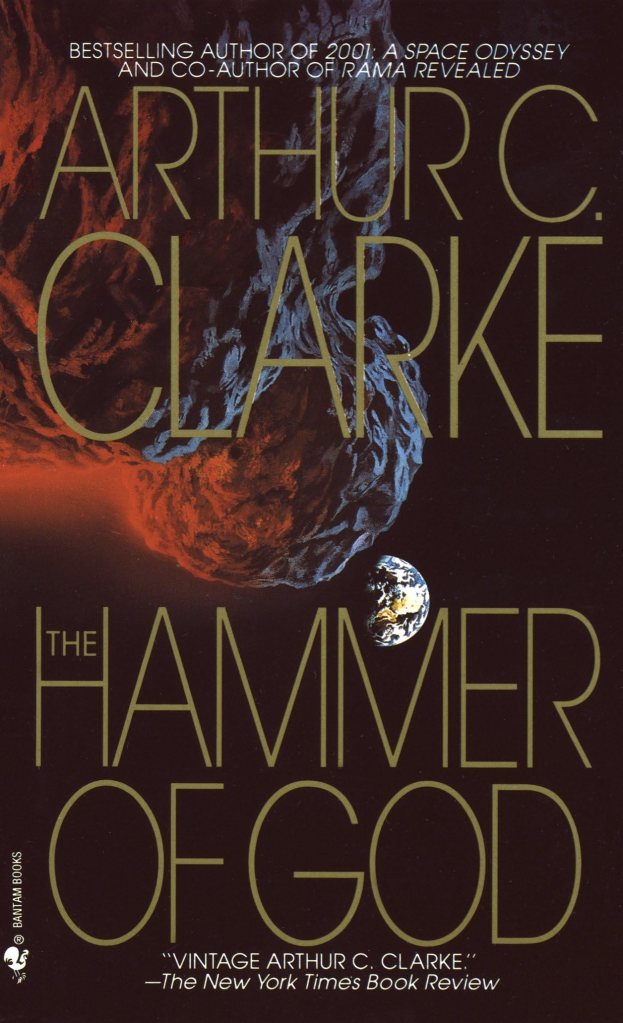
The Hammer Of God will bore you to death before it knocks your socks off

In Arthur C. Clarke’s The Hammer of God, which takes place in 2109, humans are living not just on Earth, but on the moon and Mars. One of the world’s fastest growing religions combines Christianity and Islam into something new. When Earth receives what appears to be a radio signal from another star system, Chrislamists preach it’s a message from God. In the same way paranormal investigators unwittingly construct tools to give themselves false positives, Chrislamists employ similar methods of woo to ensure they can interpret the signal in any way that supports their agenda. More on these bozos later.

In this future, 90% of all asteroids and comets in the solar system have been successfully cataloged by SPACEGUARD and a wildly imaginative idea involving the use of a space-detonated nuclear bomb. If SPACEGUARD sounds familiar, it’s because Clarke initially made the program up in Rendezvous with Rama, but in the years between that novel and this one, the initiative became a reality. Curiously, for all the backstory Clarke takes the time to weave about SPACEGUARD, it’s an amateur astronomer living on Mars who detects the titular asteroid that’s on a collision course with Earth.

Fortunately, there’s a spacecraft within rendezvous distance of the doomsday rock, which scientists dub Kali, after the goddess of destruction. Astronauts plan to touchdown on the asteroid and attach a thruster system known as ATLAS, which will nudge Kali out of its current trajectory. Easy peasy.

ATLAS, however, requires a mind-boggling amount of fuel, which takes a month to acquire. By the time they get it, Kali has entered the orbit of Mars—frighteningly close to humanity’s home world. No worries, though, because things are smooth sailing once they get their fuel. The astronauts land on Kali, attach ATLAS, turn the system on and—surprise-surprise: it’s been sabotaged by Chrislamists. It turns out the fundamentalist assholes believe only God should decide whether or not the asteroid collides with Earth.

This is when the book gets good and I mean really good. The astronauts devise one plan after another, only to encounter unforeseen issues left and right. The scientists and politicians back on Earth decide to take out an insurance policy: a hastily constructed nuke which they plan to fire at the asteroid when all is lost. If the astronauts succeed, the scientists will simply send a deactivation signal. If the astronauts fail, they’ll allow the nuke to continue as planned. As you can imagine, things won’t be as simple as that when the time to make the decision comes.

The latter half of the novel is exciting stuff, but Clarke crams too many of his ideas into the front half to make it engaging (I haven’t even mentioned the life-extension technology, artificial intelligence, chaos theory and detailed economics he writes about at length). I caught glimpses of the world-building that made Rendezvous with Rama such a compelling read, but for the most part it’s a meandering slog until things finally go tits up. I think Clarke could have cut as much as 50% out of the earlier sections, but even with all its filler, it’s an unusually short novel.

I’m tempted to tell readers to skip the first half because it’s the second half that likely interested Steven Spielberg when he optioned the book into a movie. Why his production company made the criminally boring Deep Impact instead, I’ll never know.

Chronicle (2012)

Aside from their amazingly clear complexions, I buy that the three leads in Chronicle are real teenagers. The first act delivers enough solid acting and teen drama to make us believe it is set in an actual high school. It’s yet another one of those “found footage” movies, supposedly shot on one of the character’s consumer-grade camcorder with the on-board mic… sure, I’m willing to suspend my disbelief. Every once and a while, we see different angles from the phones of eye witnesses and bloggers, security cameras and news teams.

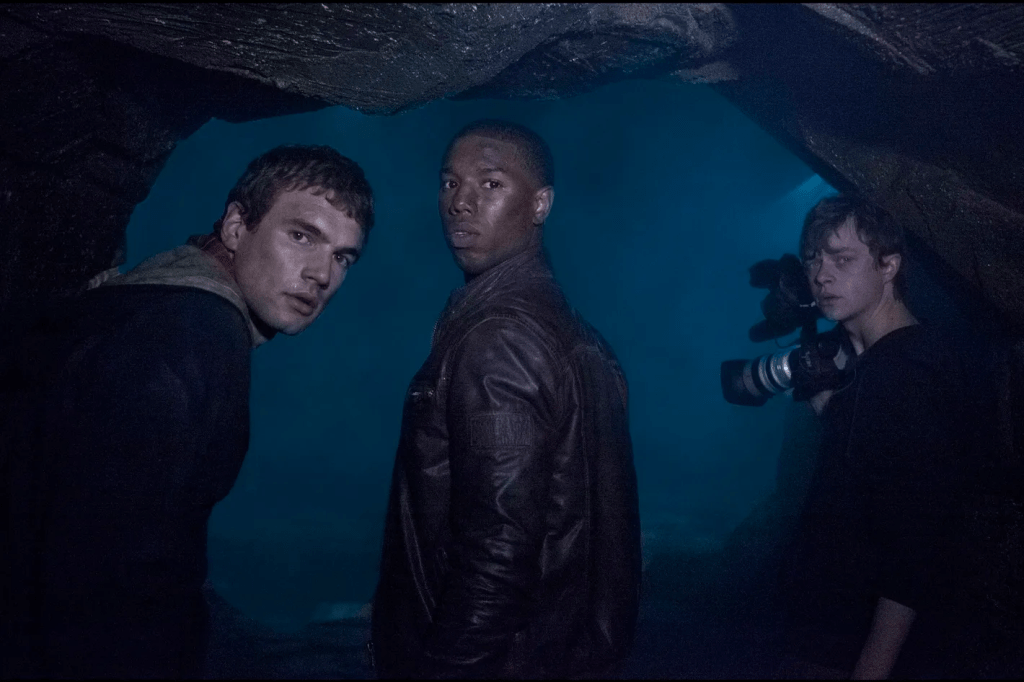
One night, the three friends stumble upon a mysterious hole in the woods and decide to go spelunking. Inside, they find something extra-terrestrial in nature and leave with nose bleeds. It’s not long before they realize they have developed supernatural powers. If there’s one movie I’d compare Chronicle to, it isn’t a Marvel film. It’s Carrie. Soon the kids are using their telekinesis to do exactly what kids would do if they actually obtained such powers: pranks. This involves humorous scenes of remotely moving shopping carts and parked cars.

When they push their powers too far, they get nose bleeds. One of the boys theorizes that it’s like a muscle: use it too much, it gets exhausted. But the muscle can be exercised, too. As they become more and more powerful, the socially awkward main character finally steps out from behind the camera he’s been using as a security blanket. Since he can levitate objects with ease, there’s no need for a dedicated cameraman anymore as the camera follows him like an automatic drone.

He’s not stable. He’s not popular. He frequently gets his ass kicked by high school bullies and his alcoholic father. When bullies push someone like that enough, they push back. But his newfound powers are a dangerous drug and he soon finds himself addicted, much to his only friends’ dismay.

Chronicle isn’t everything I usually hope for in a popcorn flick, but it’s entertaining, original, and rarely insults the intelligence. Definitely one of the more memorable superhero flicks.