Tourist Trap (1979) [31 Days of Gore]

Strap in, folks. It’s another “Who needs bathing suits for swimming?” movie which manages to show absolutely no nudity whatsoever. I mean, why even have that scene at all if everybody’s just going to be bobbing lazily up to their necks? No playful splashing? No erotic horsing around? What the actual fuck, guys?

The teens of Tourist Trap, which I happen to think is a great generic title for a horror movie, go skinny dipping after their Volkswagen Type 181 breaks down in the middle of nowhere. Chuck Connors, playing an overall-wearing good ol’ boy, happens upon the kids and warns them about the moccasins who nest in the very water they’re swimming in. Cut to: everybody fully clothed and miraculously dry, at which point Connors offers them a ride to his home. His home, as it turns out, is a “museum” full of all manner of junk. The overwhelming majority of his collection consists of mannequins, which the movie calls “wax statues,” but I know department store mannequins when I see them. One of the mannequins looks suspiciously like his dead wife. Its “wax” feels a lot like flesh. You can see where this is going, right?

I’m usually careful with spoilers, but it’s hard to extend that rule to anything so shamelessly derivative of Psycho. Tourist Trap thinks it’s pulling a fast one on the audience, but anyone who’s ever seen a movie will know, almost immediately, that Chuck Connors is the killer. It’s as obvious as a punch to the face. Yes, The Rifleman is the killer. The movie initially wants us to believe the strange happenings are caused by Chuck Connors’ unseen brother, but come on, guys. We all know it as soon as we see him. Hell, my fucking dog called it, too.

Once they get that reveal out of the way, we get a perfectly fine horror movie along the lines of the wonderful Motel Hell. You get to see Chuck Connors dressed bizarrely, playing with dolls as he chews the scenery in the best fucking way possible. The only reason I can’t give it a recommendation to everyone is the good stuff happens too late and only leaves you wanting more. They have such a great gag here, I just wish there was more of it.

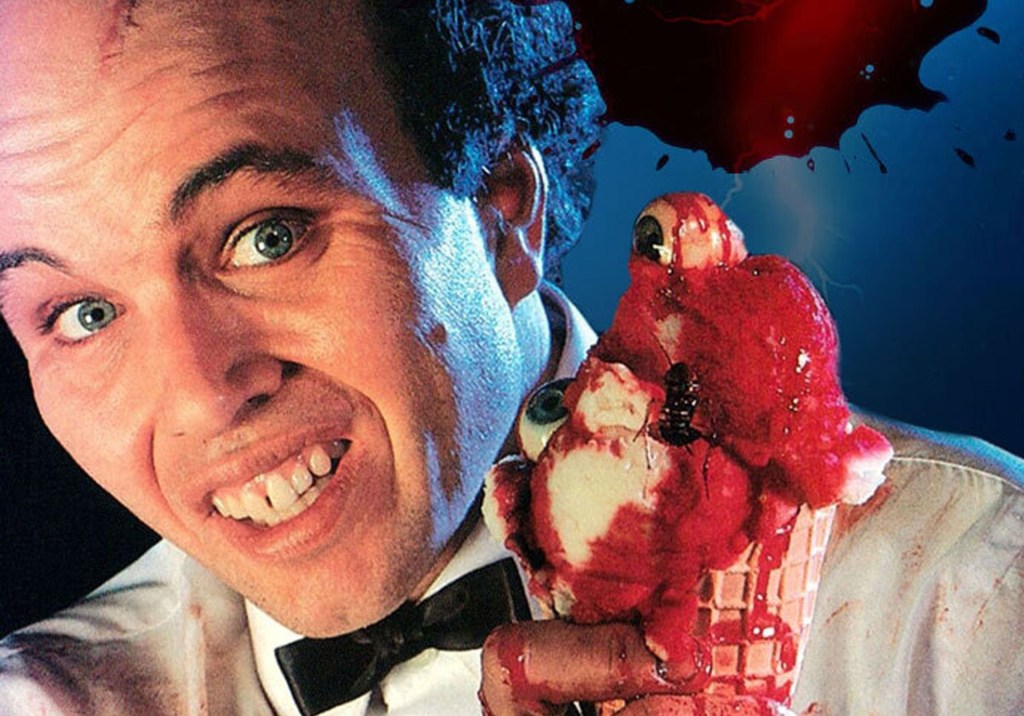
The Ice Cream Man (1995) [31 Days of Gore]

Oh, boy. I may have hit my limit. I feel like I’ve blown my fucking mind out on bad movies this year. Here’s one so egregious I don’t even want to talk about it. You might accuse me of being too hard on this movie. Clint Howard is one of my favorite faces in the industry. This blog attests to the fact that horror-comedy is my favorite type of horror and comedy. I originally saw it when I was twelve years old, which should have been the perfect viewing age for something like this. Try showing it to a two year old and you might be able to dazzle ’em… maybe.

In its 85-minute running time there are about fifty seconds of awesome. The rest is slow, plodding, and boringly shot, not to mention entirely illogical. It’s like one of those “rad” children films that frequently turned up in video stores in the early-to-mid 90s, only there’s just a little bit of gore, which feels shoehorned in only to ensure a journalist from Fangoria showed up to take pictures on set. (The severed heads, by the way, look absolutely amazing. Everything else… oof.)

Clint Howard plays the titular ice cream man. When he was a kid, he witnessed the so-called Ice Cream King get gunned down during a drive-by shooting. His mother found her trauma-stricken boy sitting on the curb, eating an ice cream cone, mere inches from the dead body. He glanced up at her and asked, “Who’s going to bring me ice cream, Mommy?” That part was kind of funny, actually.

That’s the problem: a lot of the movie is kind of funny. It would have been much funnier if they weren’t trying so hard. It would have been a lot more watchable, too, if most of the killings didn’t take place off camera. Despite the subject matter, the movie’s so tame I don’t think they would have edited very much to show it on the USA network twenty years ago.

Anyway, now that he’s all grown up, the ice cream man kills children, grinds them up, and mixes their remains into the ice cream he sells around town. Three neighborhood kids uncover his evil scheme and take matters into their own hands. Armed with giant model rockets, they decide to finish the ice cream man, once and for all. I mean… fuck. Haven’t we seen this too many times before? It’s the same old shit, a decade too late.

So the main character, whose name is Tuna, is supposed to be fat kid. Instead of casting a tubby kid, the filmmakers cast a photogenically skinny kid and stuffed his hooded shirts with what appears to be ordinary bed pillows. The movie-long effort seems pointless until the payoff at the very end of the film: with the ice cream man dead, Tuna no longer eats so much ice cream and therefor loses all his weight. Excellent character arc, that.

The Exorcist III: Legion (1990) [31 Days of Gore]

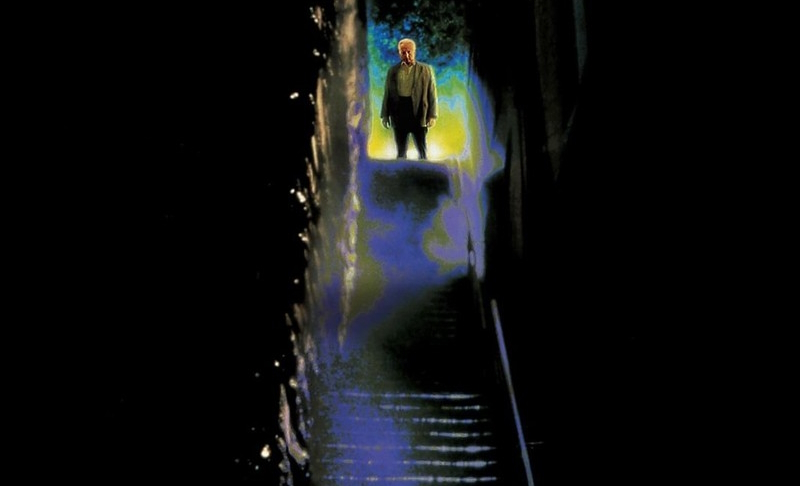
George C. Scott plays William Kinderman, a grizzled police lieutenant whose best friend was Father Karras from the first film. (Kinderman was briefly portrayed by Lee J. Cobb in the original movie, but in the novel the character had a much larger role, providing an alternative viewpoint to Karras’s already shaky faith.) The cop is investigating the gruesome murder of a twelve year old boy who was decapitated and crucified. The killing fits the MO of the so-called Gemini Killer, who was shot dead by police the same night Regan was exorcised. What does this have to do with anything? Well, it’s a stretch, but the film is so well made it’s perfectly believable within the context of the story.

The Exorcist III came on TV when I was home sick from school one day and I unexpectedly enjoyed the hell out of it as it did not garner warm reviews at the time of its release. In the years since, I’ve always wanted to see it again. Cue Scream Factory’s re-release of the movie, which is now the best way to see it at. I watched it last night long after I should have been in bed. The improved sound mix alone is better than most of the movies I reviewed this month; the subtle use of surround speakers increases the creepiness as you never quite know if it’s a rustling leaf or a demon whispering in your ear.

The trailers in 1990 gave away one of the film’s biggest twists. I bet most reviews did as well so this one won’t. If you haven’t seen any of the marketing material yet, don’t. That way the mid-movie reveal about the man in Cell 11, who’s played by Brad Dourif, won’t get ruined for you. Dourif’s performance here is something special. I’ve seen hundreds of actors go for broke in their depictions of insanity, but few have hit the mark so well. He fulfills a role similar to Hannibal Lector in the sense he may be even more dangerous when he’s locked up (incidentally, this film preceded Silence of the Lambs by one year).

You can tell writer/director William Peter Blatty wanted to protect the secret of Cell 11, too, because the reveal is executed with great care and attention to detail. Blatty battled the studio on a lot of unnecessary changes. For one, he didn’t even want the word “Exorcist” in the title at all because he wanted to distance himself from the laughably bad The Exorcist II: The Heretic. His instinct was correct because the movie has largely been overlooked until horror fans reevaluated it relatively recently.

This isn’t a cash-grab. It’s an organic continuation of the original story. It happens to contain what many believe to be the most effective jump-scare in history. It’s remarkable how masterfully quiet the moment is when you analyze it the second time around.

Splinter (2008) [31 Days of Gore]

In the cold opening of Splinter, a gas station attendant is attacked by what appears to be roadkill (Is it a rat? A possum? A rabid squirrel?). Then we’re introduced to an attractive young couple (Jill Wagner and Paulo Constanzo) who suck at camping and a couple of drug addicts (Shea Whigham and Rachel Kerbs) who are running from the law. The couples’ paths cross in the middle of nowhere and the fugitives take the would-be campers hostage. When the getaway car overheats, the four of them have to make a pit stop at the very gas station we saw in the beginning of the movie, which now seems abandoned.

That’s when things get predictably weird… just a little too predictable, in fact, which is one of the film’s few flaws. The writers even bring in a nifty biologist character who makes huge leaps of logic while spouting technobabble nonsense. They don’t bother to explain the origin of the monster, so why did they feel the need to explain how it functions on a cellular level? All I’m saying is I could have used a little more peer-reviewed research.

I certainly wouldn’t say this is a cheap-looking film (the trailer is a different matter), but it feels like the poor man’s Splice. Taking cues from John Carpenter’s The Thing, the creature effects are fantastic, if not fleeting, while the acting is better than most of the movies I feature. In fact, my only complaint about the acting is it breaks down whenever the performers interact with the special effects; I suspect the actors had nothing physical to react to.

I don’t want to spoil what, exactly, is attacking the characters, but it’s sufficiently hideous and the title is certainly relevant. The characters are trapped inside the gas station, which forces them to resort to desperate measures, some of which reminded me of the amusing solutions employed in Tremors. Unfortunately some of these solutions are a little too goofy for the film’s otherwise serious tone. (I’m reminded of The Blob and Jurassic Park, but I’ll let you discover why on your own.)

I tend to dislike movies that try too hard to be creepy. This one tries when it’s at its worst, but more often than not it’s effortless. It’s not too loud, not too spacey, and not too boring. The sweet spot, I’d say.

Madman (1982) [31 Days of Gore]

Madman with a campfire story, which serves as the backstory for the ax-wielding maniac. The group of campers consists of teens and small children. The children’s plot armor will prove extraordinary, but shouldn’t they be the easiest victims to dispatch? The teens are all played by adult actors who will become predictably easy pickin’s for the titular madman. The audience will have to endure one plodding POV shot after another, the pickup truck will fail to start when the characters need it the most, and people will amble about the woods to fill the targeted runtime.

The star of Madman is Gaylen Ross, who was also the star of George Romero’s Dawn of the Dead, my favorite horror film of all time. She’s more than adequate in the role, which isn’t particularly demanding, but appears uncomfortable in a sex scene and it doesn’t feel like acting. As soon as the awkward scene is over, her lover wanders the woods to get himself killed. Naturally, another character goes looking for him and also gets himself killed—off screen because Madman just isn’t a very remarkable slasher flick, notable only because it was among the first.

Later, a chick pokes her head into a tent where a couple are getting freaky. It would have been great if the killer chose that moment to decapitate her, so that her head would tumble into the tent with her horny friends. In another scene, the killer is hot on the trail of a young woman who takes an excruciatingly long time to empty the contents of a refrigerator so she can hide in it. The killer is so close when she does this, he’s literally in the same shot… worst attempt to hide ever. “Hey, just pretend you didn’t see me go inside, okay?”

The expected tropes, clichés—whatever you prefer to call them—are all here. Madman hits its notes with such soulless precision it’s artless and robotic. As a carbon copy, it’s perfect. As a movie, it’s fucking terrible. Ross appeared in Creepshow the same year and never acted again. I don’t know why she quit acting, but I’m going to go ahead and blame Madman. The film is so joyless, I feel like I want to quit watching movies.

It turns out there’s a documentary about Madman. Early on, those involved admit the production was only a stepping stone to the art film they actually wanted to make. Perhaps that’s why it feels so lazy. How a documentary got made about this forgettable film, I’ll never know.

Near Dark (1987) [31 Days of Gore]

Director Kathryn Bigelow (Point Break, Strange Days) was married to James Cameron around the time she made Near Dark, which is probably why three of his preferred actors appear here: Bill Paxton, Lance Henriksen, and Jenette Goldstein. At one point the main character walks past a theater which is playing Aliens. Semi-trucks, another Cameron staple, features prominently in the plot. Though that filmmaker’s fingerprints are all over this alternatively grimy and sexy vampire picture, it’s undeniably a Kathryn Bigelow film.

Caleb (Adrian Pasdar) is a southern boy who gives an attractive hitchhiker a ride. Her name is Mae (Jenny Wright) and the chemistry between her and Caleb is immediately apparent. Their necking quickly turns into an accidental bite on Caleb’s neck, which changes him into a vampire. This thrusts him into Mae’s world, which involves drifting from one town to another in order to procure fresh blood. Caleb’s worried father, played by Tim Thomerson (Trancers), scours the countryside for his missing son.

It turns out Mae belongs to an odd band of outlaw vampires who have some pretty clever (and pretty gruesome) methods of acquiring blood. Homer looks like a young boy, but Jesse (Henriksen) calls him “old man,” suggesting the eternal child is in fact the elder of the group. Then there’s Goldstein’s Diamondback, who’s kind of the irresponsible mother of the group, and Paxton’s Severen is the weirdest of the bunch. At one point Caleb asks Jesse how old he is. The response: “I fought for the south.” Following a perfectly calculated beat, he adds with a smile, “We lost.”

Due to Caleb’s reluctance to kill humans, he tries hard to win the acceptance of his vampire comrades. They keep giving him opportunities to prove himself. He keeps letting them down. Cowboys, it seems, just aren’t cut out to be vampires.

Near Dark is no more a horror movie than it is a western, providing the themes and violence we expect from both. The title doesn’t just describe the tone, but the cinematography as well. (You’re going to have a very bad time if you’re trying to watch this one in a bright room.) My favorite thing about Near Dark is how cool it is. There’s a punk rock energy about it and a downright contempt for convention. It’s one of my very favorite vampire flicks.

Stephen King’s Desperation (2006) [31 Days of Gore]

“You have the right to remain silent,” the big cop said in his robot’s voice. “If you do not choose to remain silent, anything you say may be used against you in a court of law. You have the right to an attorney. I’m going to kill you. If you cannot afford an attorney, one will be provided for you. Do you understand your rights as I have explained them to you?”

It’s been almost twenty years since I read Desperation and its parallel-universe “sequel,” The Regulators, yet I remember a lot about them. Why ABC didn’t make the obvious decision—simultaneously producing two television adaptations with the same cast—is beyond me. According to Wikipedia, the network practically sabotaged the movie by airing it at the same time as American Idol.

I try to look past the limitations of a medium, I really do, but made-for-TV movies are so quickly produced you’d have to be blind not to see flaws. What ends up on the screen often feels like a first rehearsal. Desperation is no exception. At one point you can plainly see the squib jacket on an actor’s back after his character’s shot in rapid succession. I can forgive the camera operators for not noticing it and I’ll assume the editors were under similar time constraints. What really hurts is that shot could have been easily trimmed to hide the flub.

What Desperation gets right is the casting of Ron Perlman and Tom Skerrit. Although Perlman looks nothing like the villain I imagined (wasn’t he, like, way bigger in the book?), he organically slips the “Tak!” catchphrase into his dialog with uncanny timing. Meanwhile, Skerrit looks exactly what I imagined Marinville would look like, which makes him the least distracting fixture of the cast. The best acting is when Perlman and Skerrit share screen time.

The film is chilling at times, but that has more to do with King’s involvement than anything else. There’s just something inherently scary about a psychotic cop framing unsuspecting travelers on a desert road. The helplessness comes through despite Standards’ best efforts to censor the hell out of it.

I’m a big fan of the director and I obviously admire the writer (King also wrote the teleplay), but I don’t have much more to say about this one. The end result is so mediocre, there’s no point dwelling on it.

Sorority Babes in the Slimeball Bowl-O-Rama (1988) [31 Days of Gore]

Full Moon promoted the hell out of the recent Blu-Ray release of Sorority Babes in the Slimeball Bowl-O-Rama. I don’t blame them. This is a cinematic relic which deserves to be preserved on the very best formats. You know, for historic purposes… and because of boobies. I hate to fault such an admirable sleaze flick, but it takes forever to introduce the villain: an imp who’s been trapped in a bowling trophy like a genie in a lamp.

Once the imp’s out, you’ll wish he had stayed there because the terrible puppet soaks up valuable screen time, which would have been better spent on boobies. Not that I mean to insinuate there’s a disappointing lack thereof; this movie probably would have been deemed too weird and racy for late night premium movie channels. In fact, this film’s director later made Beach Babes from Beyond, which is hands down the raciest movie I have ever seen on Skinamax.

But there is a disappointing lack of blood and gore in Sorority Babes. And for a movie that’s billed as a horror-comedy, the horror and the comedy are pretty damn weak, too. At least two of the kills involve shoving someone’s head into something off screen; one of the babes is ripped in two without spilling a single drop of blood; and somewhere along the way, the imp cartoonishly transforms another babe into the spitting image of the Bride of Frankenstein.

It all begins when a trio of nerds and a pair of freshmen girls are trapped in a bowling alley as part of a college prank. There they meet a tough-as-nails biker babe who’s ripping off the cash registers and arcade machines. Unfortunately for them, they accidentally release the imp, who offers to grant each of them a wish. As we’ve learned in countless Leprechaun and Wishmaster movies, you really must be careful what you wish for.

The nicest thing I can say about Sorority Babes in the Slimeball Bowl-O-Rama is it has some of the finest T&A ever committed to celluloid. Porky’s and Meatballs have nothing on this one, because those films didn’t star Linnea Quigley, Robin Stille, Brinke Stevens, and Michelle Bauer. I’m not being hyperbolic here: these are four of the best scream queens who ever lived. And although the film is reluctant to show any violence, I’m reminded of the words immortalized in Revenge of the Nerds: “We’ve got bush!”

I’ve mentioned three Animal House ripoffs because Sorority Babes aspires to be one. For reference, director David DeCoteau got his start with Roger Corman and later made some of the hardest softcore porn flicks ever produced. Later in his career, he defied convention by making the men the eye candy in his films. As one critic put it, “Although at first glance it’s not clear exactly who these films are aimed at—gay men? teenage girls? desperate housewives?—what is clear is that DeCoteau, who is actually a pretty talented filmmaker, knows exactly what he’s doing.”

Sorority Babes is what it is. I prefer it to Porky’s and Meatballs. Hell, I probably even prefer it to Revenge of the Nerds. Then again, I adore these actresses, so maybe I’m not the most objective person to review this film.

The Wishmaster franchise (1997-2002) [31 Days of Gore]

Wishmaster (1997)

In a medieval Persian palace, a wizard watches in terror as the people around him are tortured by all manner of supernatural machinations. Men are turned to stone, women are turned into human-plant hybrids, skeletons rip out of their own bodies and attack the first person they see. It’s the kind of pandemonium usually only reserved for a horror film’s climax. The wizard makes his way to the throne room where he discovers the demonic djinn responsible for the horrors is trying to coax the emperor into making a third and final wish. If successful, the djinn will be able to subjugate the entire world. Luckily, the wizard is able to capture the djinn in a magic gemstone, which is then hidden in a statue.

Eight hundred years later, an art dealer (Robert Englund) and his assistant (Ted Raimi) are watching as dock workers unload the recently rediscovered statue from a boat. As luck would have it, the crane malfunctions, dropping the crate on the assistant’s head. As workers scramble to dig through the debris, a forklift operator finds the gemstone, steals it, and hawks it at a pawn shop. The pawn shop operator takes the gem to appraiser Alexandra Amberson (Tammy Lauren) who accidentally frees the djinn.

It’s the same setup as before: the person who freed the djinn must make three wishes before he can rule the world. In the meantime, the djinn will roam the city, stealing faces and fulfilling humans’ wishes in predictably dishonest ways. While this certainly allows for some great movie deaths, most of the kills between the spectacular bookend scenes are kinda lame. When the djinn is purchasing some new threads, the store clerk wishes her beauty will last forever, at which point the djinn turns her into a mannequin. One man wishes for a million dollars, at which point the film humorously cuts to a sweet little old lady filling out her son’s name as her beneficiary before she promptly boards an exploding airplane.

I passed on the movie in theaters because, instead of hyping the gore, the trailers mostly advertised the bloodless CGI effects. That CGI, by the way, was not at all ready for prime time. I caught the movie about a year later when it premiered on premium movie channels and I was immediately won over by its early assurances that this was a movie by horror fans for horror fans. Robert Englund has a substantial supporting role while cameos include Buck Flower, Reggie Bannister, Joseph Pilato, Tony Todd, Kane Hodder, and Angus Scrimm as the voiceover narrator. I also like Andrew Divoff in the role of the djinn, but I’ll speak more on his performance in my review of the sequel.

KNB EFX Group, who provides the top-notch practical effects for Wishmaster, were born to make movies like this; in fact, the “K” in “KNB” is the film’s director. I remember reading a Fangoria interview with KNB’s three founders (Robert Kurtzman, Greg Nicotero, and Howard Berger) in which they say they were intimidated when they turned the page of Tarantino’s From Dusk Till Dawn script and read, “All hell breaks loose.” They certainly rose to the challenge. Only a year later, they make all hell break loose yet again for Wishmaster’s opening and closing scenes. Although their fantastic physical creations clash with the film’s overuse of early CGI, KNB’s work alone is worth the price of admission.

Wishmaster 2: Evil Never Dies (1999)

I avoided Wishmaster 2 for over a decade because everyone said it was awful. Even fanboys of the original said it sucked. In fact, the film currently holds a 0% on Rotten Tomatoes. The director himself admitted he hasn’t seen it since he made it. These facts do not bode well for the franchise, especially when I’m only at the second entry of the four.

The opening credits, which lost Craven’s seal of approval this time around, make it immediately clear Wishmaster 2 isn’t going to have any horror icons making cameos like the original did. Tommy “Tiny” Lister, Robert LaSardo, and Bokeem Woodbine from Fargo’s second season make substantial appearances, but beyond those three actors there’s rarely a moment of recognition. Fortunately, Andrew Divoff returns as the evil Djinn. His performance isn’t something I can gloss over—it’s the entire reason the picture works for me.

Sometimes good acting and compelling acting aren’t one in the same. Even though I wouldn’t call Divoff a good actor here (he’s been good in movies which didn’t have the word “Wishmaster” in the title), there’s something interesting about him—something playfully sadistic. You can almost hear the director saying, “Okay Andrew, be menacing here,” before Divoff puts on a mischievous face which looks like he secretly farted. Whether or not this bizarre facet of his performance is intentional, it works. He’s a fucking demon so why shouldn’t his expressions be completely alien to humans? I imagine it’s something Crispin Glover would have done in a similar role.

We’re going to see a lot of the Djinn this time around. If you disliked that Hellraiser: Bloodline made Pinhead a little too pedestrian, you’re probably going to hate Wishmaster 2 because the Djinn is no longer content with lurking about the shadows, cloaked in mystery. But if you want to see Ernest Goes to Jail starring an evil genie as opposed to a clumsy idiot, you’re going to get your money’s worth.

In the first film, “Be careful what you wish for” was the tagline as the Djinn had twisted interpretations of his victim’s wishes. This time we quickly learn that the rules regarding the Djinn’s powers are much murkier than previous suspected. When a police officer tells him to “freeze,” the Djinn encases him in a block of ice. This interpretation would have been acceptable if the character had said “I wish I was cool” or something along those lines, but whatever. More often than not, the setups to these ridiculous payoffs are poorly worded from the get-go.

I do have to say my favorite wish fulfillment in the entire saga is when LaSardo’s character wishes his lawyer would “go fuck himself.” The anticipation of that moment is supremely satisfying. Whether or not the payoff is any good is debatable. I won’t ruin it for you. There’s also a scene in which the Djinn is having a dull conversation, which is unexpectedly interrupted when the heroine pops out of nowhere and shoots at him. It’s one of the most awkward and hilarious things I’ve ever seen.

I know what you’re thinking: it sounds like I may have enjoyed this movie. Well, I hope this doesn’t ruin my street cred’, but I did. I’m sure you can say this of any film, but perhaps I was simply in the right frame of mind. Even though the practical effects don’t hold a candle to the original, and it’s severely lacking in the gore department, it’s an oddly satisfying picture. So yeah, if there’s ever a Kickstarter for Wishmaster vs. Leprechaun or Wishmaster in Space, I’d fund that shit in a heartbeat.

Wishmaster 3: Beyond the Gates of Hell (2001)

First off, there are no ‘Gates of Hell’ and nobody goes beyond them. Knowing nothing more than the erroneous title, I was expecting someone to, like, end up in the Djinn’s domain or something. I guess they already did that in the previous installment and it appears the series took yet another budget cut. Secondly, I wasn’t aware Wishmaster 3 didn’t have Andrew Divoff in it. I probably would’ve skipped this one had I known that beforehand.

The previous film opened with a shootout. It wasn’t spectacular by any means, but it was entertaining enough. Wishmaster 3 opens with a drawn-out introduction to some of the tamest college co-eds I’ve ever seen. If these kids were any more wholesome, they’d be organizing church events. And I’ve got a hunch the casting director chose the talent from the pages of a hairstyle book at Supercuts. Although the series’ acting was never its strong suit, it gets worse. Much worse. These kids aren’t even fit for a Stridex commercial.

At the end of Hellraiser III: Hell on Earth, the heroine hid Pinhead’s puzzle box deep in freshly poured concrete. As temporary as that solution turned out to be, the heroine of Wishmaster 2 must have done an even lousier job of hiding the Djinn’s summoning stone. (Or perhaps it’s supposed to be a different jewel and a different Djinn altogether, which could neatly explain Divoff’s absence.) Without explanation, the jewel ends up in the hands of a college professor so bland I couldn’t wait to see him die.

When the demon finally gets around to killing the professor off with the dumbest wish fulfillment to date, I was happy I wouldn’t have to endure the actor’s stupid face anymore. Unfortunately, the Djinn decides to wear the character’s skin as his own, a creative decision which makes it clear the filmmakers weren’t even trying to make a likable movie. Imagine Simon Pegg without any interesting characteristics whatsoever and you’ve got a good idea of what the villain looks like this time around.

Wishmaster 3 kills fewer victims per hour than the previous films did per scene. You keep hearing about this big party on campus and expect the Djinn to crash it for the movie’s climax, à la Nightmare on Elm Street 2. But he never does and viewers end up watching the end credits with the bluest balls in history. The one moment that almost redeems this mess is the hilariously anti-climactic resolution, which reminds me of a gag from Austin Powers: The Spy Who Shagged Me.

At this point, I’m so militantly anti-Wishmaster, I have no desire to watch the fourth film in the series. But hey, in for a penny, in for my soul, right?

Wishmaster 4: The Prophecy Fulfilled (2002)

I figured it was a safe bet the prophecy would go unfulfilled in this one. I was partially right. The heroine of this film actually makes three wishes—which is further than the Djinn has ever gotten before. Unfortunately for us, her third wish is a paradox due to the bullshit rules of the Djinn’s magic (read: lame excuses to stretch this film to feature length). We quickly learn the foretold apocalypse will be postponed once again.

I don’t know what I was expecting. If the prophecy ever does get fulfilled, it’ll bring the kind of fire and brimstone that straight-to-video producers simply can’t afford. We’ve also got the same director we got last time, Chris Angel (no, not the Mindfucker guy… at least I don’t think it is), whose climax in the previous film proved he’s not the go-to guy for an exciting ending… or an exciting anything, really. I will say this about the director: although Wishmaster 4 is more or less the same movie as Wishmaster 3, it’s a helluva lot better. Don’t get me wrong: it’s still not very good.

The new heroine is the girlfriend of a man who lost movement of his legs in a motorcycle accident. Three years later, the lawyer working with the couple surprises them with a gift: an artifact which contains the Djinn’s summoning jewel. The Djinn, played by the same guy who played him the last time around, is up to the same ol’ tricks: he uses the lawyer’s form to worm his way into the main characters’ lives. There are plenty of opportunities to be clever here, but the filmmakers have other plans.

It’s twenty minutes until we see the first victim meet his demise. The special effects for the first kill are way more convincing (and gruesome) than anything in the previous entry… and nothing after the first kill hits the same high watermark. I’m happy to say there are a lot more unintentionally hilarious moments (an unexpected decapitation is one, a stupidly gentle car crash is another, but just wait until you see the camera linger on the phoniest sword in movie history). The increased cheese factor makes this one much more watchable than its predecessor; it’s so cheap, they couldn’t even afford more than one vehicle for the big car chase.

I think the biggest missed opportunity will be apparent to anyone: a bartender casually remarks he would give his soul “just to be a pimple on her ass” in regards to an attractive stripper. Naturally, the Djinn grants him this wish, but we never actually see it. Remember the human meatball in Nightmare on Elm Street 4? Wouldn’t it have been great if they had showed they wisher’s face sprout on the woman’s ass? Even better, I would have loved to see her go twirling down the pole, intercut with reaction shots of the pimple drawing to the stage before POP! goes the bartender.

What we have here is a director whose intentions are admirable: you can tell by the amount of drama he shoehorned into it that he tried to make a more mature horror movie. The problem is parts three and four were filmed back-to-back while he was trying to make Titanic on a soap opera budget. We ultimately got two films for the price of one and it really shows. This one was a lot easier to get through than the last, but I can’t recommend either of them to anyone but masochists.

Brainscan (1994) [31 Days of Gore]

When I was a kid, I was stoked to see Brainscan. Not only was it hyped to the moon and back, even Entertainment Tonight was pushing it as some kind of historic cross between horror and modern technology. I wasn’t disappointed, either. The teenage characters were addicted to gore flicks (Who’s that remind you of?), the sets were dressed with piles of Fangoria, and there was just enough violence to keep its intended audience—me—entertained.

Terminator 2’s Edward Furlong plays Michael, the kind of outsider who would be the cops’ first suspect if his school ever got shot up. Moodiness aside, I really identified with Michael; I still want to live in his hyper-nineties, pseudo-cyberpunk bedroom, playing CD-ROMs all day while using a voice-activated interface that puts Siri to shame. Why would a teenager need his own refrigerator, especially when his mother’s dead and his father’s never home? Because fuck the rest of the house, that’s why. That attic bedroom is the tits and I would live in it forever.

Although Michael used to love horror, he’s grown blasé on the genre. He turns cynical whenever video game companies market their “terrifying experiences” and he talks about his favorite movies with all the enthusiasm of someone going through a divorce. By the time he gets his hands on a copy of the video game Brainscan, he rolls his eyes like the angsty little punk he is. The game ends up blowing his mind (never mind the seizure it caused) and he raves about it to his metalhead friend (his only friend) on the way to school the next day.

In a plot twist no one didn’t see coming, Brainscan’s depictions of murder seem so real because they are real. Michael finds out he unwittingly killed a man during a trance and spends the rest of the movie covering up the crime. Each cover-up requires an additional cover-up and so on and so forth. I’m afraid I’m making this sound cleverer than it is, but it’s not not clever, either. Just average clever, I’d say.

That’s when the Trickster enters the picture, played by T. Ryder Smith. If you don’t recognize the name, that’s okay. The film’s marketing department wanted you to believe this guy was a big deal. The impish psycho is a cross between Freddy Krueger and a bad MTV veejay. Smith, who was previously a stage actor, doesn’t necessarily suck in the role, but he feels miscast. No amount of guitar riffs and scenery-chewing antics will convince you this guy’s comfortable in the role of a bad ass, nor will you believe he’s actually eating raw chicken as advertised in the aforementioned Entertainment Tonight promo.

The film’s really punching above its weight when it folds in Frank Langella as a surprisingly likable detective. Whereas all the other adults are either missing in action or portrayed as clueless squares (Parents just don’t understand, right, fellow kids?), Langella gives maximum effort and it shows. Other portions of the movie are surprisingly mature, too, which is why I give it a cautious recommendation.

Whenever Brainscan gets odd, you just have to remind yourself: “Because the nineties.” The oddest thing about Brainscan is probably the subplot. The filmmakers go for a Judy Blume approach to teenage sexuality, which comes off as creepy by today’s standards. See, Michael secretly video tapes his high school crush whenever she gets undressed in her bedroom window. At first you think the film means to damn his voyeuristic proclivities as a despicable character flaw, but later the filmmakers make it clear it’s supposed to be romantic. I guess if you’re as vapid as these teens are, it would be kind of romantic, but that’s missing the point.

Despite the film’s many misses, it gets a lot of points for effort. Yes, they were being just a little too derivative of Nightmare on Elm Street sequels and yes, there are so many holes in the plot they begin to form clover shapes. Yet where so many other “serious” horror flicks miss the mark, Brainscan is only a near miss. I really enjoyed it at times and managed to keep my snickering to a minimum. It could very well be the fulcrum point between eighties slasher flicks and the nineties abundance of Scream knock-offs. That alone is interesting for historical purposes.