I love characters who punch their problems in the face, movies that "normal" people think are stupid, and way too many video games. In case you're wondering why I'm cranky, I haven't smoked a cigarette since September 12th, 2015.
I don’t know why the cannibals in Blood Diner opened a vegetarian restaurant of all businesses. I don’t know why the restaurant looks like a 1950s diner… I mean, who the hell would walk into a place like that expecting tofu? I don’t know much of anything except that the filmmakers probably ingested too much pot and too many Herschell Gordon Lewis movies. Though I generally favor horror-comedies, most of them that swing this far into comedy are duds. Blood Diner isn’t a dud. It’s genuinely funny, in a madcap kind of way, and serves the gore by the bucket.
Some of the same outlaw energy you would find in masterpieces such as Repo Man, Street Trash, and Frankenhooker is on display here. Early on, a group of topless cheerleaders are filming an aerobics routine when one of the cannibals, wearing a Reagan mask, bursts into the room and guns them all down with an Uzi. The cannibals promptly dismember the bodies to gather parts needed for an elaborate ritual that’s equal parts Frankenstein and Night of the Demons.
The cannibals are dimwitted brothers, devoted to their cultist uncle who is a talking brain in a jar. The brain will walk them through the complicated series of steps required to resurrect Sheetar, an ancient goddess. You may think the homicide detectives who are hot on the cannibals’ trail will stop the ritual from taking place, preventing the movie from showing the good stuff. You would be wrong. The movie culminates in an orgy of violence that has the detectives firing blindly into a crowd of people, perhaps killing more innocents than the cannibals ever did.
Borrowing a page out of Zucker comedies, the background actors are constantly up to ridiculous antics whenever the foreground characters are tasked with delivering pertinent dialogue. Pertinent dialogue such as the fact there’s a local wrestler known as Baby Hitler and one of the two brothers is going to fight him. This results in the penultimate candy bar scene, a wrestling match that turns predictably bloody. I have no idea why the filmmakers felt the need to include the scene, but I’m glad they did.
Blood Diner features unusually charismatic leads, much better gore than the films of the aforementioned Herschell Gordon Lewis, and a bitchin’ pace I can’t help but admire.
In 1955 a married couple are subjected to radiation experiments. After giving birth to a perfectly healthy child, the couple mysteriously burst into flames. Thirty-four years later, the boy is now a man named Sam. Sam (Bradley Douriff) is a school teacher who’s going through a nasty divorce when he notices people who even remotely piss him off have a tendency to spontaneously combust. The first batch of these deaths takes place off screen, leading you to believe the film may be all bark and no play, but the way the mystery unravels is sufficiently engaging.
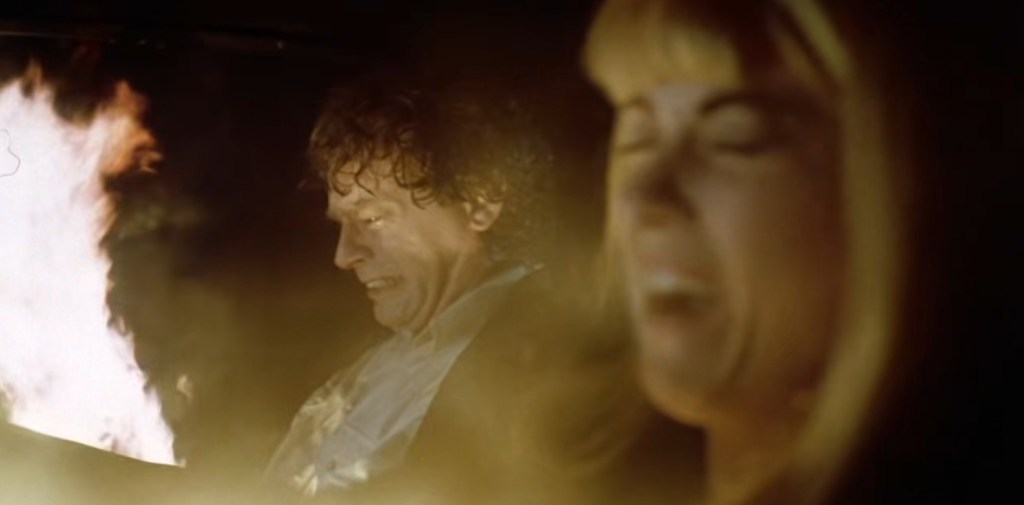
It won’t be long until Sam is violently venting jets of fire from his body uncontrollably. The way he screams, combined with the roaring sound effects, is violent and impactful. The fear of burning is one of the most potent fears a human can have, but somehow it’s underrepresented in horror films. When Hooper combines that fear with body horror, you get something you haven’t seen before.
The movie ultimately becomes so unhinged I can’t help but wonder how Tobe Hooper, such a mild-mannered film director, churned out so many far out ideas. Spontaneous Combustion reminds me of his earlier Cannon feature, Lifeforce. As he did in that picture, Hooper slathers on the optical effects as the plot careens into spectacular madness. Too many horror movies take care to compartmentalize the action so that it can be filmed in cheap, bite-sized chunks. In this film, the action goes big.
With so much going on, this movie didn’t need a human villain. I probably would have complained if a lesser director attempted it, but Hooper gives us a bad guy who’s briefly involved yet low key terrifying. I don’t want to give away which of the characters it is—not because it’s a major spoiler, but because I hope more people discover the movie organically. I will say that he employs methods fitting of his profession and one of his scenes reminds me of that chilling murder in Michael Clayton.
Spontaneous Combustion is not quite as visual as Lifeforce, but I think I prefer it? It takes a preposterous concept and successfully grounds it in a frightening way. The performances are all strong, particularly from leading lady Cynthia Bain, and Brad Douriff has the uncanny ability to swing for the fences without chewing the scenery. He’d done one Child’s Play film by the time this one got made and it’s fun hearing him occasionally slip into Chucky’s voice at times of fiery distress. If a boutique distributor cranked out a fresh restoration and a brand new trailer, the film might obtain the cult status it deserves.
It’s been a year since Sean Barker became the Guyver. By day he draws mysterious images from his dreams. By night he brutally murders criminals. (A guy’s gotta have hobbies.) Although Sean insists it’s the Guyver unit that kills people, not him, his girlfriend from the first film is understandably creeped out by his unusual night habits. After the couple splits up, Sean learns about an archeological dig which has uncovered cave paintings like the visions from his dreams. He leaves everything behind and heads to Utah.
There he meets the daughter of the head archeologist, Cori Edwards (Kathy Christopherson). Sean wastes no time pursuing Cori on the rebound as he becomes a worker at the dig site, uncovering alien artifacts and skulls. When a monster attacks the camp, Sean has to do his Guyver thing. What Sean doesn’t know is the Chronos corporation, which was seemingly destroyed in the previous film, is secretly financing the dig to uncover alien weaponry. Some of his coworkers are in fact Zoanoids: the human/monster hybrids he fought in the previous film.
While the original Guyver film targeted the children’s market with a PG-13 rating, the sequel goes full R. It also dumps the forced comic relief, instead trying to emulate the darker tone of the manga source material. This is fine and dandy, but Screaming Mad George has departed as co-director, which is immediately clear as the creature designs are a little less inspired this time around. Also gone is Brian Yuzna, who served as the producer on the first one. On the other hand, the Guyver suit itself is noticeably streamlined and looks more like metal than rubber.
Replacing Jack Armstrong’s Guyver is David Hayter, the voice of Metal Gear Solid’s Solid Snake. To my knowledge, it’s only one of a handful of times Hayter has ever done live-action work. It’s surprising that he swung a leading role for his first real acting gig. No, the acting isn’t great, but does it need to be in a movie like this? It’s pretty much a Lifetime movie for dudes. I can’t find any reason to fault that. In fact, the only major misfire is how many shots are completely out of focus in this otherwise professional production.
Guyver 2 is obviously the superior picture by normal standards, even if its focus puller needs an eye examination, but I found the campiness of the first film to be more exciting. That film took such care to cast actors with strong facial features that you never forgot who’s who in their monster forms. The fights were a lot more frequent and the practical monster transformations were more creative than the mid-90s CGI used here. I don’t want to compare them too much, though, because I enjoyed both tremendously.
Here’s one that’s been living in my head rent-free for thirty years. I read about it in Fangoria when I was a kid, got stoked to see it in theaters, and didn’t hear another word about it until it quietly showed up at the video store one day. I’ve since learned the film had a limited theatrical release in the U.S., but New Line Cinema knew it wasn’t going to be the next Teenage Mutant Ninja Turtles, which released one year prior. It showed up on the home market where it became a moderate cult classic.
A scientist-turned-whistleblower at the evil Chronos corporation makes off with an alien artifact and hides it in a pile of junk before being attacked by his boss’s goons. The scientist transforms into a humanoid fish monster to defend himself. The leader of the corporate thugs (Michael Berryman of The Hills Have Eyes) also transforms into a monster and smashes the fishman’s brains right out of his skull. Screaming Mad George’s effects look characteristically great and we’re barely three minutes into the movie.
Look, I don’t know how to properly convey this: I fucking love movie monsters. Screw Jaws theory: the more I can see the monsters, the better. In The Guyver, there is very little cheating going on. They don’t hide the monsters in the darkness. They don’t cut away after we get the briefest of glimpses. The monsters walk around and talk like any other character in the movie. It’s like Muppets for adults, only these Muppets fight each other.
Enter Mark Hamill’s character, Max Reed, a CIA agent who was working with the rogue scientist to bring the Chronos corporation down. He informs the scientist’s daughter (Vivian Wu) that her father’s been murdered. As he brings her to the scene of the crime, her milquetoast boyfriend (Jack Armstrong) happens across the artifact, which attaches to his skull and turns him into the Guyver: a human encapsulated in an alien suit of armor that exponentially increases his martial arts prowess.
The suit is supposed to be made of metal. It actually looked like metal on the original VHS release. Now, in some closeups, the metal clearly looks like rubber in high definition. I’m not complaining. Just an observation. When you go to a puppet show and you can see the rods controlling the arms, you don’t ask for your money back, do you? It’s all part of the charm.
After dispatching the least convincing street gang in cinema history, Guyver fights the corporate thugs, all of whom can transform into distinctly grotesque monsters (my favorite is the lady-monster with tits). It’s clear the performer in the Guyver costume knows at least some martial arts, but I suspect no one else did as the rubber monsters throw themselves at the hero with all the skill of a street fight on WorldStarHipHop. To be fair, The Guyver had approximately twenty percent the production budget of the Ninja Turtles so it probably wasn’t a good idea to put highly athletic performers in pricey-looking monster suits; they’d be tearing all the time, slowing down production.
I want to get the bad out of the way because the rest is fantastic. The only thing that overtly sucks about The Guyver is its comedic sensibilities, which are on par with a Saturday morning cartoon. Had very young kids not been its target audience, I have a feeling this would have been an even bigger cult classic than it is today. The movie has several funny moments that arise naturally, at least when the characters aren’t trying to be funny, which are reminiscent of many other films producer Brian Yuzna was involved in. But as soon as the filmmakers contrive goofy dialogue, the cringe is radioactive. Even as a kid I thought these jokes were insultingly bad.
For instance, Jimmy Walker of Good Times fame plays one of the monster shapeshifters. Somehow he manages to go the entire movie without saying his catchphrase “Dyn-o-mite!” That is until the final shot of the movie, at which point the filmmakers couldn’t resist the low hanging fruit. In another scene, Walker leaps over a wall and accidentally finds himself on the set of a B-movie (how’s that for meta?). Scream queen Linnea Quigley cameos (presumably as herself) and the fictional director of the production, not realizing Walker is in fact an actual monster, calls cut to give him direction for the scene.
Oof.
On the other hand, you get a stupendously entertaining movie with a swift pace and, surprisingly, a satisfying amount of gore for its PG-13 rating. I’m guessing the MPAA cut it some slack because ninety-five percent of the graphic violence isn’t committed on humans, but rubber monsters. It’s the same reason the Gremlins films got away with so much violence. If The Guyver had come out today, however, it almost certainly would have gotten an R-rating.
Look, this movie’s obviously made for kids, but I enjoyed it much more as an adult. I’ll be featuring the second film tomorrow. It’s a Guyver Weekend… why the hell not?
My review of 1988’s Evil Dead Trap wasn’t exactly glowing. This has bugged me in the ten years since I posted it. All the things I liked about the film remain clear in my memory. Everything I disliked pretty much faded with time. I’ve often wondered if I was having an off day because what I remember was pretty damn good. A Japanese giallo film… how exactly did I dislike that?
I hoped the loose sequel, Hideki, would click. Much like the first film, it takes its sweet time, entertaining with style rather than substance. Which isn’t to say there isn’t any substance. While I thought the first film had too little to say, Hideki feels like it has plenty to say, though how much of that is lost in cultural translation? I suspect I’m just not familiar enough with Japan’s folklore to make total sense of it. Perhaps I’m being too kind and it really doesn’t make sense at all. Considering how thoroughly I enjoyed it—which is to say tremendously—I don’t need to understand it all.
The main character is a full-figured young woman by the name of Aki. Aki mostly keeps to herself and runs the projector at a local movie theater. Her only friend is Emi, a conventionally attractive reporter who likes to throw coke parties for her sleazy producer friends. Emi is dating Kurahashi, a rascally businessman whose wife is too detached to wonder why he stays out all hours of the night. Emi is concerned about Aki’s introverted nature and asks Kurahashi to have pity-sex with her. Kurahashi tries, but Aki continuously shoots him down as she has a bit of a self-loathing complex.
Meanwhile, there’s a serial killer who’s killing and mutilating young women. Aki suspects she may be the one responsible for the murders, perhaps committing them in some kind of dissociative trance. In her dreams of the killings, she always sees a mysterious young boy who looks on at the violence with a slack expression. He looks like the boy from Ju-on: The Grudge. I’m not saying one ripped off the other (though this film predates Ju-On by a number of years), but as I said above: there’s probably more to the Japanese folklore than this foreigner can casually understand.
At any rate, Hideki is beautifully shot and convincingly performed. If you ever wanted to know why I have a such an allergic reaction to the majority of today’s horror movies with their digital cameras and LED lighting kits, it’s because few modern cinematographers can squeeze out images half as irresistible as these. The gore starts out strong and grows more and more unsettling until, at last, the blood is slinging all over the place. The final act has moments which are genuinely hard to watch, including a well-timed closeup of a curiously bloodless razor injury.
Do you know how long it’s been since I loved a slasher movie? I thought I had seen it all, but the novelty of Aki as a potential slasher makes the genre feel fresh for the first time in years. If you’re okay with a little confusion, and a lack of straightforward answers, you might enjoy it too. Unfortunately, I think this might be one of the films where my opinion will diverge from the general population because I’ve never heard much hype about it. In that sense, it feels even more special to me.
The Re-Animator’s David Gale plays Dr. Blake, a self-help guru who’s broadcasting his pseudoscientific gobbledygook on a small town television station. Hidden in the bowels of his fortress-like research institute is a giant telepathic brain. The film never reveals the creature’s origin, nor does it flesh out how the doctor and the creature formed a partnership. I’m actually relieved whenever such a movie doesn’t sacrifice forward momentum for a boring flashback. When watching a movie about a giant brain, you should be able to leave your own brain at home.
Jim Majelewski (Tom Bresnahan) is a trouble-making high school student who’s described as a teenager possessing unusual intellect and boundless energy. He spends his nights avoiding homework while trying to talk his girlfriend (Cynthia Preston) into having sex in the backseat of his Pontiac Strato Chief. When Jim is caught blowing up the school’s plumbing as a prank, the faculty give him a choice: see Dr. Blake or get suspended.
Believing he can bullshit his way through a psyche evaluation, Jim agrees to meet with the doctor. The brain unsuccessfully attempts to brainwash Jim at the meeting, but makes him prone to grotesque hallucinations. Jim escapes the institute, planning to blow the whistle on its diabolical machinations. When Dr. Blake and the brain fail to capture Jim, they use their telepathic airwaves to convince the town’s population, including Jim’s parents, that he’s a serial killer.
The first half of The Brain is pretty much everything I want. The kills are frequent and the creature effects are appropriately slimy. Unfortunately, the second half of the film is plagued with one chase scene after another that’s about as exciting as a cat chasing its own tail. It’s easy to shoot such action: merely set the camera up in a corridor or stairwell, have your hero run by, have your chaser run by, and have the editor inter-cut as needed. The director employs the same artless methods to shoot a needlessly long car chase that manages to wreck no cars. Thrilling.
There’s actually agreat gore movie suffocated by all the padding, but I can’t recommend it. For a similar but better experience, watch Brian Yuzna’s Society or Frank Hennenlotter’s Brain Damage. And if you still insist on watching The Brain, shut it off once your interest wanes because it doesn’t get any better. Had they stuck the landing, this movie would have easily been a cult classic.
I feel like I’m rolling the dice on Howling sequels at this point. I can probably count the number of trilogy-toppers that didn’t feel like a complete rip-off on one hand. The fact that this one went the PG-13 route, after two sufficiently bloody films, does not bode well for the series. Indeed, there is the briefest of nudity, obscured by a thin mat of werewolf hair, and not a drop of blood anywhere in its hour-and-a-half runtime.
This time the action moves to Australia, opening in an outback town called Flow. That’s an odd name for a town without a river in sight, unless you realize that Flow flipped backwards spells Wolf… I did not catch this until very late in the movie, mind you, and felt very silly when at last I did. The gorgeous Jerboa (Imogen Annesley) has just escaped the town’s cult-like traditions and finds herself on the first bus to Sydney. Sensing her distress, a priest on the bus assures her he can help if only she would tell him what’s wrong. “My stepfather tried to rape me and he’s a werewolf,” she says. The priest promptly shuts up and minds his own business. What Jerboa did not confess, however, is that she’s also a werewolf.
These aren’t the same variety of werewolves we saw in the previous two pictures. These werewolves are marsupials who carry their infants in kangaroo-like pouches. Other than a vague reference to California, Howling III bears no relation to what came before it. Its opening credits claim it was based on Gary Brandner’s The Howling III: Echoes novel, but as far as I know, that novel has little in common with this film. This marsupial angle truly is uncharted territory for the franchise, not to mention odd.
After spending the night on a bench outside Sydney Opera House, Jerboa is picked up by a talent scout who immediately puts her in a movie production while the two enter a relationship. Meanwhile, three of Jerboa’s sister-wives disguise themselves as nuns to track her down. She’s also being tracked by Harry Beckmeyer (Barry Otto), an American anthropologist who’s on a first-name basis with the President of the United States. It’s not long before Beckmeyer crosses paths with Jerboa, who is now pregnant with her boyfriend’s child.
Speaking of Jerboa’s boyfriend, the young man must have been a virgin because he lays in bed with her as she sleeps, poking and prodding the hairy kangaroo pouch on her abdomen with boyish fascination. Later, Beckmeyer will interrogate Jerboa’s boyfriend about the woman’s unusual anatomy: “When you had sex with her… was it normal?” I’m not sure this guy is qualified to answer that question.
If all this seems needlessly convoluted for a horror movie, I’m happy to report it’s entertainingly convoluted like a good crime film with a large cast of characters. It will effortlessly fold in the Australian military and the spirit of a giant werewolf that has a brief but hilarious pay-off. There’s nary a dull moment, never any time for one’s attention to wander. I hate to spoil that Jerboa’s kid will be born before the movie is over, but I have to promote the wonderful puppetry of the baby werewolf. The humor is just as present and mercifully subtle as it was in the previous films.
Howling 3: The Marsupials is not a routine cash-in. The only reason I don’t think it’s quite as good as the first two movies is the lack of gratuitous exploitation. I’m sure there are at least a handful of weirdos out there who think this is the best movie of the trilogy. It’s so good, I’m going to roll the dice again and watch the fourth picture in the series next week. Luck be with me.
Anyone who watched 80s ski movies knows the drill: if you find yourself vacationing at a mountain resort, you’ll likely find yourself in a rivalry that can only be resolved through a downhill race. Normally these scenes come at the end of a movie, not the beginning, but Iced is no normal movie. When the bully loses the competition, and the victor ends up with his girl, the bully gets drunk, skis off into a snowstorm, and gets himself killed. Four years later, the very group of friends who gathered on that faithful night have been invited to a timeshare pitch at a brand new ski resort. Eventually they begin dropping like flies.
Iced was one of those movies that, from the very second I saw the box art, I was instantly engaged. An 80s ski resort/slasher film with a modern restoration by boutique distributor Vinegar Syndrome? How lucky can a middle aged movie blogger get! Surely you’ve had similar moments of intuition: a movie-viewer relationship that seemed destined by the stars themselves….
Unfortunately, this was not destiny. This is a shot-on-video (SOV) horror flick whose murder scenes are so gentle they’re as irritating as a sneeze that refuses to budge. Taking place off screen as much as on, the kills generally lack umph. This could have been helped by some crunchier/squishier sound effects, but instead we get bizarrely quiet deaths. Consider the snow plow that idles toward a hapless victim in one shot and simply reveals bloody clothes in the next. And that’s the last kill you see for nearly an hour.
While the movie skimps on blood and guts, it doesn’t skimp on sex and nudity. Perhaps it’s not quite as racy as, say, Red Shoe Diaries, but when these graphic scenes are nestled within batches of soap opera acting, the contrast is jarring. This isn’t a movie in which the Vaseline-blurred camera respectfully turns its head as soon as the characters climb in bed. It’s a movie with full frontal and position changes. If only the kills had been so titillating.
Whereas most SOV flicks I’ve seen were at least a few steps away from a professional production, Iced is competently shot, though incompetently edited at times. Often it looks as spiffy as anything you’d see on prime time television in the late 80s, whereas a spiritual cousin such as Video Violence was clearly produced by amateurs (which in my opinion, is part of the appeal of SOV). I am not at all disappointed that I watched it, but most probably will be. The weirdos who won’t be disappointed already know who you are. Everyone else can safely skip it.
My favorite scene is when the heroine wakes up after a long night’s sleep, realizes she’s in danger, arms herself with a knife, and immediately dozes off again. You had one job, Trina. For fuck’s sake.
Sometime in the early to mid 90s, there was a badly worn VHS copy of The Serpent and the Rainbow in a sun-faded box at my neighborhood video store. I clearly remember it was on the row closest to the front window, at the absolute bottom of the shelf. I passed it countless times, thinking: “How good can a horror movie be if it has ‘Rainbow’ in the title? Probably some Carebears shit for weenies.” When at last I read the back copy, I wondered how I had lived so long (which was like twelve years at the time) without knowing that Wes Craven had directed a zombie movie with Bill Pullman. Surely it must have been forgotten for good reason, right?
As it turned out, A) it’s not a zombie movie in the Romero sense and B) I’m not sure why the film seems overshadowed even today. Of the thirty or so movies Craven directed, I would rank it in his top three, trailing only Nightmare on Elm Street and perhaps The People Under the Stairs, depending on my mood. (Yes, I really do love The People Under the Stairs. No, I don’t know why.) It’s a remarkably mature horror film for the era, reminding me of Jacob’s Ladder, Angel Heart, and The Ninth Gate. I can’t resist a horror movie with the structure of a detective novel.
Boston anthropologist Dennis Alan (Pullman) is hired by a pharmaceutical company to investigate the credibility of Haitian practices, particularly those that Vodou priests may use to turn the dead into their slaves. The simplified technobabble in the first act is probably the least believable dialogue in the entire film, but long story short: the corporate lackeys have surmised that, through centuries of trial and error, bokors have created a concoction that makes living persons appear dead for some hours before rising from the grave healthy. With dollar signs bouncing in their eyes, they decide that researching such an elixir would revolutionize modern medicine, specifically anesthesiology.
When Dennis arrives in Haiti, the country is fractured as the people there are on the precipice of revolution. As it turns out, the head of the secret police is a bokor by the name of Captain Peytraud (Zakes Mokae). Dennis finds himself in the care of Marielle (Cathy Tyson), a doctor who doesn’t let her cultural convictions conflict with her medical knowledge, and the street-wise Lucien (Paul Winfield) who will help Dennis navigate the country’s dangers. Meanwhile, Captain Peytraud doesn’t want a white foreigner poking around his territory and conjures all manner of terrifying visions to scare Dennis away before graduating to more physical tortures.
This is the first time I’ve seen The Serpent and the Rainbow in a high definition format. The pan-and-scan nature of VHS really didn’t do the film justice, cheapening its sweeping shots of presumably real rituals performed by real locals (there’s a lot of production value in those scenes). It’s not the first time a horror movie has dealt with a non-Romero variety of zombies, but it is perhaps the first time one has done it in a culturally respectful way. Haiti isn’t scary because it’s a foreign country, it’s scary because of the political backdrop and the corruption. Likewise, Dennis is not the white savior with a sophisticated Harvard education, but the guy who needs saving more than anyone else.
Whereas most horror movies lose steam as their ethereal terrors become literal ones, Craven conjures a wonderful finale that employs imagery and gore fitting of his Freddy Krueger films. Yeah, there’s some goofy stuff in there, too (near the end, Peytraud jump-scares the hero in a manner that immediately reminded me of Craven’s Shocker), but overall it’s a good time with an excellent cast of character actors. This is very much a multiple-viewing kind of film.
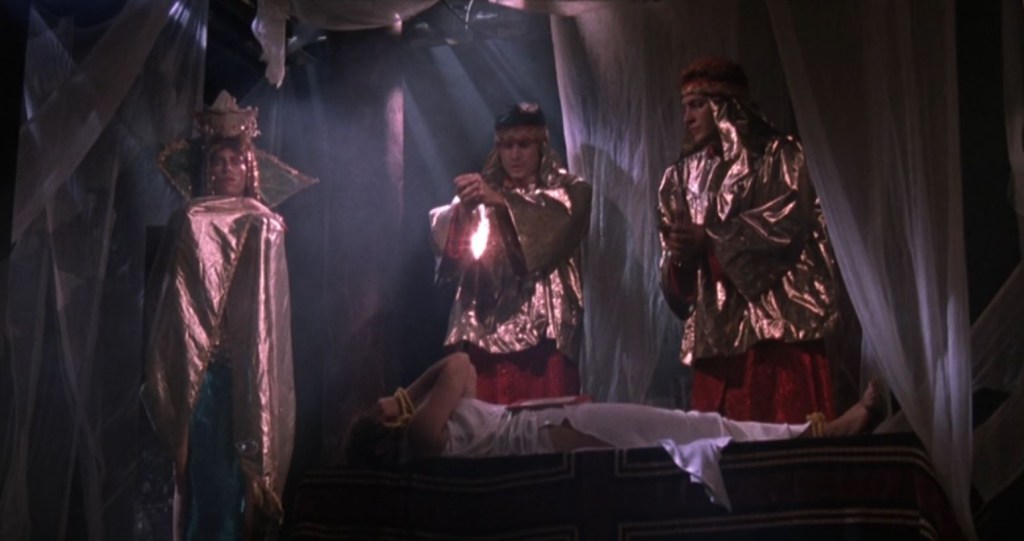
An archeologist defiles a tomb in Egypt and lasers blind him. At the same time, his daughter Susie is given an ancient amulet by an old lady who promptly vanishes before her eyes. The family returns to New York City while the father (Christopher Connelly) recovers his eyesight. The weird happenings begin almost immediately, but I’m not sure the happenings are weird enough for fans of director Lucio Fulci. Egyptian eye-seeking lasers would be pretty wacky in most movies, but in a Fulci film they’re kinda tame.
Having made more than sixty films, even the most diehard Fulci fans can be forgiven for skipping Manhattan Baby. I’m a weirdo who eats, sleeps, and breathes this kind of weird shit; I’ve bought at least two editions of The Beyond; I’ve raved about The New York Ripper, City of the Living Dead, and even A Cat in the Brain on this very blog. Yet even I don’t remember hearing about this one until it appeared on streaming services several years ago. Nor have I felt a pressing need to watch it.
None of this is to say Manhattan Baby is a bad movie. Purveyors of elevated horror will probably hate it, casual moviegoers will probably laugh at it. But if you’re subscribed to this blog, I think it’s safe to say you’ll find roughly as much enjoyment as I did. Which isn’t a lot of enjoyment, but it’s enough. Again, the only thing hampering it is you simply expect more from Fulci. He’s uncharacteristically restrained here, even as victims fall into spike traps and stuffed birds come back to life to rip a man’s face to shreds.
On the other hand, I find Fabio Frizzi’s upbeat score as nostalgic as summer break, the cinematography is solid, and the acting feels stronger than in most of the director’s films. You also get creative imagery involving scorpions and cobras. I particularly liked it when the camera takes the point of view of a snake and slithers, absurdly, across the floor. It’s exactly the kind of flourish I would have attempted when I was a kid, making Evil Dead rip-offs on a hand-me-down camcorder.
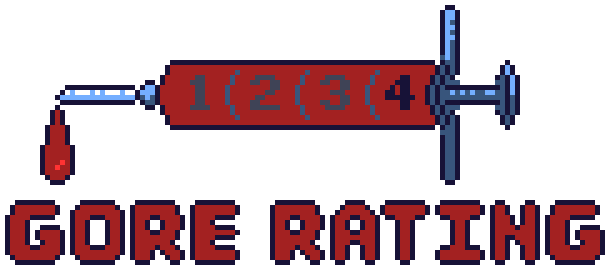
The gore, when it’s there, is a solid three. I’m only docking it a point because there’s too little of it. Don’t sleep on it if you’re a Fulci completionist, but I’d save it for a rainy day if I were you.









 The Goug' Blog