

This is the third post in my Spectral Resonance series, in which I examine films with otherworldly scores.
Forbidden Planet is the kind of movie in which intergalactic travelers still use the mile as their preferred unit of measurement. The actors have wonderfully silly lines like “reverse the polarity” (a phrase which has its own entry on TV Tropes) while tooling around in a saucer-shaped starship. The U.S. Navy serves as the structural basis for the space-faring organization even though the Air Force would be a more fitting analogy for this kind of travel. Set in the 23rd century, this is a routine voyage for the robust-sounding United Planets, which for some reason only sent white American men on this particular mission. A little sus, but technologically speaking it’s a remarkably forward-thinking bit of futurism with killer special effects and wonderfully alien music.
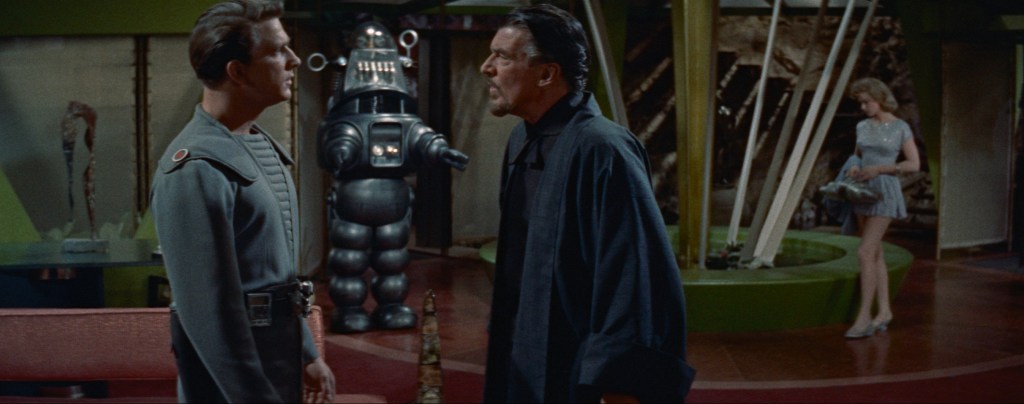
The mission: fly to the planet Altair IV to investigate a colony ship that went silent 20 years prior to the film’s opening. As Commander Adams (Leslie Nielsen) makes preparations to land, a short-range communicator begs the ship to turn around. Adams, who’s called “Skipper” by his crewmen, ignores the warning and sets down anyway. On the planet’s surface, he finds Dr. Morbius (Walter Pidgeon) and Robby the Robot, whose head seems to be equal parts crank calculator, typewriter, and stock ticker. Adams realizes that the robot, which Morbius claims to have constructed himself, is far more advanced than any robotics back on Earth. (Later, it will be revealed that Morbius has used alien technology to increase his brainpower to inhuman proportions.)
If his stories are to be believed, Morbius is the sole survivor of a doomed colonization mission. In the years since, he has managed to construct a modern mansion while raising his beautiful daughter, Altaira (Anne Francis), who has never seen a man other than her father. Which brings us to one of the film’s major complications: Adams has a ship full of young men who haven’t seen a woman in over a year. Adams’s solution: court the young woman himself so his men keep their hands off her. (That Adams… such a selfless commander.) Although Francis is given little to do other than serve as eye candy, she does it exceptionally well, fulfilling the technological inverse of the fantasy girl presented by Nova in the original Planet of the Apes films. She and Pidgeon both get their names billed above Leslie Nielsen’s.

This is my first time seeing the film in widescreen. A childhood friend and I were obsessed with 1950s science fiction films (initially to make fun of the rubber monster suits) and we both ranked this one above most of them. I even had a Forbidden Planet poster hanging on my bedroom wall; at no point in the movie does Robby the Robot carry the blonde starlet as depicted in the poster art, but you can’t claim that striking image didn’t put asses in seats. The element that holds up the best under the scrutiny of high definition is the set design which flows into the painted alien landscapes. This is a movie that’s seventy years old and, for the most part, avoids the distracting phoniness of modern films shot entirely on sound stages. (See: The latest Avengers trailer.)
As with last week’s The Andromeda Strain, the music pulls double duty as film score and sound effects. Forbidden Planet is the first Hollywood film scored entirely with electronica, courtesy of Bebe and Louis Barron, a power couple who built custom circuits to create their music, enveloped in many of the effects still used today. The early synthesizer-like devices were so delicate, they could not predict when one would get fried during use, rendering its unique sound forever extinct. Which is why they made it a habit to record everything they produced, becoming early users in magnetic tape recording as well (legend has it that a significant death in the film was scored with one of their dying sounds). The movie is plastered from beginning to end with its alien soundscape, which absolutely should not work when heaped upon the love scenes or moments of triumph, but it does. It’s as if the score never wants you to forget it’s set on an alien planet.
The Barrons’ work on the movie isn’t credited as “Music by,” but “Tonalities.” They described their sounds as “actors” as if their machines were living, breathing organisms with minds of their own, able to be directed but never controlled. Bebe said their laborious workflow produced an abundance of material, which had to be meticulously curated, mixed, and shaped in post. There are aspects of the work I prefer to Wendy Carlos’s collaborations with Kubrick, mostly the very idea of how it was developed. It is a film about an alien civilization destroying itself with its machines, scored by machines that destroy themselves.

