

This is the second post in my Spectral Resonance series, in which I examine films with otherworldly scores.
What Gil Mellé composed for The Andromeda Strain is less a movie score and more an oppressive ambiance, reminiscent of the soundscape Ennio Morricone designed for the opening of Once Upon a Time in the West. Having recorded and researched sounds at NASA’S JPL, Mellé creates a wonderfully mechanical mood… which is utterly lost on director Robert Wise’s inability to do anything exciting with it. It’s hard to understand how the guy who made The Day the Earth Stood Still, a science fiction classic with an unconventional score of its own, could make a movie that’s half as stunning as its music. Hell, he made two of the most beloved Hollywood musicals of all time, too, so there’s no reason for this film to be so unaffecting.
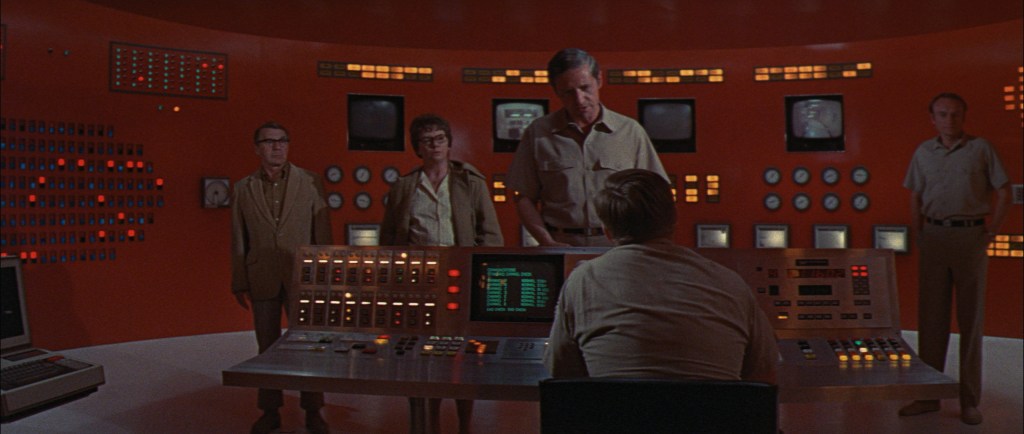
Which isn’t to say it’s a terrible movie. The rich cinematography makes everything look more epic than it actually is, employing wide lenses and huge depths of field (I will forever hate whoever decided shallow depths of field were “more cinematic”). Wise also incorporates the use of split screens at various points to track multiple subjects at once. It looks like a movie I would love for its technical prowess alone. Unfortunately, the fine photography just highlights many of the shortcomings.
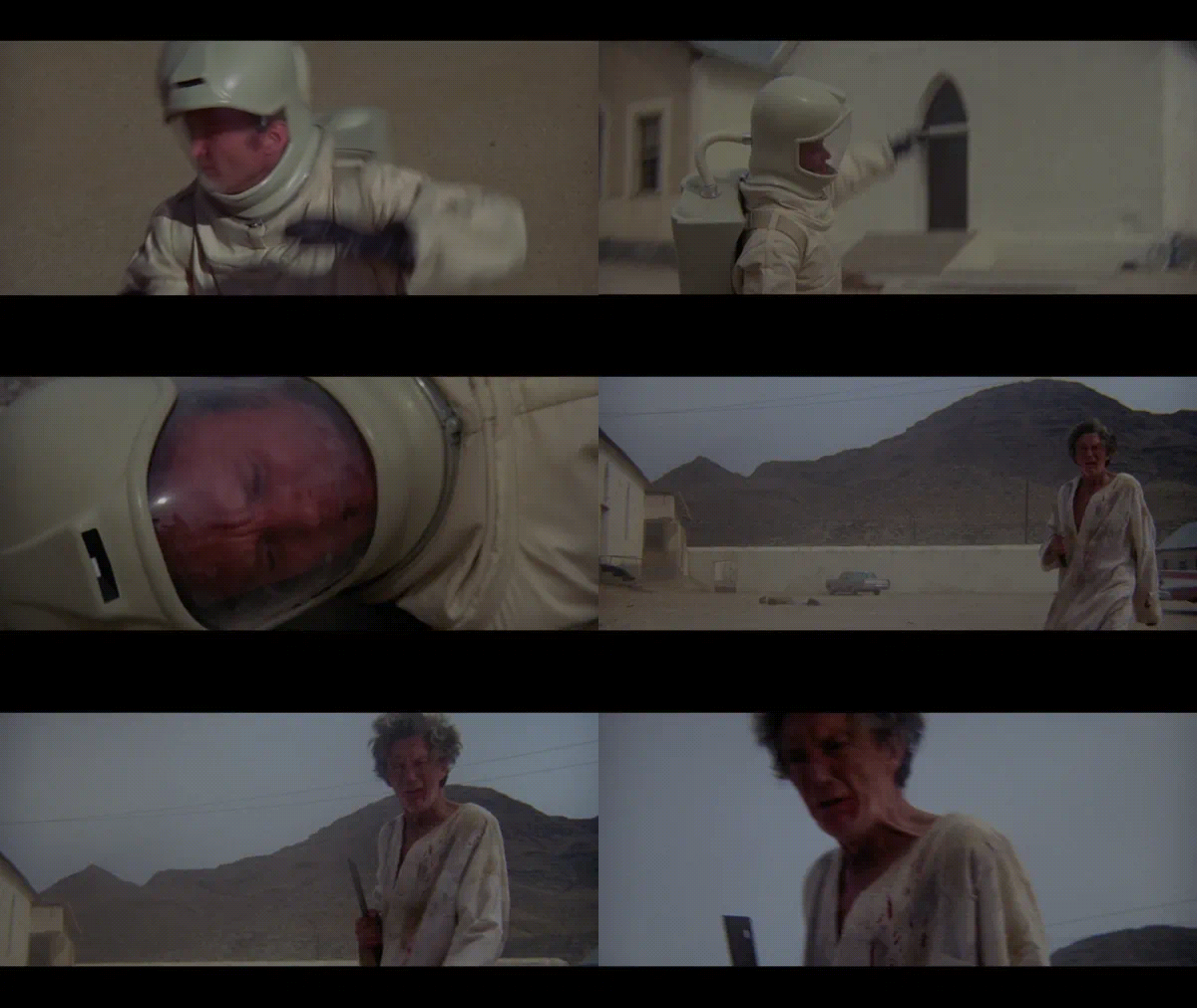
Based on the Michael Crichton novel of the same name, The Andromeda Strain opens as two Air Force officials are searching for a downed satellite in Arizona. They track its location to a small town, the residents of which have died under mysterious circumstances. When the scouts head into the ghost town to investigate, their communications back to base stop abruptly. Enter Wildfire, a government program designed to respond to virulent threats, which believes the satellite has brought a nasty organism back from space. Wildfire quickly assembles a team of researchers who investigate the town and find two survivors: a belligerent drunk and a newborn baby. They take the survivors back to a farfetched research facility, deep underground, which is probably where the film will lose the attention of most viewers.
Though Crichton often did mountains of research, and made damn sure his readers knew it, I never thought of him as a hard science fiction writer along the lines of Clarke or Asimov. His stories too often dealt with science being the cause of the problems rather than strictly the solution. (On the other hand, Crichton was a master of weaving unintended consequences into his stories as exciting plot twists, which very much is a mainstay of hard SF.) As far as films go, however, The Andromeda Strain is relatively hard SF… which makes it painfully clear why Hollywood is reluctant to film it. The subgenre is rife with dryly written characters and scant action because its stories are intended to be playgrounds for ideas. It makes for good reads, but boring films unless you specifically know how to adapt hard SF for the big screen (it helps if your name rhymes with “poo-brick”).
So the film’s biggest downfall is that it does little to adapt the novel’s rich ideas into a movie-friendly format, choosing instead to dedicate nearly an entire hour to the scientific process. This is stuff I enjoyed, if only because it was amusing to finally understand why literally none of my real-life acquaintances share my love for hard science fiction. Yet even I thought this stuff goes on way too long… the movie could have easily been trimmed to an hour and a half, but it’s over two. Whereas Spielberg knew how to pare down Crichton’s obsession with chaos theory in Jurassic Park, Wise spends too much time entertaining the novelist’s “odd-man hypothesis” and the inner-workings of his overengineered containment facility. These elements are perfectly fine in a dense tome you can put down whenever needed, but less suited for visual mediums which demand a single sitting.
Meanwhile, the film’s scientific realism is at odds with its 1970s-futuristic set designs. This is what a fun, hokey science fiction movie should look like (think Logan’s Run). This is not what a realistic science fiction movie should look like, particularly one set in the film’s present rather than the future. In one scene the characters must endure a decontamination method that’s so extreme, they have to wear head coverings to preserve their hair and eyebrows. This is all very fascinating, but why did the helmets need to look like disco balls? Why would Wise let so many elements of Flash Gordon seep into a story that allegedly takes place right now, present day?
Look, if I’m reading the novel, I want all five levels of decontamination described in detail. But when I’m watching the movie, I want those extraneous details summed up with a visual shorthand. See: William Gibson’s The Peripheral, which explicitly explains that its future society builds its towering statues out of excess carbon scrubbed from the atmosphere, versus the television adaptation which simply shows us towering statues with some science fiction shit on ’em. Both are valid for their respective mediums. In the movies, you can convince the audience you did your homework without forcing them to proofread it. (Neal Stephenson, with his footnotes and lengthy appendixes, is my favorite living hard SF writer… and the last thing I ever want to see is a movie adaptation of his complicated info dumps.)
What could have been a terrifying “what if?” scenario is robbed of any suspense early on when Wise includes a flash-forward to a congressional hearing scene that takes place after the near-disaster. Talk about spoiling your own movie, dude. When the film wants the audience to worry that the threat will escape the lab and kill the global population, you simply think, “Well, that can’t happen because all this is a flashback anyway.” And like I said, two-dimensional characters can work in a hard science fiction novel, but they don’t always work in a Hollywood movie. The male cast is so interchangeable, even their professions are hard to remember, which is usually the quickest shortcut to creating distinct characters. Kate Reid’s Dr. Leavitt is by far the most interesting character in the entire thing, but that’s because she’s the only interesting character in the entire thing.
With a soundtrack nearly half the length of last week’s Sorcerer soundtrack, Mellé’s unique score is sparsely used. Sometimes it’s hard to tell where the sound effects end and the score begins. What’s there, though, is masterful. It doesn’t just conjure images of a clinical environment, but sounds as if it were actually composed on the very instruments one might find in a lab. While it’s an effective score for a taut thriller, the film is anything but taut and it is rarely thrilling. Whatever movie Mellé had in mind when he composed the score is the movie I would have rather seen.

