
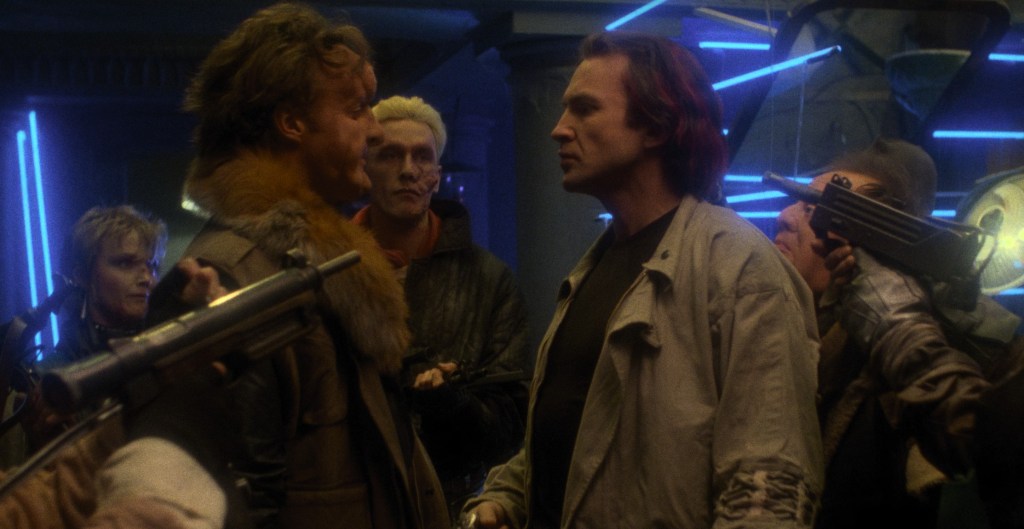
Underworld, aka Transmutations, is the first feature length screenplay by Clive Barker, who reportedly hated the finished product. There’s no word on whether he has commented on (let alone seen) the version I’m reviewing today, which is the extended cut containing eleven minutes of footage not found in the poorly received theatrical version. Although I haven’t seen the film before, it’s immediately clear which bits have been spliced back in because they stick out like a sore thumb. The 35mm film from the theatrical version was scanned for the restoration, but all the extra stuff existed only on an old VHS. (Curiously, the same thing happened when Barker himself was involved with early restorations of Nightbreed.)
This patchwork of film and shitty VHS footage sounds more jarring than it actually is—and not only because the bitchin’ synth score ties it all altogether. The restored bits make Underworld more interesting from a technical point of view while slightly improving on the neo-noir mood the director was trying to establish. Above all, it’s an intimate look at what an editor actually does, showing how much freedom they have in shaping the final movie. We’re not talking about merely restoring some missing cutaways. There are entire conversations, scenes, and bits of character development restored here. Above all, the extended cut shows just how short-sighted the producers were to go through the trouble of hiring top-tier talent, just to turn around and attempt to normalize it for maximum profits. Worse, their edits were probably demanded for a shorter runtime, so I wonder: Why didn’t they cut the long bits where the hero plods through the least convincing sewer set in history?
All that meddling didn’t help. Though Clive Barker would work again with director George Pavlou on the superior Rawhead Rex, the experience ultimately led him to become a director himself with 1987’s Hellraiser. If anybody’s gonna screw up his work, it might as well be himself, right? Still, I think there’s just enough of Barker’s personality in Underworld to make it worthwhile for his completionists. Like too many supernatural detective films, this one is at its best before the mystery reveals itself disappointingly early on. Underworld’s noir elements are fine. Its horror elements are not.
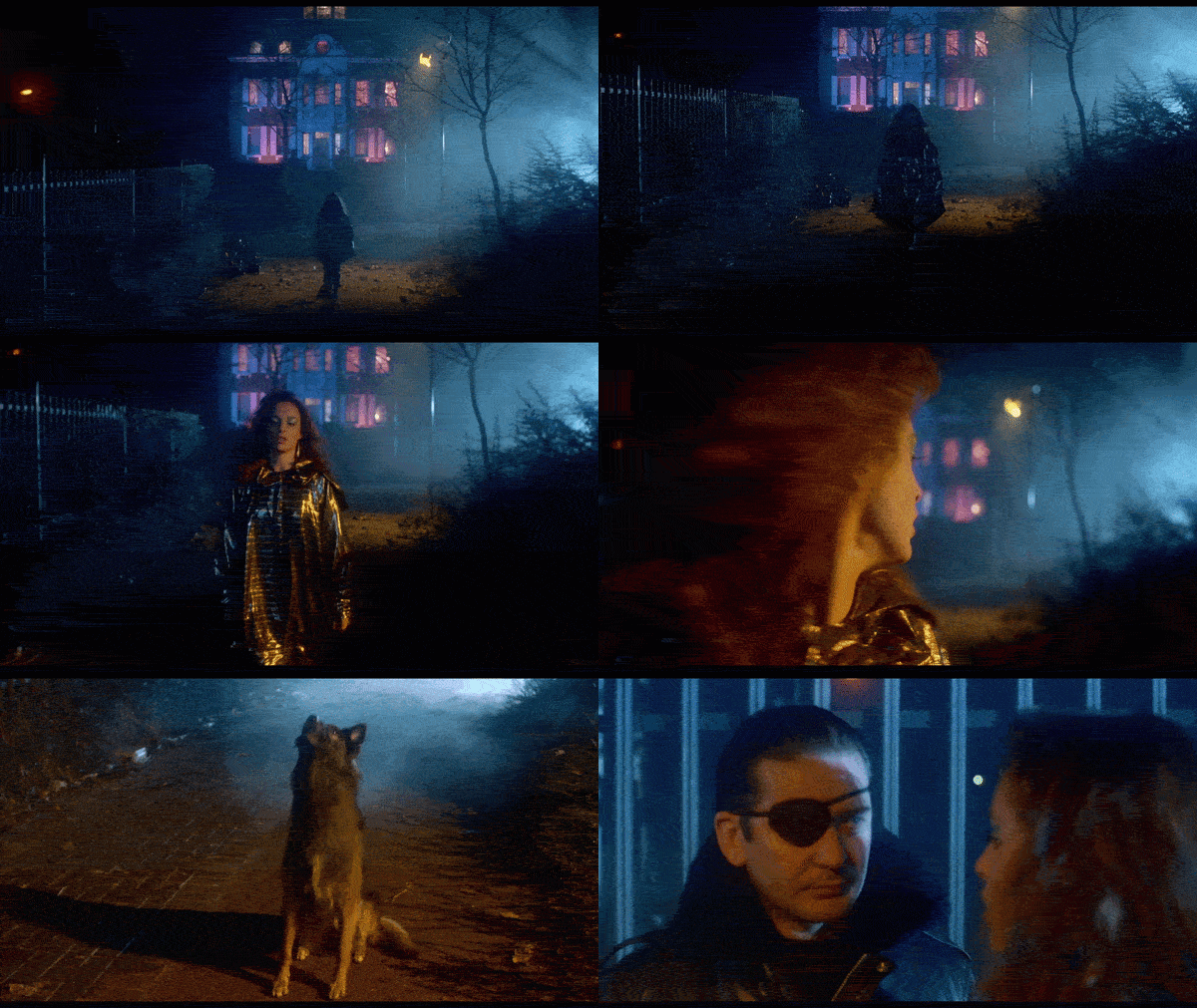
The film opens with the kidnapping of a high class prostitute, which leads a rich business mogul to hire a private investigator to find her. It turns out that the detective is the prostitute’s old flame, which is hard to believe considering he’s so reluctant to take the job. Similarly, when the detective and his love interest reunite (the first time they share any screen time in the movie), their chemistry is anything but convincing. In fact, the hero has a stronger chemistry with another prostitute whose advances he keeps turning down.
The private eye, with his oddly streaked hair, bears some resemblance to David Vanian, frontman of The Damned, particularly during the group’s brief transmutation (see what I did there?) from punk to goth. No, he’s not a particularly strong actor, but he’s serviceable as a prototype for Clive Barker’s Harry D’Amour, the hard boiled detective played by Scott Bakula in Lord of Illusions. Another point in the film’s favor is that, even forty years ago, Barker was drawn to the denizens of his fictional underworlds. An early strand of Nightbreed’s DNA is woven throughout, particularly in the film’s dreamlike opening sequence and the comradery among subterranean freaks.
Among the supporting cast of character actors (Steven Berkoff, Art Malik, and Miranda Richardson) is Denholm Elliot. He’s easily the best actor in the film, but he’s reduced to playing a mad scientist who doesn’t gel with Barker’s more recognizable sensibilities. You’d expect themes of sadomasochism, bondage, and identity, not a routine villain with a grandiose plan to… well, what the hell is his plan? To get streetwalkers hooked on a drug that will ultimately deform them? That’s, uh… I fail to see the scientific merit in that, much less any kind of financial or power gain. Even so, the film’s goofy premise does explore something Barker is very much known for: body horror, but it just isn’t horrific enough to warrant interest.
Don’t let anyone tell you it’s an uninteresting movie. It’s not. Undercooked, perhaps, but it still offers a fascinating if not crude glimpse into Clive Barker’s psyche as a filmmaker. Check it out if you’re a fan of the writer’s early work. Skip it if you’re not.