


A Shocking Pool Party
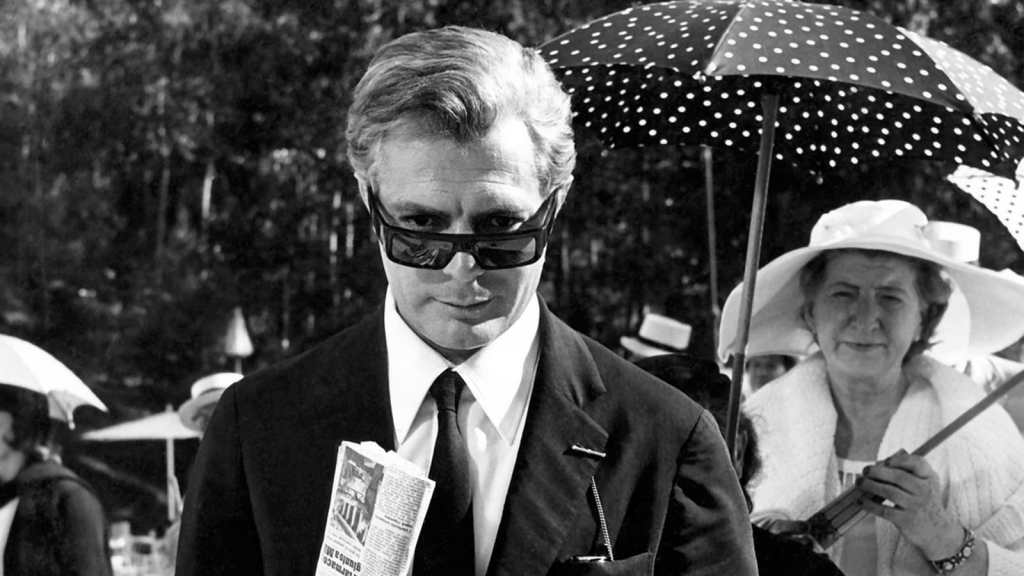
I was torn about which movie I should watch first on my new TV. It’s kind of a big deal. Whenever we got a new TV or made a change to the surround sound, the go-to in the house I was raised in was True Lies, but there hasn’t been a definitive way to view that film since it released on DVD. So I wanted the momentous movie to be something I’ve seen several times, for comparison purposes, and something that would demonstrate the inky blacks and high contrasts possible on OLED display technology. (Who am I kidding? I didn’t even know what the “O” in OLED stood for.) I deliberated over this decision for what felt like hours, halfheartedly testing big budget Hollywood flicks here and there, before going all in on 8 1/2.
A sixty year old black and white movie may not seem like the perfect test drive for a new TV, but I marveled over every pore in Marcello Mastroianni’s face, scrutinized every wrinkle around his haunting eyes, and distinguished every armpit hair on the beautiful Italian women who surround him. Considering I first saw 8 1/2 on a badly worn VHS, then a handful of times on plain ol’ DVD (which I believe was $40 at the time), to say the Criterion Collection’s latest restoration is an upgrade is an understatement.
8 1/2 is Federico Fellini’s semi-autobiographical tale which, by his own count, is his eighth and a half movie. The film depicts a director who’s torn about what his next picture is about, so much so that he frequently dodges his eager collaborators’ inquiries. Constantly hounded by his wife, her protective friends, his mistress, his producer, a brutally honest film critic, and a chain-smoking entourage of jackals, Mastrioanni portrays Guido as a filmmaker who glides along the edge of stress-induced madness, avoiding his problems whenever possible. (At one point he’s literally dragged to a press junket like a tantrum-throwing child.) The meta aspects emerge as he’s told he’s too young and inexperienced to make a film about childhood memories, which is ultimately the very thing Fellini himself is doing.
The film opens with a famous dream sequence in which Guido levitates over gridlocked traffic and takes flight through the clouds. Moments later he frantically tries to untie the rope he discovers fastened to his ankle, but it’s too late: the man flying him like a kite laughs as he jerks the semi-fictional movie director back down to earth. The “real” Guido awakens from the dream-turned-nightmare with a start. Florescent lights flicker to life as Ride of the Valkyries plays and, for the first time, we see Guido’s face framed in a mirror, his weathered eyes suggesting he’s weighed down by far more than your average forty-something.
Guido is a man who copes with the pressures of the real world—poorly—by escaping into childhood memories and self-serving fantasies. His last picture was a rousing success and everyone’s dying to know what’s next, but even Guido’s not sure. He just knows a lot of people are counting on him and he’s the reason an enormously expensive film set has been constructed on the beach. Guido has postponed production, ostensibly to relax at a spa where all the other guests move in lockstep with the music. There the line between fantasy and reality is blurred yet again as he’s served mineral water by his ideal starlet, Claudia Cardinale, who haunts his thoughts like a ghost.
You can never be 100% sure what is real and what is fantasy, if Fellini even cares to make distinction. It sounds like a muddled mess. It’s not.
In one flashback/dream/fantasy which perhaps represents Fellini’s own sexual awakening, a twelve year old Guido and a handful of his delinquent friends visit Saraghina, a large woman who lives on the beach and dances seductively for anyone who’ll watch. The boys rally for her to emerge from the remnants of an abandoned building, which she does like a vampire raised from the dead. Later, Guido imagines all the important women from his life (including Saraghina, a showgirl, his wife, his mistress, and a woman he merely saw in passing once) living in a harem where they feed, bathe, and pamper him. There they live only to serve until they reach the age of forty, at which point they must ascend to the attic, never to be seen again. However, even this juvenile fantasy devolves into a nightmare as the imaginary women revolt against his misogynistic ways. The fact that even Guido’s fantasies become self-critical represents another facet of his conflicted character; consider how much he hates the film critic and simultaneously values his suggestions. Still, Guido fantasizes about the critic hanging himself in a theater.
But talking about plot and meaning completely misses the point of a Fellini film—those elements don’t even become clear on the first or second watch. It’s like praising the the set design in a porno… why? What really drew me to his movies (and, I imagine, literally every other fan in existence) was the eye candy. The poetry of his camera movements and precise blocking is unrivaled. Every scene contains more richness than most filmmakers muster in an entire film. The camera frequently pans to performers who seem to be standing in place, waiting for their cue, but it’s always intentional as if Fellini wants us to believe that their actions are only significant if we are watching. Many have tried to ape his style and end up looking dreadfully pretentious.
I could watch Fellini films every week of my life—and damn nearly did for a significant chunk of my twenties. 8 1/2 is my favorite of the director’s films, precisely because the eye candy is laid on so thick. Some people enjoy rich fudge. I’m one of ’em. Even if it’s not your cup of tea, you gotta admit: Marcello Mastrioanni sure looks cool in sunglasses.
As absurd as it is to believe that humans could intuit some sort of grand design, such premises are irresistible in movies, where even stinkers like Nicolas Cage’s Next can be engaging. The Final Destination series has two great premises: A) What if you could cheat Death? and B) What if by cheating Death you merely bought scant time alongside a hefty penalty? In the original Final Destination, Devon Sawa’s Alex is treated to a premonition of his impending demise, which allows him to save himself and a handful of his doomed acquaintances… initially anyway.
You would have a hard time naming many mainstream films that deal with ideas as unsettling as predeterminism—and that’s before you begin to ponder what, exactly, Death is and whether or not there’s an equal and opposite force that wanted Alex and company to live. Perhaps his premonition was merely a supernatural glitch—a bug in the cosmic code. Wisely, the series has yet to ruin its emergent questions with answers, although reports say the next installment will flesh out Tony Todd’s undertaker character, presumably because Hollywood screenwriters are allergic to mystique.
Great premises can only take you so far, but the series exhibits fine execution as well. Whenever Death’s preferred design fails, it devises Rube Goldberg levels of wildly entertaining events to correct its mistakes. The fourth film in the series, idiotically named The Final Destination, is the worst of the bunch with its SyFy levels of production value, but even it features a white supremacist getting dragged down the street by his own vehicle while somehow setting himself on fire in the process. If that’s the worst you have to offer, you’ve got yourself a solid franchise. Incidentally, my favorite Final Destination is the most recent entry despite some rather stupid character decisions, which is notable because there’s no other franchise in horror movie history that manged to save the best for last.
The formula is so novel, it holds up the weight of five films with ease. In the opening reel, our hero must find him or herself dying in a horrible accident that kills dozens if not hundreds of innocent bystanders. Moments later, the hero will wake up to find it was a bonafide premonition of the future, a future which can be changed. Unfortunately, it won’t be long before the large cast of expendable characters learn that Death will come back for them with a vengeance. What’s interesting about the formula is the filmmakers keep tweaking it with new rules that don’t conflict with the old ones.
In the first film, the principal characters learn that Death comes back for them in the order they were originally supposed to die, picking them off one by one like an invisible slasher. The second film reveals that Death, if unable to carry out its hit list forward, will work backwards (this one is the least logical Destination film because its heroine has multiple premonitions for no other reason than it’s convenient to the messy plot, but overall it may very well be the most entertaining). The third outing seems to suggest Death has at least enough consciousness to taunt its victims with photographic clues of their demises. The fourth expands the mythology in no discernible way at all, which is probably for the best considering it’s the least imaginative entry. And the fifth movie introduces the most radical expansion to the rules to date: Death will give you a pass if you willingly take someone else’s life. This leads to a boringly routine climax (a Final Destination movie really didn’t need a shootout scene), but also the most satisfying twist ending ever put to film.
Yeah, I said it. Eat your heart out, Shyamalan.
There’s a lot of silly stuff in these movies, most of it intended, which compliments the heavier implications. Nothing is more thrilling than cheating Death. Unfortunately, Death always wins in the end, it just so rarely does in the movies.


I‘m working on a series of fantasy stories about a death mage named Maven.
Last summer, the mother of all trees fell on my house during the pappy of all storms. During that week of intermittent power and zero internet service, I found myself daydreaming about a monster who crawls out from underneath a fallen tree and terrifies a village. How did the monster get there in the first place? I wondered. More importantly: What kind of hero (or anti-hero) could dispatch it? A day later, I had completed the first draft of a short story called The Fallen Tree.
I’m a simple man. I write what I see.
I couldn’t stop thinking about the death mage and ended up writing two more stories in short order. In the sequel, Master Death Theater (a title that should give you an indication of just how serious the overall tone is), Maven joins a wandering troupe of actors and must use his magic to resurrect their star performer. This one is inspired by the works of H.P. Lovecraft by way of Stuart Gordon, particularly Re-Animator. Here’s an excerpt:
A caravan of wagons was parked on the beach in a loose circle. A group of performers half-heartedly recited dialogue as they went about washing their clothes in a communal tub.
“Welcome to The Wandering Theatre,” the woman said. “Part of it, anyway. Our fortune teller sleeps during the day and our knife thrower is no doubt lying in an alley somewhere, same as you were.”
“What do you do?” Maven asked.
“I’m like a falconer, only my act involves a bat.” The woman gestured at the cloth sack on her shoulder. “Isabell also sleeps during the day. Come, I want you to meet the lead performer of our troupe.”
The bat keeper walked to a wagon which was more ornate than the rest. She pulled a lever and a pair of mechanical steps dropped down below the door. Maven followed the woman inside. The room smelled of alcohol and death, two things which greatly pleased the mage’s nostrils. A rotund man lying on a bed was the source of both odors.
“Ah,” Maven said, unsurprised.
“We’ll begin auditions for his replacement as soon as we can, but we’re obligated to perform in the royal hall tonight. We believe he drowned in his own vomit.”
“Better than someone else’s,” Maven said, picking up a half empty stein from the bedside table. He swallowed its contents and lifted the dead man’s arm to see how much stiffness had set in. “He died shortly before daybreak. His joints need exercised.”
The bat keeper worked the dead man’s appendages, starting with his toes and working her way up. “You can bring him back?”
“As long as you agree I’m not responsible for anything that happens after his resurrection. And it’s important no one tells him he’s dead.”
“That would break the spell?”
“No, it would only ruin his performance—preoccupied mind and all that.” Maven sat on the bed next to the dead man and parted his lips. He breathed into the actor’s mouth and, with a wooden finger, drew the sigil of resurrection in the air. “Come back to us, friend.”
from Master Death Theater
I’m hoping to get the first story out pretty soon. Whether that means posting it here or submitting it to more traditional markets, I don’t know yet. The rest I plan to shop around, so I’ll keep ya updated on how that goes. Now, if you’ll excuse me… I’ve got some more tales to write.
Let this sink in: it’s been sixteen whole years since Grindhouse premiered in theaters. You got two movies for the price of one: Robert Rodriguez’s Planet Terror and Quentin Tarantino’s Death Proof, garnished with four fake trailers directed by Rodriguez, Edgar Wright, Rob Zombie, and Eli Roth. After the experiment mildly failed at the box office (it released on Easter weekend of all dates), the movies were regrettably split into individual entities for DVD and VOD. The fake trailers were relegated to the special features section and low resolution YouTube videos.
One of those fake trailers absolutely blew the roof off with laughter: Eli Roth’s Thanksgiving, which was the horror director’s 2-minute ode to pre-Scream slasher flicks. The audience reaction probably could have tipped the Richter scale in the theater I saw it in. Nothing is more cathartic than a group of strangers laughing at things you ought not laugh at in polite society—and here was a mainstream movie doing it. And now, almost twenty years later, Eli Roth expands the two minutes into approximately ninety.
The movie opens on Thanksgiving day, 2022, as a Plymouth electronics store is about to open its doors for an early Black Friday sale. The rabid shoppers are gathered at the front doors, foaming at the mouths, when a misunderstanding sparks a riot that devolves into Final Destination levels of violent mishaps. Throats get slashed, heads get scalped, and people punch each other’s faces in over the limited supply of discounted waffle irons. Exactly one year later, a killer wearing a John Carver mask begins picking off the shoppers and security personnel responsible for the carnage. It’s up to a group of high school seniors to figure out who the killer is.
The killer’s identity doesn’t really matter and the reveal at the end is not particularly shocking. Eli Roth knows this and the audience should intuit this, too. I don’t think anyone was expecting a clever whodunnit when they purchased their tickets. What you should be expecting instead is an old fashioned slasher that just happens to be made in modern times—not to be confused with a “modern slasher,” which in this day and age is typically about as joyless as… well, getting cooked in an oven alive.
I couldn’t help but think of four other movies while watching this one: Pieces, Blood Rage, Deranged, and William Lustig’s Maniac (which I’m surprised to find I’ve never featured on this blog because it’s a doozy). If any or all of those are your cup of tea, then so is Thanksgiving. Otherwise, avoid it all costs because it’s really not intended for polite society. I must say that Eli Roth feels about 5 to 10% tamer in his depiction of gore as he remakes the fake trailer moments with varying levels of success.
Here’s what I’m thankful for this holiday season: Thanksgiving isn’t Cocaine Bear, which mocked the bygone era of exploitation films instead of embracing the genre. This one’s an honest-to-god slasher flick whose performers play it as straight as Leslie Nielsen did in his best comedies. There’s no winking at the camera and no indication the filmmakers think they’re above this kind of material.
The only characteristic Roth doesn’t nail: the acting isn’t bad at all, actually, and I wish the film stock looked more messed up like its Grindhouse counterpart. Other than that, it’s a fine antidote to the usual holiday offerings.

Shortly after Grand Theft Auto 3 came out, a recurring topic on GTA message boards was, “Do you think we will be able to swim in the next one?” There was an aggressive group of players who reached for reasons why the ability to swim in a GTA game was “stupid” and “pointless.” (Never mind the franchise was hugely popular in part because it was seen by many as an “everything simulator.”) One side of the debate casually thought that such a mechanic would be cool. The other side took up arms as if such a suggestion was holy blasphemy, presumably because some people are hyper-defensive of anything they like. (Swimming was indeed introduced in San Andreas, and when Grand Theft Auto 5 released, the very first freeroam activity I engaged in was riding a Sea-Doo straight into the ocean and swimming off of it for no other reason than it was fun. Go figure.)
Similarly, the first time I played Perfect Dark Zero and witnessed the NPC combatants jumping over my bullets in the combat simulator, I logged into internet forums to see if the player-character was also capable of the same gymnastics. Perhaps you’ll notice a pattern emerging in one of the responses: “What are you? A circus clown or something? Why the hell would you want to leap around like a [insert expletive here]?” When Halo 2 released, I asked a forum why the sound design of the guns didn’t pack a satisfying punch on my surround sound system. The sole response was “no.”
More recently, I took to the Steam forums to ask those who had played the Mortal Kombat 1 beta to confirm or deny if there were any functions that relied solely on a right thumbstick (such as using Konsumable or navigating the Krypt in previous titles) because I was frustrated by not being able to play a fighting game solely on a fightstick, which has no right thumbstick. It was clear neither of the responses had actually played the beta, much less read my question past its title, but they had opinions nonetheless. One went so far as to suggest the Mortal Kombat moveset was “never really intended for joysticks…” as if I wasn’t there in the 90s when the first batch of games hit the arcade with—you guessed it—two big ol’ American-style joysticks.

Have you ever been frustrated that the latest racing game doesn’t play nice with that expensive steering wheel you purchased? Well, according to the forum geniuses: that game (it doesn’t matter which game it is, there will be fanatics who blindly defend its oversights) is obviously more of an “arcade racer” and “arcade racers are exclusively designed for gamepads, not steering wheels.” Yet almost ever single racing game I’ve ever seen in the arcade has a steering wheel controller. So why does this community accept “arcade racers” that are uncontrollable by a steering wheel? Rather, why does the part of the community that doesn’t own steering wheels feel the need to voice an opinion on the matter at all?
A current hot topic seems to be: “Why does travel in Starfield rely so much on menus and fast traveling?” Those of us who expected space travel to operate more like No Man’s Sky or Elite Dangerous have been told exactly why we’re absolute morons for wanting that extra step of immersion that many find boring. I get it. Not everyone has dual flightsticks and a penchant for roleplaying deep space isolation. Not everyone lit up upon hearing Sean Murray’s pre-release promise that if you see a star in No Man’s Sky you can visit it. But I certainly did and so did millions of others. It’s now a genre standard that’s eight years old, set by indie game studios. And while there are definitely assholes on my side of this issue (any issue, really), it seems to me that those who are staunchly aligned against such a mechanic are doing the same thing the anti-swimming GTA players did: reaching for any reason why Starfield is absolute perfection.
(For the record, I have close to 50 hours logged in Starfield as of this writing so I don’t want to give the impression that I dislike it. My disappointment in the lack of tooling around a galaxy has more or less melted in lieu of what the game does right. On the other hand, it does plenty wrong, too, and I suspect the chorus of 9/ and 10/10 reviews are very much on a runaway hype train. Compare it to Baldur’s Gate 3 and you will see it is very much not a next generation title… it’s not even as good as Fallout 4, but I digress.)
We can have it both ways, you know. In fact, previous Bethesda games did just that: gave the player the option to fast travel or travel to a destination in “real time.” (Quotations because the term is relative to its science fictional setting.) Obviously players can’t spend the actual time required to travel to a destination that’s lightyears away, but Elite Dangerous and NMS both found clever ways around those limitations that didn’t require the use of an awkwardly placed loading screen. What I find most hilarious is that the people defending Bethesda’s omission are the ones who got their way and they’re still angry.

As I can’t imagine anyone reaching this blog without having already seen They Live before, I play fast and loose with spoilers.
I recently saw They Live as part of a 35th anniversary screening put on by Fathom Events. Oddly enough, it’s not the first time I’ve seen it on a big screen in the 21st century—the last time was at a double feature in a friend’s backyard, projected onto an inflatable screen and paired with Roddy Piper’s vastly inferior (but somewhat entertaining) Hell Comes to Frogtown. As real life political corruption and Joe Schmoe stupidity in the United States reaches hilariously depressing extremes, They Live hits harder than ever before. It could be my generation’s Dr. Strangelove or: How I Stopped Worrying About Inequality and Learned to Idolize the Wealthy.
I rank John Carpenter movies as follows: The Thing is his best, Escape from New York is stylistically his coolest, and They Live would be his most entertaining if not for the stupendously wild Big Trouble in Little China. Part of the reason They Live is so fun is “Rowdy” Roddy Piper, whose theatrical wrestling background translates into an endearing screen presence that’s simultaneously relatable and larger than life. When he initially discovers aliens have infiltrated and control every level of government, he chuckles in defeat. “It figures it’d be something like this.”
This pessimism comes shortly after he delivers a “I believe in America” speech that would seem contradictory to his character if you don’t detect the indifference in his tone. His only pal, a laid-off steel worker played by Keith David, openly berates the idea of the American dream—he hasn’t seen his family in months because he has to go wherever the scant opportunity to work takes him. The character points out that when the steel companies were in trouble, the workers pulled through for them, but when the workers were in trouble, the executives gave themselves bonuses. “The Golden Rule,” he says, “is he who has the gold makes the rules.” David is easily the most skilled and believable actor in the entire production, at times delivering reams of dialog while Piper mostly plays the silent type.

Midway through the movie, when you would normally expect a boringly routine love interest to be introduced, Carpenter instead pairs his hero with Meg Foster. Foster plays an oddly detached woman who immediately knocks his ass out of a tall window in an attempt to kill him. Later, she shows up to apologize in what appears to be a meet-cute moment. Here’s a detail I’ve never noticed before now: during their reunion, one of the background characters is instructing members of the resistance to attempt to befriend and gain the trust of their enemies as a means of infiltration… which is exactly what Foster is doing to Piper. It reminds me of that part in The Sixth Sense when the boy is explaining that some dead people don’t even realize they’re dead while the camera lingers on Bruce Willis’s face. Another detail my girlfriend pointed out: Meg Foster is the one who led the police to the resistance’s hideout in the first place.
I believe the famous five-minute fight in the alleyway still holds the cinematic record for the longest of its kind. I’ve always thought of it as a welcome indulgence of little import, but this time I reconsidered Carpenter’s intentions. Consider how many lower class men and women are in David’s shoes, helplessly preoccupied with their own struggles to make an honest living in a system they know is rigged. People like that know that hard work isn’t all it takes and yet they work hard anyway so as not to lose any ground. Getting them to release their tenuous grip on the status quo that shuns them would very well require a knockdown, drag-out fight of the caliber exhibited here.
Salient details that are easy to miss: not all the cops in Carpenter’s dystopia are aliens in disguise, but they all serve the elite. And not all of the elite are aliens, either, as greedy humans work with the aliens despite knowing that the endgame will result in a planet that’s uninhabitable for their own species. One of the downtrodden drifters (Buck Flower) from the beginning of the movie finds himself sipping champagne by the end, rubbing elbows with the economic overlords who just ordered the police force to bulldoze his homeless encampment. “We all sell out everyday,” he reasons. “Might as well be on the winning team.”
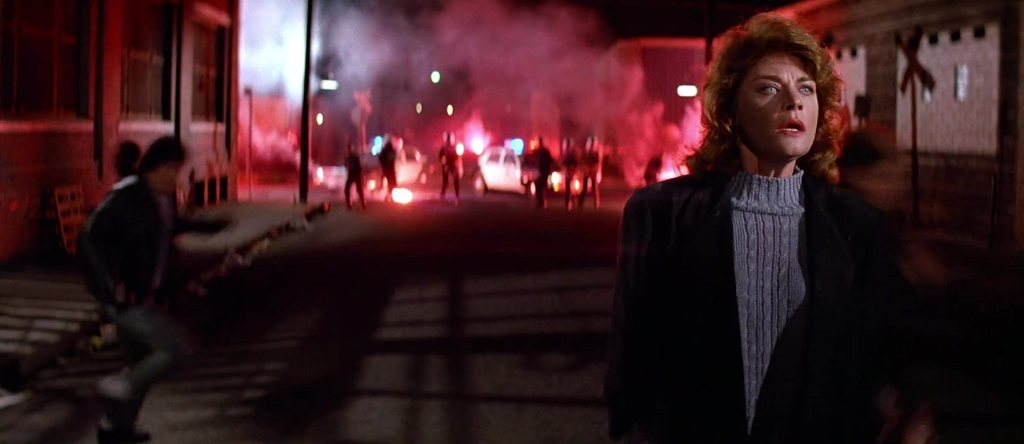
I haven’t even mentioned the iconic sunglasses. Created by scientists in the resistance, the special sunglasses let the wearers see the world in literal black and white. It turns out every form of mass media and all consumer goods are hypnotizing people to continue consuming, reproducing, and not questioning authority. The satire is sharp, but the metaphors are blunt. You can feel Carpenter’s rage against the inevitably destructive corporate machine oozing out of every pore of the screen.
I see a lot of old genre flicks screened for modern audiences. I love watching these movies with a group of strangers, but a lot of the time they laugh at the movie rather than with it. Curiously, They Live is one of the only times I’ve seen a modern audience laugh strictly at all the right parts. That’s some unusual staying power there.
Screenshots sourced from Movie-screencaps.com.

