Starfield: 3 Hours In

Let’s get this out of the way quick: Starfield appears to be a great game and I suspect everyone who’s even a little interested in it should probably try it. So far, all of my complaints are nitpicks. Let this post serve as a spoiler-free indicator of what to expect. I’ll either temper your expectations or kick your hype train into overdrive.

I’d heard two reports that the game was more like “Red Dead Redemption 2 in space” rather than a traditional Bethesda title. My brief time in the game conflicts with that statement. The music of the title screen immediately gave me Skyrim vibes. These vibes strengthened as the game faded into a cutscene that had me expecting one of the characters to say, “Hey, you… you’re finally awake!” Soon after coming into contact with the game’s MacGuffin, your character develops temporary amnesia, at which point the character editor is unlocked as you “remember” who you are, Fallout style.

The character editor has one strength: characters look better than they’ve ever looked in a Bethesda game. Unfortunately, the editor has many weaknesses, too. Recent titles like Street Fighter 6 and Diablo IV offered enough options for me to create fairly accurate replications of Brandon Lee’s The Crow (I don’t know why that’s my go-to character lately). Starfield’s character editor isn’t even close to being robust enough for that kind of detail. It offers you around thirty presets, maybe thirty hairstyles, and lets you change the oddly similar (and oddly familiar) faces within some pretty rigid parameters. Instead of having control over ear height, eye separation, etc., you decide if the preset face is round, square, thin, etc… that’s it.

As someone who has countless hours in No Man’s Sky and Elite: Dangerous (not to mention over a hundred games in my Steam library with the “space” tag), I was disappointed the first time I climbed aboard the starter ship to fly to another planet. There’s a short but rousing cutscene as the ship takes off, but then the game clumsily enters a loading screen. The next thing you know, you’re suddenly in space. In retrospect, I shouldn’t have expected an immersive sim from what could very well be the year’s best seller, but as a staunch fan of seamless ground-to-space transitions, this is my biggest disappointment so far.

Speaking of boundaries, on the first planet I visited after leaving the starting planet, I completed a main objective and was told to go back to my ship to continue the story. I decided to ignore said message and started walking to see if I could find any invisible walls. I set my sights on a distant piece of scenery that was so far removed from my landing spot that I was certain I would reach some sort of invisible wall or at least a warning to turn around. Not only did I not find any such boundaries, I saw a point of interest blip on my radar much farther away than my initial destination. I will experiment on this more when I play again, but so far (and I admit my sample size is relatively small) it looks like the explorable areas of planets might be absolutely huge. Though, I must confess my walk was quite boring.

Having recently played the new System Shock, I feel like I’m in familiar territory: so far, Starfield feels less like a next-gen defining game and more like a highly polished next-gen remake of a previous gen-game. So much of The Elder Scrolls and Fallout’s DNA is in this, which is to be expected and even desired, but some of the Bethesda aspects that have started to show signs of their age are present, too.

At any rate, I am absolutely hyped to play again and spend more time in the combat and checking the dialogue out with NPCs.

I’ll post more thoughts as I progress.

System Shock (2023): A Comprehensive Review

I’ve had a lousy run of games since Street Fighter 6. I don’t mean bad games, but games that don’t match my mood or catch my attention. I’ve grown bored of modern game design and the cliches that come with it. Why do all openworld survivalcraft titles start with a plane/spaceship crash? Why do I constantly find myself distracted by oft recycled game mechanics—and thinking about the games which did them better? Why do so many “freedom of choice” games hold the player’s hand so much? Most of all, why do remakes and remasters tend to suck more often than not?

Which brings me to System Shock, a remake which retains the design philosophy of its 1994 predecessor (I was 11 when it came out, so I didn’t have a dedicated gaming rig, and I’m a little more familiar with its sequel). Here’s a game that refuses to hold your hand—on the default difficulty, it doesn’t even pin your current objective. Even if you’re paying attention you may not have any clue as to what to do next. It’s a game that manages to feel fresh by remaining old. There’s no regenerating health, no reliable drip of helpful items to keep you alive, no characters telling you exactly what you should do and where to go next via convenient radio communication. It’s less of a hot rod and more of a painstaking restoration of a classic car.

In the interest of transparency, it should be noted that my favorite flavors are probably space themes and cyberpunk. The original System Shock and its sequel no doubt played a large part in my attraction to that wicked combination. It’s not just me—the series also influenced Deus Ex, Bioshock, Dead Space, Prey (both of ’em), and Cyberpunk 2077. I’d even argue DOOM 3 got a big dose of inspiration from System Shock as well.

Premise

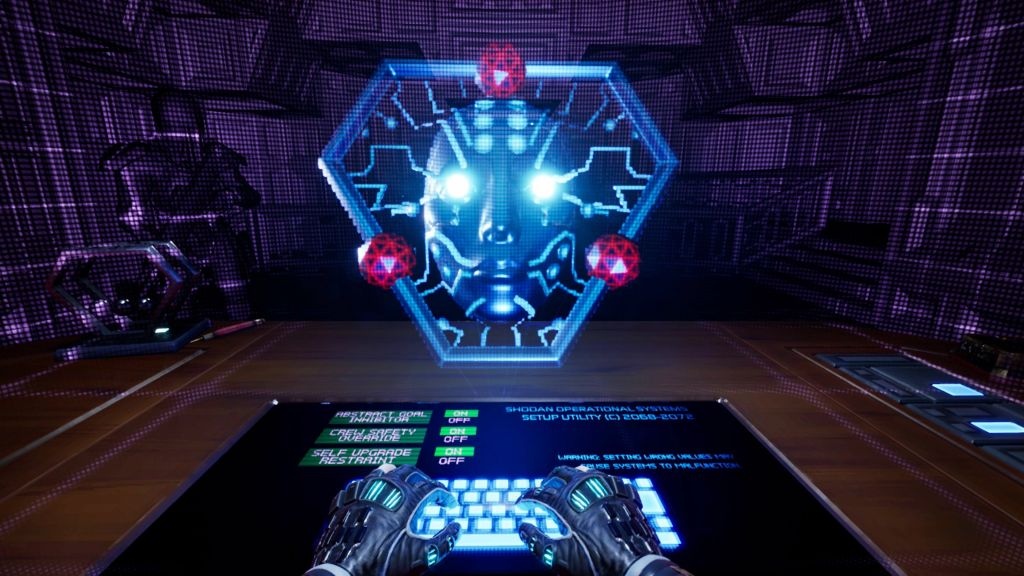
The story takes place in the year 2072. You play a nameless hacker who’s caught remoting into the servers aboard Citadel, a space station owned by the TriOptimum corporation. In true cyberpunk fashion, the evil megacorp has its own military force which takes you to the station in custody. One of the executives cuts you a deal: deactivate the cybernetic guardrails of Shodan, the super-AI which manages every system within Citadel Station, and he’ll give you the fancy cybernetic implant you desperately want. Soon after you begrudgingly agree, everything at the station goes awry and you awaken from cryonic storage after your implant surgery.

With its newfound freedoms, Shodan fashions itself as a god which begins killing the humans aboard Citadel Station with aspirations of destroying Earth itself. It accomplishes its goals by manufacturing robots, drones, human mutants, and biological weapons. You and your new cybernetic enhancements are the only things standing in the AI’s way.

Level Design

Citadel Station is comprised of around ten levels accessible by numerous elevators and trams, none of which can travel more than three floors, most of which only travel between two. Each level is an absolute maze of dead ends, initially locked doors, and crawlspaces. Stationed throughout each level are security cameras and destructible CPU nodes which determine the amount of security Shodan holds over each level. The more of Shodan’s systems you destroy, the safer the level is because fewer enemies can spawn.

When you initially reach a level, many if not most of the rooms will be locked or blocked in some fashion. You’ll either have to find a key card, find a different route, or solve one of the tile puzzles (more on those later). Even when you’ve entirely cleared the fog of war from a level map, it’s still difficult to find your way around. Although no section or level felt particularly copy-and-pasted, it all started to blend in memory anyway. It feels a bit like a Metroidvania in the amount of backtracking involved, how accomplishing things in one section could clear the way to previously inaccessible sections.

I’m not knocking it for its level design. It just plays by rules from a different time. Overall, I found it equal parts refreshing and frustrating to get around. The greatest part of the level design is how it looks. The environments aren’t necessarily rendered in AAA graphics, but they’re well ahead of the Kickstarter curve and more than sufficient for enhancing the moody atmosphere. I very much like the way the game looks and, though its layouts have more in common with the maze-like level design of early shooters (think Wolfenstein 3D and DOOM, which came out mere months earlier), it somehow feels like a lived-in world.

Enemies

The enemy AI hasn’t improved much since the 90s. There’s a reason game developers have long favored zombies, robots, and drones: such enemy types can be forgiven for being stupid. Devs can set them on a simple path and program them to attack the player on sight. They won’t flank, they won’t retreat, and they never devise any plans. Sometimes you’ll be surprised by where they appear, but they’ll never outsmart you. (I don’t think I ever encountered one in a crawlspace, either.)

Eventually you’ll encounter macroscopic viruses that would require a Petri dish the size of a trashcan lid to contain. They can disappear into the environment Predator-style and launch snot rockets that infect you with a biological contaminant, all the while soaking up your precious shotgun ammo. I hated these enemies to the point I almost considered quitting the game. At one point I just started turning around every time I saw one, but no enemy in the game can be evaded forever.

Once I found the laser rapier (essentially a lightsaber), I was eager to try it on the stubborn viruses… and then I only encountered ranged drones and other flying enemies which stayed well out of reach of my newfound melee weapon for the rest of the level. Having said that, the laser rapier and the assault rifle make the game a lot more fun the deeper you get into it.

Inventory Management

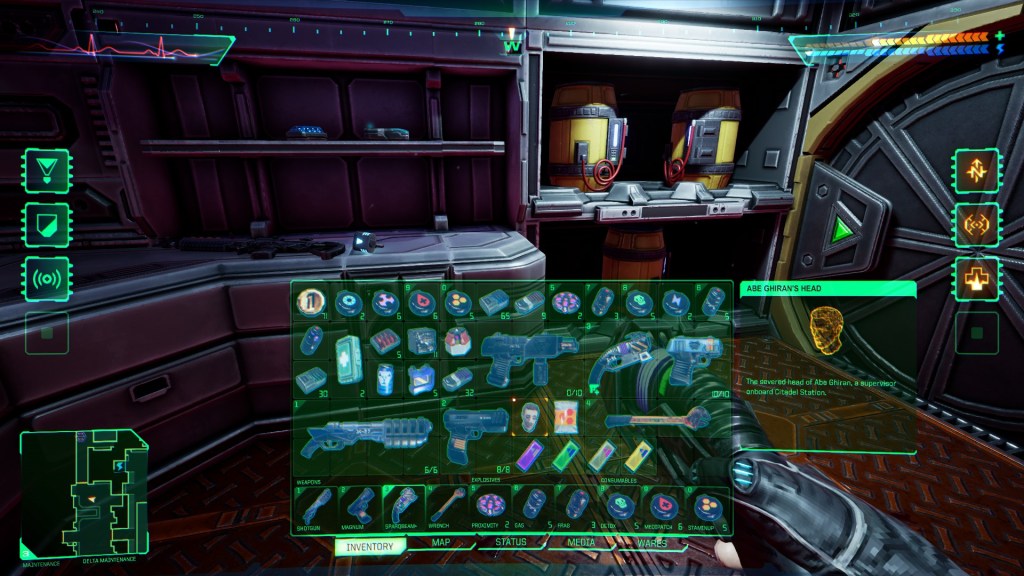
The inventory system and the mechanics that govern it were just as peculiar in the 90s as they are today. I love the “pick up anything” interactivity of games like this (you can pick up human heads just because) and the clumsiness involved with doing so. It should be clumsy. Otherwise you get the sense your character is lugging around overstuffed cargo pants à la Tommy Wiseau in The Room. It’s a clumsiness I always admired because of the added level of immersion and control.

RPG gamers have a word that I’d like to co-opt: crunchy. The term describes tabletop games that rely heavily on complicated mechanics. That’s a fitting term for System Shock’s inventory system. Choosing what to leave behind and what to take (and when to take it) creates another layer of depth. Early on you’ll come across an assault rifle that’s damaged beyond use. At this point in the game you don’t know if there will be an opportunity to repair it. Do you take it, leave it, or plan to recycle it?

If you take it you’ll have to make room in your inventory, which might mean getting rid of previous acquisitions, or you can temporarily store it in the cargo lift that moves between the levels like a dumbwaiter. And if you do decide to take a cumbersome item that you don’t plan to use, you can save room by vaporizing it (though by what means your character accomplishes this in-game is not made clear) so that you can store the resultant scrap in a single inventory slot combined with other scrap. Unfortunately, if you sell the scrap to the recycler machine, you won’t make as much money as you would have recycling the same item whole.

Logic Puzzles

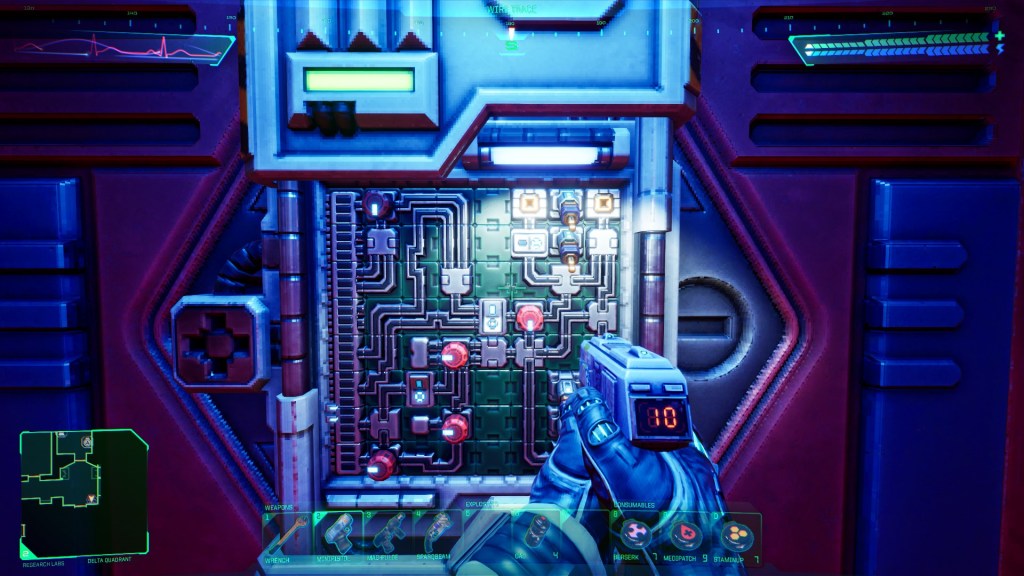
I found myself stuck on the very first puzzle I discovered mere minutes after the game started. The puzzle (think: Pipe Mania) required me to connect two nodes with an unbroken path of power on a board of rotatable tiles. A port beside the puzzle requires a logic probe to access. I wondered: Do I need a logic probe to complete this puzzle? If so, why am I allowed to interact with the puzzle at all? (The logic probe, as it turns out, lets you skip the puzzle.)

Nothing in the game tells you how to connect the power nodes—it doesn’t even tell you if that’s your goal. There’s also no indication that completing the puzzle will merely unlock a small section of the station that you’re going to unlock eventually anyway. I probably spent an hour figuring out how the different nodes work (“Oh! There are direction indicators!”) before I finally figured it out—and later on I was knocking these puzzles out in minutes, if not seconds. If you decide to cheat the solution by looking it up online, you will find the problems are randomly generated (as are the passcodes to open doors and storage caches), which hearkens back to the era when most people weren’t connected to the internet with all the answers at their fingertips.

Difficulty

Modern game design dictates that a player should know, at all times, what they’re supposed to do and where they’re supposed to go. I’m not knocking games that choose to do that, I’m just saying it becomes repetitive when almost every game chooses this philosophy now. In the 90s, games that allowed you to get stuck were the rule—and that got tired back then. Today, games like System Shock are a welcome exception for those of us who, for whatever reason, kinda miss feeling stupid from time to time. Besides, getting stuck is befitting of a hacker-themed game.

When the game begins, you don’t just choose the overall difficulty, but instead choose to increase or decrease the following parameters: Combat, Mission, Cyber, and Puzzle. The puzzles become easy once you finally understand the aforementioned easy-to-miss indicators on the components. Combat and Cyber can become a real drag because they just aren’t fun enough to justify a harder difficulty. I’ve read that choosing a difficulty of 1 for Mission introduces modern hand-holding, so I’m glad I left that one on the default setting of 2 for authenticity’s sake. Your mileage may vary.

At any rate, consider your difficulty settings carefully. They can’t be changed later without starting a new game.

Cyberspace

Hands down, the weakest part of the package is the cyber running. Representing a Mnemonic cyberspace in video games has always been done with mixed results at best. Most games add the cyberspace levels as an afterthought and System Shock is no exception. The idea is awesome, but the execution is whack. These sections feel more like Descent in 1st person view, masking the main engine with a new paint job and enemy types (though not as egregiously as Shadowrun Returns) while giving the player the ability to control altitude and rotate so that they feel like they’re flying through an ethereal dimension. (The VR-exclusive Darknet is probably the best representation of cyberspace hacking I’ve ever seen, but the entire game is cyberspace hacking so maybe it doesn’t count?)

It’s also frustrating that there is no quicksaving in these sections. When you die, you’re kicked out of the access node (minus a significant chunk of health) and have to start over from the beginning of the run. I wouldn’t have minded if the sections weren’t so bland, but later on the difficulty ramps up by merely adding more of the bullet-sponge enemies… you know, the least thoughtful way to make the difficulty harder. Though I set the Cyber difficulty at the same level as my parameters, I found these sections significantly harder than the Combat, but that’s probably just because my heart wasn’t in it. I wish the logic probes could be used to bypass these sections as I found them to be much more annoying than the wall puzzles.

Final Words

The newest iteration of System Shock is indeed a shock to the system. There’s no hint of stockholder appeasement or corporate greed. Nothing feels dumbed down. What you get is a loving remake of the 1994 game, not just a run-of-the-mill modern game with a recognizable name. The game could have safely tried to please everyone, but it’d rather be fully embraced by a dwindling subset of gamers than merely liked by all. That’s not to say it’s not frustrating at times (I rage-quit frequently), but it’s greater than the sum of its aging parts. This is a game primarily for longtime players and anyone else who’s interested in the history of game development.

Summer Movies 2023

I’ll keep this list updated as I see more of the season’s movies… and there are a few placeholders in here so I can remember to watch all this stuff.

Air

Air is the riches to riches story of a little known shoe company called Nike. Despite the fact I have zero love for mega-brands, I thoroughly enjoyed the breezy nature of this flick. (Curiously, I’ve never watched a televised ballgame in its entirely, but I’m quite smitten on ESPN’s 30 for 30.) Matt Damon and Jason Bateman are two of the most likable actors in the business and they play off each other naturally. A good movie to watch on a rainy day.

Guardians of the Galaxy 3

Placeholder… it’s taking me a while to get around to this one because I was told you have to see the The Guardians of the Galaxy Holiday Special first (you don’t), which I found to be mind-numbingly awful and not just because I hate Christmas movies (I do). I’m no longer a big fan of Chris Pratt fan, either, and I’ve found his character unlikable since Infinity War.

Fast X

This one is admirable in many ways (rich cinematography, beautiful looking people) and embarrassing in a lot of others (forced humor, Vin Diesel). When it’s not being corny, and the CGI cars aren’t flying around like toys, I can kinda see the franchise’s appeal. Jason Momoa is almost great as the villain, but he goes one notch too far. Fast is so phony looking, I can’t be sure any of its actors have ever driven a car in real life, much less stepped foot off a sound stage. Did not finish, but I’m amused that whenever the stakes are high, there’s always time to burn rubber instead of, you know, accelerating efficiently.

The Flash

I don’t care for DCU films. Against all odds, I think I liked this one. The CGI is possibly the worst special effects I’ve ever seen in a mega budget movie, but they’re so consistently terrible that I kind of grew used to it? I detest nostalgia bait (and box office returns suggest most moviegoers feel the same way), but I actually liked seeing Michael Keaton in the bat suit again, even though the stuntwork makes him look far more agile than he did when he was half his age. I was also pleasantly surprised by this iteration of Supergirl, but I feel that the marketing team blew their load by spoiling her appearance in the trailers. Like, did they really think Keaton’s Batman wasn’t enough of a draw? At any rate, The Flash isn’t a great movie (far from it, in fact) and it isn’t a smart movie, but it is a fun one.

Asteroid City

Placeholder… Every time I see a Wes Anderson trailer, I think, “Oh, I already know what this is.” So it feels like a chore getting started on a Wes Anderson movie, but most of the time he exceeds my expectations. We’ll see.

Indiana Jones and the Dial of Destiny

Here’s yet another movie churned out of Disney’s artless acquisition of Lucasfilm, but—to no one’s surprise—it’s only the second worst film in Indiana Jones franchise. The disappointment comes early on when a CGI Indy runs across a train top in a sequence that looks only marginally better than the vine scene in Crystal Skull. At the end of the day, this movie would have served Jones’s legacy better by not existing at all, but once you’re past that hump, there is a pleasantly amusing movie here, which includes an absurdly stupid but fun finale. Also: Mads Mikkelsen is one of the most versatile actors, like, ever.

Mission: Impossible Dead Reckoning Part 1

This is my second favorite action movie of the year (#1 is John Wick 4, which was the first movie that ever exhausted me in a positive way). I’m tempted to name Dead Reckoning my favorite Mission: Impossible movie, but AI-related plots are already feeling a little old hat and there weren’t enough high-tech gadgets or farfetched break-ins for my liking. Sure, they use plenty of masks and Tom Cruise parachutes onto a runaway train, but I miss the clever use of building hacking seen in previous entries. (Remember when they used an eye-scanner and a projector to break into the Kremlin? Huh-huh, that was cool.)

Talk to Me

This is the freshest urban legend vibe since It Follows and The Babadook. So many horror movies forget to be fun, which is only excusable when they’re really good. Talk to Me is fun and good, and its energetic pace thrilled the hell out of me. The kids in this Australian flick are endearing little pricks, which is evidenced by a wild montage of teens doing what teens do best: meddling with evil entities while laughing like a bunch of jackasses. There isn’t a tired scare-attempt in the entire movie, which isn’t something you can say about 99% of demonic possession flicks. The inevitable sequel will suck so embrace this one.

Barbie

Okay, this one has Pee-Wee’s Playhouse energy. My biggest problem with movies like this is they tend to establish a great fantasy world and then quickly move the characters to the boring “real world” (Last Action Hero is the worst offender of this trope). Thankfully, Barbie knows better and spends most of its runtime in a fantasy setting. This is the first movie of its kind that focuses more on its star power than the IP and it sure is refreshing. Overall, a very amusing movie and the humor is on point.

Oppenheimer

See my full thoughts here. Probably the best movie of the summer.

Oppenhype

If you’re lucky enough to see a 70mm screening of Oppenheimer, I envy you. You won’t have to sit through twenty minutes of mostly bad trailers because the movie itself is already pushing the limits of the IMAX film size. Pictures of the 11-mile long reel look as if its been jury-rigged to fit existing projectors. Unfortunately, it would have taken my group longer to drive to the nearest 70mm screening of Oppenheimer than it takes to actually watch it, so we settled for the digital IMAX projection even though there is a local theater projecting it on 35mm film.

I’m glad we chose to see it big. I love big movies with big aspect ratios. Oppenheimer is certainly big, but it’s also bold. Director Christopher Nolan famously avoids CGI whenever possible, but the limitations of shooting this way are sometimes obvious in his previous films. Dunkirk features thousands of soldiers when there should be hundreds of thousands. The climactic shootout at the end of Tenet seemed more like a paintball match than a spectacle. What you get here is a three-hour picture that promises a big detonation and only shows it to you in glimpses reminiscent of what it must have been like to see it in person, carefully peeking out from behind cover miles way.

That’s not a complaint, it’s an admirable choice. There’s not a shred of war footage in the entire movie. The only violence we see is the violence in Oppenheimer’s head.

Was the real Oppenheimer capable of such empathy? Early on, we get our first indication that the character is going to be a challenging person to like when he injects cyanide into a professor’s apple over a classroom disagreement. Later, he’s disturbed by what he did and races back to the classroom to retrieve the poisoned apple moments before it unleashes unintended collateral damage. The historical accuracy of the scene is debatable, but I think it’s a peculiar coincidence that Alan Turing, another neurodivergent mastermind of the Allied victory in World War II, chose to kill himself with a cyanide-laced apple.

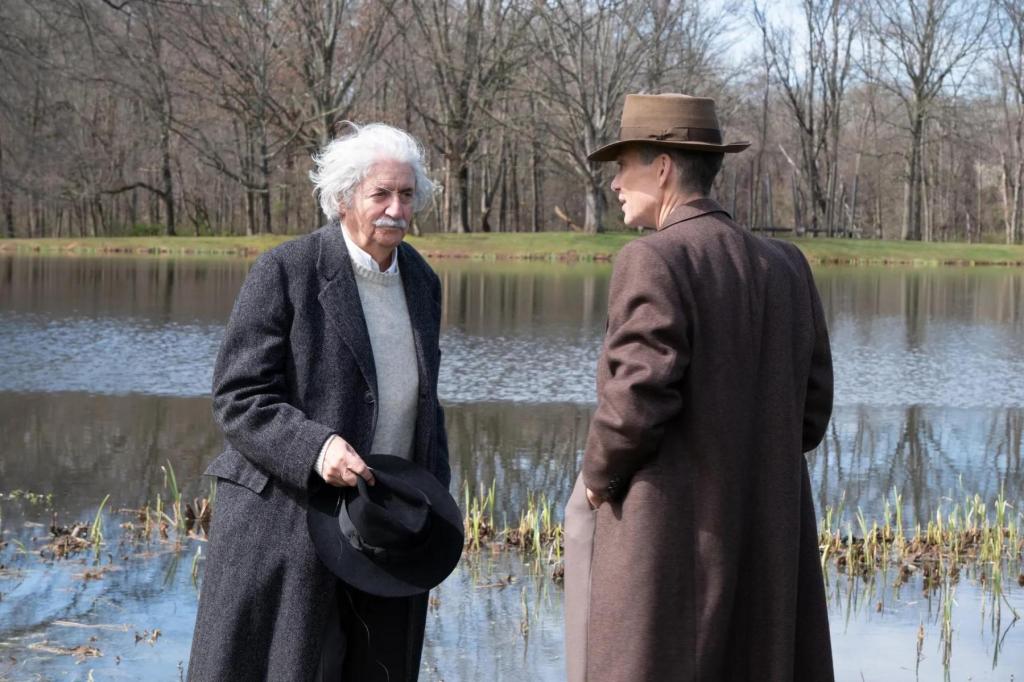
The film is so quickly paced (and dazzlingly scored) that even the audience with its benefit of hindsight is caught up in the scientists’ enthusiasm to build the mother of all weapons. By the time we remember the terrible implications, it’s too late, and the film abruptly cuts to Oppenheimer watching helplessly as two ominous crates ship out of Los Alamos. Soon after, Oppenheimer meets President Truman in person. Of the two men in this scene, one is portrayed as a tortured man who has a deep understanding of the very branch of science that eluded Einstein’s genius. The other is portrayed by Gary Oldman as a rankled sort with a high school education and the newfound power to cause unimaginable destruction. At the end of the scene, Truman ends up calling Oppenheimer a pussy when he doesn’t share his enthusiasm for the lives lost.

Famous actors with bit roles wander in and out of the movie at every other scene: Casey Affleck, Raimi Malek, Olivia Thirlby, James Remar, Tony Goldwyn, Matthew Modine to name only a few of these supporting-supporting actors. Josh Hartnett proves to be a surprisingly complex and capable actor. Macon Blair, the Jeremy Saulnier favorite who’s reportedly directing the Hollywood remake of The Toxic Avenger, levels up in this movie in a most impressive way as well. I’ve held Florence Pugh at arms length for some time now, but now I’m eager to reexamine her previous roles with a different eye. Saying the star power in this one is huge is an understatement.

Cillian Murphy deserves to be nominated for this movie, but my gut feeling is the Academy will overlook him as well as Emily Blunt. Robert Downey Jr. is just as deserving and I think he’ll probably win. I hope so. He’s never been better.

14 Years

When I created this blog, around 14 years ago, I also created my first Twitter account. Twitter was a service I used a lot more frequently in the wake of the total enshittification of Reddit (long story short: the sex creep of a CEO decided to kill 3rd party apps in an effort to appeal to investors… RIP RIF). Even as I belatedly embraced Twitter, it was clear the writing was on the wall: the service was in an uncontrollable death spiral. Now that the brilliant Elon Musk has rebranded it as X for absolutely no fucking reason whatsoever, I have deleted the app altogether.

It wasn’t easy letting go of Reddit. It was easier letting go of Twitter. It will be even easier to let go of Threads when the time inevitably comes.

So what are my options for social media? While I love decentralization in theory (that pipe dream has been thoroughly murdered by billionaires and investors), Mastodon requires its users to be a bit more technical than Twitter. I qualify as a techie, but I wasn’t on Reddit and Twitter to hang out exclusively with other techies… gods no. Bluesky is currently invite-only, but I haven’t gotten my invite yet. Threads is a clean (read: “featureless”) app, but I don’t care for The Zuckster cloning yet another service I used to like. (RIP Craigslist.)

All this turmoil has made one thing clear: blogs, though kind of passé these days, could be more important than ever… okay, I just realized I sound like Jude Law’s arrogant character in Contagion (“The blogosphere has the right to know!”). So maybe this is not so much of global importance, but it’s important to me. I need a home on the internet. And though this blog has fallen to shambles in recent years, it’s the best home I’ve got.

Speaking of homes in shambles, here’s a picture of my house after the mother of all trees fell on it during an Oklahoma storm:

As I write this, it’s been over two years since my last blog post here. The Goug’ Blog was supposed to be a place for me to write about books, comics, and the occasional video game, but mostly movies. I grew bored of that narrow-focused hobby and moved on to game development and making comics. Somehow it didn’t occur to me I could write about those hobbies (and others) here. I also get more than 280 characters to do it.

So, uh, welcome to my blog. It’s about everything.