31 Days of Gore: Intruder (1989)

It’s October. Time to talk horror. This year I’m reviewing a different horror movie each day of the month.

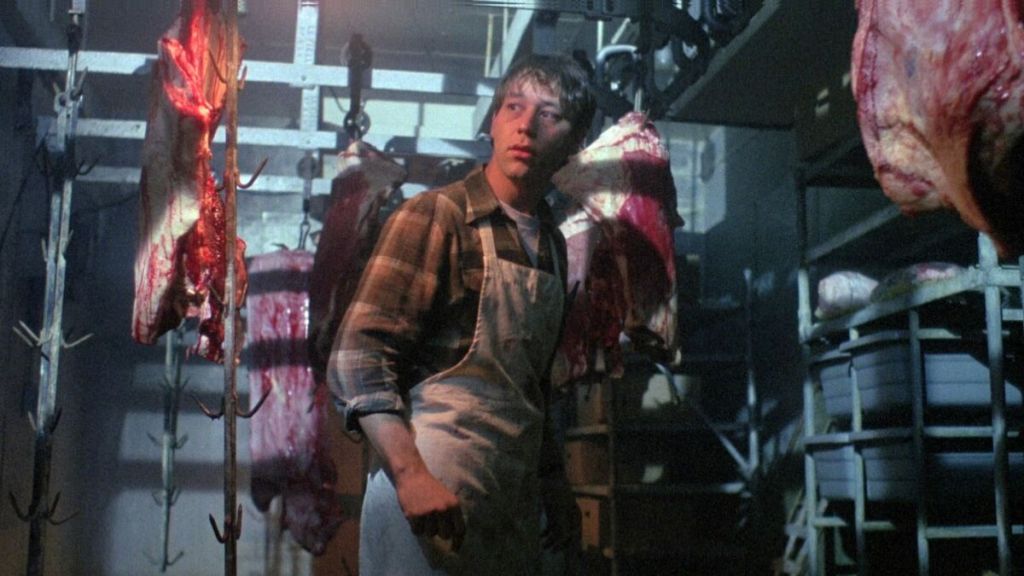
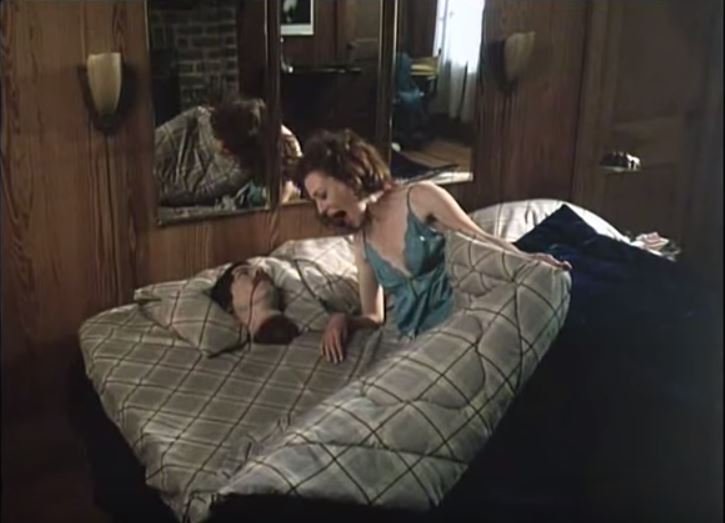
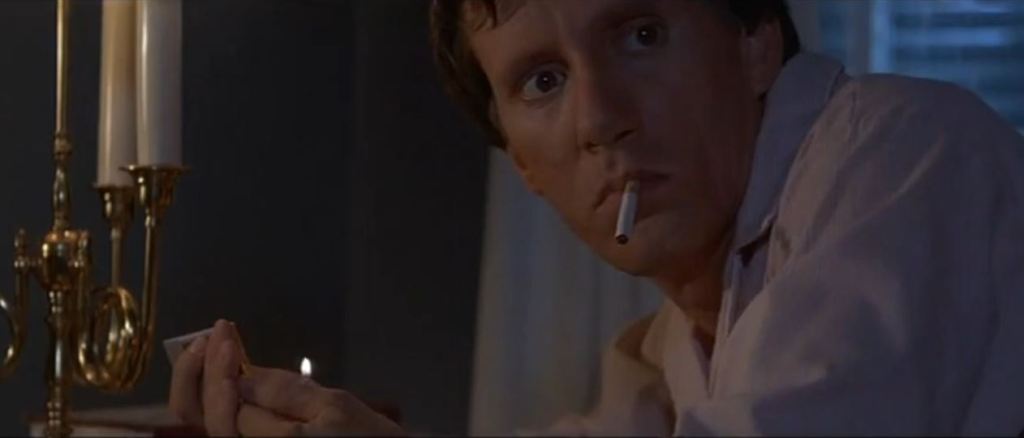
What do you think of when you hear the word “intruder?” Do you think about a homicidal bum breaking into your house? A grotesque alien borrowing human heads so he can pass as one of us? A clueless house guest who just won’t leave? Intruder is none of those things. It’s about a maniac killing the night crew at a grocery store. Okay, sure. I guess the title kind of works until you find out the deranged killer isn’t someone who wanders into the store after hours, but a guy who’s always been there.

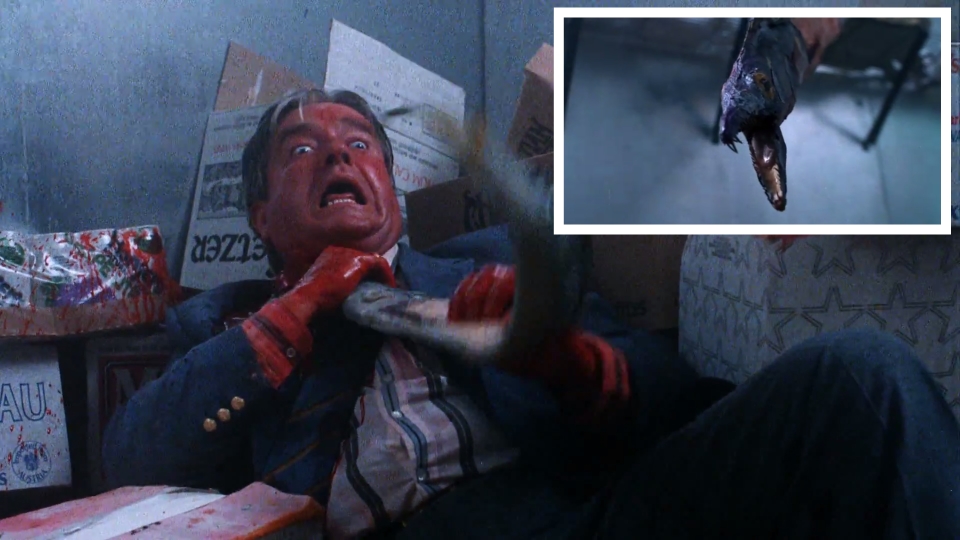
That’s not a spoiler because you won’t be surprised anyway. When a horror film takes this much care to foreshadow its trash compactor, its meat hooks, its ticket spike, and literally everything else that can kill someone in a grocery store, there simply isn’t time for surprises. The only thing that surprises me is I’ve heard splatter fans talk about Intruder as if it’s some kind of forgotten masterpiece. Maybe that’s why I’m disappointed.

The poster art for Intruder prominently features the names of Bruce Campbell and Sam Raimi as if they’re the stars of the picture. They’re certainly the biggest stars in it, but they play very minor roles. Campbell shows up about three minutes before the credits roll while Raimi spends most of his time hanging lifelessly from a meat hook. Dan Hicks, who played the hillbilly in Evil Dead 2, offers the best performance in Intruder, but even he can’t save it.

Whenever the camera ends up in a shopping basket or hovers over the actors at extreme angles, it’s obvious director Scott Spiegel learned how to direct from his pal, Sam Raimi. While there are some good gags and a few good special effects by KNB EFX Group, Intruder is just mediocre at the end of the day. It’s a shame because I really thought I was going to like this one.

Come back at midnight Central Time for the next movie.

31 Days of Gore: Death Spa (1990)

It’s October. Time to talk horror. This year I’m reviewing a different horror movie each day of the month.

It’s the late 80s/early 90s and strange things are happening at Starbody Health Spa, an inexplicably futuristic club run entirely by computers and card readers. Within minutes of its opening, Death Spa boils Laura Danvers (the unusually gorgeous Brenda Bakke) alive in a steam room. At least I thought she was being boiled, but later its revealed someone dumped a toxic dose of chemicals into the steam. The incident leaves her blind at the brink of death.

Laura is the girlfriend of Micheal (William Bumiller), the club’s owner who’s still recovering from the trauma of his wife’s suicide. See, one day his wife rolled her wheelchair into the garden and self-immolated. I’m sure the film explained why at some point, but I never paid that much attention to it. The filmmakers initially want you to believe Micheal’s wife is haunting the gym, but then they try to convince you the high-tech computers and a cross-dressing hacker are to blame. When they can’t decide what kind of movie they want Death Spa to be—supernatural or technological—they decide it’ll be both. And it’s just weird enough that it works.

I watched this scene twice and I still have no clue what happened to that dude’s head

In yesterday’s review, I said City of the Living Dead wasn’t incoherent enough for MST3K-style mockery. Get your drinking buddies together because Death Spa is a riot. Unlike Evilspeak and Shrunken Heads, I’m not entirely convinced all the cast were in on the joke. Ken Foree is obviously aware this ain’t Shakespeare. Rosalind Cash, playing one of the two investigators, understands the assignment as well. There are others who clearly know what kind of film they’re making, but I can’t say the same about all of the cast… or the director, for that matter.

The gore is so incompetently filmed, you often can’t tell what’s going on. At one point the villain merely touches a victim’s face and you hear what sounds like someone biting into an apple. The next time you see the victim, his face looks like a ball of freshly squeezed Silly Putty. In another scene, a client straps his arms into a fly machine. When the machine inevitably attempts to kill him, you expect it to rip his arms right out of their sockets. Instead, a Capri Sun-sized amount of blood spills out of his left flank.

The editing, too, is nonsensical. When Michael’s girlfriend Laura finds herself trapped in the aforementioned steam room, she’s falls toward the floor in such a manner the back of her neck will hit first. At the exact moment of impact, however, they jump-cut to her lying on the floor, her legs where her head should be according to the previous shot. In other scenes, the editor cuts to reaction shots of the actors not reacting whatsoever, which adds to the campy incompetence.

As usual, it’s another film which rewards the viewers for sitting through the boring parts by tossing them the occasional bone or severed limb. If ever you needed a reason to set a movie in a health club, it’s this: there are very attractive people in this movie, including Chelsea Field, in skimpy workout gear. Why they chose a leading man who could have appeared in Quest for Fire without the need for makeup, I’ll never know.

At only 88 minutes long, it’s brief enough not to outstay its welcome and you don’t have to wait long for the payoff. Any horror film which stocks its cast with a paranormal investigator who carries a Luger is essential viewing as far as I’m concerned.

Come back at midnight Central Time for the next movie.

31 Days of Gore: City of the Living Dead (1980)

It’s October. Time to talk horror. This year I’m reviewing a different horror movie each day of the month.

I’m a huge fan of Fulci, probably more than Argento. While Lucio Fulci’s quality perhaps dipped towards the end of his career, it didn’t dip nearly as much as Dario Argento’s did (I dare you to sit through Dracula 3D). Nonetheless, Argento was the first to win favor with international film critics. Fulci, on the other hand, has been more or less relegated to the margins of “serious” analysis.

City of the Living Dead, a.k.a. The Gates of Hell, (not to be confused with Umberto Lenzi’s City of the Walking Dead, which will be featured later this month) opens on a priest who’s taking a stroll through an idyllic cemetery. Seconds after the opening credits, he tosses a noose over a branch and hangs himself. Cut to a woman screaming in a candlelit room: she saw the entire thing play out during a seance. The image is so disturbing she has a heart attack and dies. There’s more than one fear-induced heart attack in this movie, by the way.

A news reporter (Christopher George), is investigating the psychic’s mysterious death (slow news day, I suppose). He visits her grave and hears her screaming to get out. It turns out she’s not dead after all, but what’s even more disturbing is wondering how she survived the embalming process. Trying to make sense of Italian horror is the wrong way to watch Italian horror. The films, especially in Fulci’s case, are designed more like dreams than coherent narratives; the plot details aren’t important.

So the reporter does what absolutely no one else would do: he grabs a pickax and begins hacking at the coffin lid indiscriminately, the flimsy surface of which is mere inches from the woman’s face. These characters are completely incompetent, but again: that’s okay. It’s about the mood, the atmosphere, and the style. It’s about bending your suspension of disbelief so that Fulci can squeeze in as many common fears as possible (such as being buried alive) so that the audience gets the best bang for the buck. If that’s not a noble cause, I don’t know what is.

The reporter learns from the woman that the priest’s suicide has opened the gates of hell (just go with it) and if his body isn’t laid to rest, his zombie-creating superpowers (I said just go with it, damn it!) will destroy the world. Did I forget to mention City of the Living Dead is a zombie picture and a ghost story? In fact, it’s Fulci’s first horror film since Zombie (a.k.a Zombi 2). That film famously portrayed a zombie fighting a shark, a scene I still have no idea how they pulled off. While there’s nothing as cool as that here, I may prefer this one as it’s the second best film in Fulci’s Gates of Hell trilogy.

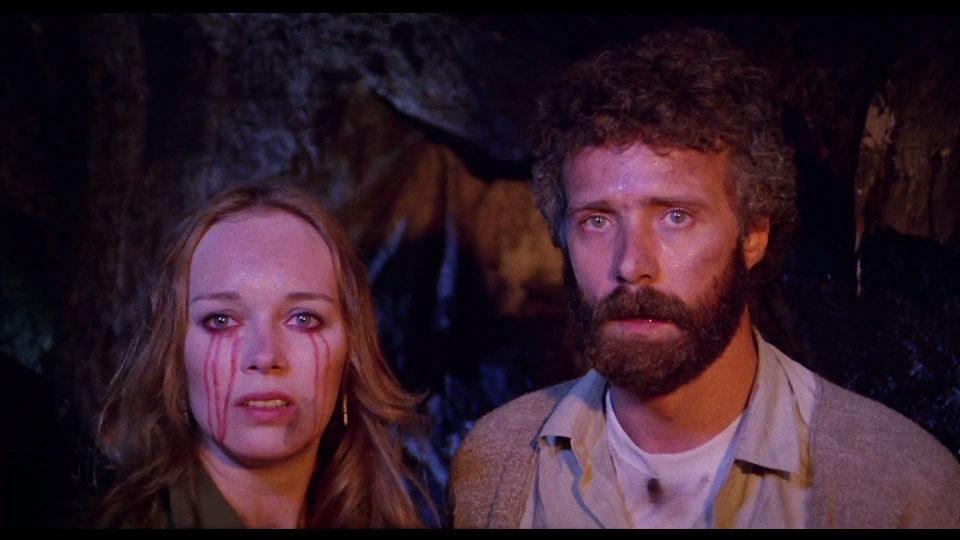
Fulci crafts a genuinely spooky atmosphere while the lingering shots of terrified faces are rarely done better by anyone else. The film is not coherent enough for the casual moviegoer, but it’s not nonsensical enough to laugh at in a MST3K way, either. It’s a haunting picture with expert cinematography and a gorgeous color palette. Definitely one of Fulci’s best and most entertaining.

At one point, Fulci attempts to top the eye-gouging scene in Zombie. In this film, a spinning drill bit is shoved through a man’s skull. It’s essentially the ol’ arrow-through-the-head gag, but the special effects team somehow makes the tip of the bit spin on the other side of the victim’s head. It’s a really neat take on an old effect. I love stuff like that.

Come back at midnight Central Time for the next movie.

31 Days of Gore: Evilspeak (1981)

It’s October. Time to talk horror. This year I’m reviewing a different horror movie each day of the month.

When you hear Evilspeak was not only one of the UK’s Video Nasties, but the studio had to cut seven minutes of footage to get an R-rating in the states, you expect bucket-loads of blood. Unfortunately, these facts speak less about how much gore you’re going to get and more about how absurdly silly things were in the era of Thatcher and Reagan. Violence-wise, Evilspeak is surprisingly tame for a horror movie in which the Carrie-like protagonist uses Satanic rituals and an Apple IIe computer to summon demonic revenge.

I’m not saying you shouldn’t pay the twenty bucks for Scream Factory’s awesome Blu-Ray edition, I’m just saying it’s not the film gore gurus probably expect. Yeah, there are some really great practical effects in there, but the promotional material makes you believe you’re in for something more splatter-heavy like the original Evil Dead. You’re not.

Richard Moll (yes, the bald guy from Night Court) plays Father Estaban, the long-dead leader of a cult of Satan worshipers. In the opening scene we see him disrobe an attractive woman before chopping her head off with a sacrificial sword. The effect looks suspiciously crunchy, like—I don’t know—maybe a department store mannequin filled with red food coloring and corn syrup. I’m pretty sure people’s necks don’t shatter like plaster when struck with a sharp blade. And believe me: I’m really not knocking the effect. It actually looks cool in the sense you’ve never seen anything like it before.

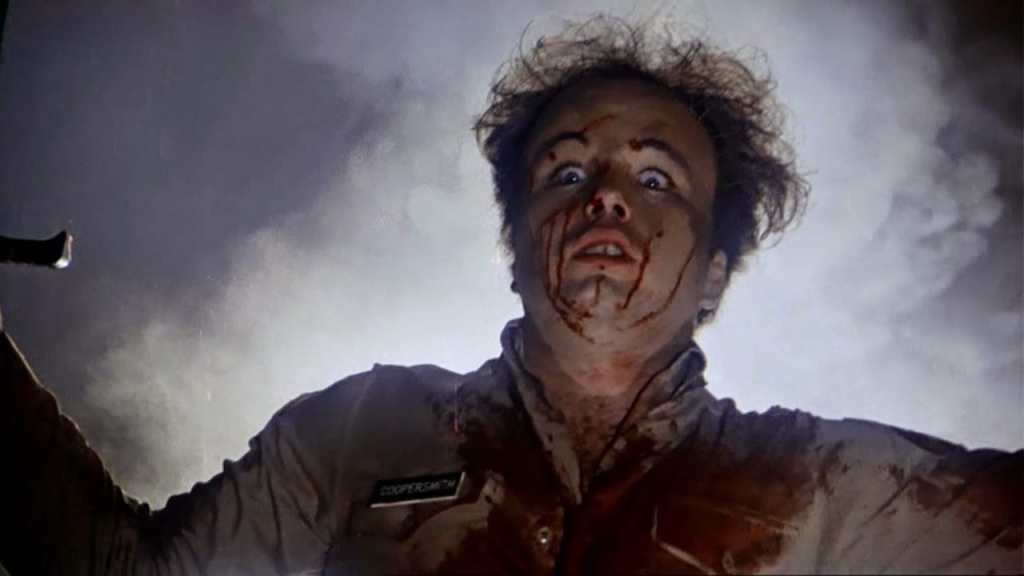
Fast-forward a few hundred years later to a modern military academy. The orthodox church on the grounds was inexplicably built on top of Father Estaban’s Satanic church. This isn’t rediscovered until Stanley Coopersmith (the insanely awesome and awesomely insane Clint Howard) finds a hole in the cellar’s brick wall. I’m surprised to learn middle age Europeans were practicing Satanism in what would later become the United States. Hell, the fact that Estaban’s church still exists at all raises more questions than answers, but I’m willing to go with it. Why? Because this movie is awesome, that’s why.

Coopersmith, who’s referred to as “Cooperdick” by his classmates, is the quintessential outcast. The first time we see him he gets his ass smeared across the soccer field. The next time we see him, a prank makes him late for class. His tardiness, of course, leads to the administration bullying him, too. Coopersmith’s only refuge is the computer lab and the secret church beneath the church. This is pretty much all the movie has to offer for the next seventy minutes or so, but it feels less like padding and more like a satisfying slow burn.

When a secretary steals one of Coopersmith’s books, I legitimately felt bad for him. When the other kids destroy Coopersmith’s catapult, I felt bad for him. And when they discover the dog he’s been hiding in the secret church, I really felt bad for him. Thing is, the movie doesn’t fail at anything it tries to do, it just sustains the same note for a little too long. That is until the glorious ending.

The climax isn’t just satisfying, it’s better than Carrie’s rampage. To see Clint Howard levitating around the church, terrorizing his bullies with a giant sword, is cheese of the finest sort. All Evilspeak promised to do was entertain me. Well, mission accomplished. I don’t know why nearly half the characters are in it, especially Haywood “What’s Happening!!” Nelson (who escapes the carnage as well as most of the movie), but man, that ending makes all the little flaws worth it.

The special features on the Blu-Ray are a little more than bare minimum. The retrospective offers some amusing anecdotes; it was fun to learn Clint Howard had to wear a hairpiece for this film. In an even better video on YouTube, Howard says the film was special to him because he lost his virginity during the production. It’s a film that’s special to me, too, and not only because it got one of my favorite character actors laid.

Come back at midnight Central Time for the next movie.

31 Days of Gore: Shrunken Heads (1994)

It’s October. Time to talk horror. This year I’m reviewing a different horror movie each day of the month.

I like Full Moon Productions. When I was a kid I loved that Dollman vs. Demonic Toys not only served as an all-encompassing sequel for two films, but for Bad Channels as well. When I saw the awesome, hand-painted advertisement for Puppet Master 3 in the back of a Fangoria, I went straight to the video shop and sought out the entire trilogy. I never really cared much for Subspecies, but I confess an unusual fondness for Tim Matheson’s Jack Deth of the Trancers franchise and the whip-cracking Musetta Vander in 1994’s Oblivion. What was really cool about Full Moon is they did crossover films two decades before mainstream Hollywood caught on.

As Shrunken Heads opens, a street gang makes life hell for a trio of young boys who just want to read their comic books in peace. The kids are murdered when they get caught stealing gambling slips from the gang’s hideout; without those slips, the gang won’t know who actually won their bets and who didn’t. In theory, the gang will have to pay everyone who gambled that week. (Because we all know kid-killing street gangs have a reputation for being honest.)

That’s when a voodoo priest (veteran character actor Julius Harris) goes to the funeral parlor with a hacksaw and decapitates the boys’ corpses. He shrinks the heads, revives them with magic, and spends a year training them how to fly and develop their superpowers so that they can get their revenge. The special effects during this sequence are surprisingly good.

It’s easy to see why Charles Band (the founder of Full Moon Productions) was so good at making straight-to-video films feel more expensive than they actually were: he was a master at calling in favors. The opening credits are scored by none other than Danny Elfman and it’s probably no coincidence the film’s directed by the composer’s unknown brother. “You wanna make a movie? Get your brother to do the theme and we can talk.”

Big Mama, the leader of the gang, is played by Meg Foster. Foster is among my favorite B-movie actresses. Unlike Zach Galligan, who once tried to distance himself from genre films, Foster fully embraced the nature of her career, playing everything from cyborg cops to the traditional love interest. You probably remember her as the female lead in They Live. Her unusually pale eyes are recognizable from space.

Which is why I was taken by surprise when I did not initially recognize her in Shrunken Heads. I initially thought she was a man and those oddly colored eyes are concealed by contact lenses. Her unusual look is only heightened by the strange creative decision to put her in drag. Something about her look in this film reminds me of the characters from a Fallout game.

Shrunken Heads is a feel-good movie for horror hounds. It’s light on the gore, but heavy on the charm. The unlikely relationship between the fifteen year old girl and one of the shrunken heads is initially creepy (Intentionally so… I think?), but against all odds, it’s endearing by the end. And speaking of the ending, it doesn’t disappoint.

So, do you want to see three children murdered in the streets, only to be resurrected as discombobulated heads? No? Then you don’t want to see this movie. But if the answer is yes, you’re gonna have a great time. Stick around for the post-credits scene.

Come back at midnight Central Time for the next movie.

The Martian: NASA’s answer to Top Gun

Andy Weir’s novel begins:

I’m pretty much fucked.
That’s my considered opinion.
Fucked.

Early on, the movie adaptation drops the F-bomb twice, which is the maximum allowed for a PG-13 film, given there’s not much violence or nudity. Through the use of clever cutaways, the filmmakers manage to preserve the unfiltered character nicely. And no, these workarounds are not nearly as insulting as sanitizing the word with a perfectly timed gunshot, à la Live Free and Die Hard.

I’m glad, too. Mark Whatley (Matt Damon) is an endearing character whose cursing is integral to his personality. He’s the only human on Mars, stranded by a mission which went tits up. His diet, consisting mostly of microwaved potatoes, is in constant peril. Worst of all, he just ran out of ketchup. That he only says (and types) “fuck” a handful of times is kind of amazing, really.

The thing that struck me most about The Martian are the landscapes. None of it is obvious CGI and none of it looks like rose-filtered Earth locations, either. The horizons and the sun look just about right. Having just seen the trailer for Ron Howard’s In the Heart of the Sea, whose liberal use of bad CGI verges on obscene, I couldn’t believe my eyes. The Martian has some of the most subtle special effects I’ve ever seen. Every minute is visually believable.

The film wastes no time setting up the comradery among the martian astronauts, whose mission is jeopardized by a freak storm. The commander (Jessica Chastain) makes the hard decision to return to Earth prematurely. Moments later, she has to make the even harder decision: leaving Whatley behind when he’s struck by a flying satellite dish. Everyone believes he’s dead because the component which relays his life signs to the ship has been impaled by shrapnel.

Cleverly, the film trades first person narration for the video diaries Whatley keeps to entertain himself, which involve ransacking his coworkers’ personal effects and making fun of the things he finds. He tells the GoPro cameras stationed around the habitat what he’s up to every step of the way. The first order of business is setting up a crop a of potatoes. Then he’ll have to “science the shit out of the situation” in order to send an SOS back home. In his first message, he says in a comically weak voice, “Surprise.”

Unfortunately, Murphy’s Law is in full effect on Mars. You always know something is about to go wrong, but you never know what or how. It’s the same kind of suspense which made Apollo 13 so tense even though we all knew the characters make it back home. Like that movie, The Martian doesn’t try too to make its audience teary-eyed. It’s primary mission is to entertain, which is exactly what elevates it above the endless supply of movie directors trying to mimic 2001: A Space Odyssey by infusing artificial mysticism into their space films (see: the incredibly insulting Mission to Mars and the merely okay Red Planet).

The Martian has everything I wanted from Gravity and Interstellar. This is real science fiction and not the Hollywood bastardization of the genre. Sure, a few of the things that happen are unlikely (Weir said he wishes he had chosen a different disaster to kick off the story as a storm of that nature is unlikely on the red planet), but there are plenty of scenes which contain more science than all the previous martian movies combined.

This is all to say The Marian is easily the best science fiction movie of the 21st century. It’s no wonder why the NASA program is promoting it like their version of Top Gun, which was a boon to the Navy’s recruitment efforts. The PG-13 rating is wise because there will be countless children pursuing careers in science and aeronautics after seeing it. We need more movies like it—exactly like it. In fact, Hollywood should just go ahead and commit to adapting every novel Andrew Weir ever publishes from here on out.

31 Days of Gore: The Slayer (1982)

It’s October. Time to talk horror. This year I’m reviewing a different horror movie each day of the month.

The Slayer opens with a series of disjointed images involving a redheaded woman who’s being attacked by… something. Whatever it is, we can tell it’s pretty gnarly and the film (at least the uncut version) isn’t going to shy away from the good stuff. The only problem? Scenes containing the good stuff are few and far between.

It turns out that scene was just a dream, which immediately reminds us of A Nightmare on Elm Street, an observation which will beg even more comparisons by the time you get to the cheat of an ending. Just don’t call it a ripoff because Wes Craven’s franchise was still two years away, believe it or not. I wish I could say The Slayer is ahead of its time in that regard, but that would be more praise than it deserves.

The entire premise: four people take a vacation on an island, but they’re not alone. We’re not talking a human slasher, but someone (or something) supernatural like Freddy Krueger. Even so, this killer is not above using low-tech methods such as bashing a victim’s head in with an oar. Like most movies of its kind, it’s painfully slow to get started, but early on there’s a delicious slice of cheese: upon arriving via chartered plane, one character gazes out the window at the island and remarks, “It’s surrounded by water.” And if there’s anything the filmmakers want to make abundantly clear, it’s this: “There’s no phone service on the island!”

Following a disappointingly tame sex scene, the redhead’s lover wanders into a dark, creepy basement alone. (I’m expecting to see a lot of creepy basements and cellars this month so let’s call it a trope rather than a cliché.) When you only have a handful of characters to kill in your scrappy little horror movie, you’ve got to concoct ways of splitting them up and killing them one by one so you don’t blow your load too soon. Rinse and repeat until you’re left with a final girl and we can all go home.

While The Slayer is little more than a standard horror movie of its time, it’s a fairly solid one and worth a watch. It’s suffering from many of the same problems films of this type almost always have, chief among them its plodding pace. But maybe it subconsciously planted the seed in Wes Craven’s head which would later become A Nightmare on Elm Street… but probably not.

Come back at midnight Central Time for the next movie.

31 Days of Gore: The Hatchet series

It’s October. Time to talk horror. This year I’m reviewing a different horror movie each day of the month. Today I’m reviewing three for the price of one... who loves ya, baby?

Hatchet (2006)

Harry Knowles proclaimed the killer in Hatchet would be “the next icon of horror.” It’s safe to say Harry jumped the gun just a little. Perhaps Victor Crowley is more memorable than the average villain, but he certainly doesn’t hold a candle to Freddy or Jason. Nonetheless, Hatchet is better than some of the Freddy and Jason sequels.

Hatchet opens with Robert Englund (Freddy Krueger) playing a hillbilly who’s hunting gators in a New Orleans swamp. Instead of letting Englund and Kane Hodder (Crowley) share screen time, Englund’s character is killed off screen, which is frustrating. Tony Todd (Candyman) makes a cameo later on and you can practically read his thoughts: “Why the hell am I in a talking scene? Couldn’t they at least give me somebody to kill?” 

That’s my biggest beef: there’s certainly cool stuff in Hatchet, but most of the time it reaches for greatness and stumbles over its juvenile sensibilities. I’ll give it a pass for not putting Englund and Todd to better use—the filmmakers probably didn’t have the money to use the established actors for any more than a day of shooting. 

Here’s where the filmmakers don’t get a pass: the movie looks goddamn terrible. Even though it’s shot on film, the copy I watched looked more like Thankskilling than the grainy B-movies the director wishes to emulate. The woods and swamps are lit so brightly it’s hilarious when one of the characters suggests a flashlight. The opening scenes, set during Mardi Gras, look as technically competent as the cinematography on a Girls Gone Wild DVD.

And although I adore horror-comedies, the jokes in Hatchet are simply bad. The only type of humor I hate more than characters being inexplicably clumsy is forcing characters to say ridiculous things just for the sake of comedic relief. “Hey, it’s like that time you caught crabs!” “What’s 911’s area code in the south?” When one character tells another to blow her dad, the response is, “I will as soon as you’re finished!” Ooo, burn.

This really hurts because there are decent comedians involved. Joel Murray (a godsend in God Bless America) and Richard Riehle (the guy who invented the “Jump To Conclusions” mat in Office Space) have bigger roles than you would expect in a slasher flick, but instead of elevating the material, they’re bogged down in the mire of forced jokes. Outside of the over-the-top kills, I laughed maybe once. The scene responsible involved a close-up of a very attractive woman scratching her crotch in a very unladylike manner.

On the other hand, the sound effects are great and the splatter is pitch perfect. I’m only disappointed there’s so little of it. We get a decent kill right out of the gate, but the movie drags on and on until the next one. In case you’re the type to fast forward through the boring parts, I checked: the movie doesn’t pick up again until the 49-minute mark. But man, I’ve never seen a belt sander used like that before.

It’s worth noting I was frequently reminded of the movie that more or less built Miramax: The Burning. Like that film (and some spoilers for both movies follow), I eventually felt sorry for the bad guy. Hatchet’s origin story also involves an accident with fire; the directors of both films concoct far-fetched ways of setting their antagonists ablaze in the climax. I’m mostly desensitized to this kind of stuff, but setting a burn victim on fire just seems needlessly cruel.

So yeah, Hatchet is a must-see for gore aficionados. Everyone else should skip it. Spoilers below.

Hatchet 2 (2010)

I love it when a sequel picks up exactly where the original left off. Like Back to the Future 2 and Waxwork 2, Hatchet 2 not only provides a seamless continuance, it replaces its lead female with a different actress entirely. This time Marybeth is played by Danielle Harris (The Last Boy Scout, Halloween 4). Harris is not the best screamer in the world, but she exudes all the other qualities we expect from a final girl, which is rare these days.

When we last saw Marybeth, she’d been caught in the killer’s grip, presumably doomed. Within seconds of Hatchet 2’s opening, she gouges one of his eyes out, affording her a chance to swim away. One pathetic jump-scare later, she’s rescued by the piss-drinker from the first film. Already the film looks better than the original and although the lame jokes are still present, there aren’t as many of them. There are some okay jokes, too. I’m guessing the director stopped smoking so much pot before he made this one.

The piss-drinker tells Marybeth not to call the cops (because that’s certainly logical) and sends her on her way to Reverend Zombie (Tony Todd) who also tells her not to call the cops (convenient). Instead, he assembles a ragtag crew of hunters in a scene which involves a Lloyd Kaufman cameo and expands on Crowley’s origin story. Although this sequel takes even longer getting to the good stuff, it’s not as boring and the payoff is sweet.

So when asked why he wants to bring so many hunters along, Tony Todd’s character replies, “Safety in numbers.” And yet, within minutes of arriving at the swamp, Todd tells everyone to split up. Yeah, it’s one of those movies, but the obligatory sex scene which results from this bad decision had me dying with laughter. It’s like something out of Eli Roth’s fake Thanksgiving trailer and, uh, the sound effects are… well, brilliant. This sex scene also provides one of the few dialogue jokes that work in the entire movie.

To say Hatchet 2 is an improvement is like saying a cold is better to get than the flu. It’s easily twice as capable as its predecessor. That says more about how disappointing the first one was, but any old school horror junkie should see it. Todd and Harris, by the way, have strong chemistry and screen presence.

Spoilers for Hatchet 3 follow…

Hatchet 3 (2013)

I wish I could say Hatchet 3 is three times as good as the first, but I’m not a liar. It’s not as good as the previous entry, but I can’t say I would have been disappointed had I gone to a theater to see it. Gone are the really lame jokes (for the most part) and we finally see cops enter the mix, which means they had a bigger budget. Although cops were strangely absent from the first two features, this time there are way too many of them to retain the 80s throwback vibe. 

Again, the filmmakers pick up exactly where they left off. Shell-shocked from the events of the last two films, Marybeth scalps Crowley’s dead body and wanders, in a daze, into the local police station. After a firehose-shower scene which bares surprisingly little skin, she’s thrown into a cell where she tells the sheriff (Gremlins star Zach Galligan) her story and where to find the twenty or thirty bodies from the previous films. 

Although Hatchet 2 was enhanced by the fact it had a kick-ass heroine, this one seems determined to keep its most interesting character locked up. Spoiler: her handcuffs don’t even come off until the end of the film. Better than being sidelined entirely, but still.

I expected to see Galligan and Harris share more screen time. I was disappointed they go their separate ways early on, thereon appearing to be in entirely different films. The stuff with Galligan is what horror fans wanted to see. The stuff with Harris is meandering bullshit with too much yapping. Why is it that so many genre films pretend they don’t want to be taken seriously, then go and throw in ungodly amounts of by-the-numbers exposition into them? When will these movies finally realize they don’t need to be “normal?” There’s just so much padding here—stuff we’ve seen in a hundred times.

As for Galligan’s half of the film, there are a lot more kills and a lot less nudity (practically none at all), but the saddest adjustment to the formula is it just doesn’t pack the punch that part 2 did. I was legitimately excited when I saw Tony Todd’s character go mano a mano with Crowley, but there’s nothing as exciting in this one. Sure, I loved what Crowley did with a defibrillator, but if the filmmakers really think a belt sander can produce that many sparks, they need their heads examined. (Although I admit: the sparks looked pretty damn cool). 

Hatchet 3 is a prime example of quantity over quality. The gore gags, as always, are top notch, but Crowley is growing fatigued. He’s less likely to take his time. More likely to just rip off your head.

Zach Galligan is probably the reason Waxwork 3 was never made. He said, at the time, he didn’t want to get typecast in horror movies. Now that he’s taking every single horror movie they toss his way, I really wish he had made that movie instead of this one. Rather, I wish he had made that and this because I like to see the guy in anything.

Hatchet 3 is not a terrible movie for gore junkies. I’d be mildly interested in a fourth entry, but let’s face it, it’s probably only downhill from here.

Come back at midnight Central Time for the next movie.

31 Days of Gore is (nearly) here! Meet the Gore Meter!

For the entire month of October, I’m putting political correctness and good taste where it belongs: in the garbage can. Decent people get eleven mind-numbing months out of the year and, considering this “trunk-or-treat” nonsense creeping into America, I’m worried about the sanctity of the ghoulish holiday.

So this month’s film marathon, in which I feature a different horror movie everyday, is a tribute to all the great things horror films have to offer: hilariously wooden acting, red-dyed Karo syrup, demons, monsters, decapitations, castrations, and tons of gratuitous nudity. Oh my.

The Gore Meter

Each film will be assigned 1-4 on the “gore meter,” which is no indication of the quality of the movie itself. The rating is less affected by the amount of gore in the film than other factors. It’s based more on the satisfaction, the quality, and the pacing of the gore effects. Like anything else, it’s highly subjective, but for easy benchmarks, let’s compare some of my favorite horror films of all time:

Rosemary’s Baby (1968)
It’s Alive (1974)
Halloween (1978)
Dawn of the Dead (1978)

That just about brings you up to speed. It starts at midnight, Central Time. See ya there, boils and ghouls.

Quitters, Inc.

I smoked my last cigarette nearly ten days ago. Supposedly, I’ve regained the sense of smell I would have had if I never started smoking. I fucking believe it. Being able to smell like a normal human is already terrible.

I keep catching whiffs of things I wouldn’t have noticed before I quit. Napoleon (our chihuahua) suddenly smells like old sweat and dirt. I can sporadically detect the scent of beer even though I haven’t had any drinks in the house in weeks. Suddenly I hate the smell of laundry detergent, so much so I’m having trouble sleeping on pillows which are now obnoxiously fragrant.

Last time I tried quitting I couldn’t focus on anything and cried for the first time in my adult life. This time, my symptoms of withdrawal aren’t bad enough to distract me from going about my day. Even so, I don’t feel like updating this blog right now (I’d rather punch it in its goddamned face to be perfectly honest), but I’m still doing 31 Days of Gore, an October-long film marathon in which I review 31 horror movies in a row. (More on that soon.)

I’m worried my blog posts might seem a bit more angry in the future. If that’s the case, just remember that’s probably the nicotine junkie talking, not me. Probably.

In other news, I was browsing OOP (eBay lingo for “out-of-print”) movies the other day and stumbled upon a VHS copy of Sonny Boy, an early 90s exploitation film which features David Carradine in drag. I remembered reading about it in a Fangoria about a million years ago and was tickled to death to rediscover it. I’ve always wanted to see it (at least during the period of time in which I remembered it) and, thankfully, I won the auction.

$8 to see a forgotten masterpiece like this? Hell yeah.

10/3/2016 Update: Sonny Boy is now available on Blu-Ray from Shout Factory and I’m still an ex-smoker. No noticeable weight gain and my tolerance for spicy foods as well as my newfound love for dark chocolate have gone through the roof.