Split (2017) [Midnight Movie]

Three teenagers are kidnapped by a man with split personalities. That’s it. That’s all you need to know. Either you want to see that or you don’t.

It turns out I didn’t. I feel like I might enjoy Split more if I ever see it again, a few years down the road, but right now I just don’t take to PG-13 horror movies, even ones as technically impressive as this. Sure, I can think of a few exceptions, but horror shouldn’t be this safe and wholesome. (Don’t get me wrong… there’s definitely a subplot that’s going to disturb a lot of people.) 

It’s a shame, too, because I really thought M. Night Shyamalan might be gravitating to the dark side after pulling off that disgusting stunt in The Visit. (If you’ve seen it, you know exactly which scene I’m talking about. If you haven’t seen it, watch it while you’re waiting for a delivery or when you’re folding the laundry or something… it’s okay at best.)

Horror should be like getting into a car with a stranger who turns out to be a madman. Yet Shyamalan is proving to be more like that goofy uncle who pulls the “uh-oh, the headlights went out!” gag on a dark but relatively safe stretch of country road. There’s a madman in Split, who’s exactly like the madmen in countless horror movies, only this madman’s portrayed by a capable actor who really doesn’t go as far overboard as a B-movie star would.
Give me a Shatner or a Jeffrey Combs. Give me a Joe Spinell or a John Lithgow. When I pay to see madmen, I want them to bounce off the fuckin’ walls. And don’t tell me, “But this is realistic!” We departed reality way back when that second trailer dropped. (That trailer, by the way, was the sole reason I decided against seeing Split in theaters.)
When I take issue with the rating, my problem isn’t that the movie’s not filled with wall-to-wall violence and profanity. My problem is that the rating assures us everything’s going to be okay. We’ll see some disturbing stuff for sure, but we won’t lose any sleep over it. 
Technically speaking, it’s a good movie, but it just didn’t work for me. Half the time I couldn’t believe it was made by the same guy who made Unbreakable, one of my favorite movies of the 2000s. The rest of the time, I realized I’d rather be watching Green Room again, which was a lot less predictable and anything but comforting. 
Guillermo del Toro on Fulci’s Zombie

I haven’t seen Zombie in years, yet the “shark versus zombie” scene is still one of the most memorable things I’ve ever seen on film. I always thought del Toro was a cool guy, but this video just made him seem a helluva lot cooler. I have the movie on Anchor Bay’s widescreen VHS (I think it was one of the last new tapes I bought), but this is one I’d love to get on Blu-Ray.

So I think Split is available to rent now. I’m probably going to post my thoughts on it this Friday.

* * *

The Black Pyramid pinball machine is mostly operational and it has been since Saturday morning. I bought a ton of stuff for it, but only needed around four dollars of resistors and diodes to get it playable. I did some flipper work and changed out the playfield rubbers, but haven’t gotten around to replacing bulbs yet. The rest is routine maintenance (I already did these ground modifications on the solenoid driver board) while keeping an eye out for leads on replacement pieces. Hopefully I’ll be getting back to my Pac-Man restoration soon, but I really hate painting and woodwork, which makes the pinball project a pretty satisfactory change of pace.

Last weekend my friend and I did around four hours of driving to get to Oklahoma City and back. The arcade there was a lot more impressive than I expected. I finally got to play a real-life version of Whoa Nellie, which I knew I would like, but it’s somehow one of my favorite pins ever. The biggest surprise was Jersey Jack’s Wizard of Oz. I had absolutely no desire to play it, but it turns out the game’s a blast (Stern’s AC/DC was like that for me, too). I was initially turned off by the theme. Not that I have a problem with Wizard of Oz, but I didn’t expect it to lend itself so well to pinball. 

Silent Rage (1982) [Midnight Movie]

Since I featured two new movies in a row, I’m happy to get back to older movies this week. Forgive any typos because I almost forgot to do the Midnight Movie this week. (I’m preparing to go on a trip to Cactus Jack’s tomorrow and I’ve been repairing my first pinball game ever since I got off work today.)

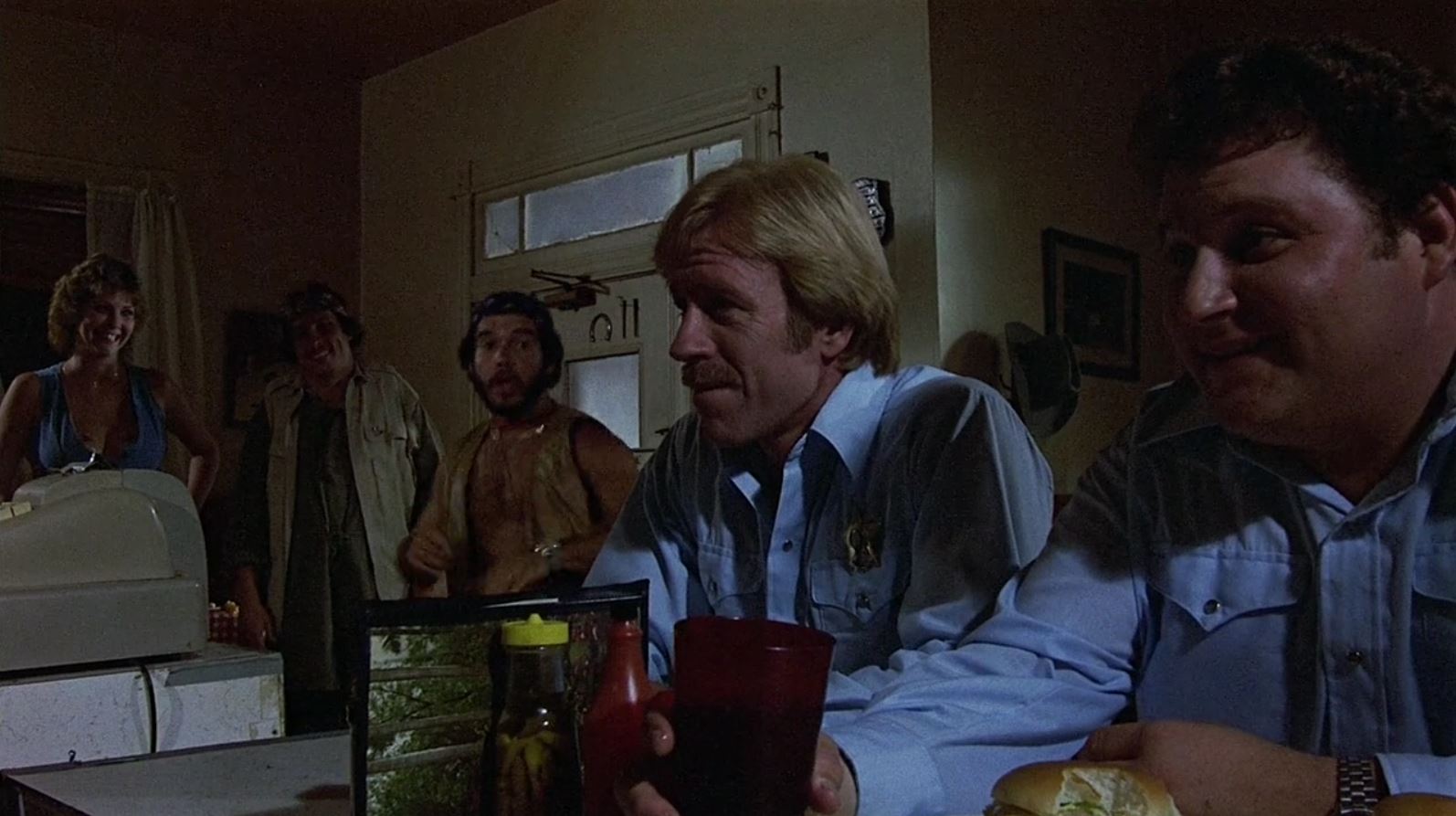
As far as I know, Silent Rage is the only 80s slasher movie which stars Chuck Norris. It’s not a great slasher movie, but it’s a pretty good Chuck Norris movie. In a nutshell, a mad science experiment goes wrong, which makes a serial killer impervious to bullets. That’s right: guns can’t stop him, but you know what can? Chuck Norris’s fists.

The movie opens with an impressive long-take of the killer’s residence. The camera follows him from the moment he wakes up to the second he picks up an ax and murders his housemates. There’s some surprisingly complicated choreography going on here and it involves several performers, three of which are children who manage to hit their marks as well as the adults. In fact, the entire movie looks better than your typical slasher movie, though not as gory as a lot of the other stuff that came out around the same time.
After the murdering spree, Chuck Norris and his police partner Stephen Furst (yes, Flounder from Animal House) arrive on the scene. Flounder acts like a complete dope while Norris, brave as ever, knowingly enters the home of the crazed killer without so much as removing his pistol from its holster. When Norris fails to placate the man, the other police blast him to kingdom come. The serial killer is then taken to the hospital under the care of Ron Silver, who’s probably the best actor in the movie. There, mad scientists spout a bunch of technobabble, talk about revolutionizing medicine, and inject their experimental healing serum into the bad guy’s bloodstream.
You can see where this is going, yes? Like most slasher movies, there’s a kill or two in the beginning of the movie, but we don’t see the killer in action again until the movie’s halfway through. Unlike most slasher movies, it doesn’t bore the ever-lovin’ shit out of you in the meantime. This stuff isn’t high art—nor is it trying to be—and it’s about as cheesy as it can get. But you know what? At least it ain’t boring. Even when Flounder’s jokes fall spectacularly flat, you smile at how genuine it all is.
So it turns out Ron Silver’s sister (Toni Kalem) is Chuck’s old flame from six years prior. They rekindle their relationship (this is where the cheese comes into play) and decide to run off to Chuck’s cabin in the mountains. The killer has other plans: targeting Kalem’s family.
At first it’s hard to put your finger on what makes this admittedly dumb movie work, but then there’s a scene in which Flounder expresses doubts about his ability to handle stressful situations. Whereas the star of other tough guy movies would have treated him like an absolute baby, Chuck comforts the character, assuring him he’s gonna do just fine. You’d expect the “rookie gets killed immediately” cliche, but the movie doesn’t go there, either. 
Chuck isn’t a particularly great actor and his fight moves aren’t all that legendary. I can see why some people have trouble understanding the appeal. Sometimes even I have trouble understanding why I like his movies so much. Silent Rage is a good reminder. It’s just a fun little movie.

Logan (2017) [Midnight Movie]

I generally like MCU movies (more than X-Men movies, in fact), but the stylistic continuity is limiting to what the filmmakers can do. Each movie is different, to an extent, but directors aren’t allowed a whole lot of breathing room, which is a shame because the franchise attracts such big names. I want to see Kenneth Branagh make a Kenneth Branagh movie starring Thor, not a run-of-the-mill MCU movie. Meanwhile, Edgar Wright’s removal from Ant-Man still feels like we missed out on something great.

X-Men’s stylistic continuity, on the other hand, has been thoroughly torched, tossed out the window, and struck by a large truck. The varying tone has made the franchise a little spotty (to put it nicely), but it’s apparently given director James Mangold a whole lot of breathing room—the same kind of breathing room Christopher Nolan had when he rebooted the Batman franchise. 
This isn’t a Wolverine film. It’s a James Mangold film. And it’s probably my favorite mainstream comic book movie since Richard Donner’s Superman. I’ve merely liked X-Men movies up until now. Here’s the first one I loved.
It’s notable something this different got made with such a huge IP. It just doesn’t move like a carefully plotted action movie. It moves like a deliberate drama and feels like a classic western. Usually when I see these movies, I’m reminded of all the other comic book movies. This one reminded me of Clint Eastwood’s A Perfect World and Unforgiven.

The first time we see Logan, he’s sleeping off a hangover in the back of the limo he drives for a living. He’s awakened by the sound of thugs trying to steal his wheels. He tells them exactly what you’d expect Wolverine to say: “You don’t want to do this.” Yet you get the feeling Logan’s talking to himself this time. He’s old, he’s limping, and when the thugs shoot him, the wounds remain for the remainder of the movie. He’s also experiencing a bit of blade-extension dysfunction.
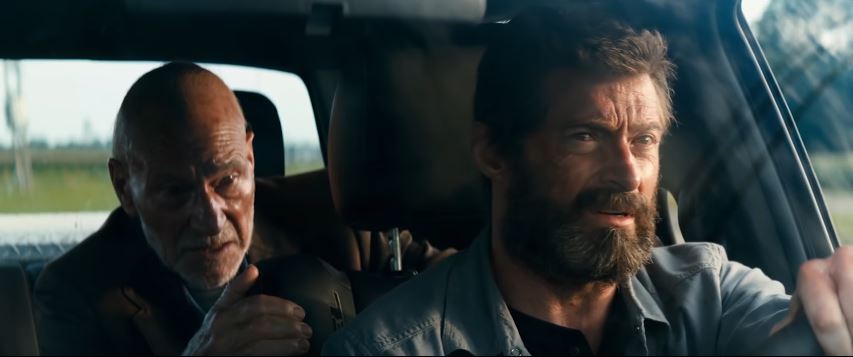
It turns out Logan’s healing factor gets weaker the older he gets and, as a result, he’s experiencing the effects of adamantium poisoning. (He’s something like two hundred years old at this point… it’s especially amusing to see the world famous hero require reading glasses.) Logan lives with Professor X and the mutant albino Caliban (Stephen Merchant, who’s great in the role) in the middle of nowhere. It’s likely they’re the last mutants alive. Charles is worse for the wear than Logan; the first time we see the professor he’s zooming about jerkily in his wheelchair, mumbling like a madman. Sometimes he has seizures, which puts everybody within a large radius at risk of death by telepathic shock.
And Charles cusses now… a lot. He’s gotten quite curmudgeonly in his old age, earning some of the best laughs in the movie. Patrick Stewart manages to play him with equal amounts of realism and dignity. 
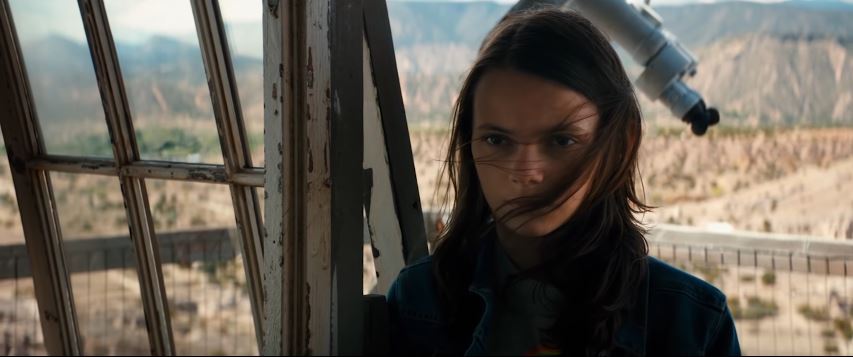
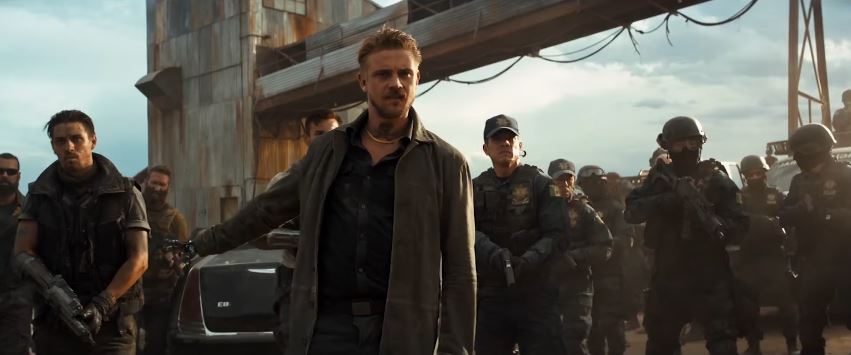
One day Logan is hired to drive a woman and her daughter across the country. It turns out the little girl is more than what she appears to be: she has mutant abilities which are suspiciously like Wolverine’s. Naturally, the secret lab responsible for her existence sends their highly militarized security team to get her back. The leader of the team is the film’s villain, Donald Pierce (Boyd Holbrook). Pierce doesn’t like “muties” and refers to his band of cyber-enhanced killers as “the good guys.” This is probably the best movie villain since Fury Road’s Immortan Joe.
There’s a bit of a surprise about midway through the movie. I’m amazed the trailers haven’t spoiled it. Lately, there have been a lot of surprises in movies like this, but when the surprises are, “Oh, look, another crossover cameo,” they kind of lose their effectiveness, don’t they? The surprise in Logan isn’t like that at all. It’s jarring, yes, but far from distracting.
What’s special about Logan is it sticks with you like a real fucking movie. I’m still piecing together some of the backstory and it occurred to me, a day later, that a lot of this stuff had deeper meaning than I initially thought. The balls-to-the-wall action at the end almost feels at odds with the rest of the movie, but maybe the movie earned it.
I saw the trailer for Justice League after watching Logan and I’ve gotta be honest: I pretty much couldn’t care less. I have a feeling a lot of superhero movies are going to feel old hat compared to this one. There are certain ways these movies comfort us, even when we’re sick of being comforted, so I’m not convinced this is the right time for the DCU to adopt a Saturday morning cartoon vibe. Meanwhile, Logan has more in common with The Road than its own franchise. And man, it feels so damn fresh.

America 3000 (1986) [Trailer]

I have an irresistible attraction to movies with four-digit numbers in the title. Love is the only thing worth nuking for! Great trailer, but I suspect it’s a shit movie. 
Come back this Friday, midnight CT to read my thoughts on Logan.

* * *
Monday I bought a pinball machine and a Blitz ’99 conversion in a TMNT cab. I fixed the monitor (Looks brand new with no burn-in whatsoever!), but I haven’t even touched the Blitz PCB or hard drive yet. The pinball machine is a little overwhelming, to be honest. I haven’t done much other than poking it with a multi-meter and checking fuses, but I have read about fifty-million pinball-related webpages in about two days.
As for my Pac-Man restoration project, the cab is sanded and primed, but a tube rejuvenator verified a heater-cathode short in the monitor. Looks like I’m doing my first tube-swap very soon, but I’m still exploring options.
As always, you can see pictures of my games on my Instagram

Ghost in the Shell (2017) [Midnight Movie]

I have a problem… call it cyberpunk addiction. Not only is cyberpunk my favorite setting for a story, it renders me completely incapable of being objective. What this means for me, the afflicted, is I somehow love Freejack, Johnny Mnemonic, Highlander 2, dozens of B-movies which played heavily on 1990s Cinemax, and at least a few questionable Billy Idol videos. I’ve got a fetish for anti-heroes, chrome, Japanese uber-corporations, questions about consciousness, and bio-electric peripherals which plug directly into the brain.

I want to turn on, jack in, and drop out. (Timothy Leary, by the way, was a pretty big fan of William Gibson’s Neuromancer.)

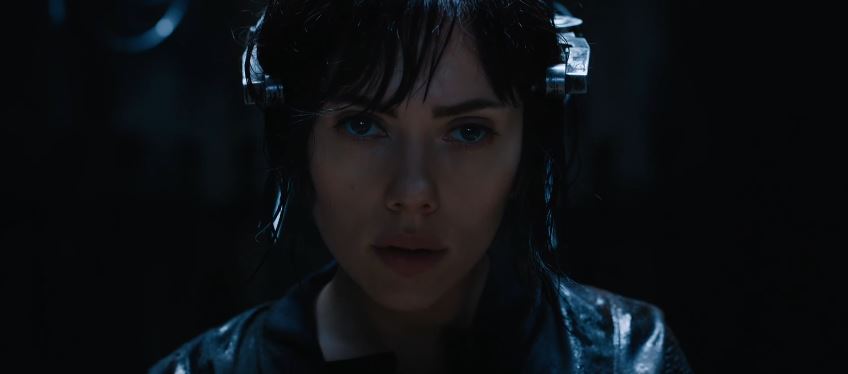
If that description reminds you of yourself, then stop reading this and go see Ghost in the Shell. Yeah, I know: remakes suck. Fortunately, this one feels more like an honest attempt at honoring the source material rather than a cheap cash-in (for what it’s worth, the original filmmakers seem to be giving this one their blessing). This ain’t Chips or Baywatch and, frankly, I want to see more cyberpunk in theaters (and more genre roles for Scarlett Johansson).

The original Ghost in the Shell is on my short list of favorite movies. The American remake, which initially sounded like a terrible idea (as all remakes do), looked surprisingly great judging from the abundance of promotional materials. For the record, I don’t mean it looked like a great movie; I mean it literally looked great, as in the trailer’s visuals were stunning. (I watched damn near every single one of the clips and trailers, and feel like they spoiled very little.)

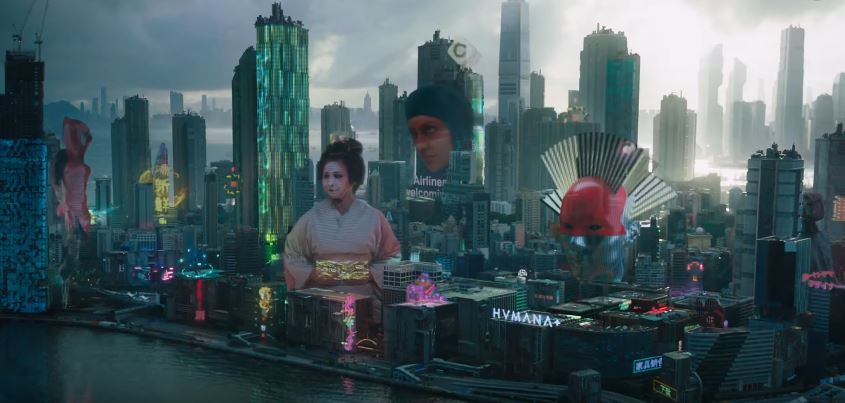
And the movie itself is stunning to look at, too. The futuristic cityscapes just don’t feel like they were made with CGI… the neon, the towers, the holographic signs—every bit of it looks convincing in the way the camera and the characters move through it all. There are details here you simply wouldn’t see in most of today’s visions of the future: perfectly placed graffiti, realistic weathering, storm drains, antennas, cables, etc. (How often do you see window-unit air conditioners in futuristic movies? Not very often, I reckon.) If I had to guess, most of this stuff was actually photographed in real life and manipulated in post, rather than built from scratch like a phony-looking Star Wars prequel.

On the other hand, there are some aspects which come off a little wonky. Some of the things the actors do, particularly later in the movie, look a lot more believable in animation than they do in live-action. Meanwhile, the borderline Matrix-y stuff seems a little at odds with the movie’s serious, anti-fantastical tone.

So if you’re new to the franchise, all you need to know is Scarlett Johansson plays The Major, a mostly cybernetic agent for Security Section 9, which is kind of like a futuristic SWAT team that does a lot of work in cyber-intelligence and espionage. (When I say she’s “mostly cybernetic,” I mean she’s essentially a human brain in a robot’s body.) She and her optically-enhanced partner, Batou, are trying to track down a terrorist who’s hacking into the brains of the scientists who created The Major.

Whereas the original film (“original” to the degree it was based on the 1989 manga of the same name) was fairly dense and often ambiguous, the American version is unsurprisingly simplified and streamlined, though not insultingly so. A lot of the original questions and motifs remain, but the characters tend to dwell on them in dialogue (they say “ghost” and “shell” an awful lot, which kind of feels like Will Smith’s “suicide squad” line even when it’s coming out of the mouths of Juliette Binoche and Beat Takeshi). Other than that, I really don’t have any complaints. I really enjoyed this movie, though I don’t think the scripted content was as compelling as the visuals.

I honestly can’t tell if the average moviegoer would like Ghost in the Shell. I don’t even know if I would like it if I weren’t such a fan of the genre, and I tend to like damn near anything. This is old school cyberpunk, not the sleek, action-oriented post-Matrix stuff. Which makes it a shame that you can sometimes see the studio’s fingerprints on it… they obviously pushed for something more commercial than the original, but I have a feeling that and the watered-down rating are going to work against it finding the viewers who would appreciate it the most. Otherwise, it’s the rare remake which compliments the original… if you’re not automatically insulted by its existence, that is.

Ghost Story (1981) [Midnight Movie]

In 1979 Peter Straub published Ghost Story, a novel heavily inspired by Stephen King’s Salem’s Lot, but a helluva lot better. It’s the kind of story which sinks its claws into you immediately. In the beginning, a man is driving across the country with a little girl. At night, when they go to sleep, he ties her up so she can’t escape… or hurt him. Ultimately, he believes he has to kill the little girl, but he fears he doesn’t have it in him.

The story is one of many told in the novel, in which a group of old timers call themselves The Chowder Society and sit around a fireplace, sipping brandy while telling each other spooky tales. The tales don’t have to be true, but they aren’t always made up, either. Their wives and acquaintances think they’re crazy old fools—they think they’re crazy old fools because they have no idea how they come up with this stuff. Yet they carry on regularly, almost obsessively, even when people in their small town begin to drop dead. The meetings always begin with a question: “What’s the worst thing you’ve ever done?” To which the designated storyteller always replies, “I won’t tell you that, but I’ll tell you the worst thing that ever happened to me….”

That’s such a great line, but I don’t remember hearing it anywhere in the movie. There’s a lot from the source material that’s abandoned, which isn’t unusual for an adaptation. What is unusual is the movie could have included a lot more of the original story if it didn’t become so fixated with its flashbacks. The flashbacks seem to take even longer in the movie than they did in the book. Meanwhile, I don’t think newcomers are going to truly understand what, exactly, The Chowder Society is all about—the movie almost portrays them as if they really are crazy old fools. Worse, most of the great stories Straub had his characters tell in the novel are boiled down into one, which is straight up lifted from Edgar Allen Poe.

In the movie version: David Wanderley, son of The Chowder Society’s Edward Wanderley, sees a ghost which scares him enough he falls through the window of his high-rise apartment. David’s twin brother, Don, returns to his hometown for the funeral, which is where he gets mixed in with his father’s old friends. He buys his way into the secretive group with a story of his own: the ghost who seduced and murdered his brother had previously seduced him with ill intent as well. The next few bits of the plot aren’t necessarily spoilers for the movie, but they are for the novel. I won’t tell you that, but I will tell you the worst thing that happened to me: I nodded off about midway through the movie. (To be fair, I was slightly hungover.)

You would expect (and probably want) a movie based on Ghost Story to fill its cast out with the likes of Vincent Price and Peter Cushing, but the filmmakers defy expectations and cast Fred Astaire, John Houseman, Douglas Fairbanks Jr., and Melvyn Douglas in the lead roles. Alice Krige is really the only person cast to type here, playing the seductive ghost who agonizes the film’s male characters, young and old alike. She manages to stand out, too, pretty much embodying the character I envisioned in the book.

Technically it’s a pretty good movie, but I think people who haven’t read the book are going to feel a little lost while those who have read it will feel slighted. I liked it, but didn’t love it. The problem with adaptations, especially the ones which change so much of the source material, is my memory blurs the details between the two. Years down the road, I’d much rather read the book again than watch the movie.