Midnight Movie: Law Enforcement Guide to Satanic Cults [VHS]

Senseless moral panics will never go away, but the 80s and early 90s did ’em best, as proven by today’s featured video. The introduction has the sweater-clad host inviting us to “pay attention and notice the reverse of everything that is normal becoming abnormal.” What does that even mean? Word salads like that sound suspiciously like the kind of nonsense you’d hear an actual cultist say.

It’s not long until the video brings in a fake expert who visits a neighborhood park. There he conveniently stumbles upon the remnants of a Satanic ritual. It’s immediately clear the only orgy that actually took place there was the orgy of evidence manufactured by the unscrupulous filmmakers. “Oh, look. There’s a pentacle right there, mere feet from where we set up our cameras. Let’s go have a look.”

As expected, the video manages to link Satanism to decorative candles, video games, modern music, homosexuality, pornography, and everything else “concerned parents” wanted to condemn at the time. Then there’s the excessively detailed list of signs that indicate your child may be the victim of a Satanic cult. This list is indistinguishable from a list of “signs your kid might be abused, period,” but the filmmakers seem convinced only Satanists are capable of such crimes.

While the Guide to Satanic Cults is chock-full of hilarious (but potentially dangerous) misinformation, the middle section drags. When the “expert’s” segment ends, I’d suggest fast-forwarding to the aforementioned “bikini girl” scene, which is obviously the repressed host’s excuse to touch a nearly naked model. I don’t know how she didn’t crack up laughing when he removed the fitted sheet from her body. And I imagine the editors had to use a pretty advanced noise gate to cover up all his heavy breathing.

Midnight Movie: Chuck Norris vs. Communism (2015)

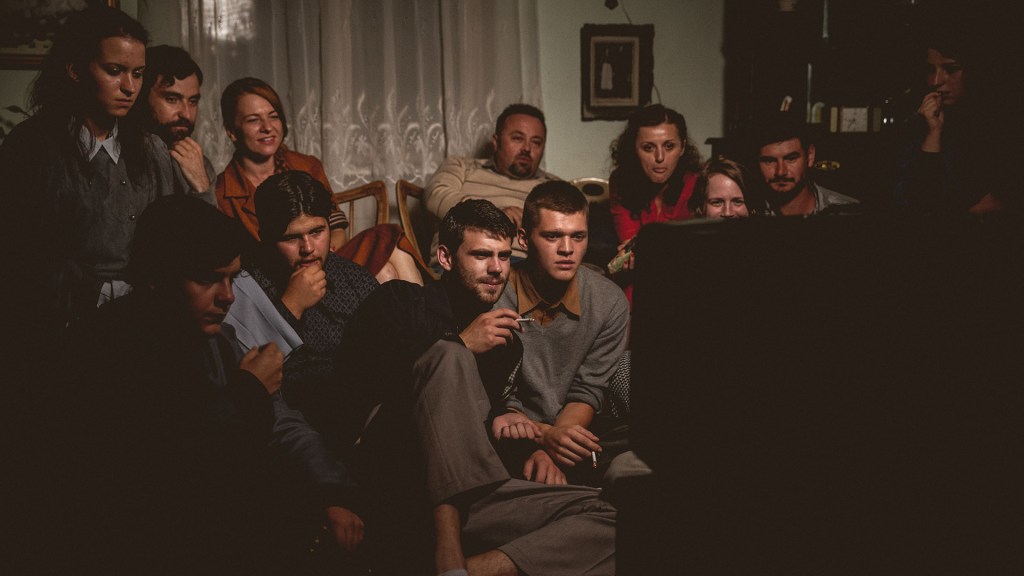
Following in the wake of American Grindhouse, Corman’s World, Machete Maidens Unleased!, and the highly watchable Electric Boogaloo: The Wild, Untold Story of Cannon Films, Chuck Norris vs. Communism represents yet another slice of history dealing with the cultural significance of B-movies. This time the focus is Irina Nistor, a translator who dubbed three thousand bootleg videotapes in spite of her country’s oppressive regime. According to one of the film’s subjects: “For regular people, video nights were the one thing that helped us survive.” Another bit of insight: “The films changed what you thought, what you were looking for, what you were interested in. You developed through films.”

Set toward the tail end of the Cold War, Nicolae Ceaușescu is the General Secretary of the Communist Party and shit generally sucks for common folk in Romania. Censorship is so extreme, Ceaușescu’s lackeys are going over every second of television programming with a magnifying glass. They delete anything which might even begin to suggest that life might be better elsewhere. 

Although VCRs can cost as much as a car there, people are buying them and showing western films to their friends and family despite frequent raids by the secret police. After the movies, the children go outside to make believe they’re Jean-Claude Van Damme, Sylvester Stallone, and Chuck Norris. Meanwhile, the adults draw comparisons between the movie’s injustices and their own. One interviewee points out that they couldn’t talk about these movies on the bus the next day. There was no telling who might be listening. No telling who’d turn them in.

The well-shot reenactments, which make effective use of brutalist architecture, are part political thriller and part espionage (think: The Secret Lives of Others). These taut scenes are sandwiched in between interviews about how films change people for the better. This is one of the leanest documentaries about film I’ve ever seen. If you love movies of any type, you’ll probably love this one. Cinema obviously wasn’t the only force pressing for revolution, but it was an integral one.

Millennium (1989)

Without giving too much away, Millennium is a time travel movie. The year (in one timeline) is 1989. A midair collision causes a jumbo jet to plunge rapidly toward earth. When the flight engineer checks the situation in the back, he discovers the passengers are already dead. Seconds before impact, the black box records the man’s final words: “They’re all burned up!”

The black box is one of several juicy mysteries for the investigators, led by Bill Smith (Kris Kristofferson). Another mystery: all the digital watches which survived the crash are now ticking backwards. I wanted the movie to explain why and how the watches tick backwards, but it never does. When it does explain things, it explains too much, often at the expense of the story. For example, there is absolutely no reason seasoned time travelers should need ideas like paradoxes and nonlinear timelines explained to them in excruciating detail. You’d think that stuff would be taught on the first day of Time Travel 101.

The film imagines a future phenomenon called “timequakes.” Unlike Vonnegut’s terrifying interpretation of the term, the timequakes in Millennium occur in the story’s present (a thousand years from now) whenever one of the time travelers change something in the past (1989). It’s disappointing that the phenomenon has less to do with temporal dimensional stuff and more to do with boring ol’ earthquakes, but after the time travelers experience one, they’re relieved that, “We haven’t changed much.” Which, like much of the movie, doesn’t make a lick of sense. If their actions in the past changed their present selves, how the hell would they know? Look, I’m not knocking a time travel movie for having plot holes. I’m knocking it because better time travel movies know how to skate by the problems all time travel movies have. Millennium is a lot like a magician who hasn’t mastered the art of misdirection yet.

What I like about the movie is the way it plays with perspective. In Back to the Future 2, Marty returns to events depicted in the first movie, but we see them from entirely different viewpoints. In Millennium, and maybe this is due to budget limitations and/or laziness, the movie wraps around to expand on earlier scenes, sometimes using the exact same shots as before. Sometimes it’s boring, sometimes it’s mildly interesting how nothing more than additional context could change a scene’s tone. Investigator Bill Smith is the focus for the first half of the movie and then… someone else becomes the main character.

Meanwhile the chemistry between Kristofferson and Cheryl Ladd tries too hard to be “future Casablanca.” Anyone who’s ever worked as a real life airline pilot or a safety inspector will scream at the screen frequently. My biggest complaint is the movie would have been a lot more interesting had it explored what happens after its final shot. That climax, by the way, is full of unintentional laughs, but the film is more or less believable as a whole. It’s just one of those movies that’s too odd for me to dislike. For instance, the all-seeing council is a direct descendant of Flash Gordon and Zardoz while the future sets, though utterly unconvincing, have a cyberpunk flair about them.

Here’s what John Varley has to say about the production, according to Wikipedia:

“We had the first meeting on Millennium in 1979. I ended up writing it six times. There were four different directors, and each time a new director came in I went over the whole thing with him and rewrote it. Each new director had his own ideas, and sometimes you’d gain something from that, but each time something’s always lost in the process, so that by the time it went in front of the cameras, a lot of the vision was lost.”

Millennium isn’t great, but it’s a helluva lot better than its 11% on Rotten Tomatoes.

Midnight Movie: Southbound (2016)

A couple of men, covered in blood, are driving down an old desert highway. The passenger glances out the window and spots something sinister hovering in the distance. When the driver asks him what’s wrong, the man brushes away his friend’s concern. Whatever’s after these two guys isn’t natural, but they’ve been dealing with it long enough that they’ve grown used to its presence.

Following the conclusion of that scene, the movie shifts focus to a group of travelers. And over the course of the next hour or so, we’ll be drifting from one character’s point of view to another, on or near the same desolate highway. Although these are some of the same people who brought us the V/H/S series, to call Southbound an anthology film is misleading. I prefer to call it “protagonistically challenged.”

What a time to be alive. After a decade or so of mostly terrible horror, 2015 has been the best year for the genre since the eighties. We Are Still Here paid homage to Fulci, It Follows to Carpenter, Deathgasm to Raimi and Jackson, and now Southbound seems to be influenced by everyone from Lovecraft to Craven. The kids raised on Video Nasties are the ones making movies now. Thanks to them, the genre is successfully making up for the 2000s, when all the films either looked too shitty or too slick.

A lot of horror movies don’t make a lot of sense because they don’t have to. There are times Southbound feels like it doesn’t make sense, but it’s not to the film’s detriment. You get the feeling early on that its madness is intentional, while the jarring nature of its sudden focus-shifts gives it the qualities of a nightmare. Just short of ninety minutes, the film’s brevity also feels dreamlike. Most horror films drag on a little too long while this one gets in, gets out, and leaves you wanting more.

If you’re wondering if it’s better than V/H/S, it is. This time the tone remains uniform throughout. It doesn’t feel like a bunch of short stories with only superficial connections. This is a bonafide movie and a damn good one at that.

Space Cop is a terrible movie so… success?

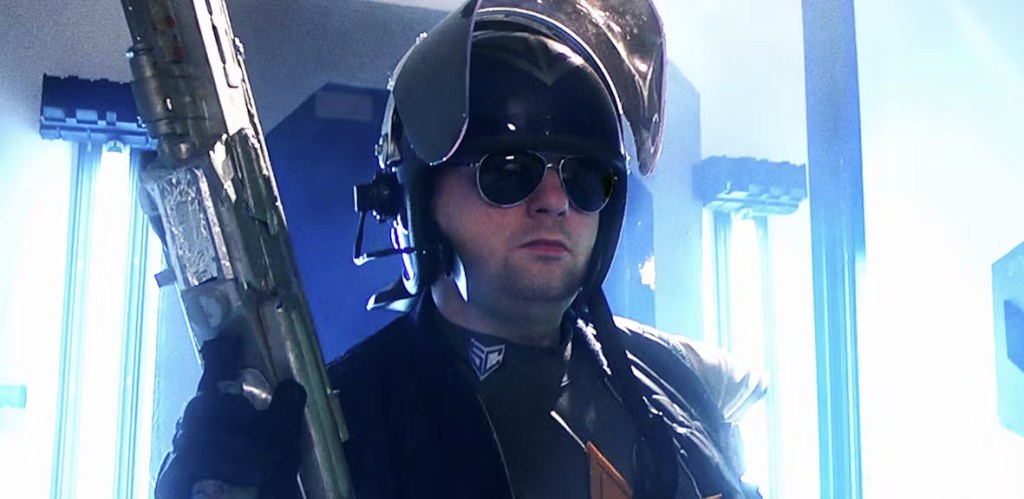
Do you know how family videos are only funny to people in the family? That’s probably what Red Letter Media’s Space Cop is like. If you’re a fan of these guys, you’ll probably enjoy their movie. When the promotional material suggests it would someday be a contender for RLM’s own Best of the Worst series, they weren’t kidding. It’s a bad movie, but that’s their expertise, isn’t it? Expecting them to make anything else is like asking Mike Tyson to figure skate.

I’m no stranger to crowdfunded films so I knew what I was getting into… in other words, I wasn’t expecting much. Space Cop is A) better than I thought it would be and B) a lot more entertaining than the Angry Video Game Nerd movie, even if that one had a lot more production value (and still looked like shit). Space Cop starts off promising enough and feels like an authentic movie for the first few minutes despite soap opera lighting. Then it quickly descends into the non sequitur jokes and politically incorrect humor which work, if I’m being kind, roughly half of the time.

As for the plot, a gung-ho policeman from the future (Rich Evans) is accidentally transported to 2007 after he chases aliens into some kind of time-space vortex. During a modern day shootout in a cryogenics lab, the future cop accidentally thaws a cop from the past (Mike Stoklasa). They’ll have to team up to save the world from a devious plot involving aliens and a brain in a jar… or something. I don’t know and it doesn’t really matter.

The two main characters are only about as good as a memorable Saturday Night Live sketch, stretched to feature length. The actors’ decision to speak in “funny” voices from beginning to end is, at best, easy to look past, while at worst I can see it grating on the uninitiated. When Patton Oswalt makes a cameo, it’s pretty clear the boys were reluctant to trim their only star’s footage because it goes on and on. The length then becomes part of the joke.

My biggest issue with the movie is a complaint RLM have voiced themselves: the best bad movies are the ones that aren’t intentionally bad. Movies that set out to be bad just can’t capture the charm of bad movies trying to be good. Space Cop isn’t a good bad movie, but it’s a decent bad movie, at least when the jokes hit their target. If you’re a veteran of bad movies, and you like RLM—really like them—then you probably want to support them in this venture.

Midnight Movie: Invasion U.S.A. (1985)

Kick the Dog: When a character does something evil for no apparent gain, because the author wants to demonstrate that he’s not a nice guy and shift audience sympathy away from him.

—TVtropes

Richard Lynch, who plays the cartoonishly cruel villain in Invasion U.S.A., does an awful lot of dog-kicking. In the opening scene, he poses as a U.S. Coast Guard who rescues a dozen Cuban refugees, helplessly adrift at sea, before gunning them all down. (It’s later revealed he even gunned down the men who helped him gun down the refugees.) In another scene, he throws a badly injured woman out the upper-floor window of a building after shooting Billy Drago’s pecker off. For his next act, he blows up a suburban neighborhood with a rocket launcher while apparently using an infinite ammo cheat.

Lynch’s plan involves flooding the United States with hundreds of terrorists who will then pose as policemen and civilians in between random acts of unkindness, mainly bombings and mass shootings. No reasons, no motives. Just pure terrorism.

Chuck Norris is our reluctant hero, this time playing a retired CIA agent living in the Everglades. He’s asked to come back for one last mission, but refuses on the grounds he’s perfectly happy doing… whatever it is he’s doing. As far as I can tell, his life mostly involves driving around in an airboat, trapping gators, and watching an armadillo drink milk from a dog bowl. What’s great about director Joseph Zito is he’s smart enough to limit these necessary but boring scenes; it won’t be long until Lynch’s men show up to kill Chuck’s only friend and blow up his house.

Back then, we all knew exactly what we were getting from the latest Chuck Norris film. Few of them ever promised anything deeper. They did so well because they appeased moviegoers’ desire to see something stupidly entertaining, the operative word being “entertaining.” There’s something pure about Invasion U.S.A., which has amazing stunts and action sequences, even if the logic leading up to them is inexplicable.

Consider the shootout in a mall. Two bad guys come crashing out of a plate-glass window in a pickup truck. You’d think after hearing all the gunfire and explosions inside, most pedestrians would’ve scattered long ago. Yet a woman walking along the sidewalk stops to scream at the henchmen for nearly running her over. The passenger takes a handful of her hair and the men drive off with her hanging from the side of the truck. Meanwhile Chuck Norris pursues in a commandeered convertible. 

The logical thing for the bad guys to do? Simply toss the woman onto the street in front of Norris’s car, forcing him to screech to a halt. Instead, the bad guys drive a couple of miles with the woman screaming the entire way. You get the feeling that screenwriters Chuck and his brother, Aaron Norris, were sitting around a typewriter (or maybe Crayons and paper), saying things like, “Wouldn’t it be cool if…?”

And it is cool. Just because Chuck Norris has the emotional complexity of a turd, it doesn’t mean his absurdly violent fantasies aren’t valid forms of art. Invasion U.S.A. is probably my favorite Chuck Norris film. The director also made my favorite Friday The 13th film: The Final Chapter. Those two films won’t seem like anything special to the casual viewer, but to those of us who indulge in fine cheese, he’s a master.

Midnight Movie: Elves (1989)

“You’ve got fucking big tits and I’m going to tell everyone I saw them!” — 7 year old boy to his sister.

Three edgy teenage girls who call themselves “the sisters of anti-Christmas” convene in the woods to “bemoan Christmas as a petty, over-commercialized media event.” One of them asks, “What’s ‘bemoan?'” The ringleader replies: “It means I didn’t get any good presents last year.” I unironically love shit like this.

One of the girls cuts her hand when a candle holder inexplicably shatters. Spooked by the strange occurrence, the girls freak out and run, but not before dripping blood on what’s presumably the burial spot of a demonic elf… or something. Honestly, I’m not sure exactly what’s going on in the preliminary scenes, but it doesn’t matter. What matters is there is now a monstrous elf lose in the world. Calling the monster a puppet would be too kind. It’s more like a barely articulate torso, which the special effects crew merely shoves into frame from time to time.

Before we go further, I have to point out that the den mother’s little shit of a brother spies on her in the shower. When she catches him, he says, “I’m not a pervert, I like seeing naked girls!” Later the boy is attacked by the troll in the middle of the night. When the mother tries to convince him it was only a nightmare, he responds with poetic delivery: “No, it was a fucking little ninja troll!” The mother decides it was the family cat who scratched the kid, so she drowns the pet in the toilet.

Enter Dan Haggerty—yes, Grizzly Adams. He’s a recovering alcoholic, ex-homicide detective who just so happens to have a bit of knowledge of the occult. He falls into the role of a department store Santa after the previous one is repeatedly stabbed to death in the nards. To make matters worse, Grizzly Adams has just been evicted from his camper trailer. Soon after, he discovers a clue the homicide detectives missed and follows the trail.

Meanwhile, the teenage main character and her airhead friends decide to have an after-hours party in the department store, which is coincidentally where Grizzly Adams is sleeping nowadays. They invite their born-to-die-in-a-movie-like-this boyfriends who arrive shortly before three Nazi goons appear, who’re hunting the elf for reasons you won’t fully understand until later on (if it at all).

Not only is the plurality of “Elves” bullshit, it’s hardly about the singular elf, either. The film is so thoroughly messed up on a technical level, the laughs are frequent. My biggest complaint is the film’s insincerity: there are several hints that indicate the filmmakers were trying to make a bad movie, including a Chinatown parody, an obvious Mommy Dearest reference, and the pulpy integration of Nazi mythology (“The Fourth Reich,” as Grizzly Adams calls it). It’s not quite as obnoxious as modern attempts at self-aware cheese, which makes it entertaining enough to watch with an audience, especially when the wheelchair-bound grandfather professes… eh, best not to spoil it.

I love Elves. Haggerty may not have been the best actor, but he’s got a unique screen presence, which makes me wish he had ended up in more movies like this. Sure, it’s a gimmick, but gimmicks can be fun, too.

Several internet sources claim this film is rated PG-13. There’s no way the version I saw would get a PG-13 rating, so there may be a censored version floating around. There’s a good amount of blood, a close-up of a cokehead getting stabbed repeatedly in the crotch, full frontal nudity, and a kid who cusses roughly as much as a comic on Def Comedy Jam. If any of those elements are absent in your copy, you might as well just turn it off and find a better source wherever you can. Who knows, maybe the full movie is on YouTube?

Midnight Movie: Bring Me the Head of Alfredo Garcia (1974)

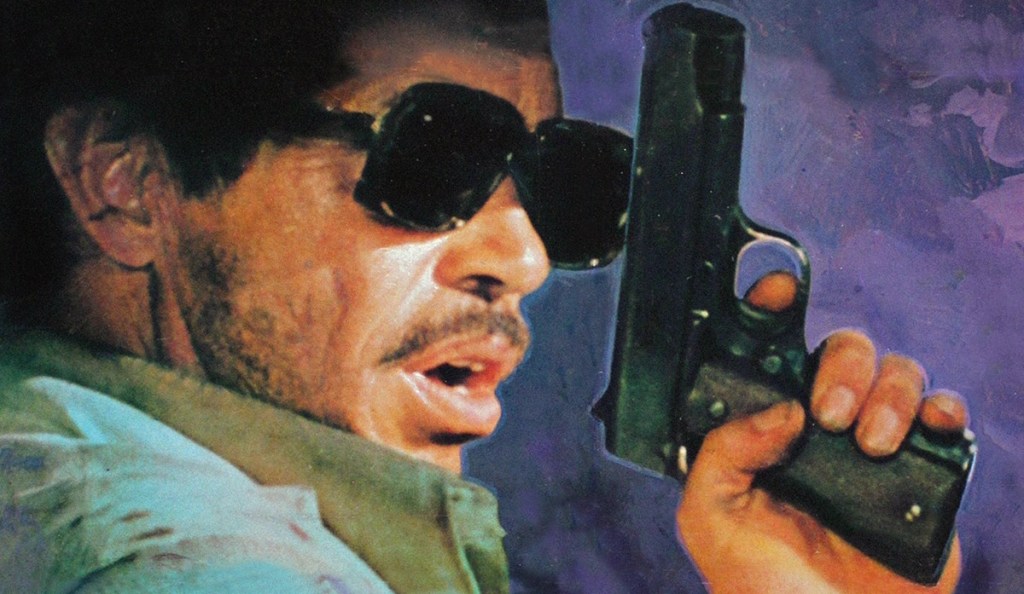
Bring Me the Head of Alfredo Garcia isn’t exactly what I had in mind when I started this feature, as the film is entirely lacking in cheese, but it’s got everything else I love about exploitation films: physical conflict, urgent characters, quick women, and tons of senseless violence. On this dreary cold day, I was simply in the mood for Peckinpah.

When the powerful El Jefe (Emilio Fernández) finds out who impregnated his teen daughter, he puts a million dollar bounty on the man’s head (literally). Months later, a couple of the tie-wearing goons end up in a rundown bar in Mexico City, asking questions about Garcia. It’s there they meet the American piano player, Bennie (Warren Oates), who plays stupid. He really doesn’t know where Garcia is, but he suspects his prostitute girlfriend, Elita (Isela Vega), just might.

Not only does Elita know where Garcia is, she’s been planning on leaving Bennie for him. Alfredo Garcia has promised to marry Elita, while Bennie remains reluctant to commit. None of that matters, though, as he comes to realize Garcia’s been dead and buried for a few days now. Armed with this new information, Bennie blows off Elita and seeks out the goons in their hotel room. He agrees to bring them the head of Alfredo Garcia in exchange for ten grand, not knowing the original bounty is much, much higher than that. They agree, giving him a deadline of a few days. They probably don’t have to mention it, but they do anyway: if he runs out on the deal, they’ll have his head.

The night before his journey into the Mexican countryside, Elita visits Bennie in the middle of the night to make up. In the morning, he’s merrily disinfecting crabs with bedside booze. Later, he proposes marriage, but neither he or Elita seem entirely convinced by his newfound enthusiasm. Nonetheless, he brings her along for the trip, which proves to be a mistake when they run into a couple of motorcycle-riding rapists, one of whom is played by Kris Kristofferson. If anything illustrates the stark contrast between the gritty realism of 70s and the almost entirely PG-13 rated present, it’s that music/movie stars used to cameo as despicable thugs. Try to imagine Will Smith or Justin Timberlake doing the same for their careers.

My favorite thing about movies like Bring Me the Head of Alfredo Garcia, and crime films in general, is they can take otherwise decent people and put them in soul-altering situations. Bennie, a U.S. Army vet, has no qualms about gunning down criminals, so it’s not taking a man’s life that threatens his soul. No, it’s the moment he digs Garcia up and looms over the corpse with a machete in hand. I believe that’s what plot-heavy screenwriters refer to as an “inciting incident.” Once he crosses that line, there’s no turning back. The descent has begun and the only way out is to continue downward.

Much of the last third of the movie is Bennie justifying his increasingly disturbing decisions to Garcia’s lifeless head, which has begun to draw flies as well as stares from the locals. These monologues, as Bennie continuously unravels, are like something out of an acid western. Warren Oates should’ve been the leading man in a lot more films, which makes Bring Me the Head of Alfredo Garcia more precious. It’s an exhilarating, completely unpretentious joyride with a mad man behind the wheel. And if you’re wondering if “mad man” refers to Peckinpah or the hero, take your pick. It hits hard and kicks ass.

Midnight Movie: Sonny Boy (1989)

Note: The version I saw is six minutes shorter than the unrated cut, which was only released in the UK. There’s a special place in hell for proponents of film censorship.

It’s been a long time since I’ve seen a movie modified for a 4:3 aspect ratio. Unfortunately, VHS or Laserdisc is the only way you can currently see Sonny Boy, a weird little film that never made the leap to modern formats. Pan and scan this terrible is like trying to watch a movie through a telescope. It’s a pain in the ass, but it’s worth watching it this way until the film is given a proper release.

Sonny Boy opens on a secluded motel where a young couple are being spied on by a desert thug named Weasel (Brad Dourif from the Child’s Play movies). Weasel murders the couple and takes off in their convertible, which he tries to sell to the local crime boss, Slue (Paul Smith, who played Bluto in Robert Altman’s Popeye). Slue lives in a junkyard with his wife, Pearl (David Carradine, who also sings the theme song of the film). As Slue and Weasel are negotiating the price of the stolen convertible, Pearl notices there’s a baby in the backseat who she immediately adopts as her own.

So what happens when a baby is raised by a trio of monsters? First, they give him “the gift of silence” by cutting out his tongue. Then, in a montage of Sonny Boy’s formative years, we see how Slue and Weasel physically torture the boy in order to toughen him up for the real world. These games of abuse culminate in Sonny Boy’s rite of adulthood, in which Slue ties the boy to a stake and Weasel lights a ring of fire around him. You’ll see Pearl desperately trying to put the fire out with a tiny bucket of water. She merely shakes her head as if to say, “Oh, boys will be boys.”

I know this sounds horrific, but it’s kind of sweet within the surreal, dark comedy context of the film. The director makes no excuses for the way his characters behave, but it’s clear this is the only way this group of people know how to raise a kid. You begin to wonder if the reason they lack a moral compass is the same reason Sonny Boy lacks one: perhaps they were raised like animals, too. Anyway, one day Sonny sees himself in the mirror for the first time, face covered with the blood of Slue’s enemy, which inspires the man-boy to begin the long, difficult process of deprogramming himself.

There’s a lot that’s wrong with the film (such as an overly explanatory voiceover, a cheat of an ending, and a hamfisted message about tolerance, acceptance, yatta, yatta, yatta), but it’s clear the movie is a labor of love. There’s creative cinematography, a great cast, and an unwillingness to make the film something it isn’t in order to satisfy more commercial audiences. According to some sources on the internet, the subject matter of Sonny Boy was so disturbing, theaters pulled it from showings within days of its release. I don’t buy that at all because the film simply isn’t that disturbing. I think the real reason it was pulled is couldn’t have been a crowd-pleaser in 1989, which was probably the biggest year for blockbuster films up until that point.

Ultimately, what’s most satisfying about Sonny Boy is its unusual restraint. You would expect crass comedy when the star of Kung Fu appears in a dress, but it doesn’t treat the crossdresser like a joke. Sure, there are people who get thoroughly blown to bits by artillery shells, but if you’re looking for a raunchy exploitation film to show a rowdy crowd, Sonny Boy isn’t it. That doesn’t mean it’s not worth a watch, though.

2016 Update: an unrated cut of the film has finally been made available on Blu-Ray by Shout Factory.

Midnight Movie: The Visitor (1979)

The Visitor opens on a plane of unreality in which a force of good (John Huston) comes face to face with a force of evil. When the evil flings off its sacramental robe, it reveals it has taken the form of a little girl. Cut to a different plane of existence: Italian actor Franco Nero, in Christ-like garb, tells a group of bald disciples the mystical backstory concerning these warring forces. My eyes glazed over at this long, dull explanation, which is probably why I had so much trouble following the rest of the movie.

Maybe I would have been lost anyway, but a great deal of The Visitor suddenly made sense in the end. I hoped to be taken on a cosmic trip, but with exposition like Nero’s, the film is like winning a free vacation, but finding out you have to listen to a timeshare pitch first. I’m not saying it’s a bad movie because it’s actually quite good for borrowing so heavily from so many different sources. (Rosemary’s Baby and The Omen came to mind for me. Others have compared it to everything from The Exorcist to Star Wars.) Despite its obvious influences, you’ve never see anything like it.

Following its dreamlike prologue, the audience is whisked away to a basketball game in Atlanta, Georgia. When the away team nearly turns the score over in the final seconds, a little girl in the front row uses her supernatural powers to make the basketball explode in the player’s hands. (No one seems to think it’s weird that the basketball blew up like a Tannerite-stuffed piñata.)

The eight year old girl responsible is accompanied by her mother, played by Joanne Nail (Switchblade Sisters). Nail’s character is being courted by Lance Henriksen, the owner of the basketball team. Henriksen proposes to the girl’s mother, who refuses his offer despite creepy persistence. We soon learn Henriksen is an agent of evil when we see him in the boardroom of rich and powerful Illuminati types. The mysterious figures, led by Mel Ferrer, remind Henriksen that their evil plot hinges on Nail getting pregnant again.

Meanwhile John Huston’s character arrives on Earth. He can freely hop between realms, but requires a commercial airliner to take him to Atlanta. When the little girl discovers her arch-nemesis is now on Earth, she angrily uses her Omen-like powers to turn a birthday gift into a loaded gun and promptly shoots her mother in the spine. This “accident” leads to a couple more surprisingly high-profile talents: Shelly Winters and Glenn Ford, who play the new nanny and a police detective. Eventually the film will introduce Nail’s ex-husband, a doctor played by Sam Peckinpah. 

The problem with The Visitor (and I’m nitpicking here because the more I think about it, the more I like it) is it has too much plot for what it wants to be. And it’s a plot that will be just a little too familiar for fans of pre-Halloween horror. I usually love movies like this and I’m no stranger to psychedelic journeys, but no one’s asking the directors of acid films to stitch their visual exercises together with coherent—but ultimately pointless—plots. I just feel The Visitor would work a lot better if it didn’t try to be so damned routine in between its short bursts of wonderful lunacy.