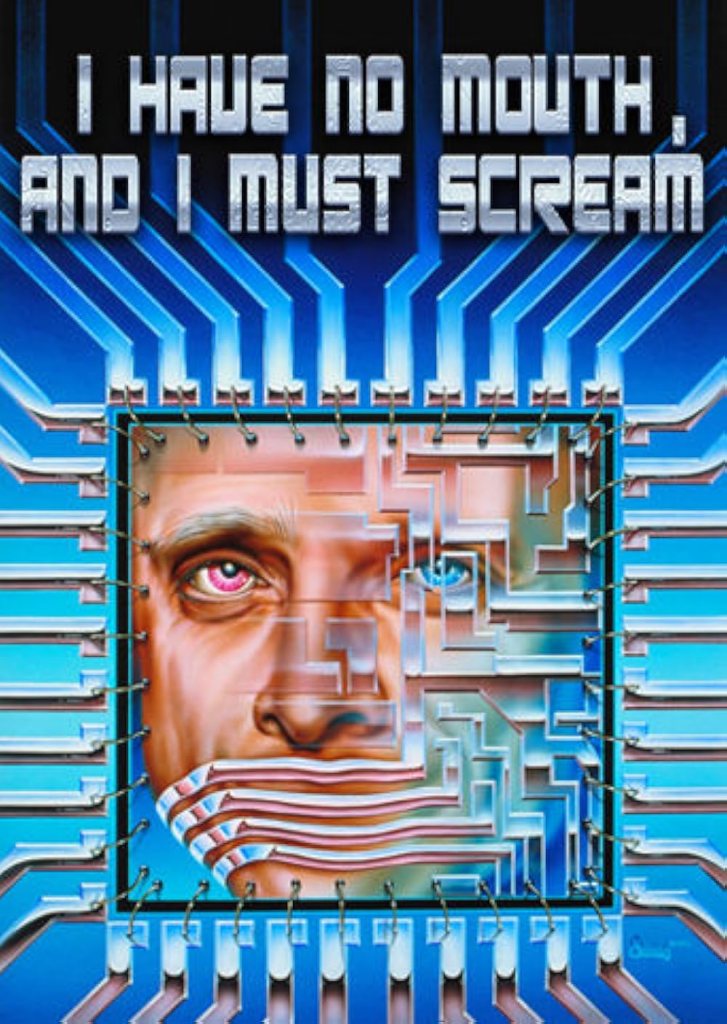
I Have No Mouth and I Must Scream: The Game (1996)

I miss The Sci-Fi Channel in the early nineties. It was weird and kooky, a far cry from the tamed content that occupies its programing today. The scrappy little station introduced me to Harlan Ellison when I was like ten or eleven years old. In those early days, Ellison had been hired as the channel’s version of Andy Rooney; his brief but audacious opinion pieces provided filler, often necessary as the oddball programming rarely conformed to 30-minute slots. The incredibly egotistical Ellison never had anything to say that wasn’t a hot take, and although he was often abrasively wrong, he was almost always right.

I actually remember the first time I saw a magazine advertisement for the video game adaptation of Ellison’s I Have No Mouth and I Must Scream. I had a similar reaction when I first heard the term “cyberpunk:” I didn’t know what it was at the time, but I instantly knew that I liked it. I am now thirty years old and I Have No Mouth is still on my short list of favorite stories of all time. It’s very much required reading before playing the game (and, luckily, it’s not hard to find on the internet in its entirety).

Ellison himself voices AM, the supercomputer which ultimately exterminates humankind, saving only a handful of humans it immortalizes for the purpose of torturing forever. In one interview for the game, Ellison insists AM is not evil, but an amplification of human nature itself. After all, humans are AM’s creator. It was our own shortcomings and self-hatred that ultimately took root and spun out of control in its circuitry.

The game deviates from the source material with Ellison’s input. Ellison initially told the lead designer he wanted a game you cannot possibly win, a game that taught you “that if you cannot win the game, at least you can lose better.” The designer pushed back, tampering Ellison’s famous disdain for his fans. I have not seen any of the good endings, but how good can they be when, at the end of the day, the player-character still lives in a world in which a computer has, for all intents and purposes, made humans extinct?

It won’t be long until the player is confronted with a “motivator switch,” just to find its sinister purpose: the torturing of six caged animals. The player-character reacts appropriately with shock, but it’s something you must do in order to progress. It’s grim choices like these that makes the game as uncomfortable as it is fun (Ellison said he wanted a game that “taught ethics”). Like a lot of games of this type, I Have No Mouth and I Must Scream requires some hit-and-miss puzzle-solving, but when you stumble onto a solution, you’ll often slap your forehead and say, “Of course!” It may seem silly removing the sheets from two bunks, but here’s a hint: they make a good rope.

The artwork and the music are fantastic. The voice work isn’t the best I’ve heard (Ellison really hams it up), but for some incredibly odd reason, it works.
Superman Begins (to suck)

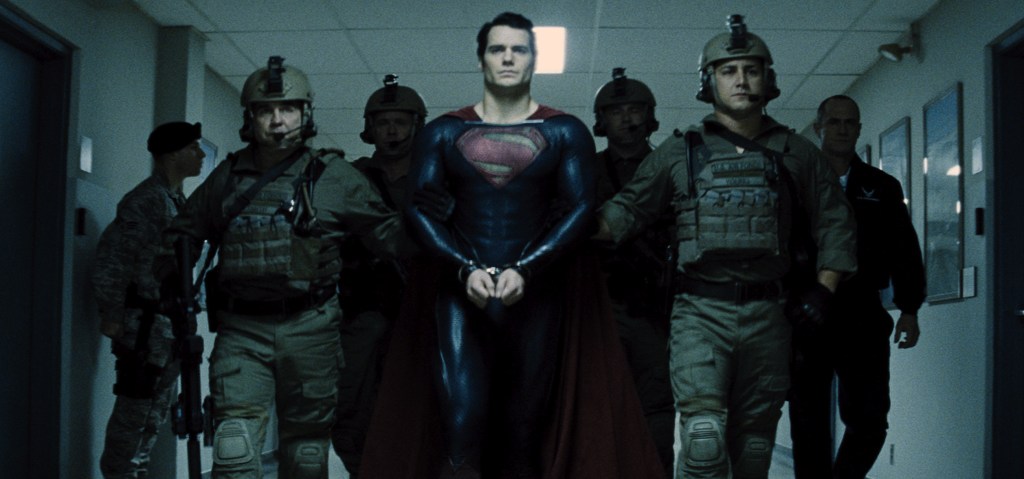
Man of Steel is what you get when too-cool-for-school movie director Zack Synder has too little confidence in a pop cultural icon who’s been around longer than anyone reading this. Give me old-fashioned Spandex and red briefs any day of the week. In due time, this blundered attempt at modernizing the hero will prove as dorky as elastic-cuffed jeans and fanny packs. If you want dark and gritty, here’s an idea: Don’t make a Superman movie, jackass.

Conversely, the trailers for Richard Donner’s Superman promised optimism: “You’ll believe a man can fly!” There was so much love poured into that 1979 film, it was bursting at the seams with magic. When Superman takes Lois on her first flight? That’s my favorite movie scene of all time. They made no attempt to modernize (read: dilute) the only thing fans wanted to see: the real Superman on the silver screen. Watching Man of Steel, which attempts to compensate for its weaknesses with exhausting action, one gets the sense the filmmakers would be embarrassed to be seen with the real Superman in public.

The film isn’t all bad—in fact, it’s far from the worst Superman movie. I’ve gotta hand it to the casting department: Henry Cavill would be the perfect Superman in a competent movie. Russell Crowe and Michael Shannon are best case scenarios for Jor-El and General Zod. Diane Lane is far too young and attractive to play Martha Kent, but great at what she does nonetheless. Meanwhile, Kevin Costner seems bored to be here… and when they have him needlessly murdered by a tornado of all things, can you blame him? (That scene will surely become as hotly debated as the door in Titanic.)

I am beyond sick of Hollywood retreading origin stories every American already knows, but the early scenes set on Krypton are fantastic. The special effects and the action there are breathtaking. The entire movie should have been taken place on Krypton as far as I’m concerned. After a sequence like that, the audience needs a breather. Instead, Snyder immediately throws more carnage and destruction at us two minutes later. I am not exaggerating that time frame.

This is all to say this movie is full of shit. You’ve got military jets and alien invasions and far too many shots of people running away from CGI destruction. Nothing about it feels like Superman, but I guess it’s the Superman we deserve when we keep voting for this shit with our wallets. The inevitable sequels really ought to focus on Martha and Lois a little bit more and Snyder really needs to chill the fuck out.

The Frighteners is a mildly likable mess

I like rules in science fiction. Any kid knows Dracula shouldn’t walk around in the daytime without slathering on a gallon of SPF 100. When Isaac Asimov invented The Three Laws of Robotics, it didn’t restrict his work, but created a rich and believable universe for his stories. You don’t feed a mogwai after midnight, you never cross the streams, and you should always be careful what you wish for.

The problem with ghosts is they have no rules. Silver bullets don’t work. You can’t hammer a stake into their hearts. They don’t have a brain to destroy. In the 1999 remake of The Haunting, ghosts could do anything or nothing at all, depending on what was convenient to the plot. Some of the same problems are present in The Frighteners, in which ghosts fall through walls when they try to lean on them, but they can walk around on floors and ride in cars.

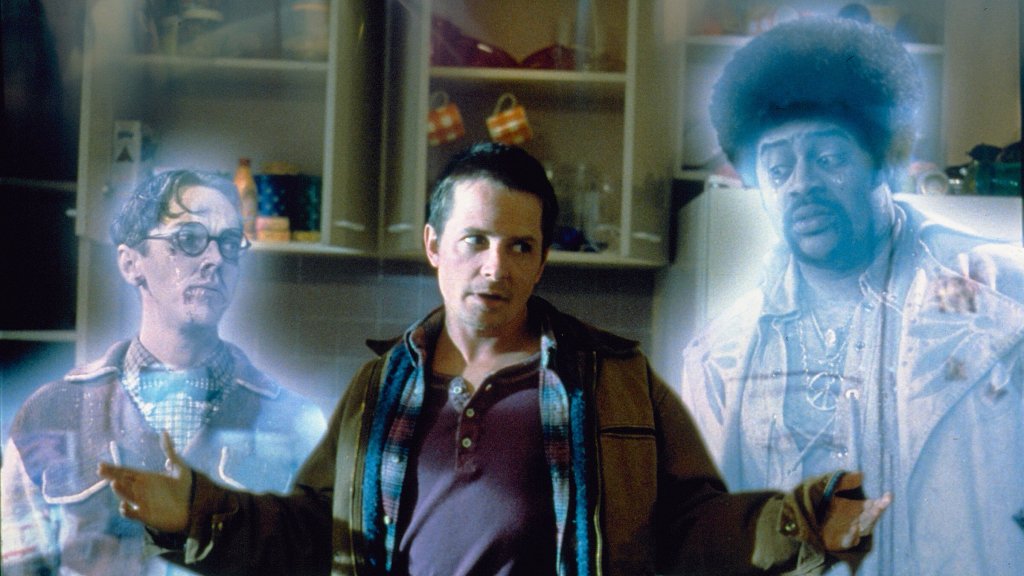
Michael J. Fox plays Frank, a former architect who got into a car crash which killed his wife. Somehow the near death experience gave him the ability to see ghosts. Now considered a crackpot in his community, his only friends are ghosts who haunt houses so that Frank can make a buck as a conman exorcist. One day Frank notices a spectral “37” written on the forehead of a man who later turns up dead; it turns out something otherworldly is killing people and only Frank can see who’s next.

I disliked The Frighteners when I originally saw it, probably because I was an edgy teenager who cherished director Peter Jackson’s ultra-gory Bad Taste and Dead-Alive. I decided to give it a second chance today. Though my opinion has definitely softened, it still doesn’t hold a candle to those aforementioned films. During my most recent viewing, I was even invested until the tiresome climax, which seems to drag on for far too long.

Touted as a horror-comedy, the humor feels like an afterthought. Someone with money on the line probably thought it was too dark and hired a script doctor to “make it funnier.” As a comedy it doesn’t work for me. Having an elderly ghost screw a mummy is a dumb joke, far beneath the talent who made Heavenly Creatures. It’s especially confusing that Frank’s maniacal driving is a running gag, when his driving his what killed his wife in the first place.

I’m a big fan of Jeffery Combs, but here he channels Jim Carrey just a little too much as he rips off Major Toht from Raiders of the Lost Ark. In that movie, there’s a wonderful gag in which you think Toht’s about to torture Marion with a mysterious device that turns out to be nothing more than a collapsible coat hanger. In this movie, Combs reaches into his jacket and, instead of the expected gun, he draws an inflatable donut. Hilarious.

So no, The Frighteners doesn’t work as a comedy. It barely works as a horror film, but it looks amazing. If you’re not watching it on a modern display, you’re missing out. The best shots are contained in the opening reel, but there are breathtaking views peppered throughout. Then there are the special effects, which must have been a logistical nightmare for the filmmakers, but they pay off in a big way. Wikipedia says:

The visual effects were created by Jackson’s Weta Digital, which had only been in existence for three years. This, plus the fact that The Frighteners required more digital effects shots than almost any movie made up until that time, resulted in the eighteen-month period for effects work by Weta Digital being largely stressed.

Also worth noting is Trini Alvarado, who doesn’t have a whole lot to do as the leading lady, but she does it exceptionally well. She’s simply one of those people you like to watch. And Michaeal J. Fox has always been underrated for the subtle physicality he brings to any role; that this is his last major performance elevates the picture to “must-see” status. As for Jake Busey… well, what the hell can one say about Jake Busey? He’s another one of those actors who command attention. While I didn’t buy his character in the slightest, it was interesting to see him paired with a brunette Dee Wallace.

The sum is much greater than its parts and it really is worth a watch despite my numerous issues with it. Pay attention to the opening shot, which floats through a window in a very familiar manner. What does that shot remind you of? If you had HBO in the nineties, you’ll probably place it in an instant. I’m guessing it’s no mistake the first credit is Robert Zemeckis Presents.

Dreamcatcher: The Cleopatra of horror movies

Dreamcatcher is fascinating—I’ll give it that. It deserves some sort of praise, considering how uniquely awful it is. It’s clearly a passion project. No one phones it in and no expense is spared (the movie cost $68 million). When you take the director of The Big Chill, the writer of Butch Cassidy and the Sundance Kid, and adapt the most popular novelist of the twentieth century, you don’t expect a spectacular failure, but here we are.

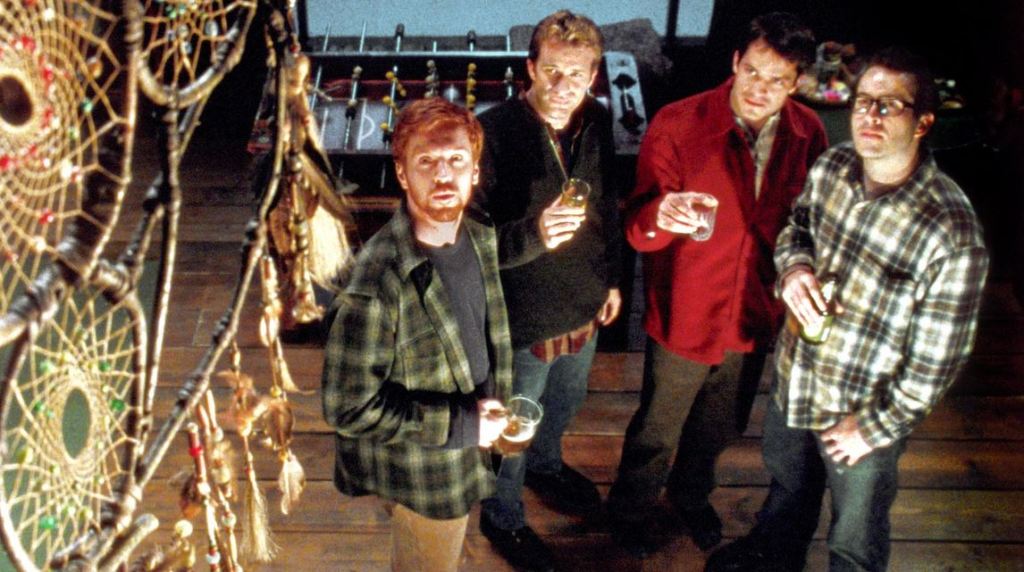
Four friends with psychic abilities have gathered for their annual vacation in a secluded cabin. What they don’t know is an alien spacecraft has crash landed nearby. When they come to the aid of a seriously ill man who they find wandering the woods, it’s revealed he’s the host of an alien parasite. Remember the chestburster from Alien? It’s like that, only this one is a, um… assburster. Meanwhile, a secret branch of the military, which apparently deal with these crash landings all the time, are willing to massacre civilians to keep the aliens contained. And if this all sounds a little scatterbrained, let me assure you that it is very scatterbrained.

I finished reading Stephen King’s source material the same day I re-watched the movie. While book fans usually complain about the stuff an adaptation left out, I’m boggled by what they left in. Consider the fact the novel takes around 20 hours to read. A screenwriter should think carefully about how to adapt such a thing to a two-hour format, but William Goldman’s solution involves reducing entire chapters to very brief scenes as if he’d rather water the novel down than alter it.

Director Lawrence Kasdan has admitted the film damaged his career. Directing must be a pretty stressful job as it only takes a single hiccup to jeopardize your future in the business. On top of that, you have to deal with the lame bloggers who rip your hard work apart (ahem). But these things need to be discussed—that’s just integral to the creative arts: the risk of negative criticism. People can’t truly appreciate the high wire act unless there’s a risk of the performer falling.

I’m glad they made Dreamcatcher. I don’t hate it and I’ll probably watch it again someday. It’s actually very entertaining, often for the wrong reasons, and I’ll be the first to admit there’s magic to be found, sprinkled throughout (as with big dumb disaster movies, the early scenes in which the characters have no clue what’s going on are the most compelling). Where else can you see what is essentially a big budget splatter film with aliens and body horror and shades of Stand By Me? I have nothing but praise for the crazy sons of bitches who made it.

One scene that sums up how stupid the movie is takes place in a bathroom. I don’t care how much you set it up—and the movie certainly tries—I will never believe (much less like) a character who gets himself killed so that he can pick up a toothpick from the bathroom floor and stick it in his mouth. Or how ’bout the part when a character is skiing very slowly and falls for no apparent reason? Or when Morgan Freeman’s character, Colonel Curtis, sincerely tells Tom Sizemore, “Okay, you just drove over the Curtis line!” My favorite moment is when one character telepathically answers a pistol like a phone.

Russia’s meteor event reminded me to finish Deep Impact

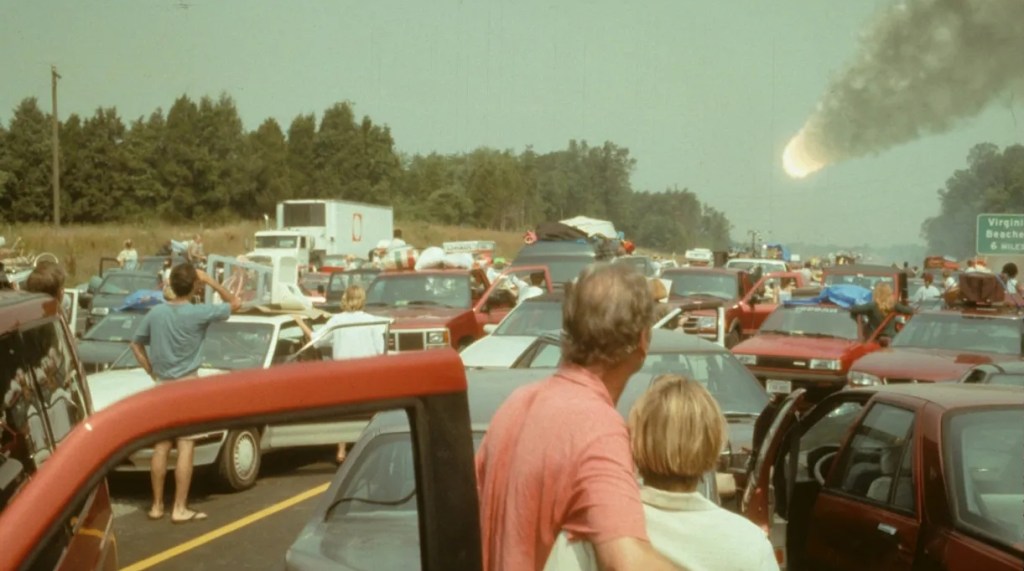
The Chelyabinsk meteor tickled me to pieces. Whereas the news had been mirroring dystopic fiction all too often lately, it was a relief to see it mirror doomsday fiction for a change. The event reminded me I had somehow never finished Deep Impact, which I had only seen portions of whenever I was channel surfing. Frankly, the film appeared to be a bore, but where else am I going to find sweet space rock action?

In the interest of transparency: I generally dislike Hollywood disaster movies. The Towering Inferno, Armageddon, The Day After Tomorrow, Earthquake, Twister, The Core, Volcano, Dante’s Peak—all of these productions feel as disastrous as the literal disasters they depict. All you need to make a disaster movie is a weak understanding of natural occurrences, a bunch of technobabble, a handful of crumbling landmarks, and gooey melodrama liberally garnished with hundreds of extras racing down city streets. Other than the visual effects, the genre has not improved at all in nearly fifty years.

In the beginning of Deep Impact, a young boy (Elijah Wood) spots a new object in the sky with a store-bought telescope. Even though the scene reeks of dishonesty, it’s kinda accurate in the sense amateur astronomers still make important contributions to this day. His astronomy club submits the finding to a full-fledged observatory where a stereotypical movie scientist keys the coordinates into his computer and realizes the object is barreling towards our planet. That alone would be exciting, but somehow it leads to a cliff-side car wreck that has the scientist’s vehicle exploding in a Hollywood fireball—in midair no less.

A year later, an investigative reporter played by Téa Leoni thinks she’s gotten the scoop on the Secretary of the Treasury’s mistress, a woman she says is named Ellie. She soon finds out that she misheard “E.L.E.,” which stands for “extinction level event.” Yes, I know the government can be pretty incompetent at times, but that’s like using the code name “U.F.O.” to cover up flying saucers. The President (Morgan Freeman) personally asks the reporter to sit on the scoop until he can announce the news himself. In typical Leoni fashion, she merely shrugs and says, “Okay.”

Two days later, The President reveals to the world that a comet is on a collision course with Earth. He freezes national wages and product prices to prevent profiteering and panic. Then he reveals the plan: scientists are already working on a manned mission that will attempt to destroy the comet with nuclear weaponry. The senior astronaut on the mission, played by Robert Duvall, was the last person to step foot on the moon. The younger astronauts resent him, which is the dumbest thing in the entire movie. I’ll give you a shiny nickel if you can name one person who had the wherewithal to complete astronaut training who doesn’t idolize any of the dozen men who walked on the moon; in Deep Impact, astronauts have the emotional intelligence of high school jocks.

As the ship makes its way to rendezvous with the comet, Leoni’s unbelievable reporter is promoted to an even more unbelievable news anchor. I know some news personalities are known for being a little stiff, but Leoni’s performance could make robots wince. It’s a shame the Earth drama is so hackneyed because the space stuff is excellent. Yes, there’s sound where there should be none and much of the suspense was ruined by the marketing, which clearly spoiled that the mission fails and the comet indeed strikes the planet, but if the space bits had been the entire movie, it could have been a great one.

Predictability aside, the second half is much better than the first. Lesser films show civilization devolving into mass hysteria when faced with possible extinction. Though it’s refreshing that Deep Impact bucks the trend, its characters can still hail a cab within seconds of raising a hand. I’d say maybe society is doing a little too well, all things considered.

Later on, the reporter’s mother says she feels relieved she won’t survive the impact. She even quit smoking and donated some of her more valuable belongings to the government’s effort to preserve antiquities. This was the sole scene which unexpectedly moved me. A lot of armchair philosophers love to talk about how shitty humanity is, but if we were all that bad, we never would have civilized in the first place. This is exactly the stuff I wish more disaster movies had.

Deep Impact is a bit like a newborn calf. There’s a lot of wobbling in the beginning, but eventually it learns to walk… sort of. It’s one of the better disaster movies, but that’s not saying much. If, like me, you found a strong interest in what happened in Russia recently, you should give it a shot.

Old Man’s War is the new man’s military SF

I did two things on my seventy-fifth birthday. I visited my wife’s grave. Then I joined the army.

John Perry is an old man from future Ohio who joins the army for a second shot at life. In Old Man’s War, which seems to be equal parts fan fiction and satire of Robert A. Heinlein’s military fiction, members of the armed forces receive benefits unavailable to everyday citizens. If you join the army on your seventy-fifth birthday, you receive the luxury of a new body. Then you’re shuffled off to boot camp on a remote planet where you’re about to discover that the disgusting, evil-looking aliens are actually your allies. (It’s the peaceful looking deer aliens who you’ve gotta watch out for.)

Remember Kick the Can? It was the episode of The Twilight Zone (remade by Steven Spielberg as a segment of the movie version) in which a group of elderly people learn how to be young again. That’s what Old Man’s War reminds me of. It’s as if a large group of seventy-five year olds relive their first day of school on an intergalactic scale. For a long, opening section of the book, it’s whimsical fantasy. In the second section it turns dark, but manages to retain a lot of its charm.

It’s worth noting that Scalzi originally self-published Old Man’s War on his blog, where it became so popular that Tor picked it up. In only a few years, Scalzi went from being a self-published author to the head of the Science Fiction & Fantasy Writers of America. Oh, and Paramount optioned Old Man’s War into a movie. Sure, options are a dime a dozen, but I imagine this movie will actually get made if Ender’s Game performs well.

Spoiler: John Dies at the End

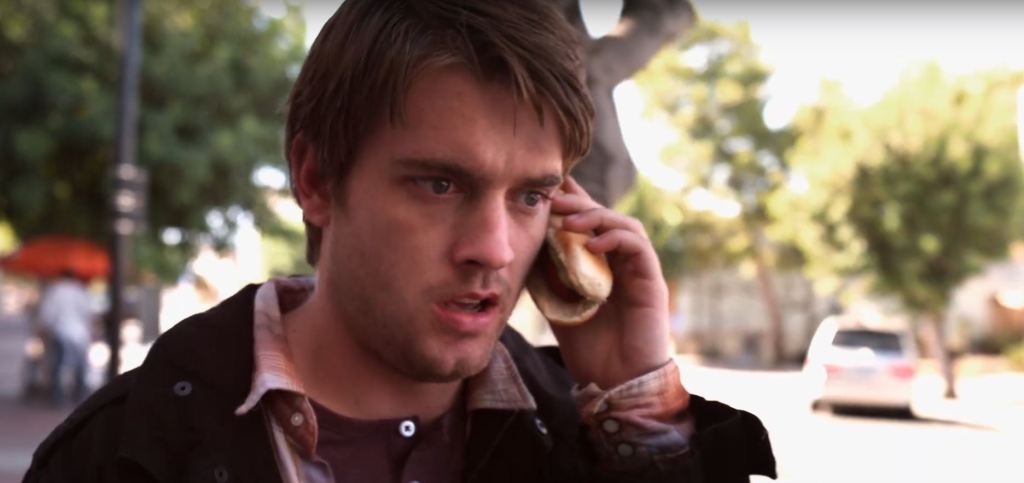
Hello? Yes, this is hot dog.

John Dies at the End is now available on VOD about a month before it releases in theaters. Pointing out the flaws in a movie like this is like refusing to go to bed with Marilyn Monroe because she has a mole. All genre classics are flawed, from Escape to New York to Evil Dead 2. Given enough time, these movies’ flaws become so endearing that drunken frat boys excitedly point the flaws out at movie parties. I suspect John Dies at the End may have launched itself on a similar trajectory, though David Wong’s serialized novel-thing somehow has better comedic timing. Questionable CGI aside, this movie’s a fine crowd-pleaser.

Don Coscarelli was the director who broke into the movies when he made the ultra-low budget Phantasm, a horror film about a demonic undertaker whose bidding was done by inter-dimensional dwarfs and sentient spheres. For me, it’s not a very rewatchable movie, but I have a soft spot for its first sequel. Coscarelli also made Bubba Ho-Tep, which supposes the real Elvis Presley (Bruce Campbell) ended up in a nursing home through an unlikely series of events (it was an impersonator who died). Teaming up with Ossie Davis, playing an elderly black man who thinks he’s JFK, Elvis must go toe-to-toe with a mummy who’s eating the souls of the nursing home’s residents.

As he did with that film, Coscarelli once again adapts a bizarre story written by a little-known cult writer. John Dies at the End is somehow even harder to summarize than Bubba Ho-Tep—and apparently harder to film as significant sections of the source material are omitted. It’s about a couple of slackers who are addicted to a drug called Soy Sauce that makes them see things from another dimension. There’s an alien subplot, too, all of which unfolds in a confusing order of events, true to the source material. The movie also features Paul Giamatti, Clancy Brown, and Doug Jones, who you may not recognize without the monster makeup he wore in Hellboy and Pan’s Labyrinth.

Just watch the trailer. If that appeals to you, then watch the movie. I have to go now. My hot dog is ringing.

Smooth launch day for Black Ops 2

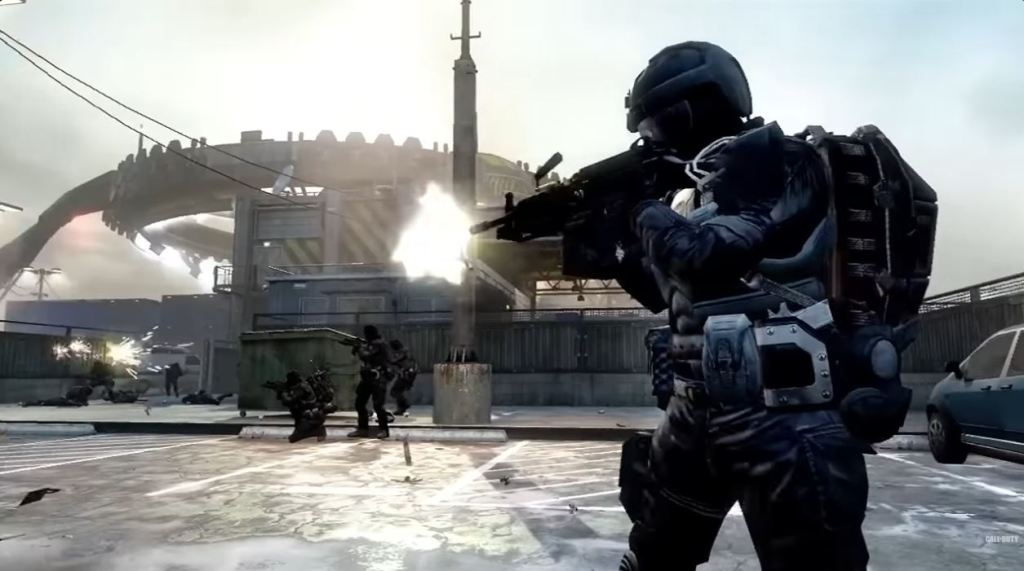
I thought I was done with Call of Duty. As launch day reviews came tumbling in this morning, I found myself excited about the newest installment. In particular, it was footage of the zombie mode additions that got my attention. So I purchased it and downloaded it while I was at work.

It’s good. It’s different. Everything I dislike about COD games has been addressed… well, almost everything. There are a few too many button prompts and quick-time events in the campaign, but there’s plenty of honest action, too. Amazingly enough, it runs better on my system on the day of launch than MW2 and 3 do after months of patches. I’ve yet to encounter any memorable bugs in the three hours I’ve played it. (Knock on wood, right?)

The sound is crisp, but Treyarch’s default mix sounds a little janky on my speakers; your mileage may vary so experiment with settings. Joining games has been a breeze and although I lagged a couple of times, it’s been pretty smooth for the most part. I like the customization. I like the futuristic weapons and tactical gear. Against all odds, I like Call of Duty again, if only briefly.

Looper is Sooper

The year is 2044. It’s thirty years before the invention of time travel. A voiceover tells us that as soon as time travel is invented, it’s outlawed. Naturally, that won’t stop the most powerful crime syndicates from using it. So where’s Timecop when you need him?

Joe (Joseph Gordon-Levitt) is a looper. Loopers are hitmen, but not the type who whack you in Scorsese movies. No, loopers simply wait in a field for a target to appear from the future. When the target arrives, hooded and bound, the looper shoots him. The only benefit of doing it this way is the body won’t be found in the future, when cops have access to higher tech forensic methods.

Before disposing of the body, the looper can find their payment strapped beneath the target’s clothes. The payment usually comes in the form of silver bars, which can be traded for their own timeline’s currency. Every looper knows full well that, one day, they’ll find gold bars strapped to a body instead of silver. The day that happens, the looper has just retired himself, which is so common it’s called “completing the loop.” When we see that Joe lives very well in a future where most live in squalor, we can see the attraction of the job despite its deadly retirement plan. He even admits that people in his line of work aren’t exactly forward-thinkers.

If you’ve seen the trailer, you already know that when Joe’s future self is sent back, young Joe fails to retire him. His future self is played by Bruce Willis, which is far less distracting than having Gordon-Levitt play dual roles—one in old-age makeup. You’re probably expecting a cat-and-mouse game to ensue. It’s actually more like a cat-mouse-dog-and-tiger game in which timelines tangle like pasta.

Does this sound convoluted to you? It’s a movie about time travel—of course it’s convoluted. Whereas so many of these movies try to make an unbelievable premise believable with endless technobabble, Looper leans into the problems of time travel with little explanation, which gives it room to do something fresh in the genre. Its interpretation of the rules leads to one of the most chilling death scenes ever filmed. The scene in question is truly the stuff of nightmares, but if you want to poke holes in it, you’re watching the wrong movie.

Dredd (2012): Don’t Call It a Remake

Olivia Thirlby and Karl Urban

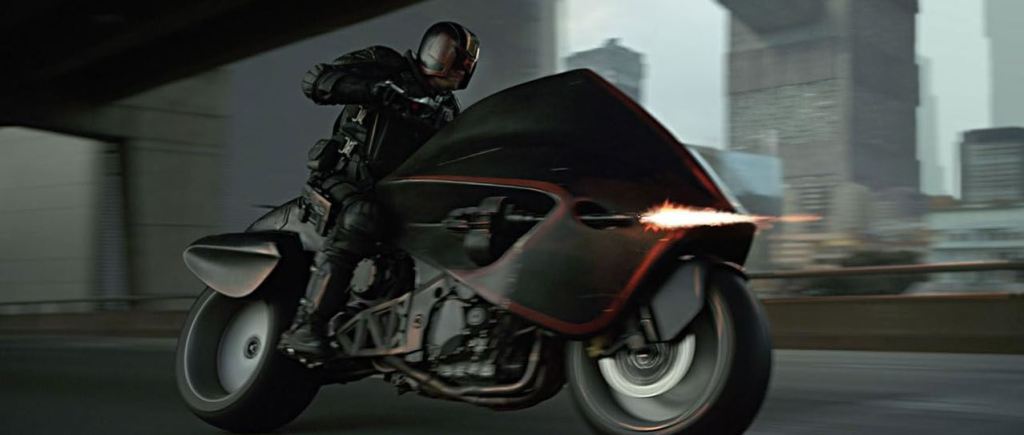
When my mother took me to see Judge Dredd on opening weekend in 1995, there was one other moviegoer in attendance. The guy got so bored he tried to read a book during the middle of the movie. Not that Judge Dredd was entirely without merit; I always thought it was a little better than most people cared to admit, Rob Schneider notwithstanding. While Karl Urban certainly has a better chin for Dredd, Sly had the more accurate body type; I may also slightly prefer the costumes and motorcycles of the 1995 film, too. That’s the only nice things I can say about that.

In Mega City One, one of the few cities left standing after nuclear war, Judges are cops, juries, judges, and executioners rolled into one. Despite its breakneck pace, this new adaptation of the 2000 AD character manages to paint a complete picture of its bleak and ultra-authoritarian setting in deft strokes of worldbuilding. We learn early on that Judges are spread so thin they can only respond to 6% of all crime in a city of 800 million people. With statistics like that, it’s a wonder why everyone doesn’t become criminals.

Batman ’66 vibes

The opening has Judge Dredd engaged in a high-speed pursuit with a street gang who’s stoned on slo-mo, a street drug that makes users perceive time at 1% of its normal speed. Dredd sentences the thugs to death, the last of which is dispensed in gruesome R-rated fashion. In the next scene, Dredd is assigned a new partner, Cassandra Anderson (Olivia Thirlby), who failed her aptitude tests, but may still get recruited for her uncanny psychic abilities… pending Dredd’s assessment, of course.

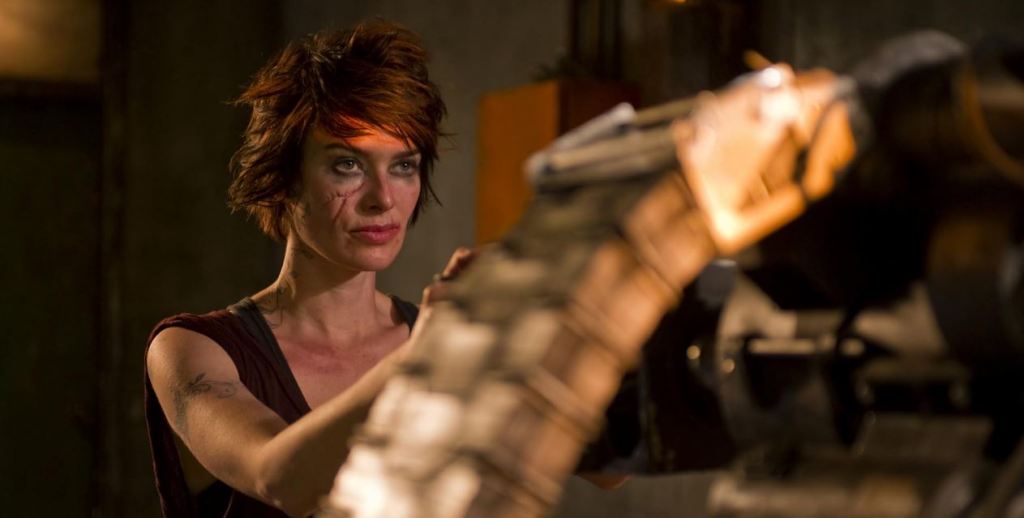
For her first day on the beat, Dredd lets Anderson pick which call to take. The rookie chooses to respond to a triple homicide in a two-hundred story slum, which happens to house a viscous crime lord known as Ma-Ma (Lena Headey, who’s even crueler in this than she is in HBO’s Game of Thrones). In a brief introduction, we learn Ma-Ma’s an ex-prostitute who “feminized” her former pimp before installing herself as the kingpin manufacturer of slo-mo. When Dredd and Anderson arrest one of her lieutenants, Ma-Ma hacks into the building’s security system, closes the blast doors, and places a bounty on their heads.

Lena Headey

That’s it. That’s the entire setup. The rest of the movie is Dredd and Anderson just trying to survive while they wait for backup. Movies like this are only as good as their villains and Dredd has a great one. She’s a believably nasty mother fucker to put it mildly.

Adults rarely have a good excuse to go see a genre movie, but Dredd’s one of the better ones. In 1995 it would have cleaned house. As of this writing, it hasn’t even recouped half of its modest budget. It’s a shame, too, because this is one of the rare franchises deserving numerous sequels. And that’s coming from someone who typically loathes sequels.