Arrival (2016)

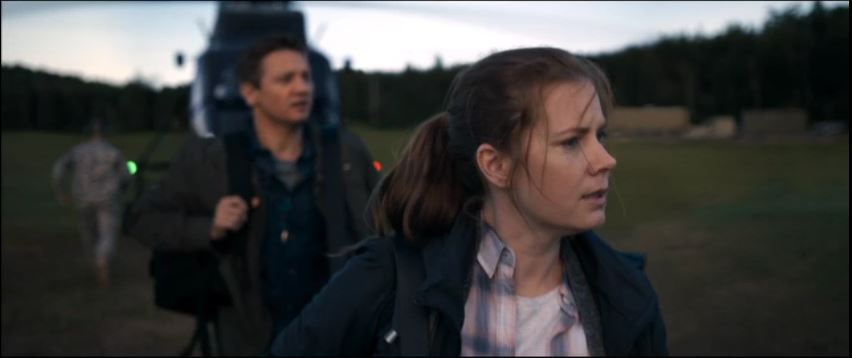
There’s so much I want to say about Arrival, but the movie works so much better the less you know about it. I certainly wouldn’t say the trailers ruined it, just that I was disappointed I saw them before letting the film unfold naturally. I’ve felt uneasy about the idea of a sequel to Blade Runner, but now that I’ve seen director Denis Villeneuve’s follow-up to Sicario (my fourth favorite film of 2015), I can breathe easy. Here’s a director who’s probably going to be a household name like Spielberg and Scorsese. He’s also the guy who’s going to pick up the torch Neill Blomkamp dropped.

This is my favorite science fiction film since last year’s Ex Machina. It might be the best movie I’ve seen all year. Arrival is so far removed from Hollywood’s narrow view of science fiction, it’s no wonder it released in November rather than the summer (it will also help get it the Oscar nominations it deserves). I don’t remember the last time I saw a non-summer movie in the middle of the day which was as packed as this one, either, so hopefully it’s making boat loads of money.

We need more of this.

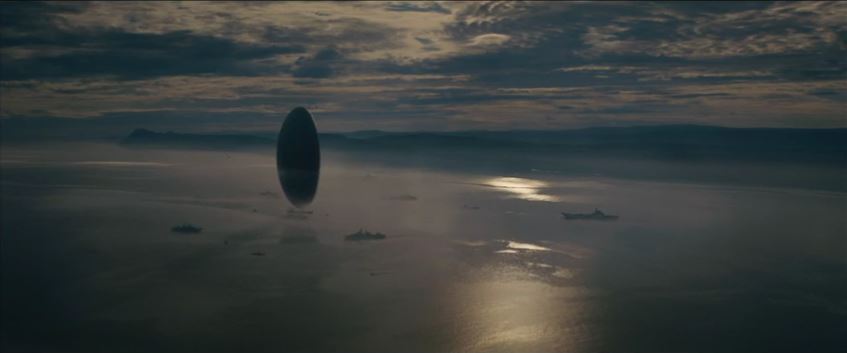
No, entire cities aren’t destroyed in the opening act. The President of the United States doesn’t look out the window of the White House and whisper, “My God.” Not only are no landmarks destroyed, they’re nowhere to be found—the alien ship which settles over America chooses to do so in Montana of all places. Even though the trailer gives away the reveal, it’s no less breathtaking seeing it within the context of the story.

The characters representing the government agencies provide strong conflict for the scientific characters without becoming the Jaws Mayor. Usually you’re supposed to hate the military character Forest Whitaker is playing, but you typically don’t draw actors as accomplished as he is if you’re so predictable. Michael Stuhlbarg’s CIA stooge also has clear and understandable motives, even though he, too, would have been made a villain in lesser movies.

I’ve complained several times on this blog about how scientists are often portrayed in movies. I’m glad I can say Amy Adams and Jeremy Renner nail it. They’re not pizza-eating losers in lab coats and they’re just the right amount of nerdy—the kind of people you would actually see interviewed in science documentaries. Adams’ character especially is complex and to say any more than that might give away some of the best stuff in the movie.

A Boy and His Dog (1975) [Trailer]

I don’t normally post fan edits, but this one’s poignant. (The official trailer, on the other hand, is all kinds of lame). Somehow I’ve never seen this movie despite the fact Harlan Ellison is one of my favorite writers of all time. I’m still deciding whether I want to rent it or buy the Blu-Ray.
As usual, there’ll be a Midnight Movie featured here this Friday so be sure to come back and check it out. Or don’t. It’s a free country, last I checked, but I must confess I didn’t see the results of the election at the time of scheduling this post. 
And I feel fiiiiiiiiiiiiine.

Midnight Movie: Starship Troopers (1997)

“If I tell the world that a right-wing, fascist way of doing things doesn’t work, no one will listen to me. So I’m going to make a perfect fascist world: everyone is beautiful, everything is shiny, everything has big guns and fancy ships, but it’s only good for killing fucking bugs!” — Paul Verhoeven

At first glance, the cast looked like it belonged in a television drama for teenagers. The jingoistic satire didn’t translate well to newspaper ads and 30-second TV spots. The goofy marketing made it look like a straight-to-video movie had somehow wormed its way into a theatrical release. And yet, I still went to see Starship Troopers on opening night, shuffling into the theater with the lowest of expectations. There were maybe six other people there including, I think, a local film critic who occasionally shone a penlight on his notes and impatiently touched the illumination dial on his wristwatch.

In Paul Verhoeven’s Robocop, the narrative is frequently interrupted by satirical advertisements and news segments, as if the film has commercial breaks baked right into it. Likewise, Starship Troopers opens with over-the-top war propaganda, simultaneously establishing its irreverent attitude and the premise: in the future, humans really hate bugs: the arachnid alien combatants who’ve thrown a wrench in humanity’s plan to colonize every nook and cranny of the galaxy. In fact, humans hate bugs so much that young men and women everywhere can’t wait to give up everything and fight the bastards.

Enter Johnny Rico (Casper Van Dien) and his dimwitted high school friends. Amusingly, the first act plays like a futuristic teenybopper drama before jerking the rug out from under the heroes’ feet. Rico has a hot girlfriend (Denise Richards), a hunky rival (Patrick Muldoon), a dangerously flirty gal pal named Dizzy (Dina Meyer), and an ultra-nerdy best friend played by Neil Patrick Harris, whose appearance in an R-rated romp was mildly scandalous at the time (Verhoeven had employed similar stunt casting with Elizabeth Berkley in his trash-masterpiece Showgirls, two years prior).

Rico’s girlfriend is sent to the space navy, his brainy best friend gets absorbed by the military’s science sector, and Rico ends up in the most elite squad of ground troops in existence. His drill sergeant is played by Clancy Brown, who always takes genre projects seriously and the same can be said of Michael Ironside (Total Recall’s Richter), who plays the lieutenant of Rico’s group. There Rico makes new friends for the first time in his adult life, including Jake Busey, whose maniacal appearance instantly washes away the Dawson’s Creek vibe from the earlier portion of the picture.

Just when Rico’s finally begins to gel with his new life, who of all people will suddenly transfer to his squad? Dizzy, the hot little baddie who’s been pursuing Rico since high school. Here’s something I really love about Starship Troopers: in practically every movie in which the leading character is pursued by two love interests, he or she inevitably ends up with the sickeningly wholesome, less attractive option. Not my boy Rico. Soon after his boring girlfriend dumps him via a video call, Rico hooks up with the considerably more exciting Dizzy.

The score by Basil Poledouris is as rousing as anything he’s ever done while the early CGI is somehow much more convincing than most digital effects today. As for the action, it’s exciting, well-paced, and comically bloody as per Verhoeven’s style. If you held a gun to my head and asked me to choose my favorite film of Robocop, Total Recall, and Starship Troopers, I literally couldn’t do it.

I had friends in high school who were even bigger science fiction readers than I. Two of them were dead-set against the idea of a Hollywood adaptation of Robert Heinlein’s source material. There are still critics who assert Verhoeven “ruined the book” by choosing to parody its values (though a lot fewer of them exist today as the general consensus of the film only seems to improve with time). Yes, Isaac Asimov wrote in his memoirs that Heinlein grew more conservative and militaristic with age. Though this is certainly true, Heinlein has suggested he was merely exploring such a society as a possibility, not necessarily promoting it.

Then you have modern SF writers like John Stalzi, who are about as liberal and anti-war as they come, writing military fiction in nearly the same vein as Heinlein. Long before the Sad Puppies (an extreme right-wing group of close-minded assholes who attempted to manipulate the Hugo Awards) I used to enjoy reading science fiction from a wide swath of political and philosophical backgrounds. To like Heinlein’s version and Verhoeven’s isn’t contradictory, but exemplary of what I loved about the brainy genre in the first place. In fact, Joe Halderman’s The Forever War, itself a direct counter-argument to Heinlein’s novel, is among my favorite SF novels of all time.

Though I wish the movie version had gotten the jet packs that Heinlein imagined in the novel, I’m going with Verhoeven’s version all the way.

Midnight Movie: Deadly Friend (1986)

Paul, the teenage hero of Wes Craven’s Deadly Friend, not only designs advanced robots, but he teaches college courses, dissects human brains, and somehow finds the time to hang out with his friends. The robot he’s created, “BB,” looks like a robot from any other 80s movie. It can crack locks, shoot hoops, and move heavy furniture. The only thing his robot can’t do is dodge shotgun spray, which we learn when it ding-dong ditches the neighborhood crazy lady, played by Anne Ramsey from The Goonies and Throw Momma from the Train. Don’t you just love her?

Paul’s love interest (Kristy Swanson in her first leading role) is repeatedly abused by her alcoholic father. In one of the film’s three or four dream sequences, which are filmed Nightmare on Elm Street style, she stabs her dear old dad with a broken flower vase. What follows is a jarringly bloody scene. Jarring because watching Deadly Friend is like getting thirty minutes into Short Circuit before discovering it’s an R-rated horror movie.

And here’s where my objectiveness flies out the window. I love killer robot movies. Terminator, Runaway, Chopping Mall, Screamers… I can’t get enough of this shit. What’s disappointing about Deadly Friend is they dispense with the actual robot twenty minutes in. The movie then goes the Donovan’s Brain/Frankenstein route: after Swanson’s father accidentally kills her, Paul transplants BB’s brain to her body. As expected, the world’s first robo-girl doesn’t come in peace. How she got superhuman strength isn’t explained nor is it entirely important in a movie like this.

This is an 80s movie, through and through, no doubt conceived by coked-up movie executives who wanted a gorier E.T. The Extraterrestrial. I mention E.T. because that’s exactly what Deadly Friend’s plot structure seems to mimic. Genre movies back then simply moved at a different pace than they do now. While most “slow-burn” horror films bore, this one has a pleasant pace. It really takes its time, but never takes more than we’re willing to give it. It makes the absurd climax, which is cram-packed with unintentional laughs, all the more entertaining.

J.J. Abrams said he got the name for one of his The Force Awakens characters from Phantasm. I’m beginning to wonder if he lifted BB-8’s name from this movie.

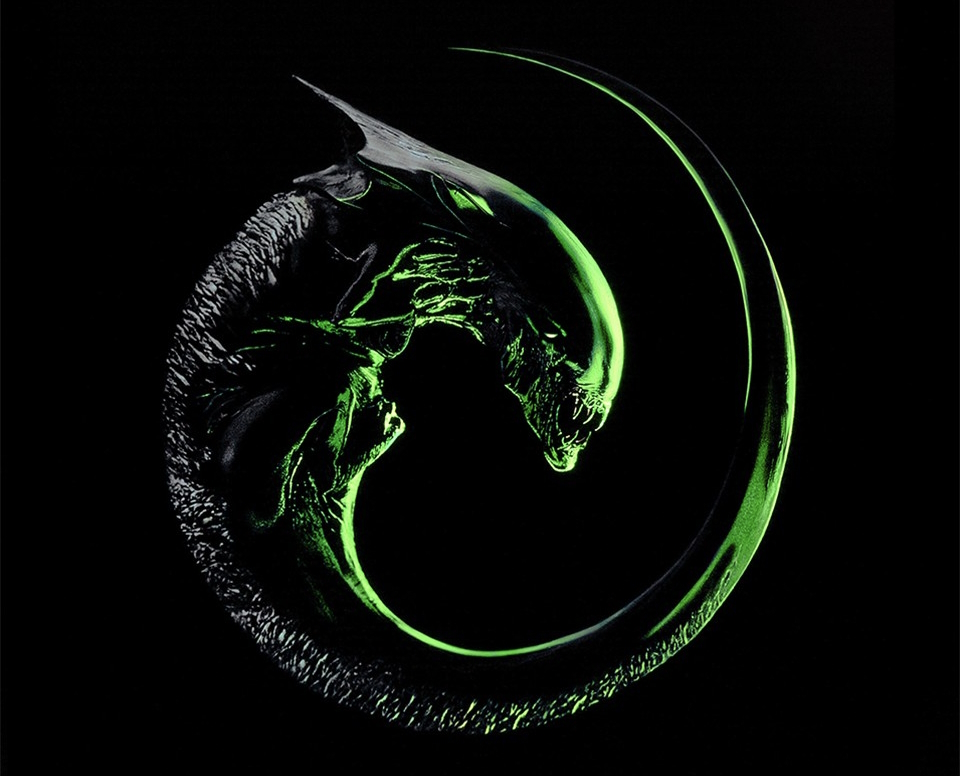
Alien 3: The Assembly Cut is a very different movie

For years I’ve heard about the so-called Assembly Cut of Alien 3, but didn’t expect much from it. I wouldn’t say I hated Alien 3 (although I would say that of Alien Resurrection), I just think Aliens’ version of Ripley is possibly my favorite movie character in history. I don’t know why I find her so endearing, I just do. I get chills whenever I merely think about her saying, “Get away from her, you bitch!” But in Alien 3 she just seems… off.

Those who claim Alien 3 was only disappointing because its critics were expecting more Aliens are mistaken. A lot of us loved the first sequel because it was so different from the original, not just because it was an action picture. Right out of the gate, Alien 3 makes the mistake of treading the same water as the original. It’s also important to remember Alien clones were a dime a dozen those days; the whole “we’re trapped in a spaceship/military complex/prison with an alien” thing was already severely played out by ’92. It was understandable audiences expected something different from a series which had yet to repeat itself.

Thankfully, the first forty minutes of The Assembly Cut feel like a completely different animal than the theatrical cut. In this edit, Ripley washes up on a beach after her escape pod crash lands on the penal colony known as Fury 161. Charles Dance’s character, whose best scenes are restored in this version, is out for a stroll on the beach when he discovers Ripley’s unconscious body. Many will oppose the idea that Ripley hops in bed with the first guy she sees, but I’ll be damned if it isn’t completely believable. It’s not, “We want you to believe these characters are suddenly in love,” but more like, “Sometimes, lonely adults have sex.”

Although there were so many lame alien clones at the time, The Assembly Cut makes it clear Fincher could have made the first truly skilled knock-off. Unfortunately, the special effects suck as bad as they did in ’92 and Ripley’s reaction to learning of Newt’s death still underwhelms. I was hoping the heavy-handed crucifixion imagery at the end of the movie was gone, and although that shot is improved in a way, it’s still stupid and pretentious. Other than that, The Assembly Cut is a decent end to the trilogy.

There are various other improvements I won’t spoil. I’ll just point out the alien’s entrance is much spookier than the one we initially got.

Millennium (1989)

Without giving too much away, Millennium is a time travel movie. The year (in one timeline) is 1989. A midair collision causes a jumbo jet to plunge rapidly toward earth. When the flight engineer checks the situation in the back, he discovers the passengers are already dead. Seconds before impact, the black box records the man’s final words: “They’re all burned up!”

The black box is one of several juicy mysteries for the investigators, led by Bill Smith (Kris Kristofferson). Another mystery: all the digital watches which survived the crash are now ticking backwards. I wanted the movie to explain why and how the watches tick backwards, but it never does. When it does explain things, it explains too much, often at the expense of the story. For example, there is absolutely no reason seasoned time travelers should need ideas like paradoxes and nonlinear timelines explained to them in excruciating detail. You’d think that stuff would be taught on the first day of Time Travel 101.

The film imagines a future phenomenon called “timequakes.” Unlike Vonnegut’s terrifying interpretation of the term, the timequakes in Millennium occur in the story’s present (a thousand years from now) whenever one of the time travelers change something in the past (1989). It’s disappointing that the phenomenon has less to do with temporal dimensional stuff and more to do with boring ol’ earthquakes, but after the time travelers experience one, they’re relieved that, “We haven’t changed much.” Which, like much of the movie, doesn’t make a lick of sense. If their actions in the past changed their present selves, how the hell would they know? Look, I’m not knocking a time travel movie for having plot holes. I’m knocking it because better time travel movies know how to skate by the problems all time travel movies have. Millennium is a lot like a magician who hasn’t mastered the art of misdirection yet.

What I like about the movie is the way it plays with perspective. In Back to the Future 2, Marty returns to events depicted in the first movie, but we see them from entirely different viewpoints. In Millennium, and maybe this is due to budget limitations and/or laziness, the movie wraps around to expand on earlier scenes, sometimes using the exact same shots as before. Sometimes it’s boring, sometimes it’s mildly interesting how nothing more than additional context could change a scene’s tone. Investigator Bill Smith is the focus for the first half of the movie and then… someone else becomes the main character.

Meanwhile the chemistry between Kristofferson and Cheryl Ladd tries too hard to be “future Casablanca.” Anyone who’s ever worked as a real life airline pilot or a safety inspector will scream at the screen frequently. My biggest complaint is the movie would have been a lot more interesting had it explored what happens after its final shot. That climax, by the way, is full of unintentional laughs, but the film is more or less believable as a whole. It’s just one of those movies that’s too odd for me to dislike. For instance, the all-seeing council is a direct descendant of Flash Gordon and Zardoz while the future sets, though utterly unconvincing, have a cyberpunk flair about them.

Here’s what John Varley has to say about the production, according to Wikipedia:

“We had the first meeting on Millennium in 1979. I ended up writing it six times. There were four different directors, and each time a new director came in I went over the whole thing with him and rewrote it. Each new director had his own ideas, and sometimes you’d gain something from that, but each time something’s always lost in the process, so that by the time it went in front of the cameras, a lot of the vision was lost.”

Millennium isn’t great, but it’s a helluva lot better than its 11% on Rotten Tomatoes.

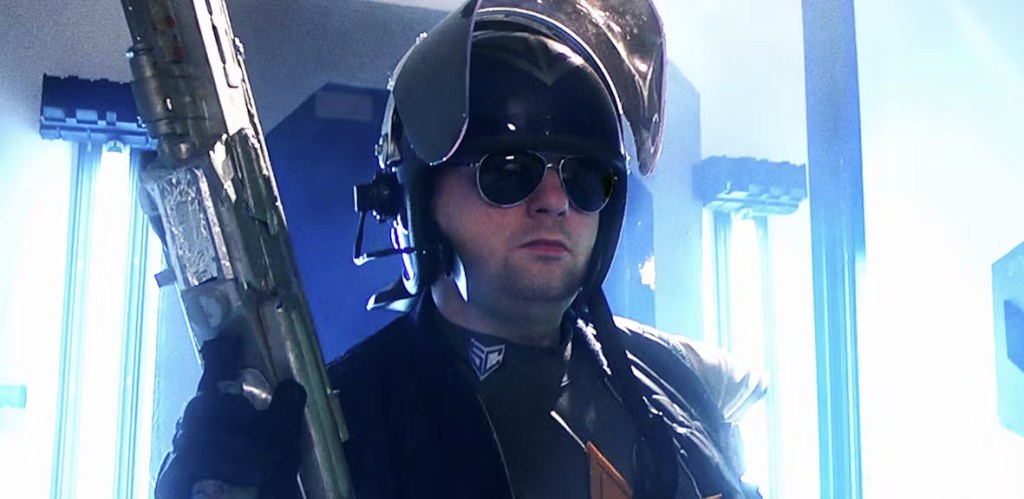
Space Cop is a terrible movie so… success?

Do you know how family videos are only funny to people in the family? That’s probably what Red Letter Media’s Space Cop is like. If you’re a fan of these guys, you’ll probably enjoy their movie. When the promotional material suggests it would someday be a contender for RLM’s own Best of the Worst series, they weren’t kidding. It’s a bad movie, but that’s their expertise, isn’t it? Expecting them to make anything else is like asking Mike Tyson to figure skate.

I’m no stranger to crowdfunded films so I knew what I was getting into… in other words, I wasn’t expecting much. Space Cop is A) better than I thought it would be and B) a lot more entertaining than the Angry Video Game Nerd movie, even if that one had a lot more production value (and still looked like shit). Space Cop starts off promising enough and feels like an authentic movie for the first few minutes despite soap opera lighting. Then it quickly descends into the non sequitur jokes and politically incorrect humor which work, if I’m being kind, roughly half of the time.

As for the plot, a gung-ho policeman from the future (Rich Evans) is accidentally transported to 2007 after he chases aliens into some kind of time-space vortex. During a modern day shootout in a cryogenics lab, the future cop accidentally thaws a cop from the past (Mike Stoklasa). They’ll have to team up to save the world from a devious plot involving aliens and a brain in a jar… or something. I don’t know and it doesn’t really matter.

The two main characters are only about as good as a memorable Saturday Night Live sketch, stretched to feature length. The actors’ decision to speak in “funny” voices from beginning to end is, at best, easy to look past, while at worst I can see it grating on the uninitiated. When Patton Oswalt makes a cameo, it’s pretty clear the boys were reluctant to trim their only star’s footage because it goes on and on. The length then becomes part of the joke.

My biggest issue with the movie is a complaint RLM have voiced themselves: the best bad movies are the ones that aren’t intentionally bad. Movies that set out to be bad just can’t capture the charm of bad movies trying to be good. Space Cop isn’t a good bad movie, but it’s a decent bad movie, at least when the jokes hit their target. If you’re a veteran of bad movies, and you like RLM—really like them—then you probably want to support them in this venture.

31 Days of Gore: Manborg (2013)

It’s October. Time to talk horror. This year I’m reviewing a different horror movie each day of the month.

Here’s a movie which was reportedly made for a little over $700 ($1,000 CAD according to Wikipedia). Yes, it’s probably the cheapest looking movie I’ve reviewed all month, but it certainly doesn’t look like they only spent $700 on it… I would have guessed the budget was at least twice that.

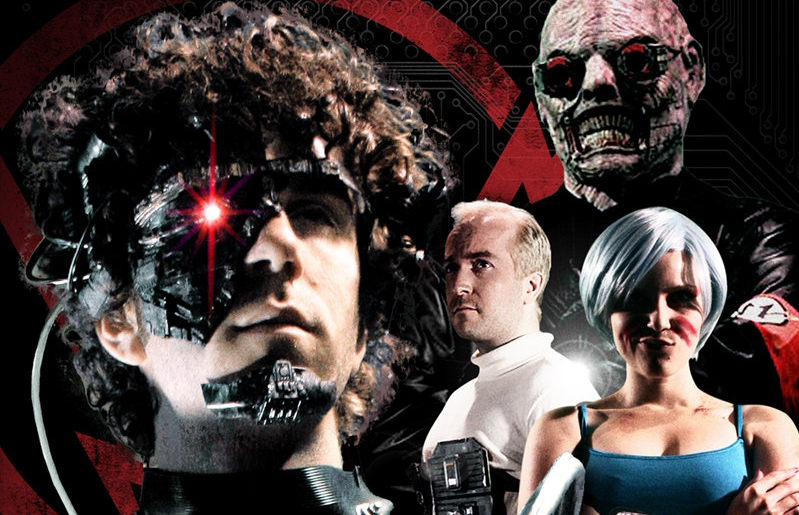
Manborg’s influences include Star Wars, Robocop, Shadowrun, Mortal Kombat, DOOM, Hellraiser, and The Running Man to name a few. The cyberpunk costumes are made out of spray-painted duct tape, plumbing parts, and a handful of comm-electronics the producers likely found lying around thrift stores. A hovering robot is obviously a modified action figure, animated with stop-motion, and the set designs utilize everything from homegrown CGI to cardboard.

And guess what. Manborg is probably one of the funnest movies I’ve watched this year. I’ve heard good thing about Astron-6, the small production company behind Manborg and Father’s Day, but this is my first time watching their stuff. It reminds me of another ultra-low budget spectacle called The Taint, which hopefully indicates a movement of poor moviegoers who are pissed off big studios no longer make entertainment for adults.

Manborg opens with a hilariously cheap-looking war between humanity and Count Draculon, a villain who’s leading an army of mutated Nazis straight out of hell. The main character dies. When he wakes up, now a cyborg, he and a ragtag crew of misfits are forced to fight in a gladiator arena for hell’s amusement.

The supporting characters include a Liu Kang knockoff, whose voice is dubbed by an obviously Caucasian actor, a female kung-fu assassin, and an illiterate Australian with a penchant for revolvers. There’s a little too much winking for the camera for my tastes, but that’s a minor complaint because most of the movie is deadpanned, which makes it feel a lot more authentic.

What else can I say about Manborg? You already know if you want to see it or not. I suggest that you do.

Come back at midnight Central Time for the next movie.

The Martian: NASA’s answer to Top Gun

Andy Weir’s novel begins:

I’m pretty much fucked.
That’s my considered opinion.
Fucked.

Early on, the movie adaptation drops the F-bomb twice, which is the maximum allowed for a PG-13 film, given there’s not much violence or nudity. Through the use of clever cutaways, the filmmakers manage to preserve the unfiltered character nicely. And no, these workarounds are not nearly as insulting as sanitizing the word with a perfectly timed gunshot, à la Live Free and Die Hard.

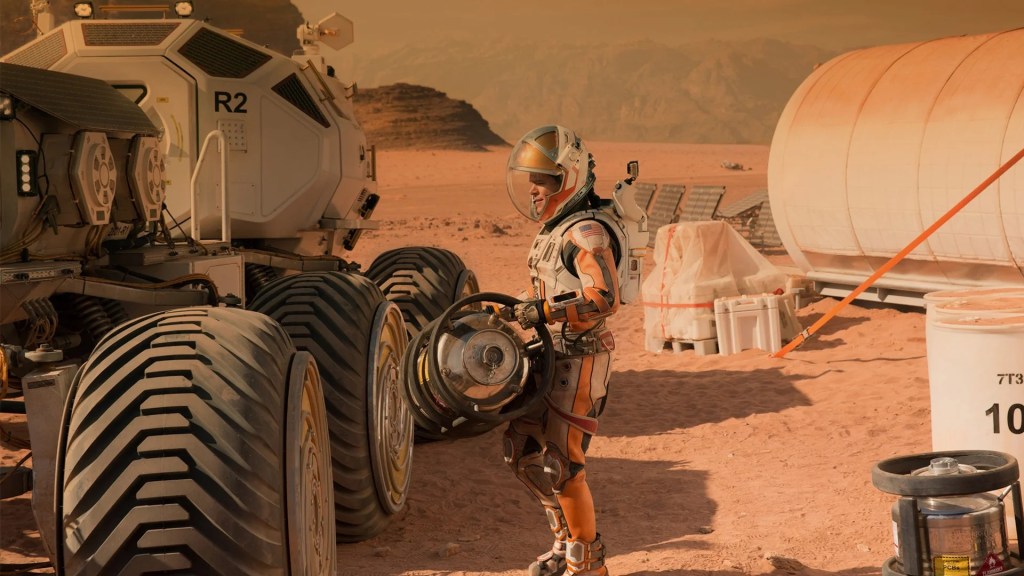
I’m glad, too. Mark Whatley (Matt Damon) is an endearing character whose cursing is integral to his personality. He’s the only human on Mars, stranded by a mission which went tits up. His diet, consisting mostly of microwaved potatoes, is in constant peril. Worst of all, he just ran out of ketchup. That he only says (and types) “fuck” a handful of times is kind of amazing, really.

The thing that struck me most about The Martian are the landscapes. None of it is obvious CGI and none of it looks like rose-filtered Earth locations, either. The horizons and the sun look just about right. Having just seen the trailer for Ron Howard’s In the Heart of the Sea, whose liberal use of bad CGI verges on obscene, I couldn’t believe my eyes. The Martian has some of the most subtle special effects I’ve ever seen. Every minute is visually believable.

The film wastes no time setting up the comradery among the martian astronauts, whose mission is jeopardized by a freak storm. The commander (Jessica Chastain) makes the hard decision to return to Earth prematurely. Moments later, she has to make the even harder decision: leaving Whatley behind when he’s struck by a flying satellite dish. Everyone believes he’s dead because the component which relays his life signs to the ship has been impaled by shrapnel.

Cleverly, the film trades first person narration for the video diaries Whatley keeps to entertain himself, which involve ransacking his coworkers’ personal effects and making fun of the things he finds. He tells the GoPro cameras stationed around the habitat what he’s up to every step of the way. The first order of business is setting up a crop a of potatoes. Then he’ll have to “science the shit out of the situation” in order to send an SOS back home. In his first message, he says in a comically weak voice, “Surprise.”

Unfortunately, Murphy’s Law is in full effect on Mars. You always know something is about to go wrong, but you never know what or how. It’s the same kind of suspense which made Apollo 13 so tense even though we all knew the characters make it back home. Like that movie, The Martian doesn’t try too to make its audience teary-eyed. It’s primary mission is to entertain, which is exactly what elevates it above the endless supply of movie directors trying to mimic 2001: A Space Odyssey by infusing artificial mysticism into their space films (see: the incredibly insulting Mission to Mars and the merely okay Red Planet).

The Martian has everything I wanted from Gravity and Interstellar. This is real science fiction and not the Hollywood bastardization of the genre. Sure, a few of the things that happen are unlikely (Weir said he wishes he had chosen a different disaster to kick off the story as a storm of that nature is unlikely on the red planet), but there are plenty of scenes which contain more science than all the previous martian movies combined.

This is all to say The Marian is easily the best science fiction movie of the 21st century. It’s no wonder why the NASA program is promoting it like their version of Top Gun, which was a boon to the Navy’s recruitment efforts. The PG-13 rating is wise because there will be countless children pursuing careers in science and aeronautics after seeing it. We need more movies like it—exactly like it. In fact, Hollywood should just go ahead and commit to adapting every novel Andrew Weir ever publishes from here on out.

“The moon blew up without warning and with no apparent reason.” Seveneves is my ideal summer book

In Neal Stephenson’s Seveneves, the moon explodes in the first sentence. At first, the damage is mostly cosmetic because all the moon’s mass is technically still there, albeit in seven large chunks. The moon’s center of gravity (and here is one of Stephenson’s many lessons in physics) remains more or less where it was before the mysterious collision so it’s business as usual for Earth’s tides. Unfortunately, it’s not long before two of those seven chunks collide and create more chunks. Scientists the world over realize that each time another chunk is created, the odds of another collision only increase. The collisions are eventually going to result in an earth-wide event called the White Sky, which immediately precedes “the Hard Rain.”

One character describes the Hard Rain like this: “Those fiery trails we’ve been seeing in the sky lately, as the meteorites come in and burn up? There will be so many of those that they will merge into a dome of fire that will set aflame anything that can see it. The entire surface of the Earth is going to be sterilized.”

Long story short, the Hard Rain is coming in two years, at which point Earth will be inhospitable for a period of fifty centuries or more. Humanity only has a handful of months to prepare the preservation of the entire species. It’s going to require a ton of jury rigging and massive risk-taking to complete such a project. And if that’s not exciting to you, check you pulse, pal. It’s a very hard science fiction story that strongly reminds me of Larry Niven and Jerry Pournelle’s seminal Footfall, minus the elephant-aliens.

Seveneves begs to be read slowly and deliberately. If Stephenson’s writing were any denser, it would pass the Schwarzchild radius and devour us all. For those of you who haven’t read any of his stuff, I say “dense” in the kindest way possible—like Gene Wolfe turned up to eleven. You may have heard critics accuse Stephenson of slipping into tangents in which he goes into meticulous detail about language, culture, history, science, mathematics, or whatever else he finds pertinent to the plot. Well, yeah. That’s, like, kind of his shtick. The info dumps are so absurdly long, they eventually become amusing.

You likely won’t find a novelist who knows more about anything, but particularly orbital mechanics; Stephenson literally had a job tracking the trajectory of space debris. And boy, does he take every opportunity to remind us he knows what the hell he’s talking about.