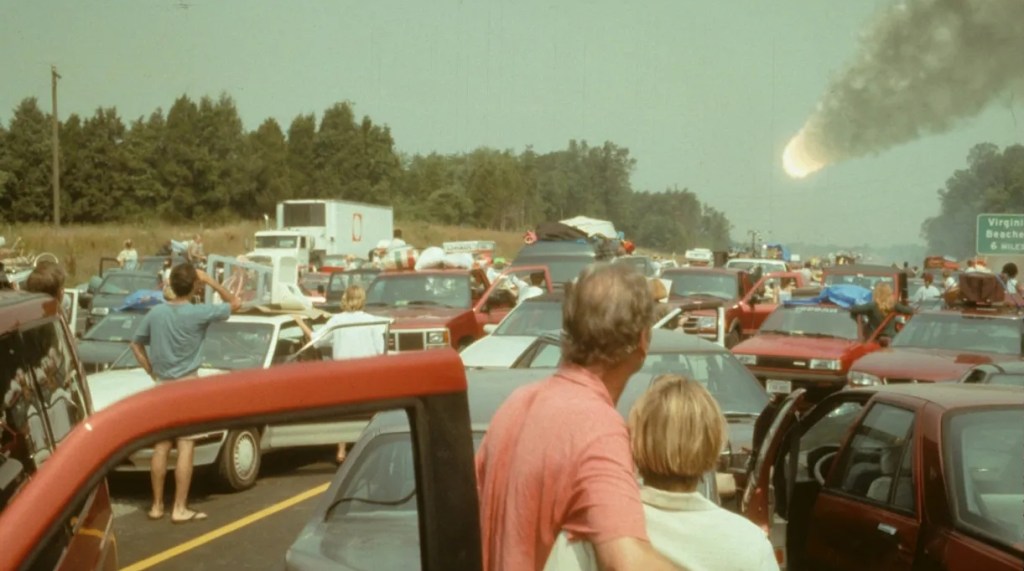
Russia’s meteor event reminded me to finish Deep Impact

The Chelyabinsk meteor tickled me to pieces. Whereas the news had been mirroring dystopic fiction all too often lately, it was a relief to see it mirror doomsday fiction for a change. The event reminded me I had somehow never finished Deep Impact, which I had only seen portions of whenever I was channel surfing. Frankly, the film appeared to be a bore, but where else am I going to find sweet space rock action?

In the interest of transparency: I generally dislike Hollywood disaster movies. The Towering Inferno, Armageddon, The Day After Tomorrow, Earthquake, Twister, The Core, Volcano, Dante’s Peak—all of these productions feel as disastrous as the literal disasters they depict. All you need to make a disaster movie is a weak understanding of natural occurrences, a bunch of technobabble, a handful of crumbling landmarks, and gooey melodrama liberally garnished with hundreds of extras racing down city streets. Other than the visual effects, the genre has not improved at all in nearly fifty years.

In the beginning of Deep Impact, a young boy (Elijah Wood) spots a new object in the sky with a store-bought telescope. Even though the scene reeks of dishonesty, it’s kinda accurate in the sense amateur astronomers still make important contributions to this day. His astronomy club submits the finding to a full-fledged observatory where a stereotypical movie scientist keys the coordinates into his computer and realizes the object is barreling towards our planet. That alone would be exciting, but somehow it leads to a cliff-side car wreck that has the scientist’s vehicle exploding in a Hollywood fireball—in midair no less.

A year later, an investigative reporter played by Téa Leoni thinks she’s gotten the scoop on the Secretary of the Treasury’s mistress, a woman she says is named Ellie. She soon finds out that she misheard “E.L.E.,” which stands for “extinction level event.” Yes, I know the government can be pretty incompetent at times, but that’s like using the code name “U.F.O.” to cover up flying saucers. The President (Morgan Freeman) personally asks the reporter to sit on the scoop until he can announce the news himself. In typical Leoni fashion, she merely shrugs and says, “Okay.”

Two days later, The President reveals to the world that a comet is on a collision course with Earth. He freezes national wages and product prices to prevent profiteering and panic. Then he reveals the plan: scientists are already working on a manned mission that will attempt to destroy the comet with nuclear weaponry. The senior astronaut on the mission, played by Robert Duvall, was the last person to step foot on the moon. The younger astronauts resent him, which is the dumbest thing in the entire movie. I’ll give you a shiny nickel if you can name one person who had the wherewithal to complete astronaut training who doesn’t idolize any of the dozen men who walked on the moon; in Deep Impact, astronauts have the emotional intelligence of high school jocks.

As the ship makes its way to rendezvous with the comet, Leoni’s unbelievable reporter is promoted to an even more unbelievable news anchor. I know some news personalities are known for being a little stiff, but Leoni’s performance could make robots wince. It’s a shame the Earth drama is so hackneyed because the space stuff is excellent. Yes, there’s sound where there should be none and much of the suspense was ruined by the marketing, which clearly spoiled that the mission fails and the comet indeed strikes the planet, but if the space bits had been the entire movie, it could have been a great one.

Predictability aside, the second half is much better than the first. Lesser films show civilization devolving into mass hysteria when faced with possible extinction. Though it’s refreshing that Deep Impact bucks the trend, its characters can still hail a cab within seconds of raising a hand. I’d say maybe society is doing a little too well, all things considered.

Later on, the reporter’s mother says she feels relieved she won’t survive the impact. She even quit smoking and donated some of her more valuable belongings to the government’s effort to preserve antiquities. This was the sole scene which unexpectedly moved me. A lot of armchair philosophers love to talk about how shitty humanity is, but if we were all that bad, we never would have civilized in the first place. This is exactly the stuff I wish more disaster movies had.

Deep Impact is a bit like a newborn calf. There’s a lot of wobbling in the beginning, but eventually it learns to walk… sort of. It’s one of the better disaster movies, but that’s not saying much. If, like me, you found a strong interest in what happened in Russia recently, you should give it a shot.

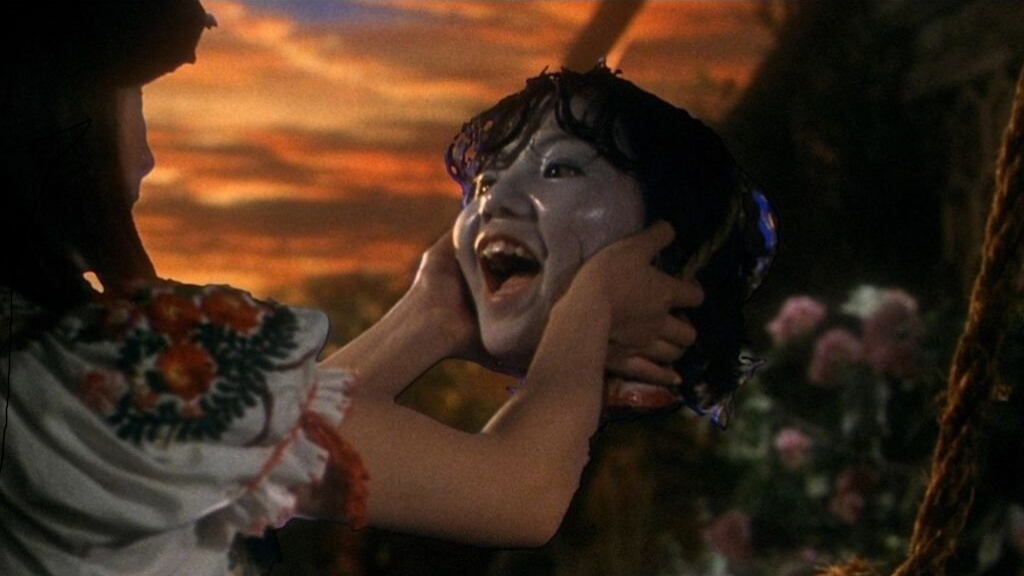
Our Hausu, in the middle of our street

Yesterday I was asked, “What’s the most absurd horror movie you’ve ever seen?” I was surprised how quickly the answer came to me. It was obviously Hausu.

Sure, there’s bound to be more absurd movies that I’ve either forgotten or haven’t seen. But when someone asks questions like that, the person isn’t asking for shitty recommendations. Hausu is as close as you can get to full blown insanity without sacrificing a cohesive and enjoyable experience. It’s fast, it’s funny, and it’s ridiculously out of its mind.

Hausu is among the best times I’ve ever had watching a movie. To this day, I still don’t know exactly what it’s about. To avoid confusing this masterpiece with the numerous other movies called House, I will refer to it as Hausu. Yes, I just called Hausu a masterpiece. It should appeal to anyone with a pulse.

I’d typically mention something about the plot by now. What’s the point? There’s a house. It’s haunted. There’s a cat. It’s crazy. Heads will fly. Literally.

‘Nuff said.

Nightbreed: The Cabal Cut

I haven’t seen Nightbreed in at least a decade, but I saw it a lot and I remember that sometimes I liked it, sometimes I didn’t. If there’s anything my multiple viewings had in common, it was this: the movie is confusing. Said one of my friends, “I love that movie, but it really doesn’t make any sense!”

There’s a reason the theatrical cut doesn’t make a lick of sense: the studio panicked when the film performed poorly for test audiences. The execs ordered several weeks of re-shoots and attempted to turn a monster movie into a slasher film (slashers were more commercial at the time) and predictably failed. Instead of releasing the film around Halloween of ’89, the studio moved it to February of the next year because nothing says “Valentine’s Day” like monster/slasher mayhem. Needless to say, the movie bombed.

I remember hearing rumors about missing footage some time ago. I didn’t think much of it—these things usually just get your hopes up. According to an excellent article in the latest issue of Rue Morgue, however, the footage hasn’t just been found, there’s a new cut of the film. That’s the good news… the bad news is this long lost footage was found on VHS dubs of the master. The current state of The Cabal Cut (Cabal being the name of Barker’s original novella) is a patchwork of VHS scenes and DVD footage. Despite the alternating quality, the screenings of the project are reportedly doing well.

Apparently the studio is taking notice. These kind of movies typically perform much better years after they find their cult following. According to Clive Barker and the other guys involved with The Cabal Cut, Morgan Creek Productions gave them permission to screen the film as a way to gauge interest. So one day there could very well be an official version of The Cabal Cut, but I won’t hold my breath.

Spoiler: John Dies at the End

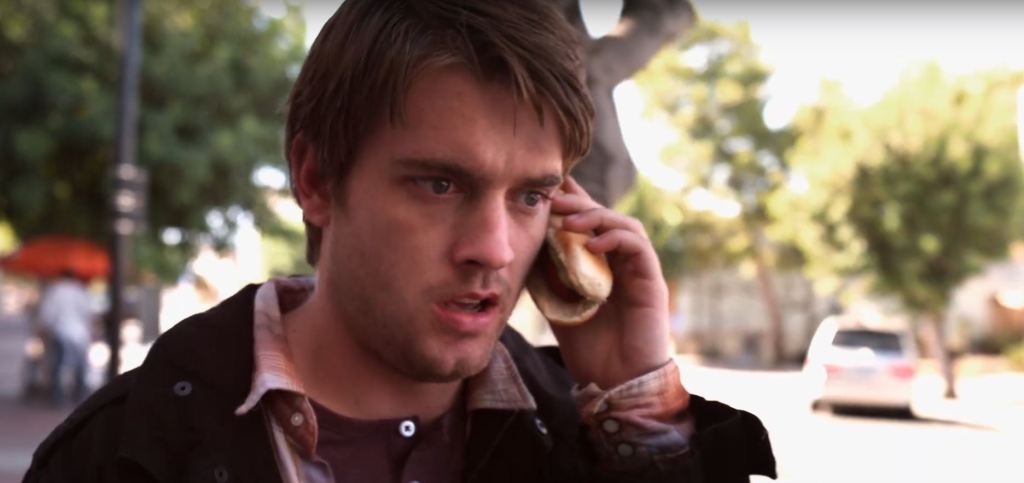
Hello? Yes, this is hot dog.

John Dies at the End is now available on VOD about a month before it releases in theaters. Pointing out the flaws in a movie like this is like refusing to go to bed with Marilyn Monroe because she has a mole. All genre classics are flawed, from Escape to New York to Evil Dead 2. Given enough time, these movies’ flaws become so endearing that drunken frat boys excitedly point the flaws out at movie parties. I suspect John Dies at the End may have launched itself on a similar trajectory, though David Wong’s serialized novel-thing somehow has better comedic timing. Questionable CGI aside, this movie’s a fine crowd-pleaser.

Don Coscarelli was the director who broke into the movies when he made the ultra-low budget Phantasm, a horror film about a demonic undertaker whose bidding was done by inter-dimensional dwarfs and sentient spheres. For me, it’s not a very rewatchable movie, but I have a soft spot for its first sequel. Coscarelli also made Bubba Ho-Tep, which supposes the real Elvis Presley (Bruce Campbell) ended up in a nursing home through an unlikely series of events (it was an impersonator who died). Teaming up with Ossie Davis, playing an elderly black man who thinks he’s JFK, Elvis must go toe-to-toe with a mummy who’s eating the souls of the nursing home’s residents.

As he did with that film, Coscarelli once again adapts a bizarre story written by a little-known cult writer. John Dies at the End is somehow even harder to summarize than Bubba Ho-Tep—and apparently harder to film as significant sections of the source material are omitted. It’s about a couple of slackers who are addicted to a drug called Soy Sauce that makes them see things from another dimension. There’s an alien subplot, too, all of which unfolds in a confusing order of events, true to the source material. The movie also features Paul Giamatti, Clancy Brown, and Doug Jones, who you may not recognize without the monster makeup he wore in Hellboy and Pan’s Labyrinth.

Just watch the trailer. If that appeals to you, then watch the movie. I have to go now. My hot dog is ringing.

Sinister isn’t false advertising

Sinister opens in grainy 8mm film. There’s a family of four hooded and bound. There are nooses around their necks, the ropes of which are draped over a tree branch above. A pole saw enters frame and cuts another branch where the other ends of the nooses are tied. As that branch goes down, the family is slowly (gruelingly) strung up. It’s an effective image and by now you should already know if this is a movie you want to see.

Enter Ellison (Ethan Hawke), his wife, and two children. They’re the new family moving into the very house where that murder took place. Ellison is a true crime writer who dreams of becoming the next Capote. He got a taste of fame a few books ago, but proved to be a hack in the meantime. Ridiculously, his wife doesn’t know the history behind the house they’re moving into. Although it’s common for men to surprise their wives with a new house, doing so in real life should be automatic grounds for divorce.

Eventually Hawke’s character stumbles upon a box in the attic containing a bunch of films and a home movie projector. The canisters are labeled innocently enough: Family Hangin’ Out ’11. Pool Party ’66. Sleepy Time ’98. BBQ ’79. My personal favorite is Lawn Work ’86, which takes creative liberties with a lawnmower. I doubt Honda paid for this product placement, by the way.

Ellison calls the police, but when he’s put on hold, he catches sight of his best-selling book on a nearby shelf. Fearing a scoop is about to slip through his fingers, he convinces himself to hang up. Be assured there will be one paper-thin excuse after another to keep him and his entire family in danger. Otherwise, there wouldn’t be a movie.

Things do indeed get sinister. Eventually Ellison gets in touch with an occult expert (Vincent D’Onofrio) who says the symbols seen in each of the home movies reference a child-consuming demon. Demon or not, considering the scorpions and snakes found in Ellison’s attic, I would have moved out of the house on day one. There are also creepy children in the movie. Like creepy clowns, I can’t be the only one who’s getting bored of creepy children in films like this. I’m also getting bored of writers for main characters and creepy home movies.

At the end of the day, it’s a watchable picture, just a little slow. The term the filmmakers would prefer is “suspense-building,” but I don’t think it’s good enough to hold a moviegoer’s attention between the candy bar scenes. The film is certainly sinister, but it isn’t scary. I’m not entirely disappointed I saw it, but it arrives at a predictable ending that has nothing to say.

Looper is Sooper

The year is 2044. It’s thirty years before the invention of time travel. A voiceover tells us that as soon as time travel is invented, it’s outlawed. Naturally, that won’t stop the most powerful crime syndicates from using it. So where’s Timecop when you need him?

Joe (Joseph Gordon-Levitt) is a looper. Loopers are hitmen, but not the type who whack you in Scorsese movies. No, loopers simply wait in a field for a target to appear from the future. When the target arrives, hooded and bound, the looper shoots him. The only benefit of doing it this way is the body won’t be found in the future, when cops have access to higher tech forensic methods.

Before disposing of the body, the looper can find their payment strapped beneath the target’s clothes. The payment usually comes in the form of silver bars, which can be traded for their own timeline’s currency. Every looper knows full well that, one day, they’ll find gold bars strapped to a body instead of silver. The day that happens, the looper has just retired himself, which is so common it’s called “completing the loop.” When we see that Joe lives very well in a future where most live in squalor, we can see the attraction of the job despite its deadly retirement plan. He even admits that people in his line of work aren’t exactly forward-thinkers.

If you’ve seen the trailer, you already know that when Joe’s future self is sent back, young Joe fails to retire him. His future self is played by Bruce Willis, which is far less distracting than having Gordon-Levitt play dual roles—one in old-age makeup. You’re probably expecting a cat-and-mouse game to ensue. It’s actually more like a cat-mouse-dog-and-tiger game in which timelines tangle like pasta.

Does this sound convoluted to you? It’s a movie about time travel—of course it’s convoluted. Whereas so many of these movies try to make an unbelievable premise believable with endless technobabble, Looper leans into the problems of time travel with little explanation, which gives it room to do something fresh in the genre. Its interpretation of the rules leads to one of the most chilling death scenes ever filmed. The scene in question is truly the stuff of nightmares, but if you want to poke holes in it, you’re watching the wrong movie.

The X-Men Rises? (First Class review)

X-Men: First Class opens in a concentration camp. The boy who will one day become Magneto is separated from his parents by Nazis, which causes his mutant powers to unlock. Stricken with grief, he discovers he can bend metal with his mind. And you’re right: we have seen this exact scene before.

Around the same time, young Charles Xavier has learned he can read minds. He demonstrates the ability when he discovers a young and homeless Mystique rummaging in his kitchen. I don’t remember Professor X ever recognizing the shapeshifter in the films set after this one, but just go with it. You’ll have bigger challenges with this film, believe me.

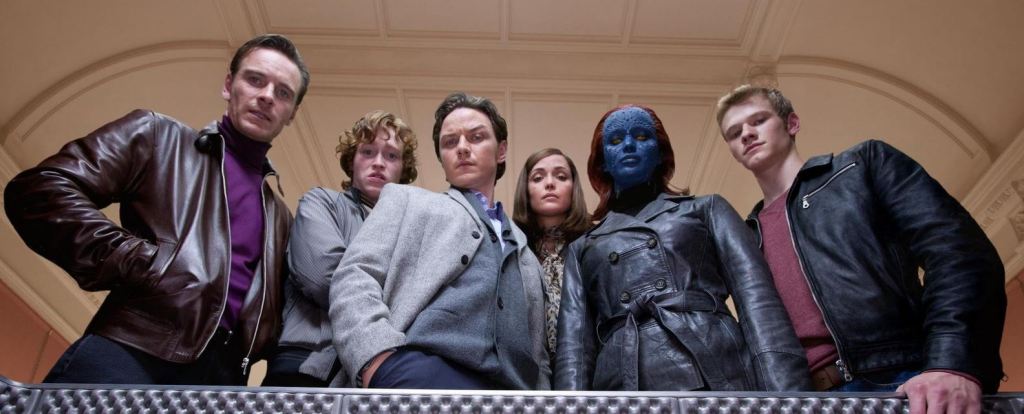
Fast forward a few years later and an adult Magneto (Michael Fassbender) is searching for Dr. Schmidt (Kevin Bacon), who cruelly studied his powers of magnetism and murdered his mother. We learn that adult Charles Xavier (James McAvoy) and adult Mystique (Jennifer Lawrence) have been hiding their mutant powers ever since they met. Mystique is forced to appear in her human form whenever they’re in public; she thinks men are unlikely to find her attractive in her natural blue form (um… sure).

Schmidt has escaped to America under the guise of Sebastian Shaw. During a stakeout, CIA agent Moira MacTaggert (Rose Byrne) learns Shaw is a mutant who plans to incite nuclear war. See, mutants were born of radiation so they will survive the nuclear winter (never mind the blasts). Most humans, on the other hand, will not. When you’ve got mutants as dangerous as Shaw, you can see why the government wants to track them all, but I digress. Again, there will be harder pills to swallow.

Charles and Mystique are recruited by the CIA to go after Shaw. Charles convinces Magneto to join him. They’re going to need a team, of course, so they scrape the absolute bottom of the barrel. See, for much of the original run of Uncanny X-Men, there was a problem: it was kind of a mediocre comic. It wasn’t until Giant-Size X-Men when the team got interesting. Which begs the question: Why bother making a film about the X-Men team no one, including Marvel itself, gave a shit about?

Look, all superhero movies are at least kind of goofy, but First Class takes the cake. Even the recognizable X-men are portrayed by younger actors with roughly half the gravitas of the old ones. Most of their powers are dull and useless. Worse, Magneto seems to exist in his own movie most of the time, a more serious movie, a darker movie, and a better movie. I would have much rather seen Magneto: Origins than this uneven mess.

Tonal shifts aside, it’s a well made movie made by an accomplished director whose first three movies I admired tremendously. It just isn’t exciting subject matter, unfortunately, and I hope he gets a chance to return to the less-Hollywood fare where he originally made a name.

Batman ends (I finally saw The Dark Knight Rises)

Batman and Bane set aside their differences and hold hands.

Most people who give a shit about Batman have probably already seen The Dark Knight Rises. I just feel no urgency to see a movie that’s going to make a billion dollars anyway and I’d rather give my money to Dredd any day of the week. Besides, going to the multiplex fills me with as much dread as getting up for work after a long night at the bar.

Speaking of dread (Have you seen Dredd?), I have a hunch that Nolan was burnt out on the idea of making another Batman movie this soon. If it took him so many years to write Inception (twelve, by his count), I can see how he may have felt pressured wrapping the series up, particularly after the serendipitous forces that made the previous film so unusually good. Nolan does a remarkable job, all things considered, but it’s not even as good as his first Batman picture.

The Dark Knight Rises opens with an airborne heist. We’ve seen that a million times, in a few James Bond films and Cliffhanger. Other than the introduction of Bane, the film’s powerhouse villain, there really isn’t a lot to discuss here. I mean, they’re not hijacking gold bars or anything as tired as like that, so it’s fresh enough and the photography is exceptional. There’s a punk rock energy to Tom Harden’s performance in the sense his version of Bane sounds absolutely ridiculous in the best (least commercial) way possible, as if telling the audience, “This is what I sound like. Don’t like it? Tough shit.”

Cut to a charity event at Wayne Manor. We learn it’s been eight years since Harvey Dent died and Batman disappeared, accused of murder. Gotham is mostly crime-free and Commissioner Gordon comes this close to telling a crowd of people that the district attorney turned into a raging psychopath at the end of the last picture. Bruce Wayne, it turns out, has become a Howard Hughes recluse whose knees are shot. That night, he catches a cat burglar (Anne Hathaway) stealing his mother’s pearls, but gets foiled by his old man cane. (Have you noticed all the franchise heroes are suddenly allowed to age lately? It’s an interesting trend, but a trend nonetheless.)

That’s where the movie lost me. Forget comparing Catwoman’s character to the other films—within the context of this film, the character is too goofy, too Hollywood, and too unbelievable. I’ve seen Schwarzenegger films with fewer one-liners. Catwoman in The Dark Knight Rises is like the ewoks in Return of the Jedi. The piece just doesn’t fit the puzzle. Hathaway is great with what she’s given, and predictably looks hot in the part, but this is one of the many reasons I think Nolan needed a little more time to let this one cook.

My second biggest complaint is Marion Cotillard, Wayne’s love interest, who you’ll remember from Inception. Movies in general could use a lot more Cotillard, as far as I’m concerned, but her character in this movie is pretty pointless until the point abruptly emerges. Then there’s Joseph Gordon-Levitt. I love this guy, but here he’s a little too run-of-the-mill. We all knew it when we saw the trailer, so let’s not even pretend this is a spoiler: he’s Robin, but don’t expect to see him suit up in his trademark underwear and leggings in the Nolanverse.

Then there’s the lighthearted comedy relief. It’s not as bad as, say, Johnny Knoxville in any non-Jackass movie he’s ever been in. It’s not even that bad, really… it’s just not right for this film. I know Rises was designed to be lighter than the last film (alluding to Dent’s speech about the night getting darkest before the dawn), but a second heist, and the ensuing car chase, struck me as a little too routine for Nolan. Meanwhile, the scenes where Batman and Catwoman fight side by side are reminiscent of Batman’s goofier days.

About halfway through the movie, Nolan drops blunt hints to the film’s conclusion. He wants us to know what happens in the end because there’s more to it than what you would expect. The ending is vague and it didn’t necessarily work for me at first. Thinking back on it, though… yeah, it works (I guess). As far as trilogy-caps go, Rises is among the best. That’s a rare honor even if the competition isn’t very thick.

You should give your money to Dredd instead.

Dredd (2012): Don’t Call It a Remake

Olivia Thirlby and Karl Urban

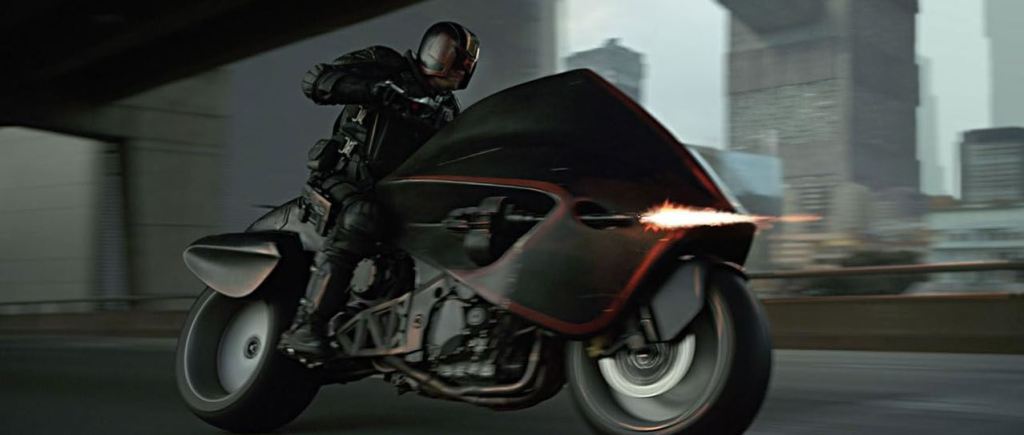
When my mother took me to see Judge Dredd on opening weekend in 1995, there was one other moviegoer in attendance. The guy got so bored he tried to read a book during the middle of the movie. Not that Judge Dredd was entirely without merit; I always thought it was a little better than most people cared to admit, Rob Schneider notwithstanding. While Karl Urban certainly has a better chin for Dredd, Sly had the more accurate body type; I may also slightly prefer the costumes and motorcycles of the 1995 film, too. That’s the only nice things I can say about that.

In Mega City One, one of the few cities left standing after nuclear war, Judges are cops, juries, judges, and executioners rolled into one. Despite its breakneck pace, this new adaptation of the 2000 AD character manages to paint a complete picture of its bleak and ultra-authoritarian setting in deft strokes of worldbuilding. We learn early on that Judges are spread so thin they can only respond to 6% of all crime in a city of 800 million people. With statistics like that, it’s a wonder why everyone doesn’t become criminals.

Batman ’66 vibes

The opening has Judge Dredd engaged in a high-speed pursuit with a street gang who’s stoned on slo-mo, a street drug that makes users perceive time at 1% of its normal speed. Dredd sentences the thugs to death, the last of which is dispensed in gruesome R-rated fashion. In the next scene, Dredd is assigned a new partner, Cassandra Anderson (Olivia Thirlby), who failed her aptitude tests, but may still get recruited for her uncanny psychic abilities… pending Dredd’s assessment, of course.

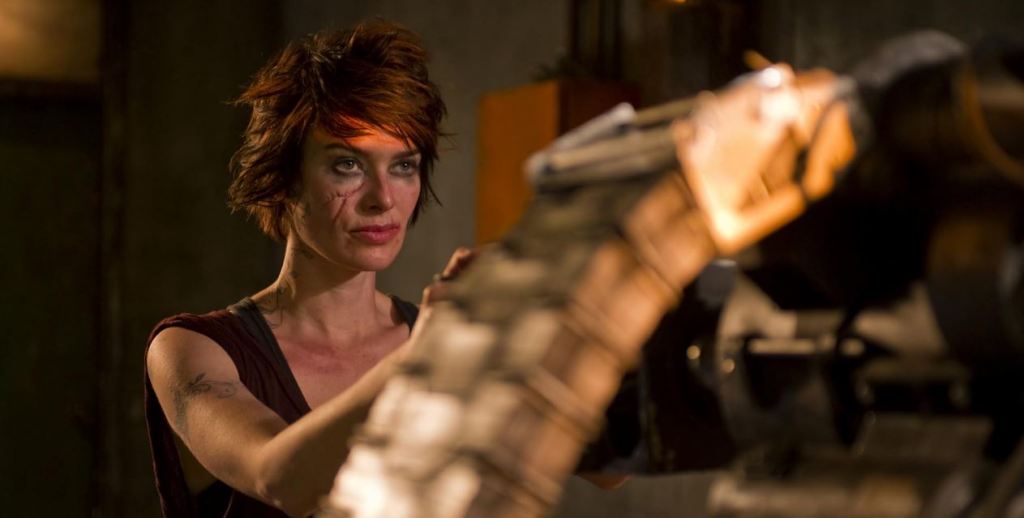
For her first day on the beat, Dredd lets Anderson pick which call to take. The rookie chooses to respond to a triple homicide in a two-hundred story slum, which happens to house a viscous crime lord known as Ma-Ma (Lena Headey, who’s even crueler in this than she is in HBO’s Game of Thrones). In a brief introduction, we learn Ma-Ma’s an ex-prostitute who “feminized” her former pimp before installing herself as the kingpin manufacturer of slo-mo. When Dredd and Anderson arrest one of her lieutenants, Ma-Ma hacks into the building’s security system, closes the blast doors, and places a bounty on their heads.

Lena Headey

That’s it. That’s the entire setup. The rest of the movie is Dredd and Anderson just trying to survive while they wait for backup. Movies like this are only as good as their villains and Dredd has a great one. She’s a believably nasty mother fucker to put it mildly.

Adults rarely have a good excuse to go see a genre movie, but Dredd’s one of the better ones. In 1995 it would have cleaned house. As of this writing, it hasn’t even recouped half of its modest budget. It’s a shame, too, because this is one of the rare franchises deserving numerous sequels. And that’s coming from someone who typically loathes sequels.