The year is 2044. It’s thirty years before the invention of time travel. A voiceover tells us that as soon as time travel is invented, it’s outlawed. Naturally, that won’t stop the most powerful crime syndicates from using it. So where’s Timecop when you need him?
Joe (Joseph Gordon-Levitt) is a looper. Loopers are hitmen, but not the type who whack you in Scorsese movies. No, loopers simply wait in a field for a target to appear from the future. When the target arrives, hooded and bound, the looper shoots him. The only benefit of doing it this way is the body won’t be found in the future, when cops have access to higher tech forensic methods.
Before disposing of the body, the looper can find their payment strapped beneath the target’s clothes. The payment usually comes in the form of silver bars, which can be traded for their own timeline’s currency. Every looper knows full well that, one day, they’ll find gold bars strapped to a body instead of silver. The day that happens, the looper has just retired himself, which is so common it’s called “completing the loop.” When we see that Joe lives very well in a future where most live in squalor, we can see the attraction of the job despite its deadly retirement plan. He even admits that people in his line of work aren’t exactly forward-thinkers.
If you’ve seen the trailer, you already know that when Joe’s future self is sent back, young Joe fails to retire him. His future self is played by Bruce Willis, which is far less distracting than having Gordon-Levitt play dual roles—one in old-age makeup. You’re probably expecting a cat-and-mouse game to ensue. It’s actually more like a cat-mouse-dog-and-tiger game in which timelines tangle like pasta.
Does this sound convoluted to you? It’s a movie about time travel—of course it’s convoluted. Whereas so many of these movies try to make an unbelievable premise believable with endless technobabble, Looper leans into the problems of time travel with little explanation, which gives it room to do something fresh in the genre. Its interpretation of the rules leads to one of the most chilling death scenes ever filmed. The scene in question is truly the stuff of nightmares, but if you want to poke holes in it, you’re watching the wrong movie.
X-Men: First Class opens in a concentration camp. The boy who will one day become Magneto is separated from his parents by Nazis, which causes his mutant powers to unlock. Stricken with grief, he discovers he can bend metal with his mind. And you’re right: we have seen this exact scene before.
Around the same time, young Charles Xavier has learned he can read minds. He demonstrates the ability when he discovers a young and homeless Mystique rummaging in his kitchen. I don’t remember Professor X ever recognizing the shapeshifter in the films set after this one, but just go with it. You’ll have bigger challenges with this film, believe me.
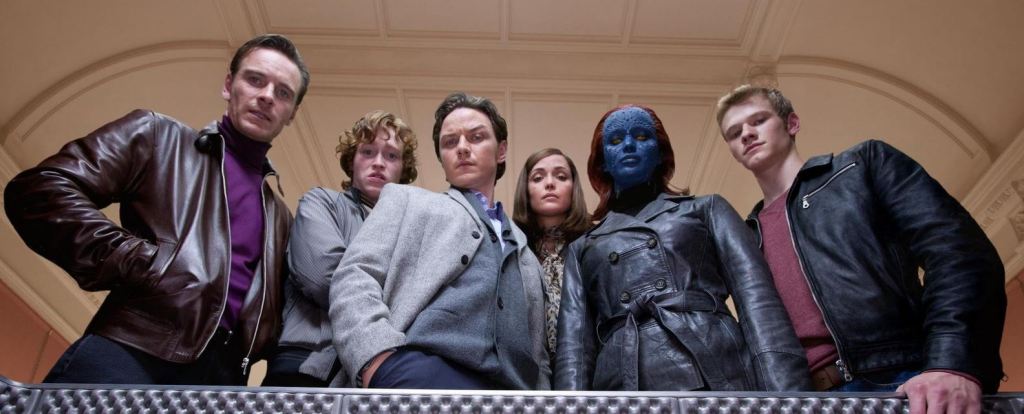
Fast forward a few years later and an adult Magneto (Michael Fassbender) is searching for Dr. Schmidt (Kevin Bacon), who cruelly studied his powers of magnetism and murdered his mother. We learn that adult Charles Xavier (James McAvoy) and adult Mystique (Jennifer Lawrence) have been hiding their mutant powers ever since they met. Mystique is forced to appear in her human form whenever they’re in public; she thinks men are unlikely to find her attractive in her natural blue form (um… sure).
Schmidt has escaped to America under the guise of Sebastian Shaw. During a stakeout, CIA agent Moira MacTaggert (Rose Byrne) learns Shaw is a mutant who plans to incite nuclear war. See, mutants were born of radiation so they will survive the nuclear winter (never mind the blasts). Most humans, on the other hand, will not. When you’ve got mutants as dangerous as Shaw, you can see why the government wants to track them all, but I digress. Again, there will be harder pills to swallow.
Charles and Mystique are recruited by the CIA to go after Shaw. Charles convinces Magneto to join him. They’re going to need a team, of course, so they scrape the absolute bottom of the barrel. See, for much of the original run of Uncanny X-Men, there was a problem: it was kind of a mediocre comic. It wasn’t until Giant-Size X-Men when the team got interesting. Which begs the question: Why bother making a film about the X-Men team no one, including Marvel itself, gave a shit about?
Look, all superhero movies are at least kind of goofy, but First Class takes the cake. Even the recognizable X-men are portrayed by younger actors with roughly half the gravitas of the old ones. Most of their powers are dull and useless. Worse, Magneto seems to exist in his own movie most of the time, a more serious movie, a darker movie, and a better movie. I would have much rather seen Magneto: Origins than this uneven mess.
Tonal shifts aside, it’s a well made movie made by an accomplished director whose first three movies I admired tremendously. It just isn’t exciting subject matter, unfortunately, and I hope he gets a chance to return to the less-Hollywood fare where he originally made a name.
Batman and Bane set aside their differences and hold hands.
Most people who give a shit about Batman have probably already seen The Dark Knight Rises. I just feel no urgency to see a movie that’s going to make a billion dollars anyway and I’d rather give my money to Dredd any day of the week. Besides, going to the multiplex fills me with as much dread as getting up for work after a long night at the bar.
Speaking of dread (Have you seen Dredd?), I have a hunch that Nolan was burnt out on the idea of making another Batman movie this soon. If it took him so many years to write Inception (twelve, by his count), I can see how he may have felt pressured wrapping the series up, particularly after the serendipitous forces that made the previous film so unusually good. Nolan does a remarkable job, all things considered, but it’s not even as good as his first Batman picture.
The Dark Knight Rises opens with an airborne heist. We’ve seen that a million times, in a few James Bond films and Cliffhanger. Other than the introduction of Bane, the film’s powerhouse villain, there really isn’t a lot to discuss here. I mean, they’re not hijacking gold bars or anything as tired as like that, so it’s fresh enough and the photography is exceptional. There’s a punk rock energy to Tom Harden’s performance in the sense his version of Bane sounds absolutely ridiculous in the best (least commercial) way possible, as if telling the audience, “This is what I sound like. Don’t like it? Tough shit.”
Cut to a charity event at Wayne Manor. We learn it’s been eight years since Harvey Dent died and Batman disappeared, accused of murder. Gotham is mostly crime-free and Commissioner Gordon comes this close to telling a crowd of people that the district attorney turned into a raging psychopath at the end of the last picture. Bruce Wayne, it turns out, has become a Howard Hughes recluse whose knees are shot. That night, he catches a cat burglar (Anne Hathaway) stealing his mother’s pearls, but gets foiled by his old man cane. (Have you noticed all the franchise heroes are suddenly allowed to age lately? It’s an interesting trend, but a trend nonetheless.)
That’s where the movie lost me. Forget comparing Catwoman’s character to the other films—within the context of this film, the character is too goofy, too Hollywood, and too unbelievable. I’ve seen Schwarzenegger films with fewer one-liners. Catwoman in The Dark Knight Rises is like the ewoks in Return of the Jedi. The piece just doesn’t fit the puzzle. Hathaway is great with what she’s given, and predictably looks hot in the part, but this is one of the many reasons I think Nolan needed a little more time to let this one cook.
My second biggest complaint is Marion Cotillard, Wayne’s love interest, who you’ll remember from Inception. Movies in general could use a lot more Cotillard, as far as I’m concerned, but her character in this movie is pretty pointless until the point abruptly emerges. Then there’s Joseph Gordon-Levitt. I love this guy, but here he’s a little too run-of-the-mill. We all knew it when we saw the trailer, so let’s not even pretend this is a spoiler: he’s Robin, but don’t expect to see him suit up in his trademark underwear and leggings in the Nolanverse.
Then there’s the lighthearted comedy relief. It’s not as bad as, say, Johnny Knoxville in any non-Jackass movie he’s ever been in. It’s not even that bad, really… it’s just not right for this film. I know Rises was designed to be lighter than the last film (alluding to Dent’s speech about the night getting darkest before the dawn), but a second heist, and the ensuing car chase, struck me as a little too routine for Nolan. Meanwhile, the scenes where Batman and Catwoman fight side by side are reminiscent of Batman’s goofier days.
About halfway through the movie, Nolan drops blunt hints to the film’s conclusion. He wants us to know what happens in the end because there’s more to it than what you would expect. The ending is vague and it didn’t necessarily work for me at first. Thinking back on it, though… yeah, it works (I guess). As far as trilogy-caps go, Rises is among the best. That’s a rare honor even if the competition isn’t very thick.
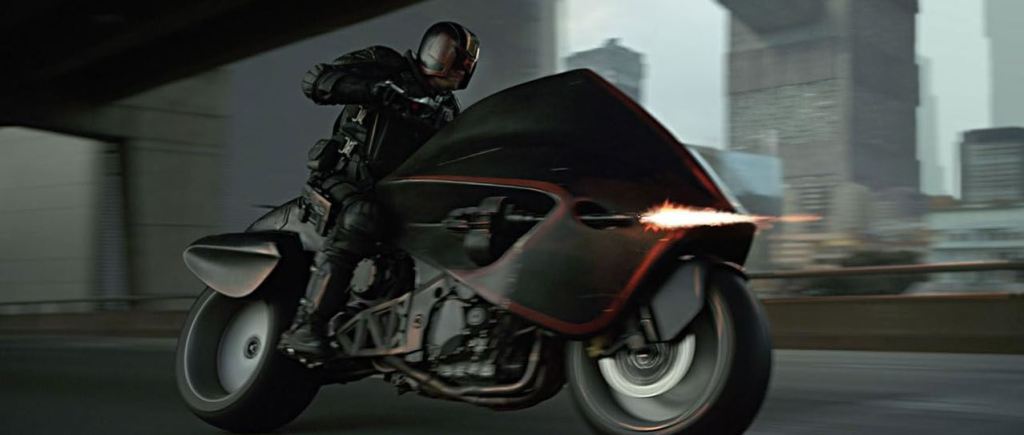
When my mother took me to see Judge Dredd on opening weekend in 1995, there was one other moviegoer in attendance. The guy got so bored he tried to read a book during the middle of the movie. Not that Judge Dredd was entirely without merit; I always thought it was a little better than most people cared to admit, Rob Schneider notwithstanding. While Karl Urban certainly has a better chin for Dredd, Sly had the more accurate body type; I may also slightly prefer the costumes and motorcycles of the 1995 film, too. That’s the only nice things I can say about that.
In Mega City One, one of the few cities left standing after nuclear war, Judges are cops, juries, judges, and executioners rolled into one. Despite its breakneck pace, this new adaptation of the 2000 AD character manages to paint a complete picture of its bleak and ultra-authoritarian setting in deft strokes of worldbuilding. We learn early on that Judges are spread so thin they can only respond to 6% of all crime in a city of 800 million people. With statistics like that, it’s a wonder why everyone doesn’t become criminals.
Batman ’66 vibes
The opening has Judge Dredd engaged in a high-speed pursuit with a street gang who’s stoned on slo-mo, a street drug that makes users perceive time at 1% of its normal speed. Dredd sentences the thugs to death, the last of which is dispensed in gruesome R-rated fashion. In the next scene, Dredd is assigned a new partner, Cassandra Anderson (Olivia Thirlby), who failed her aptitude tests, but may still get recruited for her uncanny psychic abilities… pending Dredd’s assessment, of course.
For her first day on the beat, Dredd lets Anderson pick which call to take. The rookie chooses to respond to a triple homicide in a two-hundred story slum, which happens to house a viscous crime lord known as Ma-Ma (Lena Headey, who’s even crueler in this than she is in HBO’s Game of Thrones). In a brief introduction, we learn Ma-Ma’s an ex-prostitute who “feminized” her former pimp before installing herself as the kingpin manufacturer of slo-mo. When Dredd and Anderson arrest one of her lieutenants, Ma-Ma hacks into the building’s security system, closes the blast doors, and places a bounty on their heads.
Lena Headey
That’s it. That’s the entire setup. The rest of the movie is Dredd and Anderson just trying to survive while they wait for backup. Movies like this are only as good as their villains and Dredd has a great one. She’s a believably nasty mother fucker to put it mildly.
Adults rarely have a good excuse to go see a genre movie, but Dredd’s one of the better ones. In 1995 it would have cleaned house. As of this writing, it hasn’t even recouped half of its modest budget. It’s a shame, too, because this is one of the rare franchises deserving numerous sequels. And that’s coming from someone who typically loathes sequels.
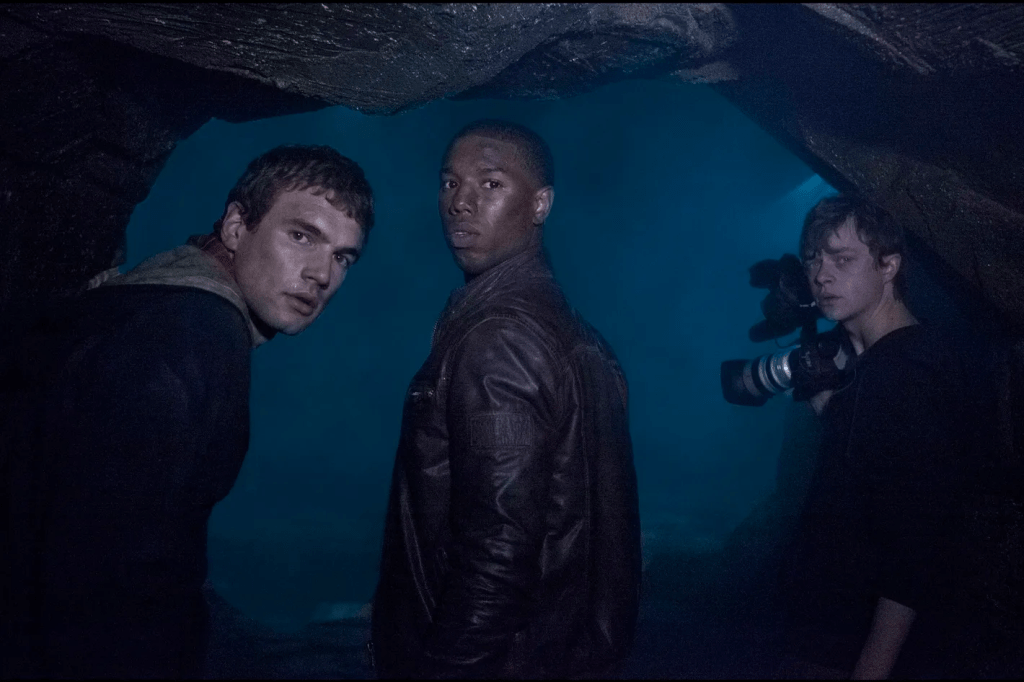
Aside from their amazingly clear complexions, I buy that the three leads in Chronicle are real teenagers. The first act delivers enough solid acting and teen drama to make us believe it is set in an actual high school. It’s yet another one of those “found footage” movies, supposedly shot on one of the character’s consumer-grade camcorder with the on-board mic… sure, I’m willing to suspend my disbelief. Every once and a while, we see different angles from the phones of eye witnesses and bloggers, security cameras and news teams.
One night, the three friends stumble upon a mysterious hole in the woods and decide to go spelunking. Inside, they find something extra-terrestrial in nature and leave with nose bleeds. It’s not long before they realize they have developed supernatural powers. If there’s one movie I’d compare Chronicle to, it isn’t a Marvel film. It’s Carrie. Soon the kids are using their telekinesis to do exactly what kids would do if they actually obtained such powers: pranks. This involves humorous scenes of remotely moving shopping carts and parked cars.
When they push their powers too far, they get nose bleeds. One of the boys theorizes that it’s like a muscle: use it too much, it gets exhausted. But the muscle can be exercised, too. As they become more and more powerful, the socially awkward main character finally steps out from behind the camera he’s been using as a security blanket. Since he can levitate objects with ease, there’s no need for a dedicated cameraman anymore as the camera follows him like an automatic drone.
He’s not stable. He’s not popular. He frequently gets his ass kicked by high school bullies and his alcoholic father. When bullies push someone like that enough, they push back. But his newfound powers are a dangerous drug and he soon finds himself addicted, much to his only friends’ dismay.
Chronicle isn’t everything I usually hope for in a popcorn flick, but it’s entertaining, original, and rarely insults the intelligence. Definitely one of the more memorable superhero flicks.
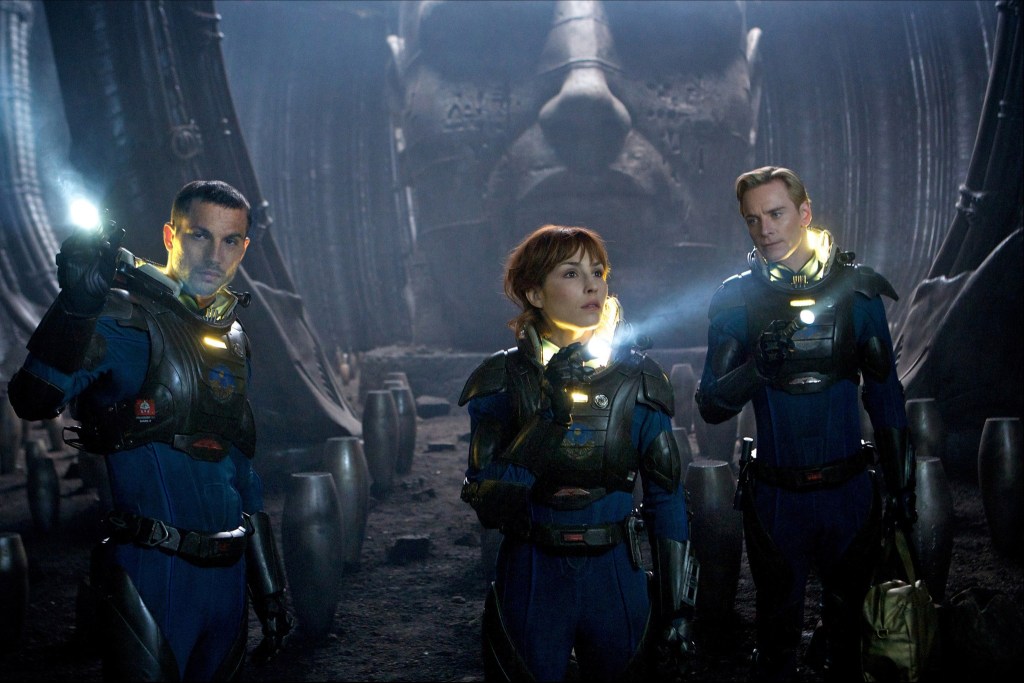
The year is 2089. Scientists have just uncovered caveman drawings which somehow depict a far-away star system. Fast forward a few years later and the scientists are on a ship to the star system, aiming to touch down on a planet remarkably like Earth. Fans of the franchise can probably already guess that the Weyland Corporation is footing the bill.
Ridley Scott’s Prometheus reminds me of The History Channel’s Ancient Aliens. Like that show, there are huge leaps of logic. 2001: A Space Odyssey was great because it found a way to balance Arthur C. Clarke’s rigorous science with Kubrick’s interest in mysticism. Prometheus, on the other hand, dumps the science entirely while crapping out unbelievable woo which doesn’t just aim to explain the origin of the aliens, but humanity itself. I just find it embarrassing that one of the most beloved science fiction franchises is now entwined with the idiotic pseudoscience made popular by Chariots of the Gods.
Scott plays well with the canon established since his original film, but Prometheus isn’t sure whether it wants to be a horror film, like the quiet original, or an action movie like James Cameron’s bombastic sequel. The result is a constant tug-of-war between the two styles, which makes for an unusual pace. If you’re expecting a tonal prequel to Alien or Aliens, you’re going to be disappointed, if not a little discombobulated. Having said that, it’s probably the most inspired effort since 1986, though with stinkers like Alien 3 and Resurrection, is that really saying much?
Charlize Theron has never seemed more robotic. (Perhaps she’s an android? If so, what the hell does that add?) In behind-the-scenes footage, producers claimed the writers fleshed out her character when they learned she was playing the part. If this is true, I can’t imagine how one-dimensional the character must have been in the first place.
Guy Pierce, playing the founder of Weyland Corporation, appears in old-age makeup that looks so phony you don’t accept him as a character, but an unnecessary special effect. There’s no need to have young men playing old men unless you see the character young and old in the same movie—even then, it’s almost always more effective when you just get two actors to… you know, act.
Meanwhile, the trailer gives away more than it should have, much more than I’m giving away here. If I say anymore about what I’m referring to, I’ll be spoiling it myself. But if you’ve seen the trailer and you have a decent memory, you’ll probably be able to put two and two together long before you were supposed to figure it out.
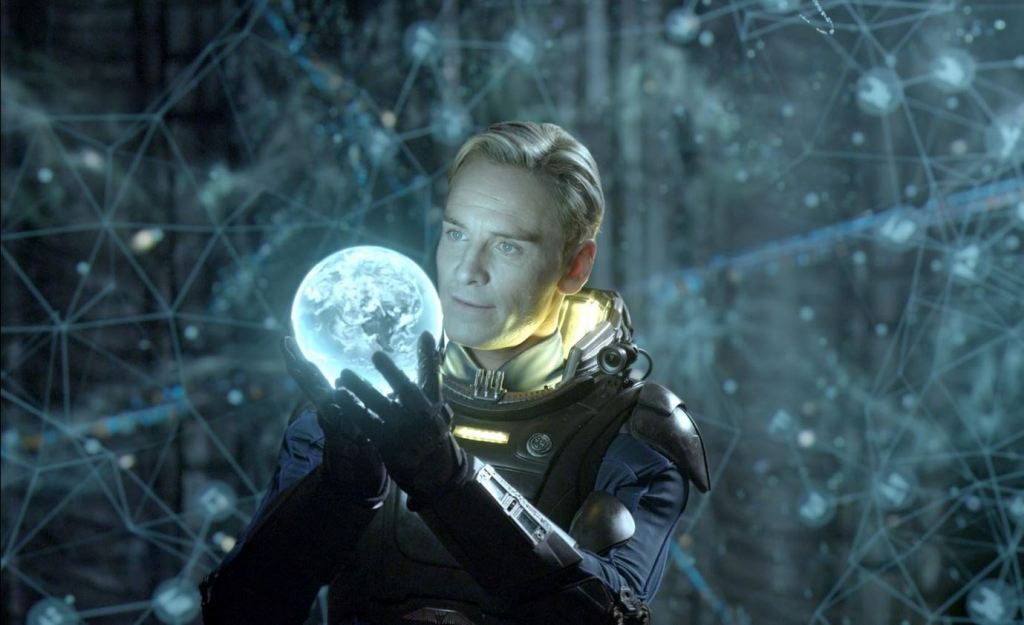
I do want to point out that Michael Fassbender as David the android is probably the most intriguing character of the entire seventeen-man crew, but most of that comes down to the mystery surrounding him. Does he have human emotions? If not, why does he act the way he does? Why does he idolize Peter O’Toole? Is he merely programmed to behave as if he idolizes O’Toole? The oddest thing about David is the fact he seems to be more advanced than Ian Holm’s depiction of Ash in the original film, which is set nearly a hundred years after this one.
At any rate, there’s quite a bit good in Prometheus, too, but I don’t want to spoil the fun. It’s not good enough to be a classic, but it’s good enough to go see it in theaters.
By the end of Melacholia, the world will be destroyed. That’s no spoiler—it’s shown first thing so the audience won’t hold out for an unlikely Hollywood ending. Although the classical music and imagery begs comparison to 2001: A Space Odyssey, to call this science fiction is both an insult to Lars Von Trier’s intentions and to science fiction itself. The idea that such a rogue planet exists is a “serious” subject of countless conspiracy theories; frankly, the concept is too preposterous to take seriously.
Indeed, there was a Father Sarducci joke in which the comedian asserts there is a planet on the other side of the sun. There, everything is just as it is on Earth… only the inhabitants eat their corn on the cob vertically. In Melancholia, the vertical corncob planet is on a collision course with Earth. There’s no last ditch effort to save humanity. Nothing can stop it.
The most impressive shots are in the overture, before the title card is ever shown. Von Trier plays with the same high speed cameras he employed in Anti-Christ, giving us a taste of the themes and motifs to come. Then the film abruptly switches to hand-held photography as it focuses on Justine (Kirsten Dunst), a hyper-depressed individual who is struggling to deal with a dysfunctional family on the day of her wedding. It’s hard to believe nearly everyone in her family can be, as one character puts it, “stark-raving mad,” but Von Trier always exaggerates to show us how people like Justine (and himself) actually feel.
Despite her many blessings, including a wedding that may have cost as much as a Bugatti, Justine cannot be happy through little fault of her own. John, her brother-in-law (Kiefer Sutherland), comes to her and threatens, “You better be goddamn happy.” Justine’s sister Claire (Charlotte Gainsbough) initially comes off as a snotty bitch, but we soon intuit just how far Justine has pushed her. Claire loves her sister, warts and all. She’s a lot more stable and caring from her own point-of-view scenes than she is from Justine’s. When it’s clear the planet’s days are numbered, the roles swap: Claire becomes a mess while Justine stabilizes.
It’s hard to review a film like this. It’s not a crowd pleaser, it’s a deeply challenging and exhausting piece of cinema with real and unlovable characters. Yet I see parts of myself in Justine and I can relate to those around her. There’s a brutal but refreshing honesty which is more interesting to watch than a ragtag group of unlikely heroes flying around in spaceships to save the world. You’re either going to love it or hate it. Frankly, I’m far more offended by mediocre movies than polarizing ones. I can confidently say I will see it again someday, but I’m not in any rush to do so… as with Anti-Christ, I need time to recover.
Rapace is unreasonably attractive, in a non-Hollywood way, and she’s among the least obvious leads for a summer blockbuster. My favorite part of the trailer is when someone tells her, “You’re smiling.” She is smiling, giddily, presumably over a scientific discovery. That’s what I want to see: characters who react like humans, not stone cold action heroes. It’s so strange that so many actors are incapable of emoting awe, especially in otherwise fantastical movies.
2. Charlize Theron
Theron said Ridley Scott is her dream director. Word on the street is the role was a two-dimensional character, which the writers punched up when Theron came on board. You’d expect the company stooge (I’m guessing it’s this film’s equivalent of the Paul Reiser part in Aliens) to be a boring stereotype, but it sounds like some thought has been given to her. Besides, there are reports that Theron does push-ups in the nude in one scene… need I say more?
3. Ridley Scott
When I was growing up, absolutely secure in my belief that 2001: A Space Odyssey was the greatest science fiction film of all time, I was collecting every new version of Blade Runner that released over the years, from VHS to DVD, from theatrical cuts to supposed director’s cuts. Little did I know how much the film was growing on me. By the time The Final Cut came out, it became one of my favorite science fiction films. It’s a good sign that Scott would return to the franchise he pioneered in the first place.
4. The R-Rating
We all expected this to be a PG-13 cash grab, because that’s what Hollywood does these days (even Die Hard 4 was rated PG-13). No, the R-rating isn’t an automatic indication of quality, but on the other hand, whenever a sequel to an R-rated film is rated PG-13, we can be certain that wasn’t an artistic decision. Usually it’s just the studio chasing a demographic that wouldn’t know a good movie if punched in the face by one.
5. Alien films were really beginning to suck
Imagine if the Alien Vs. Predator films had closed out the franchise. They were rated PG-13, sported generic directors, and the studio took the chicken-shit stance of refusing to screen it for critics. And whereas the ol’ metamorphis of an alien (facehugger > chestburster > xenomorph) was highly creative at the time, the novelty wears off when it’s literally older than I am. Frankly, it’s nigh time the Alien franchise got a shot in the arm.
Emilio Estevez is a race car driver in the year 1991. He’s married to Rene Russo who has a killer set of legs. An early shot frames those legs against a messy bed. I distinctly remember this shot piquing my interest when I first saw it on Pay-Per-View as a 10 year old boy. Unfortunately, when the camera panned up, I was dismayed to discover it was not Russo at all, but the considerably boyish and oddly hairless Estevez, wearing a pair of whitey tidies.
One of the reasons I love B-movies is they’re often in a hurry to get to the good stuff. It’s not long before Emilio is racing his pink race car around the track while the music lets us know something bad is about to happen. Here’s what happens next in a dazzling (if not confusing) matter of seconds:
1. A closeup reveals a race car’s front tire has just rubbed Emilio’s back tire. Just before the camera cuts away, we see the tail end of Emilio’s car lift from the track.
2. An awkwardly inserted shot, one of pure cheese, zooms in on Russo wearing a dumb hat as she screams.
3. The camera cuts back to Emilio’s car, which is now sailing through the air (somehow) before it collides with an overpass and explodes in slow motion.
4. Emilio, sans car, falls on an operating table. The medical team waiting for him are dressed in silver hazmat suits, which A) lets us know this is the future and B) kind of makes them look like giant baked potatoes. One of the baked potatoes calls for “the lobotomy gun.”
5. Transient rebels (every 90s cyberpunk movie has ’em) attack the convoy… wait, did I forget to mention the operating table was housed inside a moving vehicle?
6. Mick Jagger acts… kind of.
7. The rebels’ missile launchers rock the vehicle Emilio’s in. He seizes the opportunity to swat away the lobotomy gun, which fires green lightning. One of the nurses screams, “We’ve got a freejack!”
8. Emilio escapes from the vehicle, which is somehow on its side now.
9. Mick Jagger instructs his henchmen to, and I quote, “Get the meat.”
10. Emilio, despite being the only person wearing a 90s jumpsuit, manages to evade the police of the future until he’s caught by a phone booth of all things. He’s a little slow, but eventually realizes he’s in the far-flung year of 2009, which is so far in the future, I frankly have a hard time imagining it.
The reason they set the bulk of the movie a few measly years later is so Emilio’s character can rekindle the flame with his wife, Russo, who’s barely aged a day. That’s all fine and dandy, but there’s talk of the “Ten Year Recession,” which means the movie was already dated eight years after it came out. Not that anyone involved with this turkey thought anyone but lame bloggers would be talking about it in the future.
So no, I won’t make fun of the dated stuff. What I will make fun of is the casting. The obvious mistake is Mick Jagger. I hoped he would be funny bad, but he’s just bad. And the problem with Emilio is he already looks eighteen years younger than Russo. I’m not saying Rene Russo looks old. I’m saying Emilio Estevez looks like the kind of guy who still gets carded at bars. (“Don’t you know who I am! Haven’t you seen Young Guns?“)
I have a lot of issues with this movie. One is the absurd lack of characters of color. One black man lives in Emilio’s old house, which is now a slum, another is Russo’s chauffeur, and the third is a bum. Movies about the future should have a good reason for only having white people in it and Freejack has no excuse.
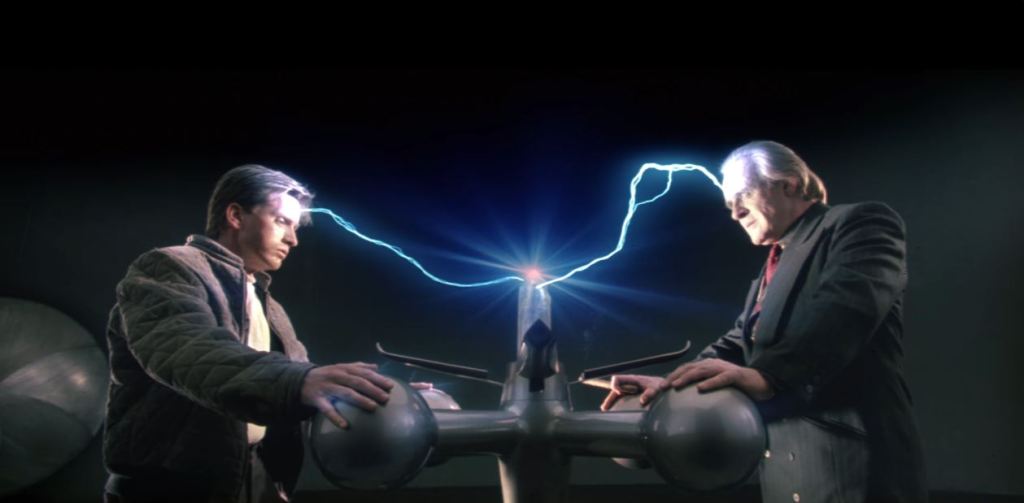
Anthony Hopkins is the bad guy, by the way, stumbling into the picture exactly as the Emperor was introduced in The Empire Strikes Back, hooded cloak and all. So we’ve got Hopkins and Russo, two great actors neutralized by Mick Jagger’s ability to ham up absolutely anything.
The most watchable part comes towards the end. There’s a fun sequence taking place inside the mind of Anthony Hopkins, though it’s nothing really new to the genre. Unfortunately, I’d been struggling to stay awake for so much of the movie, I finally fell asleep at that point and missed most of the good stuff. When I woke up, Mick Jagger had somehow turned into a good guy.
My biggest complaint is the lackluster romance between Emilio and Russo. When they’re reunited in 2009, Russo promptly turns him in to the authorities. When they’re reunited a second time, Emilio is inexplicably cruel. I don’t even remember if they ever kiss. The most they do is hold hands and speak to each other in whispers. What a dud.
Note: I haven’t read the Robert Sheckley novel Freejack was based on, but I admire Sheckley and I’m sure the book was better than this.
The human personnel in a missile silo are faced with the task of maintaining a launch station. They never thought they would actually get the order to launch. To them it’s just a routine job: monitoring the blinking lights while they make idle chitchat. What human could possibly accept what it means to actually push The Button? When men are ordered to fire, unaware that it’s an attack drill, they fail to do so. This convinces the brass at NORAD to take humans out of the equation all together. A super computer, they reason, would have all the capabilities of a human, with none of the pesky conscience.
Following the suspenseful opening is a conventional introduction to our protagonist. Seventeen year old David Lightman (Mathew Broderick) is a high school kid who spends too much time in his bedroom, messing about with his modem-enabled Imsai 8080 computer. His girlfriend’s character is never really fleshed out, but that doesn’t matter because she seems like a real girl and her interest in David never came off phony.
One day David is leafing through a magazine when he discovers an advertisement for a mysteriously marketed video game that won’t be revealed until Christmas. David refuses to wait. He commands his computer to dial every phone number within the game studio’s area code so that he can create a list of every modem in the area. When David accidentally connects to the super computer at NORAD, he thinks he found the studio he’s looking for and launches a game called Global Thermonuclear War. The super computer is more than willing to play, as it’s an artificial intelligence that plays war games 24/7, constantly learning, constantly improving. Unfortunately, David soon learns that he may have inadvertently started the ball rolling towards World War III.
WarGames occasionally insults the intelligence (micro-cassette recorders can be hacked to open keypad-protected doors), but it’s fun and cleverly so. If anything, it really captured the attitude of real life hackers who, though often vilified by the media, are the people who gave us affordable computers and created the internet in the first place. There are some things I didn’t like about the movie, notably the stereotypical computer specialists who help David crack NORAD’s backdoor password, but the climax of the film is unlike any I’ve ever seen. It hit me hard and it stuck with me.












 The Goug' Blog