The Void (2017) [Midnight Movie]

A man and a woman come racing out of a farmhouse, running for their lives. The woman is disabled by a shot to the back and the man disappears into the treeline. The shooters can finish the woman off with a clean blow to the head. Instead, they dig a can of gasoline out of the trunk of their car and set the woman on fire. The reason for their cruelty will become apparent later in the movie… sort of.

Sometime later, the deputy spots the man stumbling out of the woods. After getting the man to the local hospital, the building is surrounded, Assault on Precinct 13 style, by masked cultists, each brandishing a giant hunting knife. The shooters from the beginning of the movie show up, further complicating matters, though not as much as the Thing-like monsters lurking in the shadows.

Lord of Illusions, one of my favorite horror movies of the 90s, has this fantastic scene in which the villain grabs another character’s head and sinks his fingers into his brain with supernatural ease. That’s kinda what the cosmic entities in The Void do: they don’t just deal in body horror, of which you’ll see plenty, but they also get into your head and rattle around in there, seriously fucking up your day. This is a dizzying, disorienting, and not fully coherent movie about people going truly insane.

The reason it works is because these characters start out entirely sane, sincerely likable, and down-to-earth. Too many horror movies concoct stupid excuses for their characters doing stupid things. I’ve seen other fans of the genre reason that people do stupid things in stressful situations. Maybe. But it gets boring… hell, it’s been boring for decades.

The Void thinks so, too. The main character doesn’t want to use his gun, but he’s not afraid to use it, either. Other characters have a tendency to keep their cool, that is until the living nightmare escalates to epic levels of mind-fuckery. The vaguely explained plot, which turns out to hinge on some pretty major coincidences, makes less and less sense the more you poke at it, but the ride is too thrilling to notice the holes until it’s over.

I really liked this movie. However, whereas I think I might appreciate Split more on additional viewings, I think I might like this one a little less in the future. I don’t know. Maybe I’m wrong and an additional viewing will actually answer a lot of the questions I have.

The first viewing, however, is a great ride any which way you slice it. These characters aren’t stupid, the acting is good, and you’ll see some seriously messed up shit.

Split (2017) [Midnight Movie]

Three teenagers are kidnapped by a man with split personalities. That’s it. That’s all you need to know. Either you want to see that or you don’t.

It turns out I didn’t. I feel like I might enjoy Split more if I ever see it again, a few years down the road, but right now I just don’t take to PG-13 horror movies, even ones as technically impressive as this. Sure, I can think of a few exceptions, but horror shouldn’t be this safe and wholesome. (Don’t get me wrong… there’s definitely a subplot that’s going to disturb a lot of people.) 

It’s a shame, too, because I really thought M. Night Shyamalan might be gravitating to the dark side after pulling off that disgusting stunt in The Visit. (If you’ve seen it, you know exactly which scene I’m talking about. If you haven’t seen it, watch it while you’re waiting for a delivery or when you’re folding the laundry or something… it’s okay at best.)

Horror should be like getting into a car with a stranger who turns out to be a madman. Yet Shyamalan is proving to be more like that goofy uncle who pulls the “uh-oh, the headlights went out!” gag on a dark but relatively safe stretch of country road. There’s a madman in Split, who’s exactly like the madmen in countless horror movies, only this madman’s portrayed by a capable actor who really doesn’t go as far overboard as a B-movie star would.
Give me a Shatner or a Jeffrey Combs. Give me a Joe Spinell or a John Lithgow. When I pay to see madmen, I want them to bounce off the fuckin’ walls. And don’t tell me, “But this is realistic!” We departed reality way back when that second trailer dropped. (That trailer, by the way, was the sole reason I decided against seeing Split in theaters.)
When I take issue with the rating, my problem isn’t that the movie’s not filled with wall-to-wall violence and profanity. My problem is that the rating assures us everything’s going to be okay. We’ll see some disturbing stuff for sure, but we won’t lose any sleep over it. 
Technically speaking, it’s a good movie, but it just didn’t work for me. Half the time I couldn’t believe it was made by the same guy who made Unbreakable, one of my favorite movies of the 2000s. The rest of the time, I realized I’d rather be watching Green Room again, which was a lot less predictable and anything but comforting. 

Silent Rage (1982) [Midnight Movie]

Since I featured two new movies in a row, I’m happy to get back to older movies this week. Forgive any typos because I almost forgot to do the Midnight Movie this week. (I’m preparing to go on a trip to Cactus Jack’s tomorrow and I’ve been repairing my first pinball game ever since I got off work today.)

As far as I know, Silent Rage is the only 80s slasher movie which stars Chuck Norris. It’s not a great slasher movie, but it’s a pretty good Chuck Norris movie. In a nutshell, a mad science experiment goes wrong, which makes a serial killer impervious to bullets. That’s right: guns can’t stop him, but you know what can? Chuck Norris’s fists.

The movie opens with an impressive long-take of the killer’s residence. The camera follows him from the moment he wakes up to the second he picks up an ax and murders his housemates. There’s some surprisingly complicated choreography going on here and it involves several performers, three of which are children who manage to hit their marks as well as the adults. In fact, the entire movie looks better than your typical slasher movie, though not as gory as a lot of the other stuff that came out around the same time.
After the murdering spree, Chuck Norris and his police partner Stephen Furst (yes, Flounder from Animal House) arrive on the scene. Flounder acts like a complete dope while Norris, brave as ever, knowingly enters the home of the crazed killer without so much as removing his pistol from its holster. When Norris fails to placate the man, the other police blast him to kingdom come. The serial killer is then taken to the hospital under the care of Ron Silver, who’s probably the best actor in the movie. There, mad scientists spout a bunch of technobabble, talk about revolutionizing medicine, and inject their experimental healing serum into the bad guy’s bloodstream.
You can see where this is going, yes? Like most slasher movies, there’s a kill or two in the beginning of the movie, but we don’t see the killer in action again until the movie’s halfway through. Unlike most slasher movies, it doesn’t bore the ever-lovin’ shit out of you in the meantime. This stuff isn’t high art—nor is it trying to be—and it’s about as cheesy as it can get. But you know what? At least it ain’t boring. Even when Flounder’s jokes fall spectacularly flat, you smile at how genuine it all is.
So it turns out Ron Silver’s sister (Toni Kalem) is Chuck’s old flame from six years prior. They rekindle their relationship (this is where the cheese comes into play) and decide to run off to Chuck’s cabin in the mountains. The killer has other plans: targeting Kalem’s family.
At first it’s hard to put your finger on what makes this admittedly dumb movie work, but then there’s a scene in which Flounder expresses doubts about his ability to handle stressful situations. Whereas the star of other tough guy movies would have treated him like an absolute baby, Chuck comforts the character, assuring him he’s gonna do just fine. You’d expect the “rookie gets killed immediately” cliche, but the movie doesn’t go there, either. 
Chuck isn’t a particularly great actor and his fight moves aren’t all that legendary. I can see why some people have trouble understanding the appeal. Sometimes even I have trouble understanding why I like his movies so much. Silent Rage is a good reminder. It’s just a fun little movie.

Logan (2017) [Midnight Movie]

I generally like MCU movies (more than X-Men movies, in fact), but the stylistic continuity is limiting to what the filmmakers can do. Each movie is different, to an extent, but directors aren’t allowed a whole lot of breathing room, which is a shame because the franchise attracts such big names. I want to see Kenneth Branagh make a Kenneth Branagh movie starring Thor, not a run-of-the-mill MCU movie. Meanwhile, Edgar Wright’s removal from Ant-Man still feels like we missed out on something great.

X-Men’s stylistic continuity, on the other hand, has been thoroughly torched, tossed out the window, and struck by a large truck. The varying tone has made the franchise a little spotty (to put it nicely), but it’s apparently given director James Mangold a whole lot of breathing room—the same kind of breathing room Christopher Nolan had when he rebooted the Batman franchise. 
This isn’t a Wolverine film. It’s a James Mangold film. And it’s probably my favorite mainstream comic book movie since Richard Donner’s Superman. I’ve merely liked X-Men movies up until now. Here’s the first one I loved.
It’s notable something this different got made with such a huge IP. It just doesn’t move like a carefully plotted action movie. It moves like a deliberate drama and feels like a classic western. Usually when I see these movies, I’m reminded of all the other comic book movies. This one reminded me of Clint Eastwood’s A Perfect World and Unforgiven.

The first time we see Logan, he’s sleeping off a hangover in the back of the limo he drives for a living. He’s awakened by the sound of thugs trying to steal his wheels. He tells them exactly what you’d expect Wolverine to say: “You don’t want to do this.” Yet you get the feeling Logan’s talking to himself this time. He’s old, he’s limping, and when the thugs shoot him, the wounds remain for the remainder of the movie. He’s also experiencing a bit of blade-extension dysfunction.
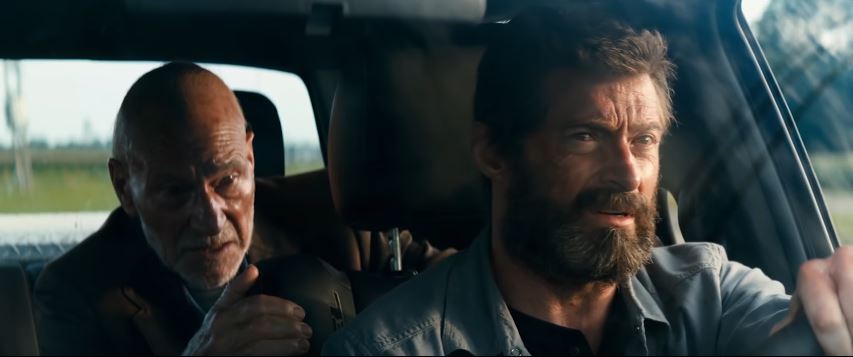
It turns out Logan’s healing factor gets weaker the older he gets and, as a result, he’s experiencing the effects of adamantium poisoning. (He’s something like two hundred years old at this point… it’s especially amusing to see the world famous hero require reading glasses.) Logan lives with Professor X and the mutant albino Caliban (Stephen Merchant, who’s great in the role) in the middle of nowhere. It’s likely they’re the last mutants alive. Charles is worse for the wear than Logan; the first time we see the professor he’s zooming about jerkily in his wheelchair, mumbling like a madman. Sometimes he has seizures, which puts everybody within a large radius at risk of death by telepathic shock.
And Charles cusses now… a lot. He’s gotten quite curmudgeonly in his old age, earning some of the best laughs in the movie. Patrick Stewart manages to play him with equal amounts of realism and dignity. 
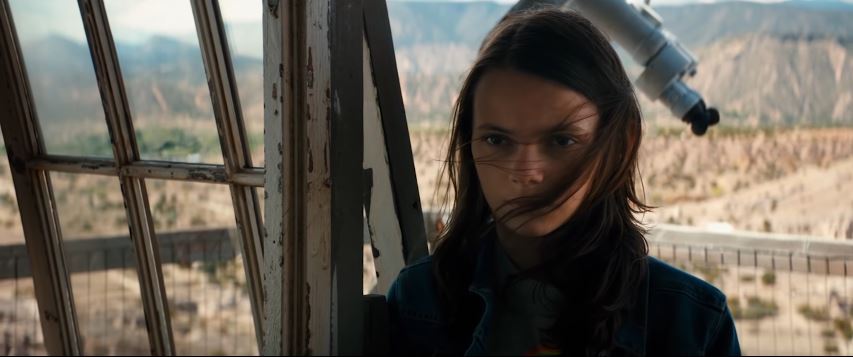
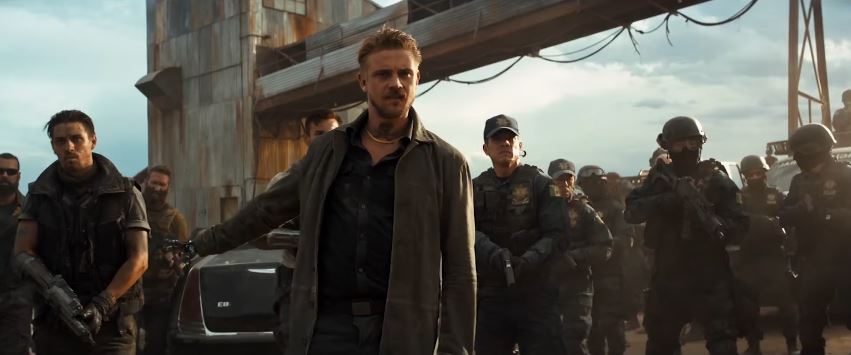
One day Logan is hired to drive a woman and her daughter across the country. It turns out the little girl is more than what she appears to be: she has mutant abilities which are suspiciously like Wolverine’s. Naturally, the secret lab responsible for her existence sends their highly militarized security team to get her back. The leader of the team is the film’s villain, Donald Pierce (Boyd Holbrook). Pierce doesn’t like “muties” and refers to his band of cyber-enhanced killers as “the good guys.” This is probably the best movie villain since Fury Road’s Immortan Joe.
There’s a bit of a surprise about midway through the movie. I’m amazed the trailers haven’t spoiled it. Lately, there have been a lot of surprises in movies like this, but when the surprises are, “Oh, look, another crossover cameo,” they kind of lose their effectiveness, don’t they? The surprise in Logan isn’t like that at all. It’s jarring, yes, but far from distracting.
What’s special about Logan is it sticks with you like a real fucking movie. I’m still piecing together some of the backstory and it occurred to me, a day later, that a lot of this stuff had deeper meaning than I initially thought. The balls-to-the-wall action at the end almost feels at odds with the rest of the movie, but maybe the movie earned it.
I saw the trailer for Justice League after watching Logan and I’ve gotta be honest: I pretty much couldn’t care less. I have a feeling a lot of superhero movies are going to feel old hat compared to this one. There are certain ways these movies comfort us, even when we’re sick of being comforted, so I’m not convinced this is the right time for the DCU to adopt a Saturday morning cartoon vibe. Meanwhile, Logan has more in common with The Road than its own franchise. And man, it feels so damn fresh.

Ghost Story (1981) [Midnight Movie]

In 1979 Peter Straub published Ghost Story, a novel heavily inspired by Stephen King’s Salem’s Lot, but a helluva lot better. It’s the kind of story which sinks its claws into you immediately. In the beginning, a man is driving across the country with a little girl. At night, when they go to sleep, he ties her up so she can’t escape… or hurt him. Ultimately, he believes he has to kill the little girl, but he fears he doesn’t have it in him.

The story is one of many told in the novel, in which a group of old timers call themselves The Chowder Society and sit around a fireplace, sipping brandy while telling each other spooky tales. The tales don’t have to be true, but they aren’t always made up, either. Their wives and acquaintances think they’re crazy old fools—they think they’re crazy old fools because they have no idea how they come up with this stuff. Yet they carry on regularly, almost obsessively, even when people in their small town begin to drop dead. The meetings always begin with a question: “What’s the worst thing you’ve ever done?” To which the designated storyteller always replies, “I won’t tell you that, but I’ll tell you the worst thing that ever happened to me….”

That’s such a great line, but I don’t remember hearing it anywhere in the movie. There’s a lot from the source material that’s abandoned, which isn’t unusual for an adaptation. What is unusual is the movie could have included a lot more of the original story if it didn’t become so fixated with its flashbacks. The flashbacks seem to take even longer in the movie than they did in the book. Meanwhile, I don’t think newcomers are going to truly understand what, exactly, The Chowder Society is all about—the movie almost portrays them as if they really are crazy old fools. Worse, most of the great stories Straub had his characters tell in the novel are boiled down into one, which is straight up lifted from Edgar Allen Poe.

In the movie version: David Wanderley, son of The Chowder Society’s Edward Wanderley, sees a ghost which scares him enough he falls through the window of his high-rise apartment. David’s twin brother, Don, returns to his hometown for the funeral, which is where he gets mixed in with his father’s old friends. He buys his way into the secretive group with a story of his own: the ghost who seduced and murdered his brother had previously seduced him with ill intent as well. The next few bits of the plot aren’t necessarily spoilers for the movie, but they are for the novel. I won’t tell you that, but I will tell you the worst thing that happened to me: I nodded off about midway through the movie. (To be fair, I was slightly hungover.)

You would expect (and probably want) a movie based on Ghost Story to fill its cast out with the likes of Vincent Price and Peter Cushing, but the filmmakers defy expectations and cast Fred Astaire, John Houseman, Douglas Fairbanks Jr., and Melvyn Douglas in the lead roles. Alice Krige is really the only person cast to type here, playing the seductive ghost who agonizes the film’s male characters, young and old alike. She manages to stand out, too, pretty much embodying the character I envisioned in the book.

Technically it’s a pretty good movie, but I think people who haven’t read the book are going to feel a little lost while those who have read it will feel slighted. I liked it, but didn’t love it. The problem with adaptations, especially the ones which change so much of the source material, is my memory blurs the details between the two. Years down the road, I’d much rather read the book again than watch the movie.

Repo Man (1984) [Midnight Movie]

“Ordinary fuckin’ people… I hate ’em.” — Bud

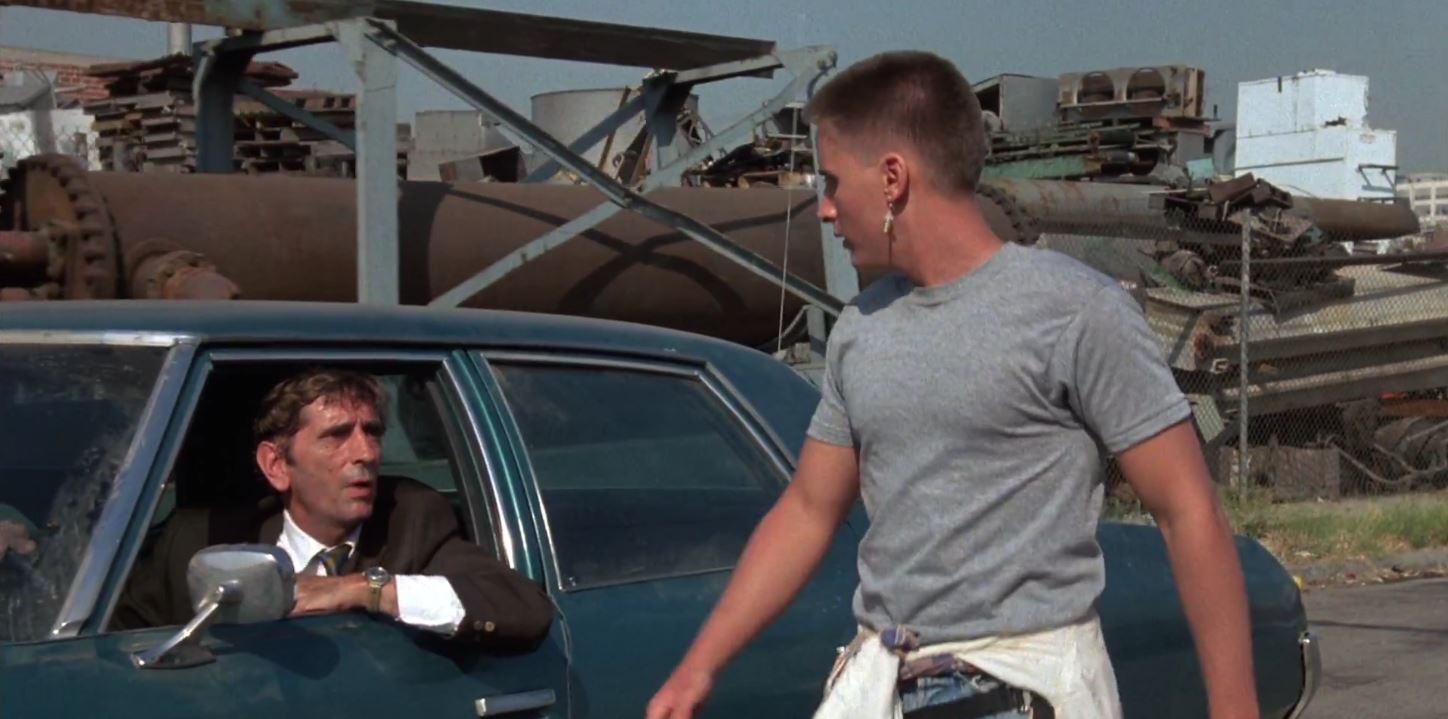
Otto (Emilio Estevez) is “just a white suburban punk” (his own words) who loses his shitty job stocking groceries in a shitty store. After finding his girlfriend in bed with another punk, he takes to wandering the streets of Los Angeles, looking for trouble as he chugs his beer.

Beer, like most of the consumables in Repo Man, is labeled generically. People who live in this version of LA, which is portrayed no more seriously than Grand Theft Auto’s highly satirical Los Santos, are too busy being hypnotized by their television sets to worry about the freedom to choose; there’s no need for brand names because it’s all the same shit anyway. You just get Beer.

A stranger named Bud (Harry Dean Stanton) spots Otto on the sidewalk and offers him a job as a repo man. Bud’s eager to share his trade secrets: a repo man shall not cause harm to any vehicle, a repo man thrives on tense situations, and a repo man does speed. Whenever they’re not repossessing cars and getting shot at, they’re starting fist fights and car chases through the Los Angeles River.

Why? Because why not.

Meanwhile, a suspiciously odd driver is making his way through town in a Chevy Malibu. We don’t know much about him, but we do know whoever looks in his trunk gets vaporized by something extra-terrestrial in nature. (It’s worth noting that Weekly World News is the newspaper of choice in Repo Man.) One day there’s a $20,000 bounty put on the Malibu, pitting Otto’s friends and rivals against one another. Otto’s friends and rivals, by the way, are pretty indistinguishable.

Amidst the flurry of action-packed scenes are relatively quiet ones in which the supporting characters launch into wordy monologues about life, the universe, and everything… without saying anything significant at all. (It kind of reminds me of David Byrne’s True Stories… so much of this stuff isn’t relevant to the plot, but then again, there really isn’t a plot.) Miller, a grease monkey, makes far-out observations which might sound sensible coming out of the mouth of a new age guru, but if you actually look for meaning you’ll find a whole lot of nothing. Otto, who’s too stupid to look for meaning in the first place, just kind of raises an eyebrow.

Back to Bud: he’s a well-meaning everyman who’s fearful of commies and convinces himself his hard work is going to result in the American dream. (His idea of the American dream is running a repo business of his own.) In other movies, the main character’s protégé might have shone light on the film’s deeper meaning by becoming a thinly disguised parrot for the filmmaker’s beliefs. In this movie he’s just a guy who hates bums… Christians, too. It probably doesn’t mean anything. It doesn’t have to mean anything when it’s as witty as this.

So yeah, Repo Man isn’t a typical movie. It’s a movie that feels just as fresh, unpredictable, and effortless as it felt the first time I saw it. Even the most conventional aspect of the movie—the trunk-kept MacGuffin—refuses to adhere to any traditional rules of storytelling. Whenever you hear screenwriting experts go on and on about the importance of structure and carefully measuring the beats of your plot, you’re not wrong to think: “Yes, but you won’t ever make a movie like Repo Man that way.”

Come to think of it, I have no idea how this movie got made. It’s too funny, too alien, and too genuine to have been created by a mere human. I can’t imagine it working on the page and it shouldn’t work as a film, either. Somehow it does. And how it manages to sustain its breakneck pace until the very end, I’ll never know. Impossibly, Repo Man doesn’t get bogged down by cramming too much into it the way Buckaroo Banzai did (a movie I also adore, though not as much as this one); somehow it thrives on becoming bloated with too many characters, too many subplots, and too many words which don’t necessarily mean anything in and of themselves, but speak volumes about the film’s don’t-give-a-fuck attitude.

Honestly, I don’t know why this uneven movie runs like such a finely tuned machine. Yet for anyone raised on Mad Magazine, it’s just about the perfect middle finger to all that is average. Stay in this weekend and watch it instead of going to see Movie.

Ichi the Killer (2001) [Midnight Movie]

I can say without exaggeration that Ichi the Killer is a vile movie. If images of graphic violence have ever scarred you, you should avoid it at all costs. There are people who have legitimate reasons for not being able to stomach this level of imagery, and then there are people who simply dislike it. That’s fine. To be clear, you’re not supposed to like it, which seems to be lost on many of its most vocal critics.

Despite multiple recommendations, I initially avoided Ichi the Killer because I assumed the violence was going to be all style and no substance. I never understood the popularity of The Boondock Saints, which seemed utterly forced to me. Crucify me if you must, but it’s high up on the list of reasons I disliked so many genre films from the late 90s and early 2000s. I assumed Takashi Miike was a Japanese Troy Duffy because so many of the people who recommended Ichi the Killer were fans of Saints.

In other words, my expectations led me terribly astray. Hey, I’m only human. I try my hardest not to pre-judge movies, but sometimes it can’t be avoided when there are millions of them to choose from.

Thankfully, I quickly discovered Miike’s Audition and fell head over heels in love with it. I think that movie is best described as beautifully horrendous. Or horrendously beautiful, take your pick. I’ll probably watch it again soon as I continue to thread my way through Miike’s overwhelming filmography.

The special quality that drew me into Audition is hyper-realized in Ichi the Killer. The opening scene depicts the brutal rape of a prostitute. Meanwhile Ichi, the hapless hero, is shown masturbating as he peers through the window, watching the gruesome scene unfold. We later learn Ichi was traumatized by witnessing the rape of a classmate when he was in high school. The event had a very unfortunate effect on him, which isn’t sugarcoated in the least. In some ways Ichi is just as monstrous as the film’s villain, which makes it hard to like him at times. Maybe you’re not supposed to like him, but you should (and probably will) pity him nonetheless.
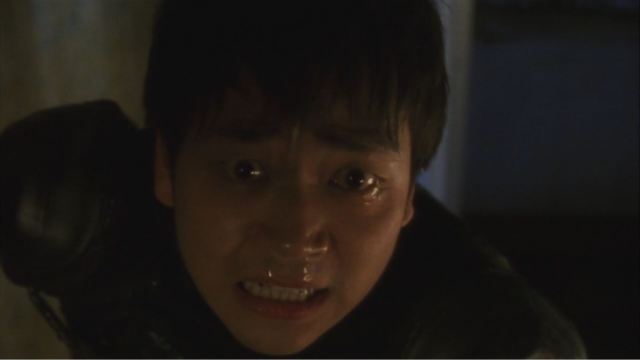
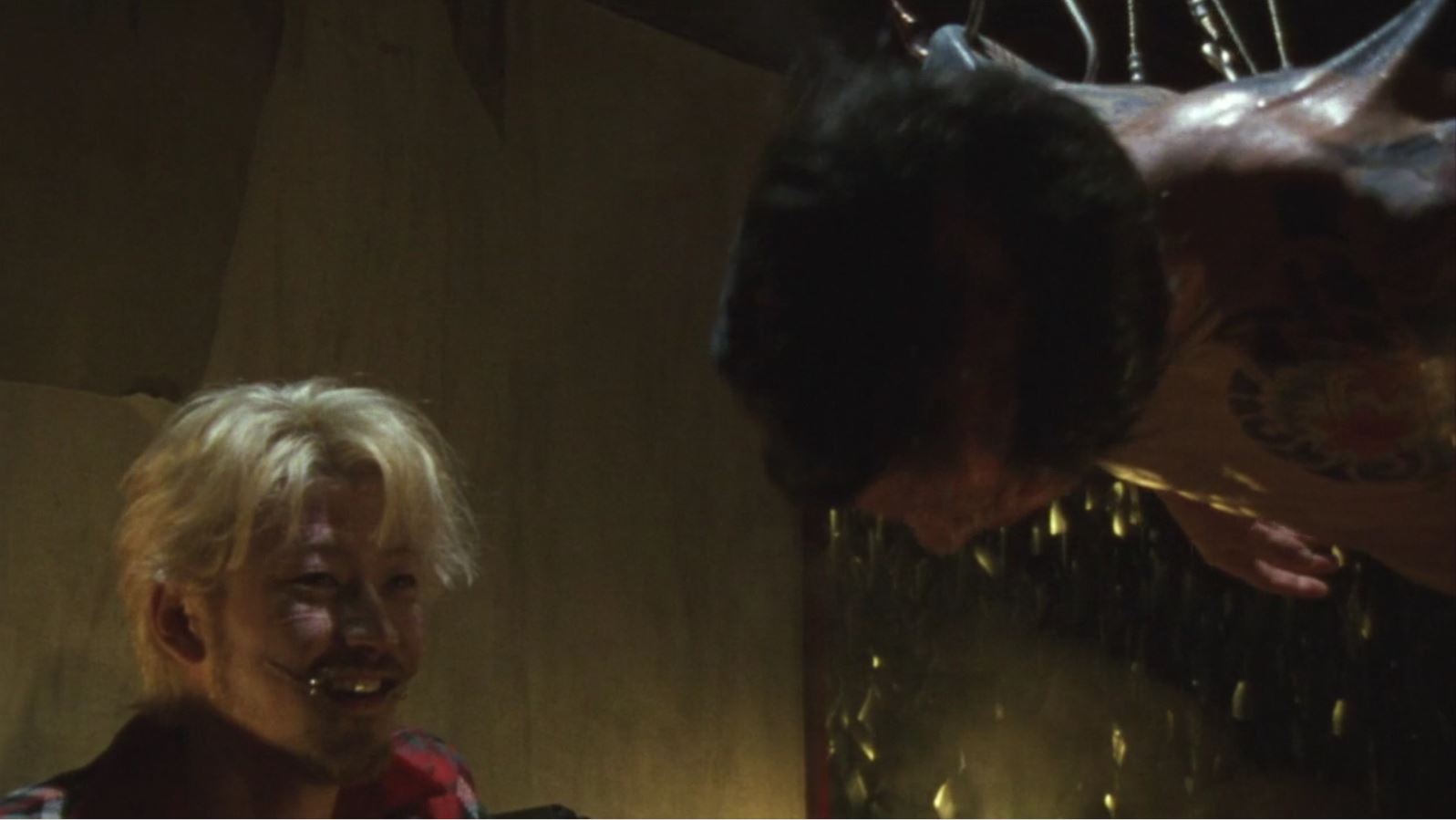
Although the story revolves around Ichi, Miike mostly focuses on Kakihara, a sadomasochistic gangster whose mentor has disappeared. What the audience already knows is the missing crime boss is dead, but Kakihara assumes leadership of the gang and launches a twisted inquisition to track him down. Kakihara has scars reminiscent of Heath Ledger’s Joker (I’d be willing to bet that wasn’t accidental on Christopher Nolan’s part), only his are so deep he has to keep them pinned shut with facial piercings. And whenever he has a cigarette, he exhales the smoke from the sides of his face.

Like Ichi, Kakihara is also a victim of untold abuse, which he suffered at the hands of the very man he’s risking everything to rescue. In an attempt to assuage his sense of loss, he has a potential love interest chain him up and beat the shit out of him, but it doesn’t do the trick. He needs more. While interrogating members of other gangs, he employs needles, hooks, and scalpels, but he just isn’t his old self until he learns Ichi is coming to kill him next. The fear of impending death, it turns out, makes Kakihara giddily excited because he has seen Ichi’s work and admires it greatly. “I’m scared!” he says with a childlike glee. “I have goosebumps!”

I’m leaving an awful lot out, as I often do, to avoid even minor spoilers. Yet what I want to talk about most is the ending, which is both extremely satisfying and anti-climatic. Hollywood has programmed us to expect everything to be neat and tidy by the time the credits roll, expecting the surviving characters to be miraculously cured of their afflictions. Yet Ichi the Killer has set itself up in such a way that if it gives us what we expect to see, it will only leave us disappointed. Either way, you won’t necessarily be happy with the outcome, but I maintain you’re not supposed to like it.

I keep saying you’re not supposed to like it, which is misleading because I very much liked it as a whole. The movie can have you laughing (nervously, perhaps) when you aren’t peeking through your fingers or reeling in disgust. Like Audition, it’s a beautiful movie which can turn hideous at the drop of a hat, especially when it isn’t cutting corners with cheap CGI. There are plenty of scenes in which it goes too far, maybe even way too far.

That’s probably the point. Miike obviously isn’t concerned about viewers who will take a knee-jerk moral stance, which is refreshing in the era of corporate-owned studios frequently bowing to the slightest bit of social media pressure. (Mob mentalities do not make good writers and the trend to give audiences exactly what they think they want is the biggest reason I don’t go to the theater much anymore. Criticism is fine, but so is making movies which will generate strong criticisms.) The only thing Miike’s concerned about is being true to his characters, so it isn’t a movie in which traumatic events make heroes out of victims, but a movie in which traumatic events fuck people up in complex, unpleasant, and inconvenient ways.

I think that’s much more effective and true-to-life than heroes who solve their problems with a loaded gun (not that I have anything against a good revenge tale). So you killed the person who fucked you up. Now what? You stop being traumatized? Once again I point to The Texas Chainsaw Massacre as the rare example of a genre film which points out that surviving isn’t always what it’s cracked up to be. Ichi the Killer is another example, though in a much different way.

As with many movies which get banned by governments around the world, it’s probably not so much the content that scares them, but the power behind the movie. There are those who love Ichi the Killer and those who hate it. They’re both right. I happen to be one of the people who love it. Maybe I’m just a masochist, but I need this much more than I need another Thor or Batman movie.

Blue Ruin (2013) [Midnight Movie]

Last year I featured Jeremy Saulnier’s Green Room, which I liked a lot. The movie has continued to grow on me. I love crime movies, scenes of genuine terror, and mean bad guys. Green Room checked all of those boxes while subverting the usual cliches—I loved it when the closest thing to a hero begins to tell his life story, and the lead female interrupts him to point out she doesn’t give a shit.

There’s a bit of that in Blue Ruin, too. A gun nut who may have had some experience killing people advises the main character not to give any big speeches before blowing the bad guys away. Just pull the trigger and move on with your life. When the main character fails to heed this advice, it almost gets him killed.

Blue Ruin was one of those movies I really wanted to see, but it somehow slipped through the cracks for me. (I assumed Blue Ruin was Saulnier’s first film, but it turns out he made a movie called Murder Party first; I’ll be catching up on that one sometime this year, too.) Now that I’ve seen it I can say it’s one of those movies I live to see. Maybe I didn’t like it as much as I currently enjoy Green Room, but I have a feeling this one will grow on me as well.

Macon Blair, who plays the wildly bearded Dwight, is first seen soaking in a bathtub. When he hears a noise in the house he leaps through the window like a startled raccoon. It turns out Dwight doesn’t live here and the people who do have unexpectedly come home. Dwight actually lives in a beat-up car just off of the beach, which is where he’s been living ever since his parents were murdered. Since he leaped out of the stranger’s tub with nothing more than a bath towel, we learn early on he’s an expert at acquiring clean clothes. This is a skill which will prove useful more than once throughout the movie because things are going to get very bloody.

I didn’t know who Macon Blair was before this movie. He’s already becoming one of the my favorite actors.

I want to be vague about the next few bits because the movie is so much more exciting if you know next to nothing about it. Treading lightly in regards to spoilers: the man who murdered Dwight’s parents has just been released on a technicality, and Dwight decides he’s going to kill him. There’s not a whole lot of thought put behind the plan, but Dwight’s sister is on board until she realizes the murder attempt makes her family a target.

Long story short: it’s an extremely entertaining crime thriller which examines the self-destructive nature of revenge (and blah blah blah) without becoming the least bit preachy. And if you want to know more about the plot before seeing it, see any other review, but I’m telling you: if you like grizzly crime movies, this one’s a winner. There’s really nothing else you need to know before seeing it.

Is this movie and Green Room part of a planned trilogy of “color” films? I hope so. Red Rune? Orange Doom? Yellow June? The possibilities are endless.

The Conjuring 2 (2016) [Midnight Movie]

You’ve got to be a gifted filmmaker to make me care about a couple of characters based on the paranormal investigators known as The Warrens. Were they delusional or professional scumbags? Or both? I’m going with both.

In case you haven’t noticed yet, I’m a card-carrying skeptic, through and through. Before I saw The Conjuring I would have gladly forgotten The Warrens existed at all. In a piece of fantasy, however, the characters are fascinating. Years ago, as mentioned in the first film, Vera Farmiga’s Lorraine Warren had a premonition so terrifying, she refused to tell her husband (Patrick Wilson’s Ed Warren) what she saw in it. I would have preferred it if The Conjuring 2 kept her vision a mystery, but this time around they spill the beans. Their reason for doing so, however, induces a feeling of dread which helps drive this sequel.

The Warrens have been called in to investigate the strange happenings at a London home occupied by a single mother (Frances O’Connor) and her three children. There’s an entity in the house who calls himself Bill. Bill likes to rip sheets from the beds and tug on the children’s ankles. When the mother tries to intervene, he graduates to biting, which leaves behind nasty sets of teeth marks on their skin.

Bill’s not the only presence at play here. The kids own a creepy old zoetrope. The spindly figure it depicts sometimes vanishes from the toy altogether, only to reappear creeping around the house in a mixture of CGI and stop-motion effects. It’s the best visual of the entire movie. Hell, it’s probably the best visual in any horror movie in years. Meanwhile the kids sing a nursery rhyme about this character, calling him the crooked man. (This is apparently a real-life nursery rhyme.)

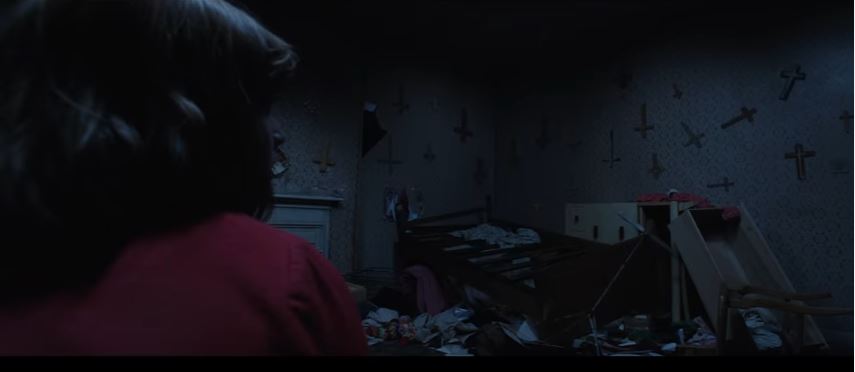
Finally, there’s the demonic nun who seems unrelated to the London house, but frequently torments Lorraine. The demon is, disappointingly, a shoe-in for Marilyn Manson, which may be a case of director James Wan showing his age. And if this sounds like the movie is getting a little too overloaded with villains, I would have to agree. They should have kept the crooked man and dumped the Marilyn Manson lookalike altogether.

Still, The Conjuring 2 is the rare horror sequel which feels like a worthwhile continuation. It mixes in just enough new stuff to dazzle us while keeping enough of the old ingredients we liked so much the first time around. I do think it’s pretty dishonest to portray skeptical characters as stupid assholes, but hey, whatever—it’s Wan’s movie, not mine. Elsewhere, the characters are expertly written and the leads become even more interesting than they were in the first movie. Maybe the horror isn’t quite as good as it was in part one, but you’d need a very precise measuring tool to know for sure.

When The Conjuring 3 comes out I’ll be the first in line.

The Conjuring (2013) [Midnight Movie]

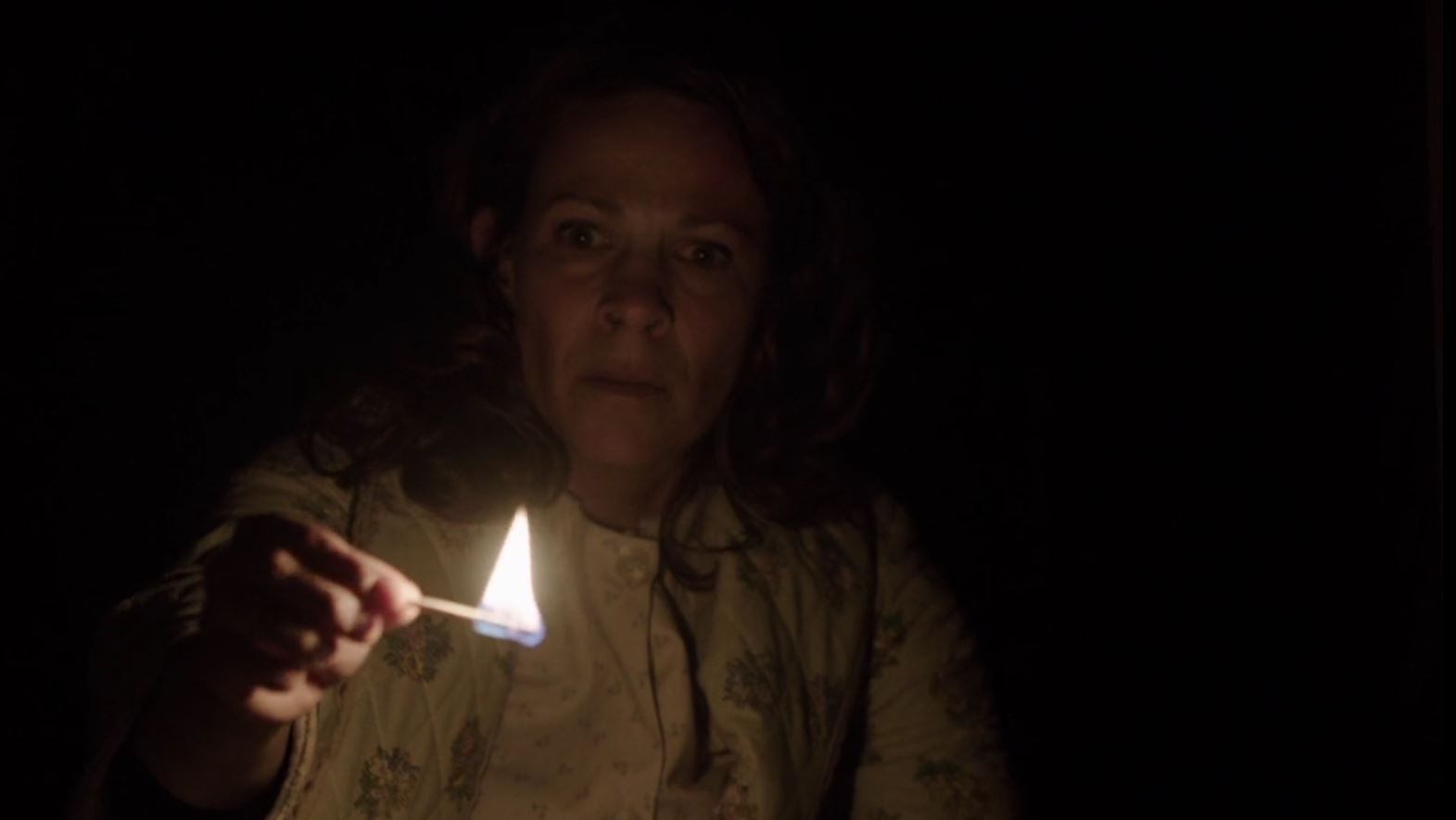
One reason I avoided The Conjuring is I wasn’t a fan of director James Wan’s Saw, which I thought had great actors yet phony acting. Besides, the last time I saw Lili Taylor in a horror movie was 1999’s The Haunting, which helped kick off the crappiest era in horror movie history. Then there’s the conceit of calling this a true story (‘kay), which reeks of the same dishonesty that produced The Amityville Horror, one of the dumbest fucking movies ever made.

And if you think The Amityville Horror really happened, I would like to sell you a bridge, but there’s a good chance you’ve already got all your money locked away in a scam anyway. It just really rubs me the wrong way when movies try to exploit the “open-minded” by slapping “based on a true story” on a title card. Every other week I have to read news about children getting killed by make-believe exorcists and parents who chose prayer over medicine. (I imagine this problem might get worse now that Dr. Oz is focusing on faith-healing every Friday this month… that’s where we are now.) So when I heard this movie was about The Warrens, you better believe I rolled my eyes so hard they nearly popped out of my skull.

I could go on and on about why The Conjuring didn’t look like my cup of tea, but now that I’ve seen it I’m in danger of something which shocks me: I could gush about this movie. Really. I think this is one of the finest horror films ever made—this in spite of the fact that, from a distance, it appears to embody everything I dislike about modern horror.

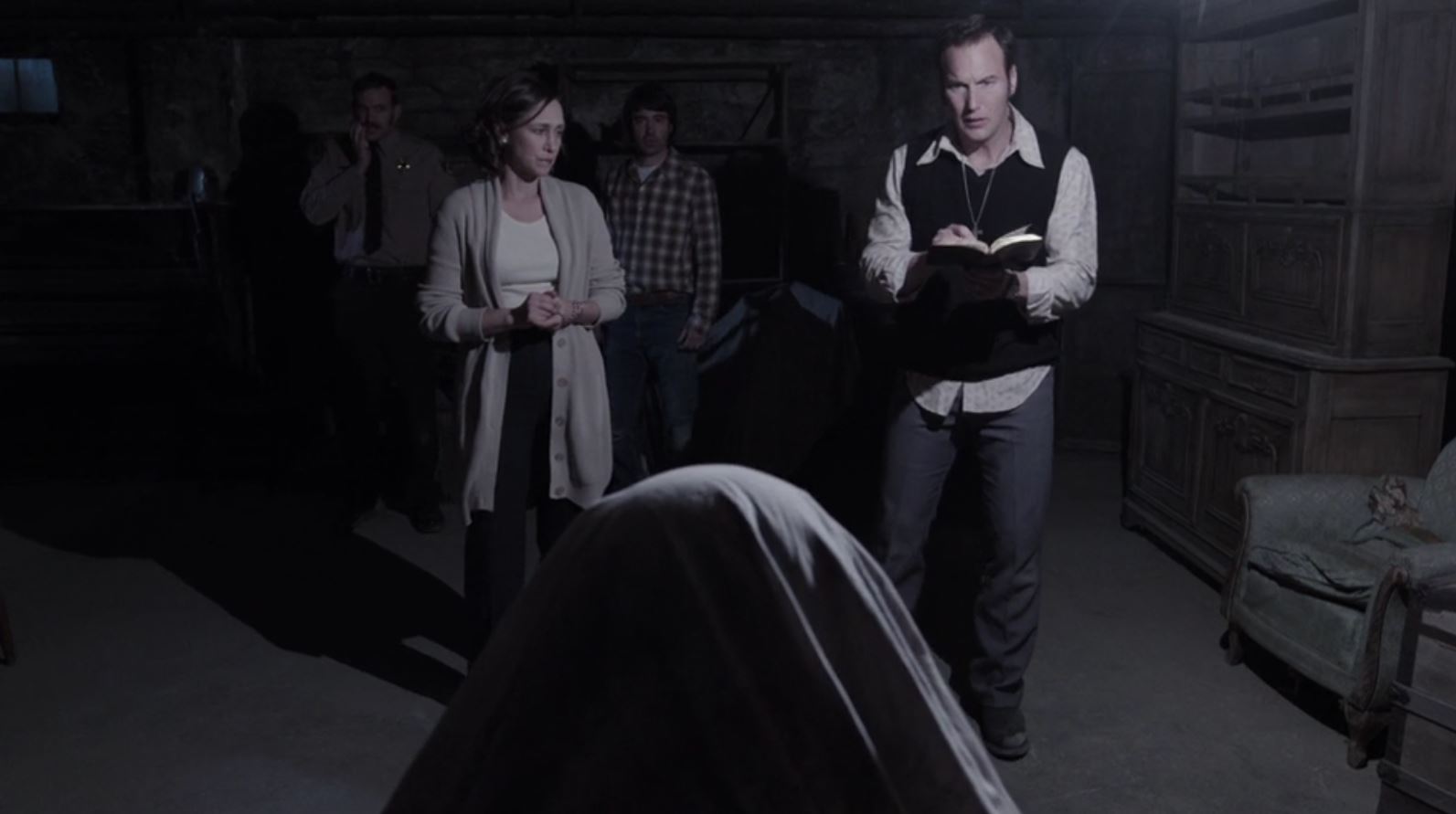
Vera Farmiga and Patrick Wilson, who play the paranormal investigators known as The Warrens, are the kind of screen talent we don’t see much of today. They find themselves in introspective roles which might have been filled by the likes of Shelly Winters and Henry Fonda several years ago. There’s something satisfyingly old fashioned about their methods, which makes them perfectly believable in a story set in 1971, and I have to give James Wan credit for casting adults who look and act like real people.

Meanwhile, Ron Livingston and Lili Taylor play The Perrons, the parents of five daughters who are targeted by the presence haunting their home. Eventually, the strange happenings in the house become so frightening the family resorts to sleeping in the living room together because they’re too scared to stay in separate bedrooms. It’s at this point The Perrons seek out The Warrens for help, who will have to document the case in such a way the church grants them an exorcism. Naturally, the presence doesn’t like The Warrens’ involvement one bit and things become increasingly violent.

Here’s a movie which successfully homages everything from The Exorcist to Poltergeist with a lot of respect. I have a feeling I wouldn’t like James Wan’s opinions on the source material’s legitimacy, but damn it, he’s made a great movie with genuinely creepy moments. I love that little room where the Warrens keep the relics they’ve accumulated over the course of their career… if that’s not a bubbling cauldron of imagination, I don’t what is.

I’ll be featuring the sequel next Friday. Let’s just say I’m cautiously optimistic.