

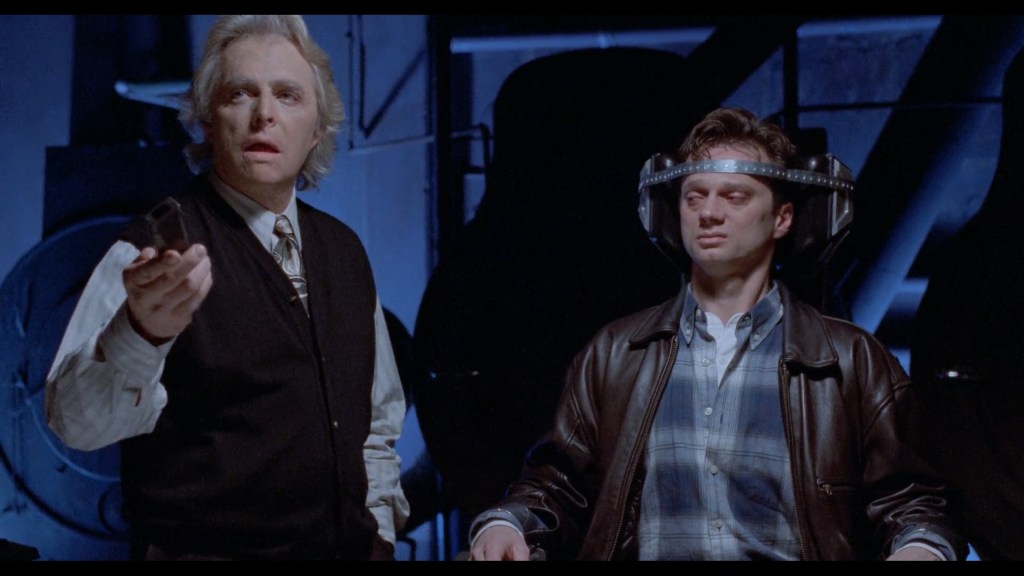
With a title like Scanner Cop, you’d have to assume it’s the goofiest film in the franchise yet. Somehow it sports the most serious tone since David Cronenberg’s original. Hell, I’d argue that parts of this one are more grounded than that one. As far as the sequels go, I still prefer Scanners III for Liliana Komorowska’s insanely entertaining performance, but Scanner Cop is the more rounded experience. From a technical point of view, it’s probably the best made of the sequels.
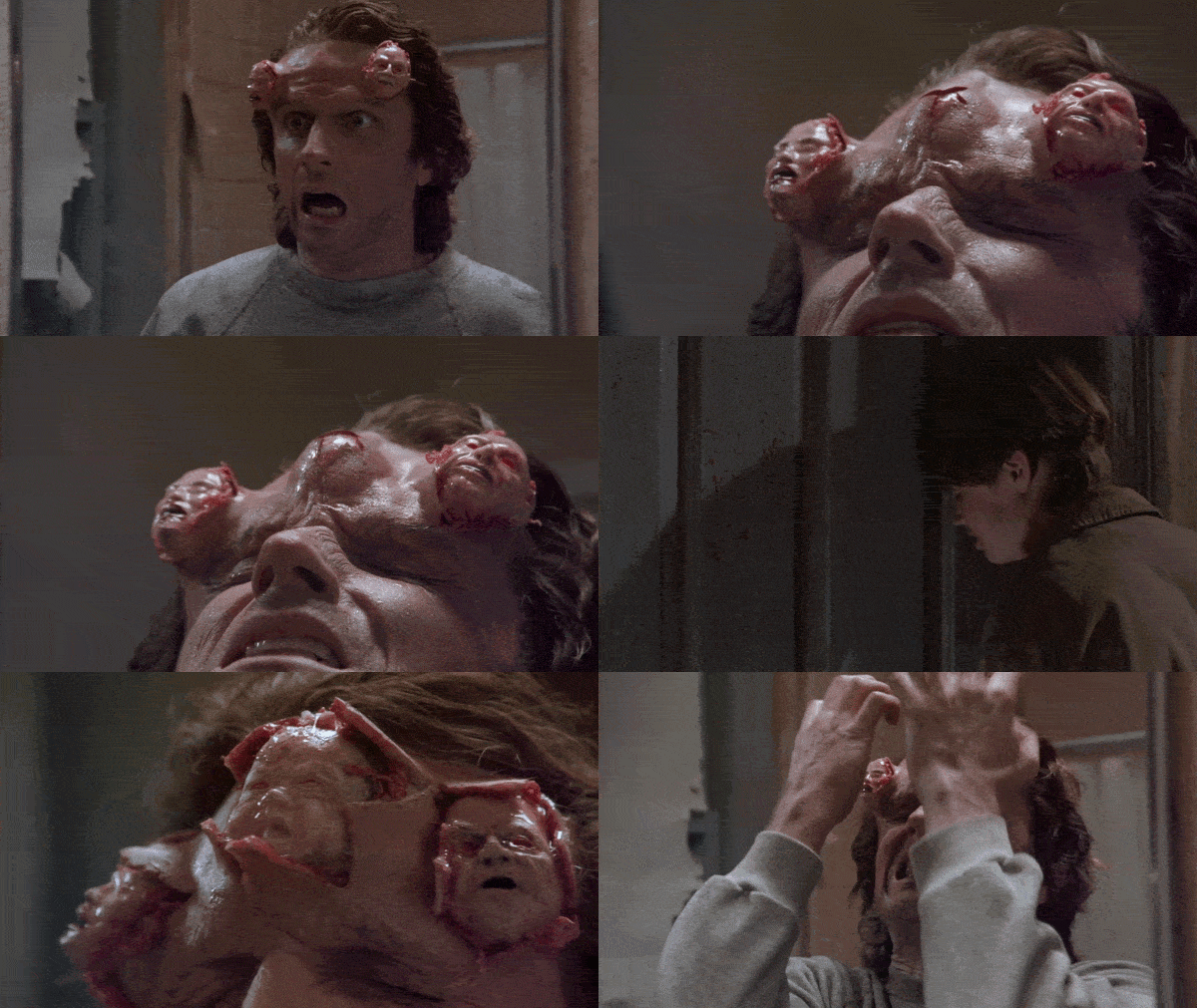
In it, two LAPD cops are attacked by a scanner who’s gone critical in a spectacular way, sprouting miniature faces that form on his head like mutant skin tags. The cops have no choice but to put him down, leaving the scanner’s son an orphan. One of the cops takes pity on the boy and adopts him, providing a steady supply of Ephemoral to keep the boy’s scanner symptoms in check. Fifteen years later, the cop is now the commander, welcoming his son to the force as a rookie officer.
Shortly after, multiple policemen are murdered by civilians with no criminal records whatsoever. When the commander realizes he’s dealing with something beyond the LAPD’s understanding, he turns to his adopted son, urging him to temporarily go off his meds so he can scan one of the perps. His son initially refuses, but once he finds himself entangled in the case, he decides to skip dose after dose, slowly slipping down a slope that typically leaves scanners in psychiatric care, prison, or worse.
Despite turning in the most intimidating villain since Michael Ironside’s Revok, Richard Lynch is burdened with the weakest writing of the movie. The role he’s been given is better than what you’d find in most direct-to-video sequels, but it isn’t quite up to par for this movie. Conversely, there’s a believable comradery on display among Scanner Cop’s tight-knit group of coworkers, but the villain’s backstory is only briefly explored and his motivation essentially boils down to plain ol’ revenge. Notably, the villain not a scanner, nor is he allied with scanner henchmen, which gives him a Lex Luther vibe as he fearlessly squares off with the hero.
What’s most interesting about Scanner Cop is what it doesn’t do. There are moments of predictability, maybe even a scene that induces an eyeroll or two, but they’re few and far between. Consider that Scanner Cop’s adoptive father, played convincingly by Richard Grove (Henry the Red in Army of Darkness), seems destined to die by the second act, but the film sidesteps that obvious hero motivator entirely. These characters feel like real cops who care about each other in honest ways, much like the characters in a Maniac Cop film. Somehow, the fun scanner stuff slots in smoothly between the bouts of solid character development.
I don’t have much more to say. It’s just a surprisingly good picture.


