
If the stars should appear one night in a thousand years, how would men believe and adore, and preserve for many generations the remembrance of the city of God!
—Ralph Waldo Emerson
In 1941, Astounding Science Fiction editor John W. Campbell suggested Isaac Asimov should write a short story inspired by the quote above. What if humanity had never seen the stars? In both the famous short story (anthologized over fifty times in various collections) and the lesser known novel, Nightfall proposes the idea that the night sky could drive one literally insane.
The short story takes place on a planet orbiting six suns. At any given time, the six suns light every inch of the world’s surface. A group of scientists make a terrifying discovery: once every two thousand years, a celestial event plunges the planet into darkness. Much like the “psychohistorians” in Asimov’s Foundation, the scientists in Nightfall know their civilization is quickly coming to an end because the inhabitants of the planet are not prepared to see the heavens.
The story is unsettling. It doesn’t play on the fear itself, but the fragile nature of sanity when faced with the unknown. The last line of the story is chilling.
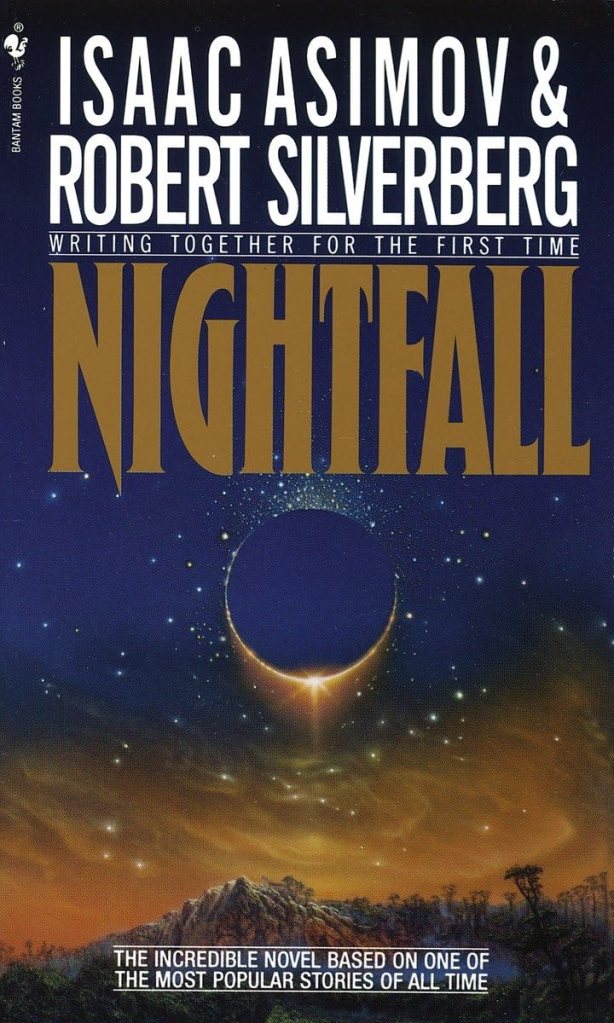
You could say the novel version, co-written with Robert Silverberg in the 1990s, dilutes that final line by telling us what happens next. That isn’t to say it’s not worth your time; Asimov and Silverberg mange to conjure unforgettable images of mass hysteria, including the widespread conflagration that naturally results from this brand of madness. When darkness reveals the stars, the people of the story burn everything they can get their hands on in an effort to make it light again.
The novel begins years before the events outlined in the short story. We get to know many of the characters: a psychologist who is treating patients who have been exposed to darkness, an archaeologist who discovers several civilizations in the past have burned to the ground with remarkable regularity, and the astronomer who realizes nightfall is coming.
The titular event takes place about midway through the book, more or less exactly as it happened in the short story. The last third of the book is about the aftermath, in which most of the world’s survivors are irreversibly insane. At one point, one of the main characters observes a group of men desperately trying to uproot a tree with their bare hands. That’s an image that sticks.
The original title of this post was Nightfall VS Nightfall, but it wasn’t fair to compare the two. They are separate entities written at different times in Asimov’s life. The novel will likely never be considered a classic if only because it retreads familiar territory. I highly recommend reading the short story first, then trying out the novel years after you’ve ruminated over the original ending.
 The Goug' Blog
hello Groug my name is Alex Kirk. I have previously read Ender's game and other books written by Orson Scott Card and was very interested in his books.
please follow my blog allthoselisting at blogger.com
LikeLike