Zardoz: The gun is good. The penis is evil.

The year is 2293. Zed (Sean Connery) is a part of a post-apocalyptic group of barbarians who worship a floating head statue called Zardoz. Zardoz shows up from time to time and commands Zed’s group to rape and kill the peasants who live on the countryside. The god even supplies the weapons and ammunition in exchange for sacrifices. This goes on for several decades until, one day, Zardoz commands them to start agriculture. The Brutals begin to question their god, so Zed smuggles himself aboard the floating head to get answers. He soon finds himself whisked away to The Vortex, a domed city where the Eternals live.

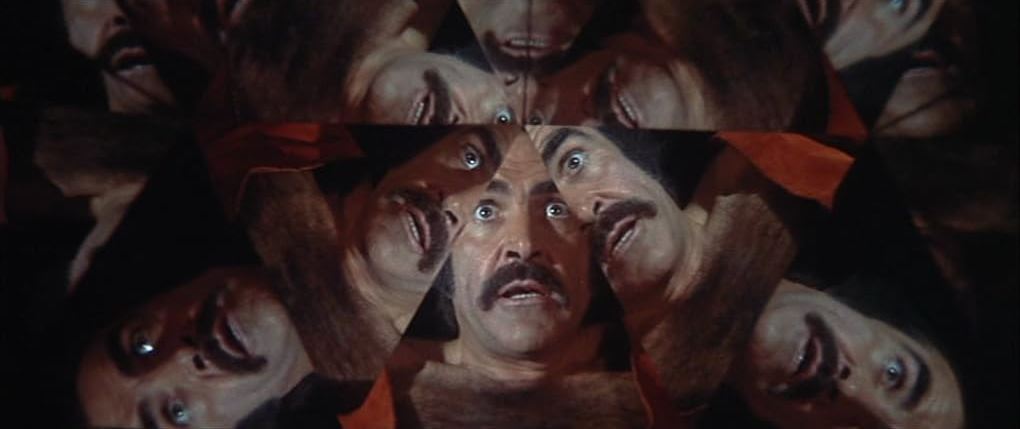
This is when things get weird… well, weirder. The Eternals don’t like life anymore. As their advanced technologies have eliminated the need—and subsequently the desire—for sex, one can easily see why they’re so bored. Many of them are thrilled to find Zed has infiltrated their compound as it’s the only exciting thing in ages. At one point the Eternals decide to test exactly what kind of stimuli gives Zed an erection… the scene is hilarious, mostly thanks to Sean Connery.

I’m often accused of liking bad movies, but this isn’t true. Last night I tried watching Ice Pirates for the first time in two decades. That’s a bad movie. What makes Ice Pirates bad and the eighties version of Flash Gordon good is simple: one’s a Star Wars cash-in which tries too hard to be funny; the other is a genuine love letter to its source material. Zardoz is in the same camp as Flash Gordon in the sense there is passionate filmmaking on display here. Casual moviegoers may snicker, but then again casual moviegoers are the reason superhero movies are getting churned out every other week.

Director John Boorman made Zardoz after his plan to follow up Deliverance with a live action adaptation of The Lord of the Rings fell through. After Zardoz bombed, he made Exorcist II: The Heretic, which was… well, you can’t win ’em all, I suppose.

Zardoz is weird at its finest. It’s 2001: A Space Odyssey if directed by Fellini. It’s psychedelic, ambitious, blasphemous, pessimistic, and optimistic. Speaking of Kubrick’s 2001, cameraman Geoffrey Unsworth turns in cinematography here that could’ve won an Oscar. And where else are you going to see a movie star of Sean Connery’s stature in a red diaper and knee-high boots? (Before Connery signed on, the role was supposed to be played by Burt Reynolds, but he got sick… I’m sure he’s not kicking himself over this one.)

Young, fun, and dead before 31: Logan’s Run

In the otherwise utopian future of Logan’s Run, humans are required to die at the ripe old age of thirty. Most people who reach the cut-off age believe the execution ritual is in fact transferring their immortal souls to a higher plane of existence even though all the spectators can clearly see their bodies fucking explode. Those who try to escape their birthday spankings are called runners. The men who hunt them down are called sandmen.

One such sandman is Logan Five (Micheal York). Logan loves the chase. He and his work partner toy with terrified targets before dispatching them violently. The glee on Logan’s face is truly vile; the way he dispenses the word “runner” is analogous to the way white supremacists scream their favorite slur.

One day Logan is forced to go undercover in order to find Sanctuary, the safe haven where runners attempt to go. Unfortunately, Logan’s partner thinks he really went on the lam so Logan must actually run. (I believe Spielberg’s Minority Report owes some unpaid homage to this.) The next thing you know there’s an oddly placed cameo by Farrah Fawcett, a lot of fiery deaths (because sandmen use flare guns instead of pistols), and a “big reveal” that pales in comparison to the one in Planet of the Apes. As you probably guessed, Logan will slowly have the wool pulled from his eyes.

Logan’s Run posits that people under the age of thirty are idiots. The film’s young and insanely attractive citizens mill about their dome city in slinky costumes with sex-crazed mindsets. I’ll be the first to admit these kind of movies are an acquired taste, but I just love this kind of shit. As far as movies go, it’s the closest you can get to the kind of bizarre science fiction that truly insane novelists like Philip Jose Farmer and Roger Zelzany unleashed in yellow DAW paperbacks. You’re going to see an unbelievable amount of sex, violence, and gratuitous nudity for a PG-rated film, and sheer awesomeness in the truest sense of the word.

It’s a hell of a spectacle, yes, but not a seamless one. Analog future technology is adorable when watched in the digital age. The miniature effects look as realistic as toys. There’s a robot effect so painfully obvious you can actually see the lips of the actor who’s wearing the costume.

Logan’s Run is far too goofy to be considered a classic, but you’ll probably grin an awful lot.

How much man could The Omega Man man if The Omega Man could Omega Man man?

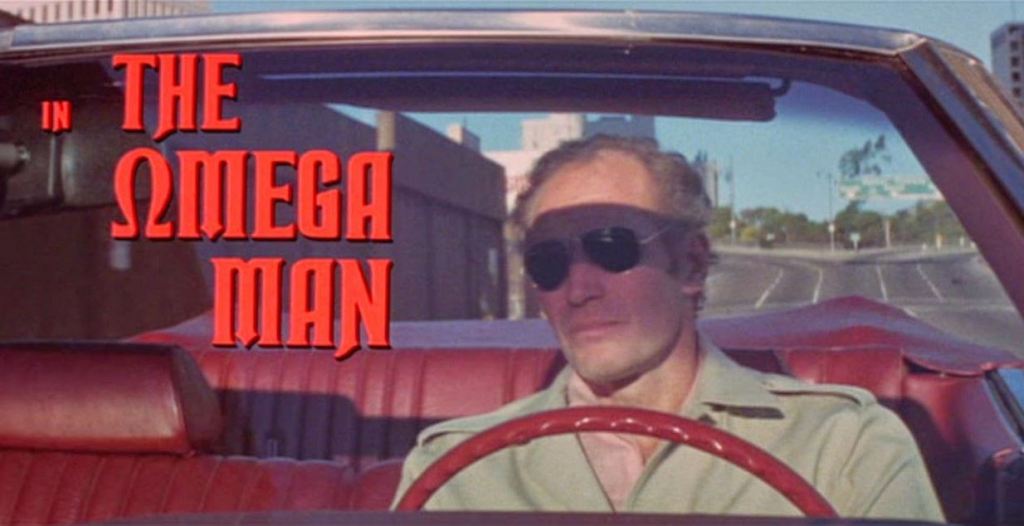
Dr. Neville (Charlton Heston) is driving his convertible through deserted Los Angeles. It’s a pleasant day and he’s just vibing, listening to Theme from a Summer Place on an 8-track player. When Heston spots movement in a window, the machine gun comes out and he releases a barrage of bullets. This is two years after a biological apocalypse has rendered nearly everyone else on the planet dead. According to the poster, “The last man alive… is not alone!” That’s because most of the people who survived the plague are now mutants who specifically want to kill Neville.

If this sounds vaguely familiar, it’s because it’s a 1970s retelling of Richard Matheson’s 1954 classic novel, I Am Legend, in which the bad guys are vampires, not mutants. It also served as the basis for Vincent Price’s The Last Man on Earth, which is a fairly standard but watchable B-movie, and a 2007 Will Smith vehicle which bore the same title as the novel even though it entirely missed the point. Matheson’s novel depicted Dr. Neville as a man so badly isolated that when the vampires came to his home to taunt him nightly, he often fantasized about opening the door and stepping out.

The Omega Man scales back the isolation-horror and becomes one of the very first tough guy films, complete with witty one-liners (which mega Omega Man fan Tim Burton has pointed out in interviews). While browsing a car lot, Neville has a humorous conversation with an imaginary car salesman who’s trying to screw him over. After being captured by the bad guys, Heston asks, “Are you fellas really with the Internal Revenue Service?” When it’s revealed that Neville is not, in fact, the last person alive, his love interest decides to go shopping, referring to her shotgun as a “credit card.”

The film’s so hip, in fact, the mutant ghouls wear mirrored shades with their sacramental robes. This may have seemed a little silly in the 70s, but in the time since it’s managed to age like a fine wine. The last woman alive is sassy black Lisa (Rosalind Cash), who’s not the only prominent character in the film who wears a bitchin’ afro. The first time she meets Heston it’s with perfect comedic timing: she catches him caressing the curves of a department store mannequin.

The Blu-Ray looks great, though it’s painfully obvious whenever motorcycle-driving Charlton Heston transforms into a stunt double with a bad toupee. Also shitty is the inclusion of the same special features which appeared on a DVD version ten years ago. Nonetheless, I haven’t enjoyed the picture more. Watch it before Tim Burton inevitably remakes it.

I (kind of) saw Godzilla 2014

Last night I went to see Godzilla at the drive-in during an intense thunderstorm. Because I am an Oklahoman, it was far from the first movie I watched in a thunderstorm—the first was when I was around sixteen years of age, sharing a plastic bottle of vodka with a couple of friends as we stood in the middle of the field, laughing at the way the hairs on our arms and necks were rising from all the static electricity in the air. As I went to the bathroom, the power suddenly went out. I cannot adequately describe the existential horror of being trapped in a drive-in bathroom as it’s darker than the Mariana Trench… and you really don’t want to touch anything to find your way out because it probably hadn’t been surface-cleaned since the 1950s.

Nonetheless, I really enjoyed Godzilla. At least, once the storm finally passed around halfway through.

Dual-wield sniper rifles in Wolfenstein: The New Order

You assume the role of William B.J. Blazkowicz, whose favorite pastime is killing Nazis. The game opens in 1946 and initially feels routine, like a retread of Return to Castle Wolfenstein. Then a laboratory explosion puts a chunk of shrapnel in B.J.’s skull and the character spends the next fourteen years in a coma. When Nazis are ordered to shut the hospital down, B.J. wakes up just in time to slay the bastards. In this alternate timeline, the Nazis have won the war after dropping an atomic bomb on New York.

Severely culture-shocked, B.J. interrogates a Nazi commander with a chainsaw to find out where members of the underground resistance are imprisoned. Naturally, he breaks them out and finds himself battling the Nazi bastards all over the world… and the moon. Yes, that’s right. The friggin’ moon.

B.J. is a surprisingly sympathetic killing machine. His love interest—the woman who took care of him while he was in a coma all those years—is believably realized in both appearance and voice. Having recently played the less-than-stellar Rage, I’m surprised by how realistic these characters are rendered by the id Tech 5 engine. Take, for instance, the paraplegic Caroline Becker. When she and B.J. are reunited in 1960, they take turns listing their injuries and injustices in an attempt to one-up the other. The pissing contest is concluded with a hug, at which point Caroline warmly says, “Good to see you, William.”

Which isn’t to say the game is flawless. You’ve no doubt heard a lot of reports the game isn’t as linear as the demo which journalists first saw a year or two ago, but those reports are misleading. You’re constantly told what to do in great detail by another character (e.g., “B.J.! Get up to that ventilation shaft and try to ambush the bastards!” etc.). On top of that there’s almost always a little beacon pointing you to an easy-to-miss objective. I understand many gamers don’t have the patience for getting stuck, but the hand holding is a little strong.

As for the multiplayer? There isn’t any. Perhaps that’s just as well as I can’t say I had a whole lot of fun in DOOM 3’s multiplayer and what they tacked onto Rage wasn’t even worth the bandwidth. The developers focused on what really counts: a kick-ass game with very little fat.

What makes the game really special is the way it feels, something that doesn’t translate well to gameplay videos. You’ve gotta try it yourself to truly appreciate it.

Splice isn’t what you think it is

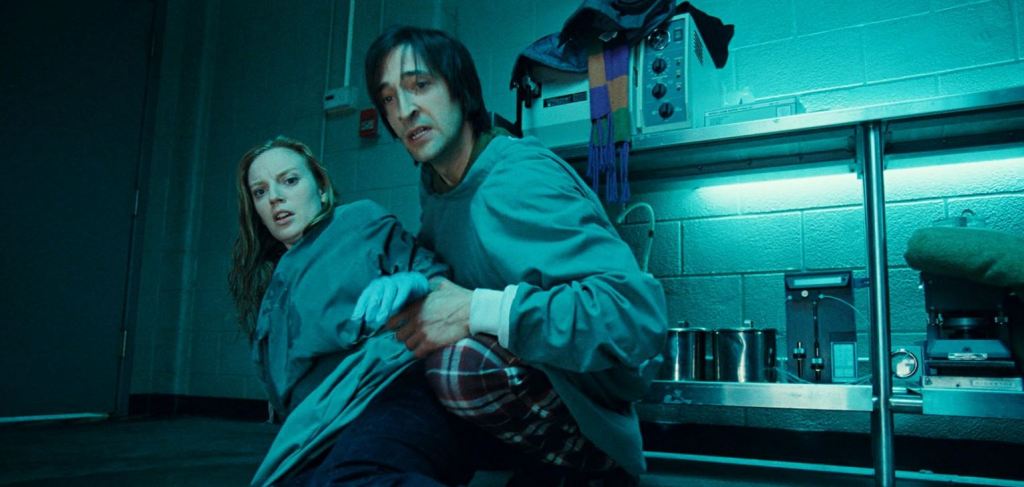
Behold: the birth of a human-designed creature! It’s the second of its kind—a gross, slimy monstrosity about the size of a football. The scientists responsible, who happen to be dating, are Elsa and Clive (Sarah Polly and Adrien Brody). They drive a Gremlin. They eat pizza at work (because movie scientists always eat pizza). They think their designer creature is cute. And this will become relevant later on: Clive wants kids while Elsa doesn’t mind waiting.

The scientists are on the cusp of curing all the bad things that tend to happen to the human body. Naturally, bureaucrats conspire to take the project away. The scientists’ lofty goals simply aren’t profitable to the company’s investors. Polly pushes forward with the research anyway. It results in something that resembles a human fetus outside the womb. Now they’ve got something on their hands that was highly unethical to make in the first place. Getting rid of it is even more so.

The scientists attempt to keep the creature a secret, but this causes one complication after another. And if you’re anything like me, you’ll be waiting for the routine horror stuff to begin any second. Thankfully, the movie doesn’t become routine until the last seven minutes or so. By then, it’s earned it. Its horror is bizarre, cerebral, and wonderfully gross a lá David Cronenberg’s The Fly. The “monster” (and I’m really trying not to give too much away here) has more in common with Frankenstein’s than you might suspect.

So do you like body horror? This picture’s got it. You like dance scenes? There’s a pretty unique one, I guess you could say. You like movies that really aren’t for the faint of heart? Then step right up. Sure, sometimes you kinda know where it’s going, but that’s part of the fun: watching characters on a slow motion collision course with outcomes that could have been easily avoided earlier, but can’t be avoided now.

Event Horizon doesn’t affect the outside observer

When Sam Neill attempts to explain black holes to his crew members, they roll their eyes. One says, “Singularities? Speak English!” I can’t imagine a depressing future in which people who live in space are lost at the mere mention of singularities, but Paul W.S. Anderson apparently can. He’s the guy who made Mortal Kombat, Resident Evil, and Alien Versus Predator. He’s got as much taste as a toenail.

The Event Horizon, an interstellar ship with an experimental gravity drive, has vanished. Seven years later, it mysteriously reappears, orbiting Neptune. A second ship is sent to investigate. Sam Neill is the scientist who designed the Event Horizon, Laurence Fishburne is the captain, and Kathleen Quinlan looks great in a tank top. Due to unforeseen circumstances, the rescue vessel is damaged and the crew have to swap ships. Unfortunately, the Event Horizon begins to make the characters hallucinate. We’ll soon find out it’s been places it shouldn’t have been and brought something sinister back with it.

It’s fair to compare Event Horizon to Alien, even though that’s like comparing restroom graffiti to Picasso. On second thought, it’s actually among the better Alien rip-offs (and some of the official sequels, to be honest), because instead of yet another alien running around, it at least tries to do something different with the supernatural angle. I often see Event Horizon regarded with reverence in movie forums, and I certainly see why others love it, but I just wish it were a little more fun.

To be clear, it’s okay for horror films not to be fun, but those need to be exceptionally good in other ways. Event Horizon is not exceptionally good in any way. It’s not just joyless, it’s pointlessly joyless, partially because the director has the emotional complexity of a housefly. Compare it to another Sam Neill horror movie, one that’s also as serious as a heart attack: Possession. That’s a movie that actually has something to say and it’s even more unsettling than this one.

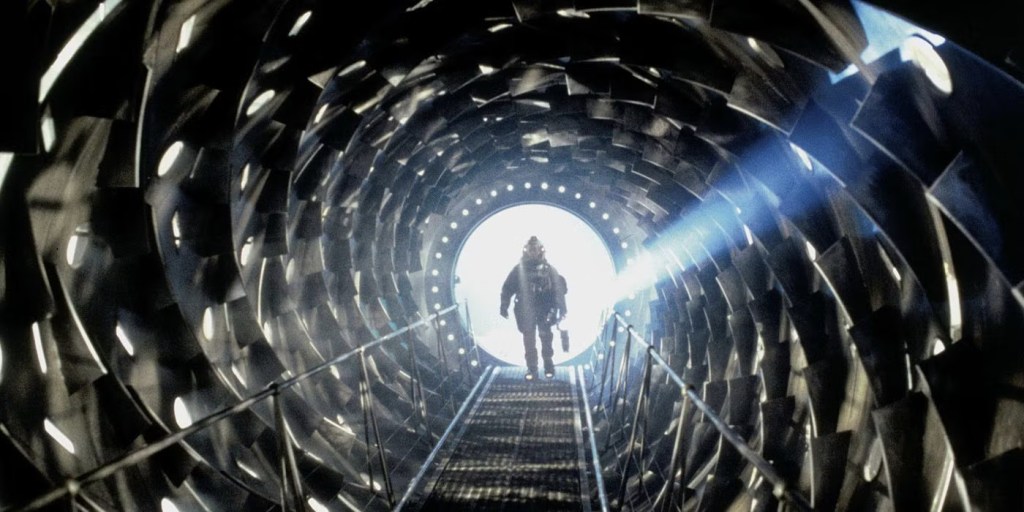
I’ll be the first to admit Event Horizon isn’t without merits. The set designs look fantastic, though there’s no logical reason for the maintenance lighting to turn eerie colors or for there to be a hundred headlights all over the wormhole generator. The CGI is terrible, but the rest of the special effects are top notch. I’ve heard tale that there’s a more graphic cut somewhere in the studio’s vault. I have the sneaking suspicion that’s a better film than this, the watered down theatrical version. I would be extremely interested to see it some day.

As is, Event Horizon just isn’t my cup of tea. Almost, but not quite.

The Arrival holds up today

The year was 1996. The must-see alien movie was Independence Day. Millions of moviegoers, myself included, chose that film over The Arrival, the trailer of which looked like dog shit. (Interestingly, The Arrival is much better than the trailer while the ID4 trailer is much better than the movie.) When The Arrival premiered on HBO some months later, I was immediately drawn in. The movie was ridiculous at times, but overall it was a thoughtful science fiction flick. Unfortunately, the movie bombed at the box office, which somehow didn’t stop a direct-to-video sequel.

A climate scientist is roaming a picturesque meadow. She stops to sniff the flowers and says, “This shouldn’t be here.” The camera pulls back—way back—into outer space. We discover she’s near the north pole and the meadow is completely surrounded by ice. (Never mind there isn’t any dirt that close to the north pole, just go with it.) The aliens aren’t coming. They’re already here. And whatever they’re up to is climatic in nature.

Enter Zane, a radio astronomer played by Charlie Sheen. The Hollywood bad boy seems like a terrible choice to play a scientist, but he believably pulls it off with a dorky goatee, spiked hair, and glasses. Zane has just recorded forty-two seconds of a radio signal from a star fourteen light years away. When he takes the recording to Phil Gordian (Ron Silver) at Jet Propulsion Lavatory, Gordian promises to send the audio up the ladder, but breaks the tape the moment Zane walks away. It’s pretty early for a bad guy reveal, but it’s best to get it out of the way now because, with Silver in the part, we all would have guessed he’s a bad guy anyway.

So when Zane loses his job for supposedly unrelated reasons, he pivots to “telecommunications” (read: installing home satellite dishes). Before long he has the idea to link several of the dishes in an unauthorized array for his own purposes. How he does this with 90s technology without stringing miles and miles of cable to his house, I don’t know, but it’s good to see a character with agency. He manages to lock onto the mystery signal again, but this time it’s not coming from the star, it’s coming from Earth.

Zane tracks the origin of the second signal to Mexico and takes the first plane to the general area of the broadcast location. There he meets the climate scientist from the beginning of the movie, whose separate investigation has brought her to the same place, and the pair discover a power plant the aliens are using to pump huge quantities of greenhouse gases into the atmosphere. See, the aliens like it hot so they need to raise our planet’s temperature, soon to be their planet.

The Arrival posits one WTF moment after another. Some of the risks Zane takes are pretty preposterous, but we want him to take those risks. The audience eventually demands answers more than he does.

Elysium is no District 9

It’s the future. Rich people live on a space station called Elysium. Poor people live on Earth, oppressed by robots, working menial jobs just to survive. The factory that manufactures the robots is where Max (Matt Damon) works. After receiving a lethal dose of radiation on the job, Max is told he’s only got a few days left to live.

On Elysium, the rich have access to med-bays which can cure any ailment including radiation sickness. All Max has to do—in theory—is sneak onto Elysium and climb into one of the bed-shaped devices. Unfortunately, Jodie Foster’s defense secretary (basically the head of border security, the “border” being space itself) is on high alert and will shoot dead any trespassers. Max, growing sicker by the second, has to have a robotic exoskeleton surgically implanted on his body just to remain mobile.

Excitement is curiously missing from Neill Blomkamp’s much anticipated follow-up to District 9. Here’s a movie which is far from terrible, but nothing really clicks. There was a wide variety of action sequences and creativity in Blomkamp’s previous film. In Elysium, it’s all about the gunfights. When you have a giant space station in the shape of a wheel, you’re telling me the most the filmmaker can come up with is standard shootouts, the majority of which take place on desolate old earth?

Is there a reason why Jodie Foster speaks in a phony accent? Even William Fichtner, one of Hollywood’s most solid character actors, is off his game. Casting Sharlto Copley (the weenie hero of District 9) as bad guy Kruger is a stroke of inspiration, but his character just isn’t realized enough for us to believe his machine-like agency. Matt Damon absolutely feels at home in a movie like this, but there’s not much for him to work with, either.

At the end of the day, I wouldn’t say Elysium scars Blomkamp’s reputation. I’m still excited to see his next movie because I still think (hope) he’s Hollywood’s ace in the hole. Hell, I still want to see what he would do in the Halo universe, which was at some point the original plan for the breakout director. I just pray he’s not a one-hit wonder.

Elysium is a solid rental, but only if you don’t have something better to do tonight. It looks great, has some interesting ideas, but that’s about it.

Can The Wolverine make up for Wolverine: Origins?

A group of guards wave a metal detector over Logan’s body. His adamantium bones, of course, set the wand off.

“Hip replacement,” Logan explains.

That scene is about twenty minutes in. By then we’ve already seen the atomic bombing of Nagasaki, the cameo of a former X-Man, a bar fight, and a sword that can slice through beer bottles. The violence is so graphic you’ll wonder how they got away with a PG-13 rating. So there’s a lot happening in The Wolverine, but it works. With a darker tone and a more tasteful approach to casting, this Logan pic quickly atones for the sins of Origins.

Logan’s no longer with the X-Men. He’s living in the Canadian wilderness while perfecting his brooding face. Shortly after avenging the death of a grizzly (straight from the pages of Wolverine #1), Logan receives an invite to Japan. There, a man he saved in Nagasaki is on his death bed. The tech CEO offers Logan the gift of mortality: “You can get married, have a family, lead a normal life.” Logan’s tempted, but politely turns down the offer. The old man dies, yakuza attack, and ninjas spring from the shadows. Somewhere along the way Logan loses his healing abilities. He becomes vulnerable at that point, but his adamantium bones still shield his vitals from bullets.

Convoluted? Kinda. Awesome? Very. We’ve seen many action sequences on top of a moving train before, but this one sets the new standard. Logan’s so determined and unflinchingly violent it seems more like the a Schwarzenegger flick than a modern action movie. It’s been far too long since we had a ‘roided action hero fist-fighting his way through an army of nameless bad guys.

I do think the film’s villain, Viper, is perhaps the weakest link, but there are enough bad guys to make up for it. Sure, the plot teeters on the edge of preposterous, but it’s a comic book movie—isn’t that why we’re all here? I wasn’t exactly expecting the sophistication of Shakespeare when I purchased my ticket.

Slight spoiler ahead…

About the mid-credit sequence: we now have a solid link between this film and the much-anticipated Days of Future Past. I have to admit I was pretty skeptical about it when it was announced (Professor X is no longer dead and Magneto has reclaimed the powers he was robbed of in The Last Stand… or perhaps they’re ignoring that film entirely), but seeing Patrick Stewart and Ian McKellen return to the characters was exciting. No, it doesn’t explain their return, but a bigger question remains: Why the fuck would Wolverine even attempt to walk through airport security?