Repo Man (1984) [Midnight Movie]

“Ordinary fuckin’ people… I hate ’em.” — Bud

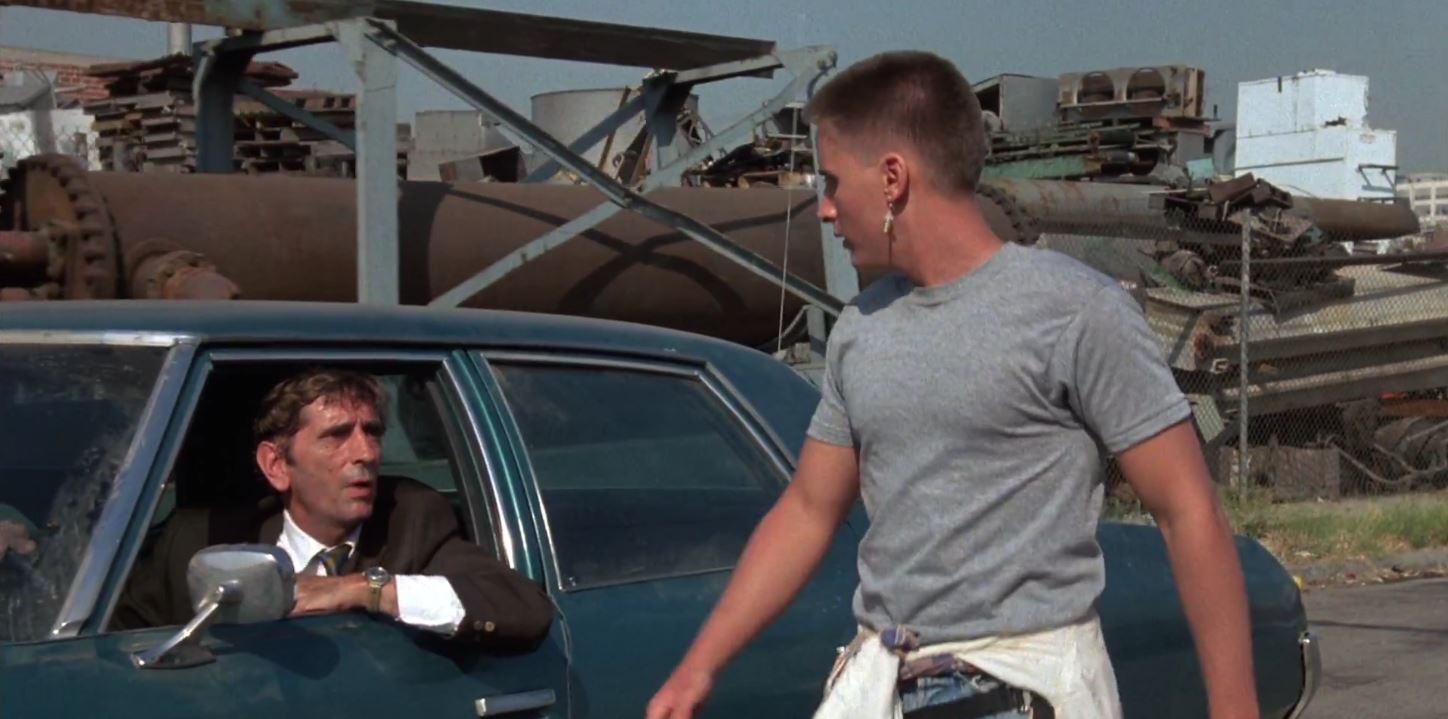
Otto (Emilio Estevez) is “just a white suburban punk” (his own words) who loses his shitty job stocking groceries in a shitty store. After finding his girlfriend in bed with another punk, he takes to wandering the streets of Los Angeles, looking for trouble as he chugs his beer.

Beer, like most of the consumables in Repo Man, is labeled generically. People who live in this version of LA, which is portrayed no more seriously than Grand Theft Auto’s highly satirical Los Santos, are too busy being hypnotized by their television sets to worry about the freedom to choose; there’s no need for brand names because it’s all the same shit anyway. You just get Beer.

A stranger named Bud (Harry Dean Stanton) spots Otto on the sidewalk and offers him a job as a repo man. Bud’s eager to share his trade secrets: a repo man shall not cause harm to any vehicle, a repo man thrives on tense situations, and a repo man does speed. Whenever they’re not repossessing cars and getting shot at, they’re starting fist fights and car chases through the Los Angeles River.

Why? Because why not.

Meanwhile, a suspiciously odd driver is making his way through town in a Chevy Malibu. We don’t know much about him, but we do know whoever looks in his trunk gets vaporized by something extra-terrestrial in nature. (It’s worth noting that Weekly World News is the newspaper of choice in Repo Man.) One day there’s a $20,000 bounty put on the Malibu, pitting Otto’s friends and rivals against one another. Otto’s friends and rivals, by the way, are pretty indistinguishable.

Amidst the flurry of action-packed scenes are relatively quiet ones in which the supporting characters launch into wordy monologues about life, the universe, and everything… without saying anything significant at all. (It kind of reminds me of David Byrne’s True Stories… so much of this stuff isn’t relevant to the plot, but then again, there really isn’t a plot.) Miller, a grease monkey, makes far-out observations which might sound sensible coming out of the mouth of a new age guru, but if you actually look for meaning you’ll find a whole lot of nothing. Otto, who’s too stupid to look for meaning in the first place, just kind of raises an eyebrow.

Back to Bud: he’s a well-meaning everyman who’s fearful of commies and convinces himself his hard work is going to result in the American dream. (His idea of the American dream is running a repo business of his own.) In other movies, the main character’s protégé might have shone light on the film’s deeper meaning by becoming a thinly disguised parrot for the filmmaker’s beliefs. In this movie he’s just a guy who hates bums… Christians, too. It probably doesn’t mean anything. It doesn’t have to mean anything when it’s as witty as this.

So yeah, Repo Man isn’t a typical movie. It’s a movie that feels just as fresh, unpredictable, and effortless as it felt the first time I saw it. Even the most conventional aspect of the movie—the trunk-kept MacGuffin—refuses to adhere to any traditional rules of storytelling. Whenever you hear screenwriting experts go on and on about the importance of structure and carefully measuring the beats of your plot, you’re not wrong to think: “Yes, but you won’t ever make a movie like Repo Man that way.”

Come to think of it, I have no idea how this movie got made. It’s too funny, too alien, and too genuine to have been created by a mere human. I can’t imagine it working on the page and it shouldn’t work as a film, either. Somehow it does. And how it manages to sustain its breakneck pace until the very end, I’ll never know. Impossibly, Repo Man doesn’t get bogged down by cramming too much into it the way Buckaroo Banzai did (a movie I also adore, though not as much as this one); somehow it thrives on becoming bloated with too many characters, too many subplots, and too many words which don’t necessarily mean anything in and of themselves, but speak volumes about the film’s don’t-give-a-fuck attitude.

Honestly, I don’t know why this uneven movie runs like such a finely tuned machine. Yet for anyone raised on Mad Magazine, it’s just about the perfect middle finger to all that is average. Stay in this weekend and watch it instead of going to see Movie.

Ichi the Killer (2001) [Midnight Movie]

I can say without exaggeration that Ichi the Killer is a vile movie. If images of graphic violence have ever scarred you, you should avoid it at all costs. There are people who have legitimate reasons for not being able to stomach this level of imagery, and then there are people who simply dislike it. That’s fine. To be clear, you’re not supposed to like it, which seems to be lost on many of its most vocal critics.

Despite multiple recommendations, I initially avoided Ichi the Killer because I assumed the violence was going to be all style and no substance. I never understood the popularity of The Boondock Saints, which seemed utterly forced to me. Crucify me if you must, but it’s high up on the list of reasons I disliked so many genre films from the late 90s and early 2000s. I assumed Takashi Miike was a Japanese Troy Duffy because so many of the people who recommended Ichi the Killer were fans of Saints.

In other words, my expectations led me terribly astray. Hey, I’m only human. I try my hardest not to pre-judge movies, but sometimes it can’t be avoided when there are millions of them to choose from.

Thankfully, I quickly discovered Miike’s Audition and fell head over heels in love with it. I think that movie is best described as beautifully horrendous. Or horrendously beautiful, take your pick. I’ll probably watch it again soon as I continue to thread my way through Miike’s overwhelming filmography.

The special quality that drew me into Audition is hyper-realized in Ichi the Killer. The opening scene depicts the brutal rape of a prostitute. Meanwhile Ichi, the hapless hero, is shown masturbating as he peers through the window, watching the gruesome scene unfold. We later learn Ichi was traumatized by witnessing the rape of a classmate when he was in high school. The event had a very unfortunate effect on him, which isn’t sugarcoated in the least. In some ways Ichi is just as monstrous as the film’s villain, which makes it hard to like him at times. Maybe you’re not supposed to like him, but you should (and probably will) pity him nonetheless.

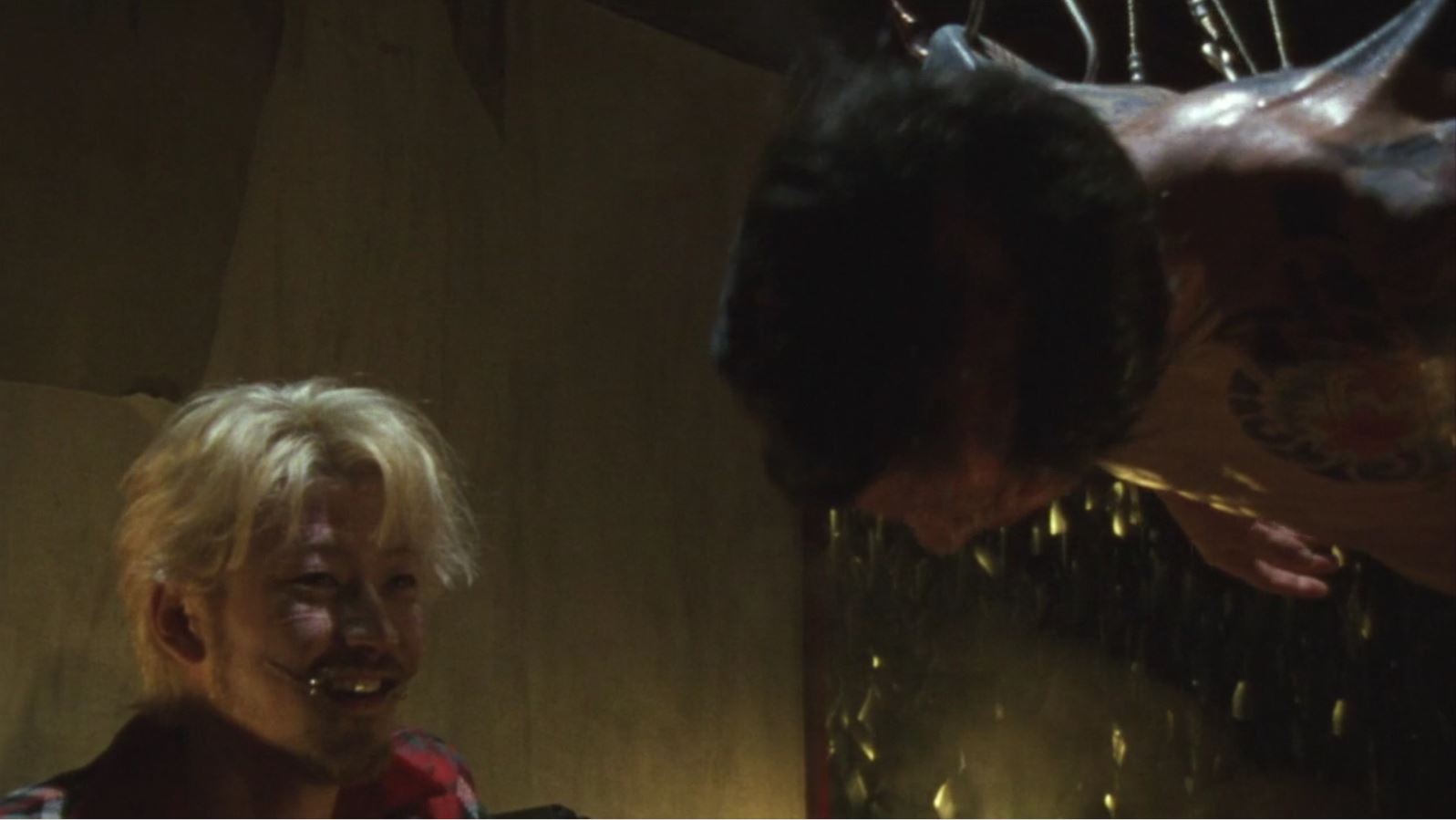
Although the story revolves around Ichi, Miike mostly focuses on Kakihara, a sadomasochistic gangster whose mentor has disappeared. What the audience already knows is the missing crime boss is dead, but Kakihara assumes leadership of the gang and launches a twisted inquisition to track him down. Kakihara has scars reminiscent of Heath Ledger’s Joker (I’d be willing to bet that wasn’t accidental on Christopher Nolan’s part), only his are so deep he has to keep them pinned shut with facial piercings. And whenever he has a cigarette, he exhales the smoke from the sides of his face.

Like Ichi, Kakihara is also a victim of untold abuse, which he suffered at the hands of the very man he’s risking everything to rescue. In an attempt to assuage his sense of loss, he has a potential love interest chain him up and beat the shit out of him, but it doesn’t do the trick. He needs more. While interrogating members of other gangs, he employs needles, hooks, and scalpels, but he just isn’t his old self until he learns Ichi is coming to kill him next. The fear of impending death, it turns out, makes Kakihara giddily excited because he has seen Ichi’s work and admires it greatly. “I’m scared!” he says with a childlike glee. “I have goosebumps!”

I’m leaving an awful lot out, as I often do, to avoid even minor spoilers. Yet what I want to talk about most is the ending, which is both extremely satisfying and anti-climatic. Hollywood has programmed us to expect everything to be neat and tidy by the time the credits roll, expecting the surviving characters to be miraculously cured of their afflictions. Yet Ichi the Killer has set itself up in such a way that if it gives us what we expect to see, it will only leave us disappointed. Either way, you won’t necessarily be happy with the outcome, but I maintain you’re not supposed to like it.

I keep saying you’re not supposed to like it, which is misleading because I very much liked it as a whole. The movie can have you laughing (nervously, perhaps) when you aren’t peeking through your fingers or reeling in disgust. Like Audition, it’s a beautiful movie which can turn hideous at the drop of a hat, especially when it isn’t cutting corners with cheap CGI. There are plenty of scenes in which it goes too far, maybe even way too far.

That’s probably the point. Miike obviously isn’t concerned about viewers who will take a knee-jerk moral stance, which is refreshing in the era of corporate-owned studios frequently bowing to the slightest bit of social media pressure. (Mob mentalities do not make good writers and the trend to give audiences exactly what they think they want is the biggest reason I don’t go to the theater much anymore. Criticism is fine, but so is making movies which will generate strong criticisms.) The only thing Miike’s concerned about is being true to his characters, so it isn’t a movie in which traumatic events make heroes out of victims, but a movie in which traumatic events fuck people up in complex, unpleasant, and inconvenient ways.

I think that’s much more effective and true-to-life than heroes who solve their problems with a loaded gun (not that I have anything against a good revenge tale). So you killed the person who fucked you up. Now what? You stop being traumatized? Once again I point to The Texas Chainsaw Massacre as the rare example of a genre film which points out that surviving isn’t always what it’s cracked up to be. Ichi the Killer is another example, though in a much different way.

As with many movies which get banned by governments around the world, it’s probably not so much the content that scares them, but the power behind the movie. There are those who love Ichi the Killer and those who hate it. They’re both right. I happen to be one of the people who love it. Maybe I’m just a masochist, but I need this much more than I need another Thor or Batman movie.

Eyes Wide Shut (1999) [Trailer]

Kubrick movies often had great marketing. Imagine seeing this vague trailer and knowing nothing else about the movie other than the fact it was Kubrick’s last. Then, armed with precious little plot information, the movie just kind of… happens to you.

Great use of music and mystery. The aspect ratio seen in this trailer is actually Kubrick’s preferred format for this film and many of his others. He makes a strong case for squarish images. 

Blue Ruin (2013) [Midnight Movie]

Last year I featured Jeremy Saulnier’s Green Room, which I liked a lot. The movie has continued to grow on me. I love crime movies, scenes of genuine terror, and mean bad guys. Green Room checked all of those boxes while subverting the usual cliches—I loved it when the closest thing to a hero begins to tell his life story, and the lead female interrupts him to point out she doesn’t give a shit.

There’s a bit of that in Blue Ruin, too. A gun nut who may have had some experience killing people advises the main character not to give any big speeches before blowing the bad guys away. Just pull the trigger and move on with your life. When the main character fails to heed this advice, it almost gets him killed.

Blue Ruin was one of those movies I really wanted to see, but it somehow slipped through the cracks for me. (I assumed Blue Ruin was Saulnier’s first film, but it turns out he made a movie called Murder Party first; I’ll be catching up on that one sometime this year, too.) Now that I’ve seen it I can say it’s one of those movies I live to see. Maybe I didn’t like it as much as I currently enjoy Green Room, but I have a feeling this one will grow on me as well.

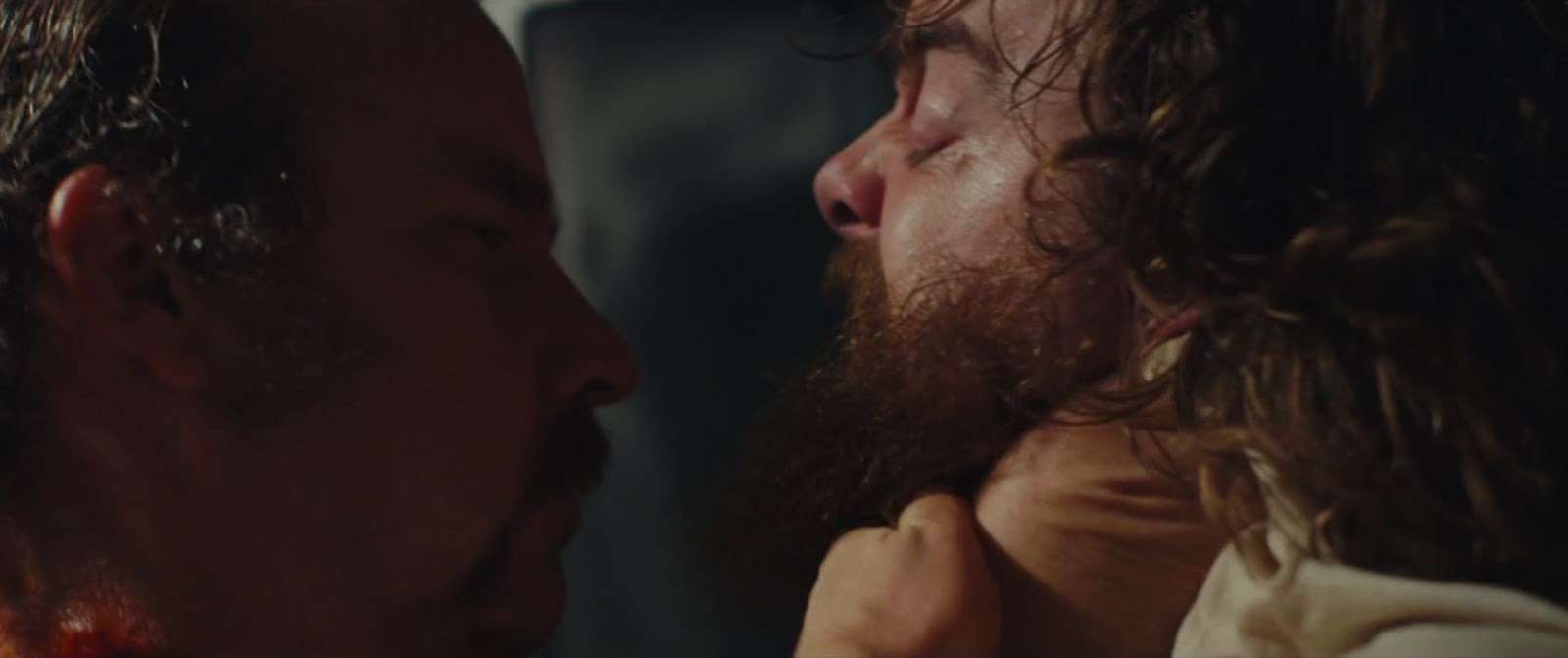
Macon Blair, who plays the wildly bearded Dwight, is first seen soaking in a bathtub. When he hears a noise in the house he leaps through the window like a startled raccoon. It turns out Dwight doesn’t live here and the people who do have unexpectedly come home. Dwight actually lives in a beat-up car just off of the beach, which is where he’s been living ever since his parents were murdered. Since he leaped out of the stranger’s tub with nothing more than a bath towel, we learn early on he’s an expert at acquiring clean clothes. This is a skill which will prove useful more than once throughout the movie because things are going to get very bloody.

I didn’t know who Macon Blair was before this movie. He’s already becoming one of the my favorite actors.

I want to be vague about the next few bits because the movie is so much more exciting if you know next to nothing about it. Treading lightly in regards to spoilers: the man who murdered Dwight’s parents has just been released on a technicality, and Dwight decides he’s going to kill him. There’s not a whole lot of thought put behind the plan, but Dwight’s sister is on board until she realizes the murder attempt makes her family a target.

Long story short: it’s an extremely entertaining crime thriller which examines the self-destructive nature of revenge (and blah blah blah) without becoming the least bit preachy. And if you want to know more about the plot before seeing it, see any other review, but I’m telling you: if you like grizzly crime movies, this one’s a winner. There’s really nothing else you need to know before seeing it.

Is this movie and Green Room part of a planned trilogy of “color” films? I hope so. Red Rune? Orange Doom? Yellow June? The possibilities are endless.

The Conjuring 2 (2016) [Midnight Movie]

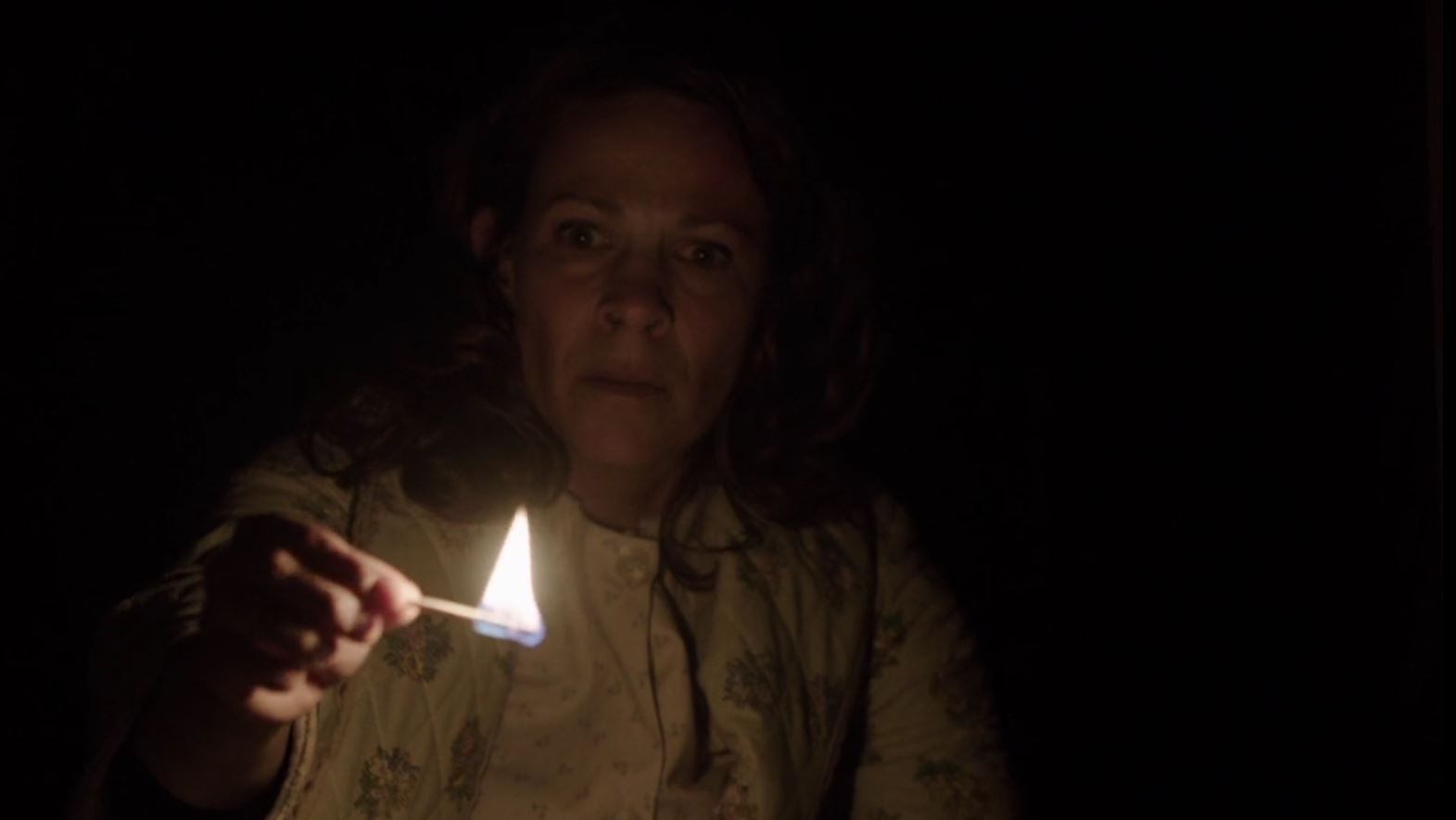
You’ve got to be a gifted filmmaker to make me care about a couple of characters based on the paranormal investigators known as The Warrens. Were they delusional or professional scumbags? Or both? I’m going with both.

In case you haven’t noticed yet, I’m a card-carrying skeptic, through and through. Before I saw The Conjuring I would have gladly forgotten The Warrens existed at all. In a piece of fantasy, however, the characters are fascinating. Years ago, as mentioned in the first film, Vera Farmiga’s Lorraine Warren had a premonition so terrifying, she refused to tell her husband (Patrick Wilson’s Ed Warren) what she saw in it. I would have preferred it if The Conjuring 2 kept her vision a mystery, but this time around they spill the beans. Their reason for doing so, however, induces a feeling of dread which helps drive this sequel.

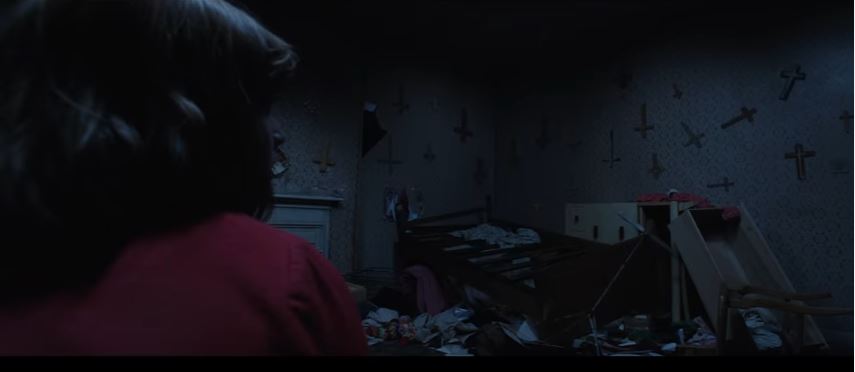
The Warrens have been called in to investigate the strange happenings at a London home occupied by a single mother (Frances O’Connor) and her three children. There’s an entity in the house who calls himself Bill. Bill likes to rip sheets from the beds and tug on the children’s ankles. When the mother tries to intervene, he graduates to biting, which leaves behind nasty sets of teeth marks on their skin.

Bill’s not the only presence at play here. The kids own a creepy old zoetrope. The spindly figure it depicts sometimes vanishes from the toy altogether, only to reappear creeping around the house in a mixture of CGI and stop-motion effects. It’s the best visual of the entire movie. Hell, it’s probably the best visual in any horror movie in years. Meanwhile the kids sing a nursery rhyme about this character, calling him the crooked man. (This is apparently a real-life nursery rhyme.)

Finally, there’s the demonic nun who seems unrelated to the London house, but frequently torments Lorraine. The demon is, disappointingly, a shoe-in for Marilyn Manson, which may be a case of director James Wan showing his age. And if this sounds like the movie is getting a little too overloaded with villains, I would have to agree. They should have kept the crooked man and dumped the Marilyn Manson lookalike altogether.

Still, The Conjuring 2 is the rare horror sequel which feels like a worthwhile continuation. It mixes in just enough new stuff to dazzle us while keeping enough of the old ingredients we liked so much the first time around. I do think it’s pretty dishonest to portray skeptical characters as stupid assholes, but hey, whatever—it’s Wan’s movie, not mine. Elsewhere, the characters are expertly written and the leads become even more interesting than they were in the first movie. Maybe the horror isn’t quite as good as it was in part one, but you’d need a very precise measuring tool to know for sure.

When The Conjuring 3 comes out I’ll be the first in line.

The Conjuring (2013) [Midnight Movie]

One reason I avoided The Conjuring is I wasn’t a fan of director James Wan’s Saw, which I thought had great actors yet phony acting. Besides, the last time I saw Lili Taylor in a horror movie was 1999’s The Haunting, which helped kick off the crappiest era in horror movie history. Then there’s the conceit of calling this a true story (‘kay), which reeks of the same dishonesty that produced The Amityville Horror, one of the dumbest fucking movies ever made.

And if you think The Amityville Horror really happened, I would like to sell you a bridge, but there’s a good chance you’ve already got all your money locked away in a scam anyway. It just really rubs me the wrong way when movies try to exploit the “open-minded” by slapping “based on a true story” on a title card. Every other week I have to read news about children getting killed by make-believe exorcists and parents who chose prayer over medicine. (I imagine this problem might get worse now that Dr. Oz is focusing on faith-healing every Friday this month… that’s where we are now.) So when I heard this movie was about The Warrens, you better believe I rolled my eyes so hard they nearly popped out of my skull.

I could go on and on about why The Conjuring didn’t look like my cup of tea, but now that I’ve seen it I’m in danger of something which shocks me: I could gush about this movie. Really. I think this is one of the finest horror films ever made—this in spite of the fact that, from a distance, it appears to embody everything I dislike about modern horror.

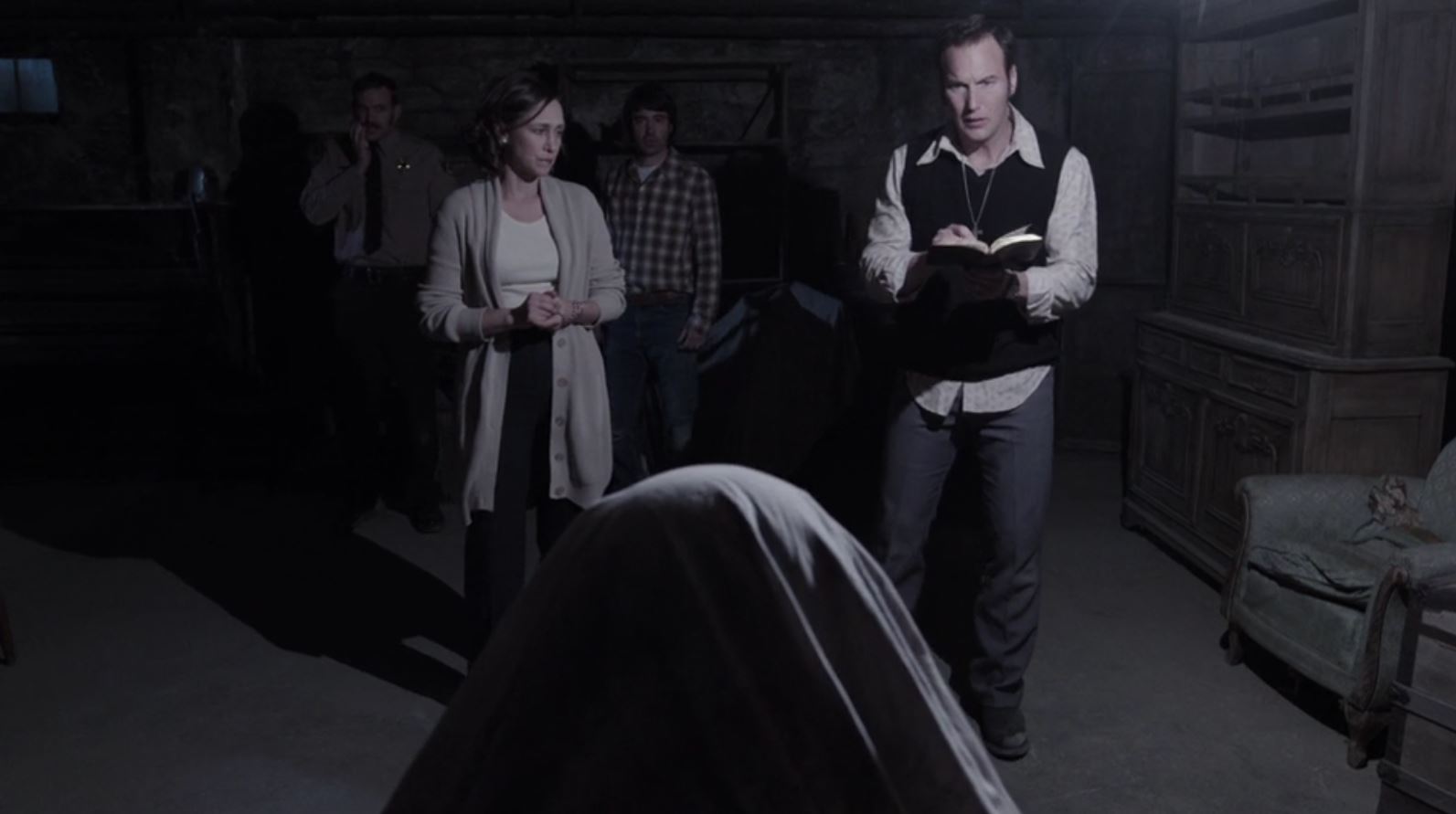
Vera Farmiga and Patrick Wilson, who play the paranormal investigators known as The Warrens, are the kind of screen talent we don’t see much of today. They find themselves in introspective roles which might have been filled by the likes of Shelly Winters and Henry Fonda several years ago. There’s something satisfyingly old fashioned about their methods, which makes them perfectly believable in a story set in 1971, and I have to give James Wan credit for casting adults who look and act like real people.

Meanwhile, Ron Livingston and Lili Taylor play The Perrons, the parents of five daughters who are targeted by the presence haunting their home. Eventually, the strange happenings in the house become so frightening the family resorts to sleeping in the living room together because they’re too scared to stay in separate bedrooms. It’s at this point The Perrons seek out The Warrens for help, who will have to document the case in such a way the church grants them an exorcism. Naturally, the presence doesn’t like The Warrens’ involvement one bit and things become increasingly violent.

Here’s a movie which successfully homages everything from The Exorcist to Poltergeist with a lot of respect. I have a feeling I wouldn’t like James Wan’s opinions on the source material’s legitimacy, but damn it, he’s made a great movie with genuinely creepy moments. I love that little room where the Warrens keep the relics they’ve accumulated over the course of their career… if that’s not a bubbling cauldron of imagination, I don’t what is.

I’ll be featuring the sequel next Friday. Let’s just say I’m cautiously optimistic.

John Wick: Chapter 2 (2017)

I just re-watched the original John Wick in preparation for the sequel and enjoyed it as much as I enjoyed Dredd and Fury Road, similarly old fashioned action flicks. Both of those movies have a lot in common with John Wick’s fictional universe, the world-building of which is more suggestive than fleshed out. The fact that the sketchy people who live there have their own laws and currency makes the setting fascinatingly mysterious, much like Wick himself. Yet my favorite thing about the movie is that when characters say things like, “John’s not exactly the boogeyman… he’s who you send to kill the boogeyman,” you don’t snicker as you would in a movie which takes itself too seriously.

The entire point of John Wick is to entertain. As is such, a lot of it is style over substance, but it’s not all style, and unlike Tony Scott’s Domino era there’s not so much style it resembles a music video more than a movie. I think what I’m saying is John Wick is a damn near perfect film for my particular tastes. Besides, aren’t you getting sick of little goody two-shoes like Jason Bourne and all the other PG-13 action heroes?

In the first film, a grieving John Wick murdered everyone even remotely connected to the death of his puppy, which was his deceased wife’s final gift to him. At the end of the movie he broke into an animal shelter and stole a pit bull, then walked off into the sunrise. And when Chapter 2 comes along, it’s really good to see John Wick and that pit bull are still together, even though you can estimate the dog’s plot armor around 50%… 75 if you don’t believe they’d kill two dogs in the same franchise and somewhere around 25 if you remember how graphic the first dog slaying was… that long streak of blood was some fucked-up shit, after all.

Chapter 2 expands on the same criminal underworld as seen in the first movie, this time revealing the existence of a blood contract signed by Wick sometime before the events of the first film. The beneficiary of the contract has complete control over Wick, and Wick will never be free until he performs an impossible task. When Wick politely asks for the deal to be rescinded, his house explodes, which leads you to wonder what else he’ll get taken from him.

So here was my worry going into the movie: nobody wants to see John Wick put through as much hell as he was put through in the first movie. Yet if they don’t put him through the ringer, would we lose the satisfaction of seeing him shoot dozens of people in their faces and heads? As it turns out, they don’t put Wick through the same level of shit they put him through in the first movie… at least not up front. (Let’s just say—extremely vague spoiler—he doesn’t exactly walk into the sunrise at the end this time.) There’s a slower burn leading to Wick’s ultimate melting point, but the action scenes are no less exciting. In fact, they’re a little more creative this time around, which you’ll see during the very first stunt sequence of the movie.

And holy shit this movie is beautiful.

If you’re a fan of the original film, you’re almost certainly going to like this one just as much if not more. I don’t think I’ve been this pumped up since I saw Fury Road. If you want them to keep making these kinds of movies for adults, then go see it instead of whatever other bullshit they’ve got coming out right now. Hell, see it twice.