Nemesis (1992) [Midnight Movie]

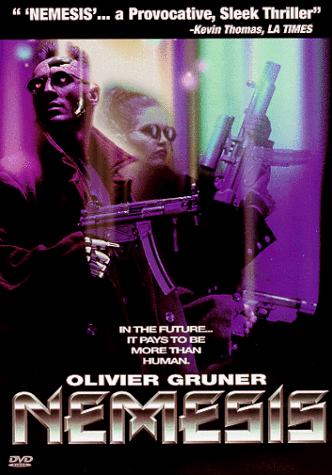
The opening credits aren’t even over by the time the bullets begin to fly in Nemesis, one of the better cyberpunk adventures of the early 90s. And boy do the bullets fly. In one scene the heroes and the villains alike are shredding through walls to pass from one room to another. Then the hero (Olivier Gruner) creates an escape hatch in the floor by firing his futuristic machine gun in a circle around his feet.

Yes, this is mindless action, but holy shit is it glorious.

Any character in the film can (and usually will) double-cross the hero without warning—to the point it stops making a whole lot of sense. And it’s not really clear why the action hops from one rundown location to the next, other than that’s just the way director Albert Pyun works. (In an interview with io9, Pyun sheds some light on his methods, which were often more practical than artistic.)

So it’s the future and just about anyone who’s anyone has had their bodies heavily modded with illegal implants. Some of the bad guys have faces which split open like nutshells to reveal automatic firearms concealed inside. Other characters exist as digitized ghosts in the machine to guide the hero through the complicated plot. Meanwhile the (presumably) human character can do back- and side-flips as well as the enhanced characters because fuck it, why not?

In the opening scene, Gruner’s character, a kind of blade runner, is ambushed by a group of cyborgs who leave his less-than-human body on the brink of death in a scene reminiscent of Murphy’s demise in Robocop. After a long recovery in the body shop, he tracks them down, shoots the ringleader, and ends up in a dank jail cell for reasons that are escaping me at the moment. A lot of spectacular shit happens and Gruner finds out his boss (Tim Thomerson) has implanted a time bomb in his heart. Gruner, whose ex-lover has been reduced to an artificial consciousness rivaling Siri, leads him through the web of deceit and explosions, insisting he make his way to the top of a volcano because… well, probably because the film crew had access to a volcano location.

The plot really doesn’t matter. What matters is you get beautiful stunt women, more explosions than you can shake a stick at, and early performances by Thomas Jane and Jackie Earle Haley, the latter of whom I didn’t realize was in the movie until I saw the credits. You should know by now if this is your kind of movie. I’ve enjoyed many of Pyun’s movies, which is why it sucks to read his most recent tweet:

Judging from his blog, the disease hasn’t stopped him from directing. Right on.

Split Second (1992) [Midnight Movie]

It’s the year 2008 and global warming has managed to submerge London in about a foot of murky water. I’m not sure where the mutant rats figure into this poor man’s cyberpunk world, but the little buggers are ubiquitous and the characters will wreck entire apartments just to gun ’em down. Harley Stone (Rutger Hauer) is a loose cannon of a cop who punches and kicks anyone who gets in his way. When a fellow cop inquires about his sanity, the chief of police (Alun Armstrong) replies with that good ol’ “he’s the best there is” cliche.

Actually, calling anything in this movie cliched might be missing the point. It isn’t “only” science fiction, fantasy, horror, and action, but I want to say it’s a parody of all that stuff, too. It even goes out of its way to do the old “meet your new partner” routine with surprising freshness. Or maybe I’m being too kind to it, considering I feel like I’m the only person who likes this movie. And I always liked this movie.

Split Second opens in a scuzzy night club called The Non-Stop Striptease. A spiky-collared Rottweiler attempts to bite Stone’s nuts off in the alleyway entrance, at which point Stone calmly flashes the dog his badge and says, “I’m a cop, asshole.” This placates the dog. We don’t know why Stone is here—we get the feeling he doesn’t know, either—but soon a woman’s heart is ripped out and, somehow, no one saw who was responsible for the murder. This doesn’t stop Stone from racing out into the dark streets, punching and shooting anything that moves (or doesn’t) in an attempt to alleviate his severe anxiety.

See, a long time ago Stone’s partner was murdered by the very thing which is running around town, ripping hearts out and drawing intricate astrological signs in blood. Stone has been steadily going downhill ever since the incident and it’s not until later when we find out why he’s psychically linked to the beast. The monster, by the way, is ten feet tall, has a wicked set of teeth and claws, but turns out to be one of the most disappointing rubber suits you’ll ever see. Never mind that because the ride up until that point is fun as hell.

Featuring Kim Cattrall, Pete Postlethwaite, and Michael J. Pollard, this British production from The Burning director (my favorite slasher film) is a madhouse that rarely loses steam. You’ll laugh at it for the first ten to twenty minutes, then you’ll realize it’s very much in on the joke, allowing you to laugh with it for the rest of the running time. Rutger Hauer is one of the few bonafide actors who fell into these low budget films with the same wit and enthusiasm he had in more serious efforts—you can tell he’s enjoying it, too. I can’t think of anyone else who was equally great in both A- and B-movies, then slipped back into A-movies without missing a step.

Do you like the early 90s ridiculous vision of the future? Do you like Rutger Hauer? If yes, you’re going to like this movie. Early nineties Terminator, Alien, and Predator ripoffs are kind of a guilty pleasure for me, if only because I’m so damn nostalgic for them.

And you know what? Fuck the haters. This is a legitimately exciting movie. It was the perfect cure for the unbelievably disappointing Star Trek Beyond, which I saw on the same day. How a movie can have so much cool stuff in it, and completely fail to excite me, I’ll never know, but I digress. Split Second delivers the speed.

Memoirs of an Invisible Man (1992) [Midnight Movie]

You have to admire the simplicity of this setup: Nick Holloway (Chevy Chase) becomes invisible after a freak accident. Rogue CIA spook David Jenkins (Sam Neill) will stop at nothing to capture the invisible man for nefarious, espionage-related reasons. So far, so good, right? Poor Daryl Hannah, unfortunately, gets relegated to playing the afterthought love interest who’s simply here to stretch out the middle portion of the movie. Can you imagine being the star of Splash, then having to eat shit in a role like this?
It’s hard to make invisibility boring, but Memoirs of an Invisible Man forgets to include any of the built-in fantasies most people would have when daydreaming about the subject. In Unnecessary Monologue #2,356, Chase’s voiceover confesses he thought being invisible would be fun, but it’s not.

Seriously? Being invisible isn’t the most awesome thing in the world? Maybe that’s why I like the movie a lot more today than I did when I was a kid: a kid can’t look past the preposterous notion that invisibility would be a burden rather than a useful super power. 

Here’s my other problem with Memoirs: Chevy Chase didn’t want to be funny in it. That sounds like I’m being snarky—and I am, to an extent, because his notorious ego is the entire reason this film doesn’t work—but director John Carpenter said this about Chase:

He wanted to sort of slowly, whether this is right or wrong, to slowly move away from broad comedy and do something with a little more depth. And so he resisted the comedy all the way through it. 

On the plus side, the score is exciting, Sam Neil plays a great bad guy, and the special effects are out of this world. You automatically know how they did an effect in 99% of today’s movies, and the answer is usually: “Oh, that’s just CGI.” In Memoirs, there are some head-scratchers. The invisible man will chew bubble gum, inhale cigarette smoke into his lungs, and see his own stomach full of food (minus the stomach) before puking the contents up. I really had no idea how they did some of this stuff before looking it up.

Otherwise, it’s not a great movie for fans of John Carpenter. There are times a scene can have a bit of a whimsical Starman feel to it, but most of the time the camera is moving far too often (and far too conventionally) for this to be a genuine Carpenter flick. Meanwhile the concept isn’t deceptively simple in Carpenter’s usual style, it’s just straight forward and simple. It’s one of his few movies which really is about what it’s supposed to be about, yet the result still isn’t bad enough to pan it.

It’s just a movie. Often an enjoyable one. I have nothing more or less to say.

Gods of Egypt (2016) [Midnight Movie]

How did this happen? How did I enjoy something as absurd and silly as this? How could I go into it so negatively and come out so satisfied? Because it’s a surprisingly fun fantasy film, that’s how.

In fact, here’s a long list of fantasy films I enjoyed a lot less than I enjoyed Gods of Egypt:

  • 300
  • Peter Jackson’s King Kong
  • The Hobbit trilogy
  • Howard the Duck
  • Independence Day movies
  • Indiana Jones and the Kingdom of the Crystal Skull
  • Jumanji
  • Men in Black II
  • Any of The Mummy films
  • Any of the Pirates of the Caribbean sequels
  • Sin City 2
  • Sky Captain and the World of Tomorrow
  • Stardust (actually, I liked this one about the same)
  • Star Wars prequels
  • Underworld
  • Wild Wild West
  • Willow

So why did Gods of Egypt get some of the same negative press as the more infamous films on the list above? How in the hell did it get such a low Rotten Tomatoes rating while painfully routine comedies and remakes consistently garner higher ratings? I don’t have the answer to those questions and I suspect anyone who claims to know for sure is reaching just a little too far. Even so, I can’t help but feel something dishonest is going on here, such as pressure from social media groups or… okay, now even I’m reaching. (Let’s not forget this stuff is subjective… maybe the movie really is shit and I’m just out of touch.)

Yet it seems Gods of Egypt was dragged through the mud long before its February release date and everyone wanted it to fail. I expected pretty much what everyone else expected: another mind-numbing 300 ripoff with loads of bad CGI and no creativity whatsoever. I’m not saying the CGI in Gods of Egypt isn’t bad, just that it’s a lot less distracting than I expected. This is a huge, somewhat complex fantasy world—how else could they have filmed it? On location? (The Lord of the Rings filmed an awful lot on location, sure, but this ain’t Lord of the Rings. It set out to be a lot richer than that world.) It also doesn’t feel nearly as phony as Sky Captain and the Star Wars prequels did.

Yes, there’s an awful lot of white faces and English-speaking characters for a story that’s allegedly Egyptian. And no, this isn’t a very accurate portrayal of that particular mythology, either. (I guess that’s where the fantasy part comes in, isn’t it?) I’ll be honest: most of the humor was what you would expect from bad children’s movies, and the action is pretty lackluster whenever it goes all Matrix-y. On the other hand Nikolaj Coster-Waldau, who hasn’t found a lot of mainstream success beyond Game of Thrones, has “movie star” written all over him while Gerard Butler is an extremely likable screen presence as well. Both of these guys aren’t getting the hits they deserve.

Look, if you’ve ever enjoyed Highlander, Flash Gordon, or Krull, you should really give this one a chance, especially now that it’s on HBO. I can’t say I would have liked it as much had I paid money for it, but for a free movie, this is some very creative entertainment.

Assault on Precinct 13 (1976) [Midnight Movie]

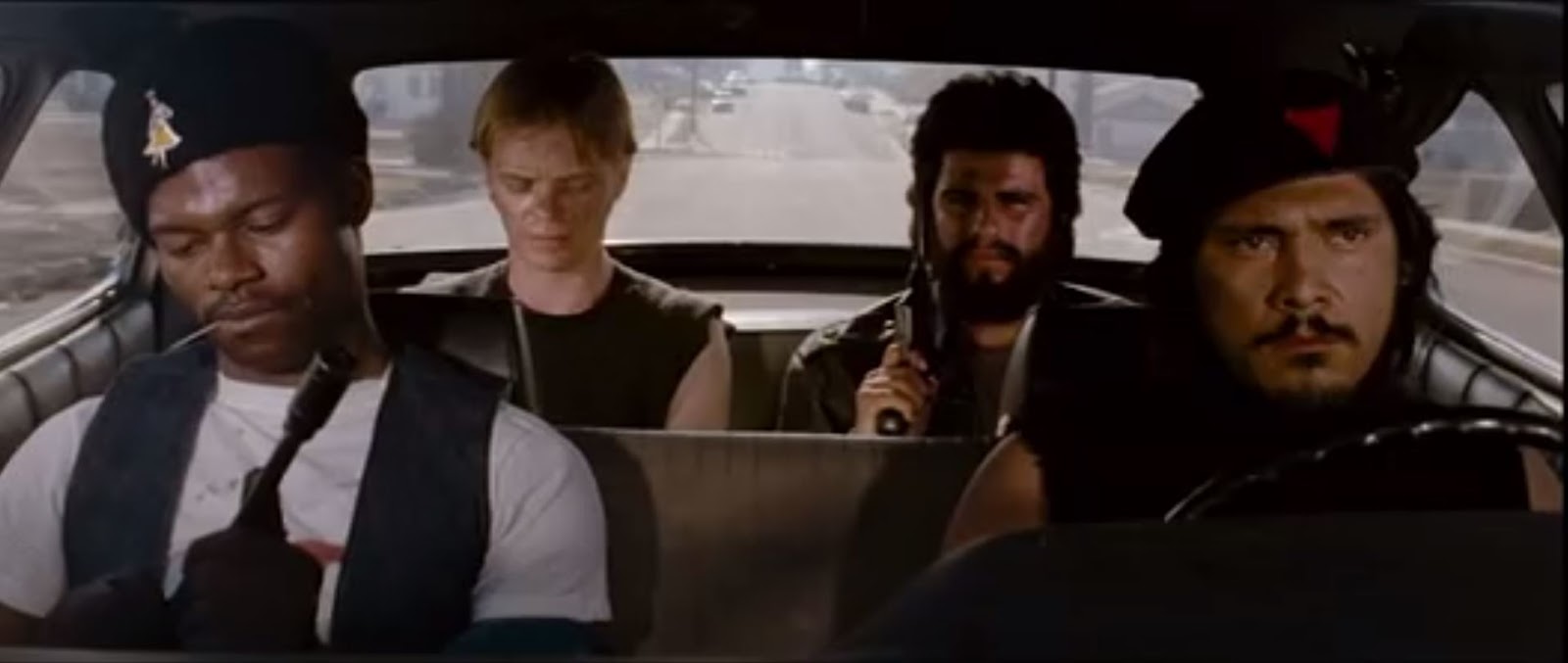
In the opening scene, the handheld point of view is following a diverse group of Los Angeleno gang members who are obviously up to no good. The gritty style, in combination with John Carpenter’s pleasantly droning music, is immediately inviting. We begin to wonder: Why are we here? What are these guys up to? Just when you think you’re about to get an answer, the players are ambushed by police and brutally gunned down.

Come to think of it, you never really know what the gang members are up to or why they do what they do. Carpenter chooses to keep them enigmatic, which makes their resolve doubly spooky. You rarely (if ever) see them talking and there isn’t a singular villain who explains his diabolical plot to the audience. Lesser movies, such as the embarrassingly average 2005 remake with Ethan Hawke, would have missed the point: these guys are scary because we don’t what makes them tick. If Anton Chigurh had been the type to join a street gang, this is where he would have pledged.

Soon after the gundown, we’re introduced to Lieutenant Bishop (Austin Stoker), a green policeman who’s just been assigned overnight duty at the titular precinct which is about to be permanently closed down. It’s a thankless job, the last thing Bishop had in mind when he became a police officer. There he meets Napoleon Wilson (Darwin Joston), a lifer who’s unexpectedly brought to the holding cells along with a handful of other prisoners. Then there’s Leigh (Laurie Zimmer), an oddly collected and level-headed clerical worker who seems as mysterious as the gang which besieges the precinct.

When Leigh first meets Bishop, she offers him coffee. “Black?” she asks him. “For over thirty years,” replies Bishop, before breaking out in a huge grin. It’s the kind of exchange modern movies really suck at. It’s reminiscent of the scene in the original Shaft, in which the characters compare the color of their skin to coffee mugs and point out they’re not so black and white after all. Fast forward to today and I’m guessing 1995’s Die Hard with a Vengeance is probably the last time a major action film dealt with race without completely embarrassing itself, which is pretty sad if you ask me.

So there are many details along the way, showing how the characters find themselves in the dangerous situation, but here’s all you need to know: the good guys are holed up in the building and the bad guys will stop at nothing to kill them. The great thing about Carpenter is he was a working class filmmaker who wasn’t interested in making movies the modern way. All you really need is a camera, a hero, and bad guys. That’s movies in their purest form.

Assault on Precinct 13 is one of my favorites—easily in my top fifty, perhaps twenty. The last time I saw it was on a badly worn VHS rental. Seeing it in HD blew my mind because I had no idea it looked this damn good. (Please forgive the low quality of the screenshots… I was having technical issues.) I’ve never enjoyed the film more thoroughly than I did tonight.

31

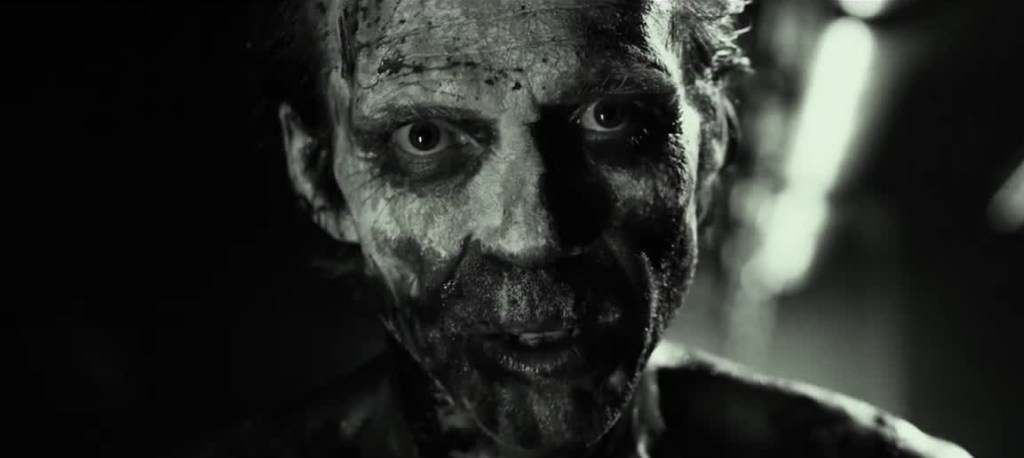
31 is like a horror version of The Running Man, masterminded by Malcom McDowell and Judy Geeson. A group of hypersexual carnies, including Sheri Moon Zombie and a remarkably fit Meg Foster (two years shy of 70, by the way), are taken hostage and forced to play the twisted game. Remember the video game Manhunt? It’s like that. Director Rob Zombie concocts one great villain after another, but unlike more memorable Most Dangerous Game movies, has absolutely nothing to say. (I’d be fine with that if it were at least entertaining.)

The most frustrating thing about Zombie is he’s almost there. He’s uncompromising, unapologetic, doesn’t pull punches, and makes old fashioned horror without a lick of unnecessary CGI. Best of all, he populates his films with veteran B-movie performers who may otherwise be pushing autographs for a hundred bucks a pop at horror conventions. Unfortunately, his characters are too dumb to fulfill the all-important role of becoming a surrogate for the viewer. You need characters you can relate to so you can wonder: “What would I do in this situation?”

If Zombie put one-tenth of the effort into his good guys as he puts into villains like Doomhead (Richard Brake, who’s legitimately fantastic), we’d have a great film. This is why The Devil’s Rejects is still his most watchable project to date: everybody in that movie is a villain, which is what Zombie excels at. If he’d put Doomhead in the lead and made him go against even badder guys, I would’ve been thrilled.

Unfortunately, that’s a different film and this one looks as if it were edited with a cross-cut paper shredder. Editing is supposed to establish things like geography, a sense of time, flow, and most of all coherency. 31 accomplishes little of that. At one point, the group is split up by a trap door, but for most of the scene I thought they were all on the same side. In another scene, the characters watch one of their own die and somehow discover his body in the very next room.

I’m always pulling for Zombie to make a great movie because I think he’s got it in him. He keeps proving me wrong. The joke’s on me, though, because I paid ten bucks to see the damn thing. I haven’t been more disappointed all year.

Over the Top

My partner and I were channel surfing. When I passed Over the Top, she asked me to go back. Reluctantly, I did. I was in the mood for literally anything else, but whenever I’m dead set against watching something, Starla goes all in. I tried to explain it’s an embarrassingly sappy film about arm wrestling. This only enticed her.

Several minutes in, she asked, “Wait, are you sure this is about arm wrestling?” The movie takes forever to warm up, but once it does: whoa boy. You’re going to need a serrated blade to cut this cheese, maybe even an electric carver. Sylvester Stallone plays Lincoln Hawk, a truck driver who just reunited with the son he walked out on a decade earlier. See, the mother is dying. Although her wealthy father (Robert Loggia) is gunning for custody, she wants the boy to be with his deadbeat father. Long story short: complex emotional conflicts will be resolved with arm wrestling. As God intended.

Hawk, with his muscular physique and rust bucket of a truck, is portrayed as an everyman whose home contains one-arm exercise equipment. Loggia’s character, who may be perfectly justified in his assessment of Hawk, is portrayed as the villain. Loggia represents The Man who despises his son-in-law because no college-educated sophisticates could possibly understand arm wrastlin’ and truck drivin’. It’s always bizarre and highly entertaining to view American culture through the eyes of Israeli director Menahem Golan, co-founder of The Cannon Film Group, whose unpretentious productions greatly shaped the pop culture of my formative years. Here he cranks his unique patriotism up to eleven… or perhaps “jumps the shark” is more accurate.

Nonetheless, Over the Top is a fun ride through the cheesiest depths of the 1980s. This remarkable artifact even films its climax during a real life arm wrestling tournament. I know what you’re thinking: “Arm wrestling tournaments really exist?” Well, sort of. This one was created specifically for the film, and two guys actually got their arms broken. One of the gruesome incidents ends up in the obligatory sports movie montage.

In typical Cannon fashion, Over the Top is vapid but impossible to turn off. It’s interesting how Golan spins sport-movie clichés to make them fit arm wrestling instead of ball games. In case you’re wondering about the curiously apt title, Over the Top refers to a special move Stallone’s character has incorporated into his matches. I suspect the physics have no basis in reality, but this movie isn’t directed by a man who lived in reality, so who cares?

Don’t Breathe (2016)

There’s a scene in Don’t Breathe that people are going to talk about for a long time. It’s a rabbit-in-the-stew kind of moment. Think along the lines of what Kathy Bates did in Misery… or maybe the “hair gel” scene in There’s Something About Mary is a more apt comparison. Either way, I haven’t seen such a memorable WTF moment since Bone Tomahawk. I guarantee the scene is fueling Don’t Breathe’s runaway word-of-mouth.

On the way out the theater doors, I overheard just as many people praising the scene as lambasting it. But at least the audience was electrified. Most of the movies I’ve seen this year evoked little more than a shrug as attendees quietly collected their belongings and shuffled outside to remember where they parked. Don’t Breathe knows the secret to making a story stick: you can try to please everyone, but nobody falls in love with movies that play it safe.

Have you ever seen The People Under the Stairs? Don’t Breathe reminds me of that one. A trio of good-for-nothing burglars break into a house, knowing full well the Gulf War veteran who lives there (Stephen Lang) is blind. They expect the guy to be a pushover, but once he shuts off the electric to his fortified home, they come to realize the odds are in his favor. You’ll probably be rooting for him until you discover… well, let’s not get ahead of ourselves.

Although I wasn’t the biggest fan of Fede Alvarez’s Evil Dead remake, I was interested to see what the guy made next. Now he tries his hand at an original horror movie which doesn’t comprise on scares. Unlike his previous film, this one is quiet—so quiet you can hear a pin drop in the theater. You’ll notice the people around you holding their breath, tensing for the next jump-scare, which are few and far between. It’s just a straightforward (and gross) horror film that works.

My biggest complaint is the Rottweiler in the film. That dog is one of the shittiest actors I’ve seen in years.

Doctor Mordrid (1992) [Midnight Movie]

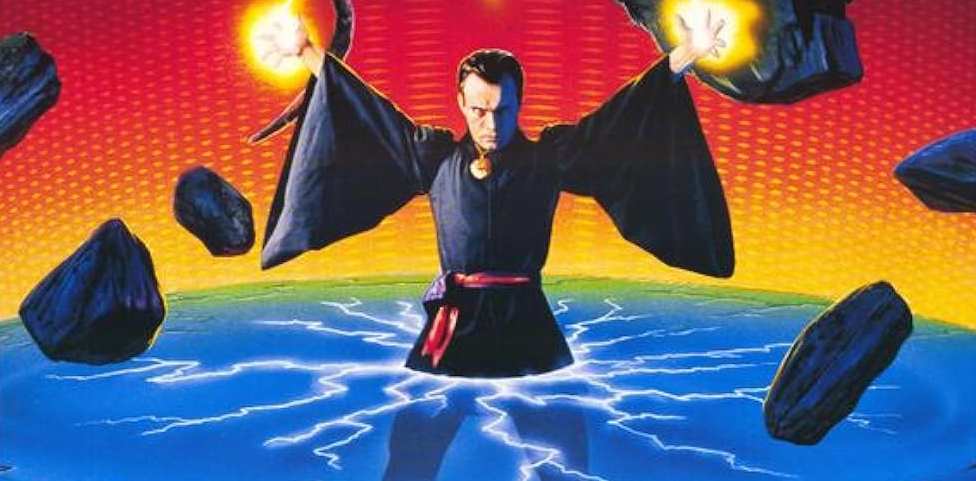
Doctor Mordrid entered production as an official Doctor Strange film until directors Albert and Charles Band let their option expire. That didn’t stop them from making the movie anyway (I wouldn’t expect any less from Full Moon Pictures). The character names have been changed. The filmmakers are legally obliged to inform you that absolutely no part of their movie takes place in the Sanctum Sanctorum. This is a film about an alchemist—not a wizard, not a magician, and certainly not a sorcerer. Any similarity to Marvel characters, living or dead, is purely coincidental.

The “alchemist’s” name is Anton Mordrid (Jeffrey “The Re-Animator” Combs) and he’s in charge of protecting the film’s MacGuffin: the Philosopher’s Stone. He and his brother Kabal (Brian “Cobra” Thompson) were taught all manner of wizardry—er, I mean alchemy—when they were children. Kabal is breakin’ bad now that he’s all grown up and he plans to unleash demons from hell… or something. I didn’t really follow that part, but if he succeeds, Earth is all kinds of fucked. He leaves a rash of murders in his wake, which begs the attention of Samantha Hunt (Yvette Nipar), the policewoman who just happens to live in Mordrid’s apartment building.

What develops between Mordrid and Samantha is one of the mildest romances in movie history. You won’t even know they’re attracted to each other until the last scene in the movie—and even then you won’t know for sure. What Mordrid suggests to her, out of the clear blue, is the equivalent of popping the question to a neighbor you occasionally see when you go for a walk. I love Combs to death, but his chemistry with actress Nipar is nonexistent. Considering they appear quite at ease with one another in this behind-the-scenes video, I’m not sure how the ball was dropped, but I suspect it had something to do with Full Moon’s speedy production schedule.

Look, Full Moon made tons of movies. They’ve managed to produce more memorable features than you would expect from a fledgling studio, so you can’t be surprised whenever they make a dud like this one. The directors, at that point in their careers, were such experienced filmmakers you can’t even laugh at the movie in a so-bad-it’s-good way. Technically, it’s a well-made film, it just happens to stink. Even if you go into it seeking the “so bad it’s good” factor, you’re bound to be disappointed.

Midnight Movie: Starship Troopers (1997)

“If I tell the world that a right-wing, fascist way of doing things doesn’t work, no one will listen to me. So I’m going to make a perfect fascist world: everyone is beautiful, everything is shiny, everything has big guns and fancy ships, but it’s only good for killing fucking bugs!” — Paul Verhoeven

At first glance, the cast looked like it belonged in a television drama for teenagers. The jingoistic satire didn’t translate well to newspaper ads and 30-second TV spots. The goofy marketing made it look like a straight-to-video movie had somehow wormed its way into a theatrical release. And yet, I still went to see Starship Troopers on opening night, shuffling into the theater with the lowest of expectations. There were maybe six other people there including, I think, a local film critic who occasionally shone a penlight on his notes and impatiently touched the illumination dial on his wristwatch.

In Paul Verhoeven’s Robocop, the narrative is frequently interrupted by satirical advertisements and news segments, as if the film has commercial breaks baked right into it. Likewise, Starship Troopers opens with over-the-top war propaganda, simultaneously establishing its irreverent attitude and the premise: in the future, humans really hate bugs: the arachnid alien combatants who’ve thrown a wrench in humanity’s plan to colonize every nook and cranny of the galaxy. In fact, humans hate bugs so much that young men and women everywhere can’t wait to give up everything and fight the bastards.

Enter Johnny Rico (Casper Van Dien) and his dimwitted high school friends. Amusingly, the first act plays like a futuristic teenybopper drama before jerking the rug out from under the heroes’ feet. Rico has a hot girlfriend (Denise Richards), a hunky rival (Patrick Muldoon), a dangerously flirty gal pal named Dizzy (Dina Meyer), and an ultra-nerdy best friend played by Neil Patrick Harris, whose appearance in an R-rated romp was mildly scandalous at the time (Verhoeven had employed similar stunt casting with Elizabeth Berkley in his trash-masterpiece Showgirls, two years prior).

Rico’s girlfriend is sent to the space navy, his brainy best friend gets absorbed by the military’s science sector, and Rico ends up in the most elite squad of ground troops in existence. His drill sergeant is played by Clancy Brown, who always takes genre projects seriously and the same can be said of Michael Ironside (Total Recall’s Richter), who plays the lieutenant of Rico’s group. There Rico makes new friends for the first time in his adult life, including Jake Busey, whose maniacal appearance instantly washes away the Dawson’s Creek vibe from the earlier portion of the picture.

Just when Rico’s finally begins to gel with his new life, who of all people will suddenly transfer to his squad? Dizzy, the hot little baddie who’s been pursuing Rico since high school. Here’s something I really love about Starship Troopers: in practically every movie in which the leading character is pursued by two love interests, he or she inevitably ends up with the sickeningly wholesome, less attractive option. Not my boy Rico. Soon after his boring girlfriend dumps him via a video call, Rico hooks up with the considerably more exciting Dizzy.

The score by Basil Poledouris is as rousing as anything he’s ever done while the early CGI is somehow much more convincing than most digital effects today. As for the action, it’s exciting, well-paced, and comically bloody as per Verhoeven’s style. If you held a gun to my head and asked me to choose my favorite film of Robocop, Total Recall, and Starship Troopers, I literally couldn’t do it.

I had friends in high school who were even bigger science fiction readers than I. Two of them were dead-set against the idea of a Hollywood adaptation of Robert Heinlein’s source material. There are still critics who assert Verhoeven “ruined the book” by choosing to parody its values (though a lot fewer of them exist today as the general consensus of the film only seems to improve with time). Yes, Isaac Asimov wrote in his memoirs that Heinlein grew more conservative and militaristic with age. Though this is certainly true, Heinlein has suggested he was merely exploring such a society as a possibility, not necessarily promoting it.

Then you have modern SF writers like John Stalzi, who are about as liberal and anti-war as they come, writing military fiction in nearly the same vein as Heinlein. Long before the Sad Puppies (an extreme right-wing group of close-minded assholes who attempted to manipulate the Hugo Awards) I used to enjoy reading science fiction from a wide swath of political and philosophical backgrounds. To like Heinlein’s version and Verhoeven’s isn’t contradictory, but exemplary of what I loved about the brainy genre in the first place. In fact, Joe Halderman’s The Forever War, itself a direct counter-argument to Heinlein’s novel, is among my favorite SF novels of all time.

Though I wish the movie version had gotten the jet packs that Heinlein imagined in the novel, I’m going with Verhoeven’s version all the way.