Freaked (1993)

Ricky Coogan

I usually don’t like movies which try this hard to be funny, but the jokes here are less like their lazy ancestors in a Not Another ______ Movie and more like the groaners a dorky dad would tell. It also doesn’t hurt that the people telling these jokes are kind of charming. You’ve got Mr. T playing the bearded lady, Keanu Reeves as the wolfman, and Bobcat Goldthwait as a sock puppet with a human body. Why not?

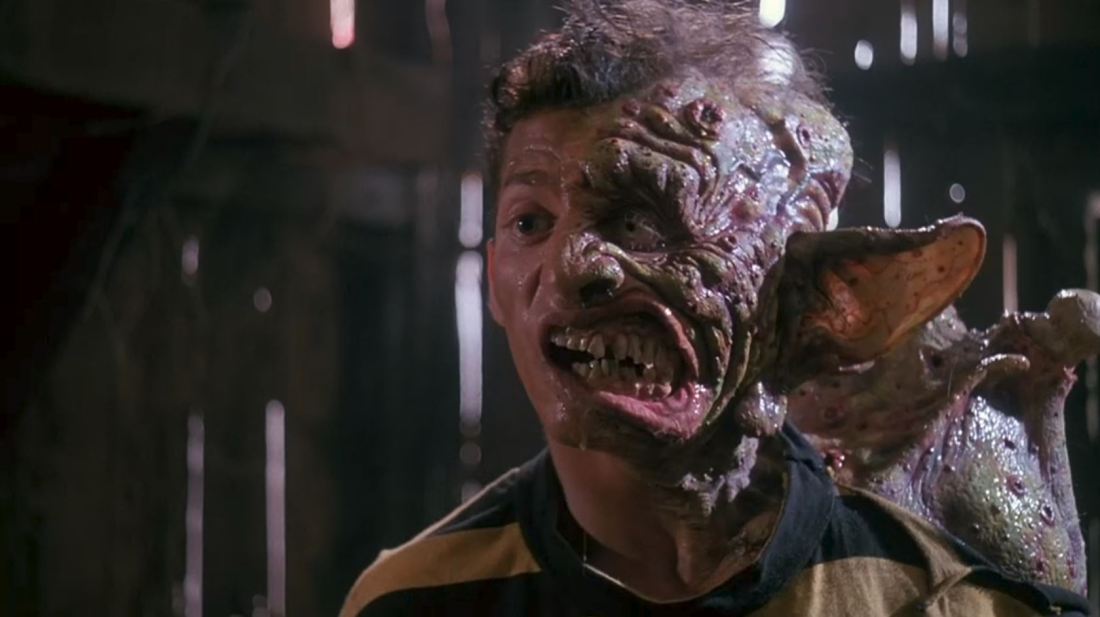
The creature effects are unbelievable for a film which was, for all intents and purposes, a straight-to-video flick; I’m not even sure I knew it existed until it quietly appeared on Cinemax one night in the mid-90s. Screaming Mad George is probably the king of special effects for movies like this, which is why I’m disappointed his last major credit is 2003’s Beyond Re-Animator. Like I said when I featured Society: his films aren’t always great, but they’re almost always great to look at. Freaked is no exception.

Hammer time freaks

Alex Winter plays Ricky Coogan, a narcissistic movie star who signs on as the spokesman for an evil corporation which deals in toxic fertilizer. He and his best friend fly down to South America (for reasons which are escaping me at the moment) and end up getting detoured by a sideshow attraction operated by Randy Quaid. It turns out Quaid is using the evil corporation’s fertilizer to transform unsuspecting victims into freaks of nature. He turns Coogan into a hideous monster and turns his best friend into one-half of conjoined twins—the other half of which can’t stand his guts.

When Randy Quaid was normal

The movie is gross, in a Garbage Pail Kids kind of way, and the violence is cartoonish enough not to push its PG-13 rating. There are things to dislike about Freaked, but every bit of it is overshadowed by the aforementioned special effects and well-meaning vibe of it all.

The jokes don’t always land, but it’s fast paced and fun. I have no complaints.
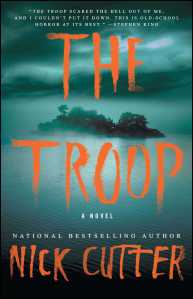
Doomed Boy Scouts and Alien Objects

Here’s everything I knew about Nick Cutter’s The Troop when I started it: it was a horror novel which people seemed to like. That’s pretty much it.

I thought it was going to be about a viral outbreak and, without giving too much away, it kind of is, but it’s more parasitic in nature… and kind of gross, too. In other words, it was right up my alley. It was a bit of a stretch to believe such a thing could find itself on the same island as a character like Shelley (this little fucker deserves a cell next door to Hannibal Lecter), but it was worth suspending my disbelief. If, like me, you had trouble enjoying Stephen King’s Dreamcatcher, this is a much better version of that story.

The Troop

Growing up, I was inexplicably drawn to the cover of Arthur C. Clarke and Gentry Lee’s Rama Revealed when I saw it sitting on the shelf of a book store one day. When I realized it was a sequel, I convinced my mother to order the first in the series, Rendezvous with Rama, at Steve’s Sundry (R.I.P.). The rest is history: I annihilated the series and I’ve been a fan of Clarke and science fiction ever since. I even loved the sequels as a kid (though I’ve never been able to get into them as an adult) and I’ve been forever chasing the high that first book gave me.

I love superstructures and I love big science fiction. The harder the better. I’m increasingly turned off by the self-aware geek-chic SF of today, which seems to be suffocated by pop cultural references and nostalgia. I want academic characters talking about real world theories and all the known unknowns and unknown unknowns, and everything in between.

Sphere

Over the years, the itch has been scratched here and there. Asimov’s Foundation (though I somehow never read beyond the first book) did the trick. Larry Niven’s Ringworld and The Ringworld Engineers did okay, too (let’s just pretend the series ended there). More recently and unexpectedly, however, Michael Crichton’s Sphere kicked all kinds of ass for me, mostly because I’ve had a love-hate relationship with Crichton’s work… also because I have no idea what possessed me to read it. It’s kind of like Rendezvous with Rama if it had been written by James Cameron.

I’ll take it.

33 days until Corpus Evil releases!

My eyes are swollen, my head is light, and I feel like I’m being waterboarded with mucus.

Allergies, man. Who needs ’em?

Let’s get the promotional junk out of the way: We’re about a month away from the release of Corpus Evil. Mark your calendars. It’s gonna scare your tits off.

The Amulet

Considering my allergies have whooped my ass to the point of lethargy, I would rather talk about Michael McDowell’s The Amulet, one of the most entertaining—and absurd—pieces of horror I’ve ever read. His later novel The Elementals seems to crop up on Amazon every time I browse the fiction section, so it’s satisfying to see such an underrated writer trending so many years after his death. I couldn’t tell you which of the two books I enjoyed more. I expect to burn through the rest of his stuff before the end of the year.

Another book I enjoyed recently is Jack Ketchum’s The Girl Next Door. For years I’ve avoided it based on its reputation. I don’t care how fucked up a story is as long as it’s fun (read: not mean), but joyless stories which participate in debauchery for the sake of being extreme tend to bore me. Mercifully, The Girl Next Door doesn’t belong in the extreme category. Yes, what happens to the titular character is certainly extreme, but it’s not without purpose and it counterbalances Ketchum’s sentimentality for the time and place. It’s an honest, beautifully written story about a horrific act, and it doesn’t use “evil” as a lazy, catch-all excuse for why bad things happen to undeserving people.

I honestly couldn’t remember the last time I reeled from a book, not wanting to go any further. And when you get to that point (you’ll know which part I’m talking about), you’ll probably discover you can’t put it down, either. That’s some powerful stuff.

Hellraiser Judgment, Skull Island, and The Cloverfield Paradox

Yeah, I’m still alive. Work has been busier than it’s been in ages, my girlfriend and I are remodeling our kitchen (extensively), and I’m still working on Corpus Evil. I haven’t forgotten the blog, it’s just low on my list of priorities at the moment, which sucks because I’d rather be doing this than most things.

So I saw Hellraiser Judgment today. I only fell asleep once.

The prologue is a promising ten minutes of gore-filled debauchery. Maybe it’s because the bar was set so low by the other direct-to-video sequels (I believe there were, like, a thousand of them), but it felt relatively fresh for a franchise that was always better in its idea department than in execution. I even began to think I was in for a fun stupid movie as opposed to a plain ol’ stupid movie.

My first problem (of many) is the same problem I had with the earlier sequels: Pinhead gets a little too much dialogue. (Come to think of it, that was one of my problems with Clive Barker’s The Scarlet Gospels, which I kind of suspect was ghostwritten by someone else.) I don’t care what makes Pinhead tick because I just don’t want that particular veil of mystery lifted. It’s the same reason I’ve never read the Hannibal prequel: some villains are much more interesting without a backstory and monologues. Pinhead has become so pedestrian as of late.

Thankfully there’s a new villain who retains his mystique and his name is The Auditor. Like a cross between Yul Brynner’s role in Westworld and the bad guy from Highway to Hell, he’s a formidable screen presence played by an actor who’s far better than any of the other leads. His face covered with scars and sunglasses as black as welding goggles, he bores intimidation directly into the soul of any mortal foolish enough to cross his path… okay, maybe I’m laying it on a little thick, but trust me: the first ten minutes of Judgment are a blast.

It’s the rest of the movie that stinks to high hell.

If a CSI spin-off is your idea of a good time, you might like Judgment. Hopeful and/or desperate fans of the franchise, on the other hand, are going to be especially disappointed. I’m still wondering why it needed to be a Hellraiser movie in the first place. Like the more recent sequels, it feels like Pinhead was shoved in there just to get tortured fans to shell out money to see it. Unlike the recent sequels, it feels like the supplemental stuff could have made for a decent movie had they been given room to breathe.

I saw Kong: Skull Island and The Cloverfield Paradox, too. Skull Island has gotta be one of the best dumb blockbusters ever made—and believe me: it’s really dumb, going so far as to incorporate Hollow Earth Theory, the proponents of which could even make Flat Earthers cringe. Thankfully, I’m a sucker for giant monster movies (Peter Jackson’s King Kong remake notwithstanding). My brain is telling me not to like this movie, but it’s downright irresistible, even as one helicopter pilot after another repeatedly flies into Kong’s arm reach instead of firing their heavy weaponry from a safe altitude and distance.

The Cloverfield Paradox, on the other hand, sucked almost as bad as Hellraiser Judgment. JJ should really lay off the parallel dimension stuff, which kind of explains key events of the first two films at the expense of failing to explain any of the key events in this film. I fell asleep during this one as well.

I’m getting old, y’all.

American Satan (2017)

DaBand

After watching A Ghost Story, I decided I needed something a little louder to cleanse the palette. (For the record, I enjoyed A Ghost Story, but I did fall asleep during the drawn-out pie-eating scene). I booted up my VOD service and saw American Satan near the top of the horror section. With no prior knowledge of the movie I started it.

I’m impressed. What I saw, during the first third of the slightly bloated runtime, was a movie that didn’t look or feel like the current trend of indie horror films. From a technical standpoint, the movie’s damn near flawless. Despite the abundance of clearance merch’ from Hot Topic, I surprisingly found myself engaged by the young characters’ plight to move to Hollywood and become big rockstars.

That’s because the characters are a lot less annoying than their regrettable fashion choices would suggest. Once you see Denise Richards turn up as the main character’s mother, you’d expect another “Gee, my parents just don’t understand” subplot, but the movie never goes there. There are a lot of places it avoids, places lesser horror movies go to time and time again, but this is a movie that’s focused on cutting through the bullshit and getting to the point. Much of it verges on cliche, but not nearly as much as you would expect from a movie in which the main characters sell their souls to the devil for rock stardom.

Malcolm McDevil

Forty minutes in, however, you start to see the cards up its sleeve: many of its plot points seem to have been recycled from Behind the Music and other rock n’ roll legends, stories involving floozies who sneak their party-hard daughters onto the tour bus and musicians appearing on live television, drugged out of their minds. The realization doesn’t necessarily ruin the movie, but it does disperse a little bit of the magic. As far as plots go, this one’s about as pleasantly aimless as a Scorsese movie, only dragging a little towards the end.

I could have used a little less of the conspiracy theory exposition. This stuff is certainly fun, but going to such lengths to “prove” that real-life rock stars have enjoyed flaunting their devilish affiliations slows down the otherwise smooth pace. Still, I enjoyed it a lot, more because of what it doesn’t do than what it does. It’s just a fresh, fun movie with as many recognizable faces as new ones.

White House of the Dead [Nonexistent Movies]

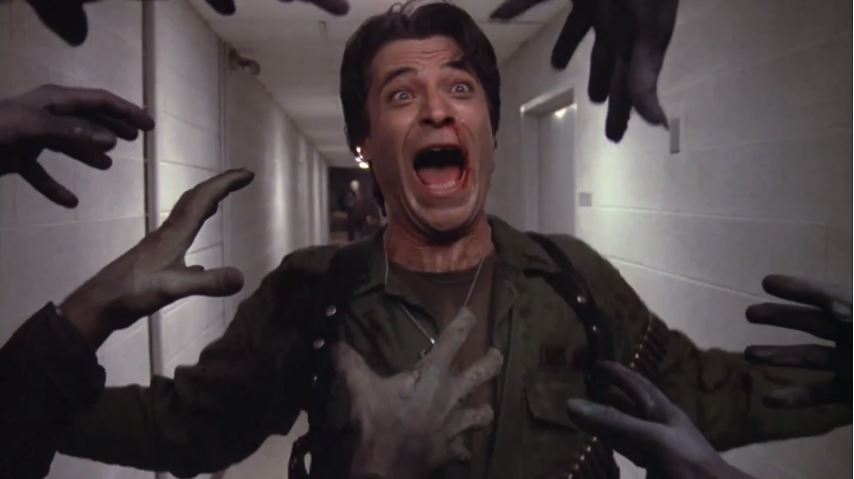
Day of the Dead hands on

This is the test run for a new feature I’m thinking about making a regular thing. I got the idea several weeks ago when I was thumbing through old Fangorias and noticed how inaccurate their “Terror Teletype” column could be. Sometimes the upcoming movie news was right on the money, sometimes it got the details wrong, and sometimes the movies mentioned there never entered production at all. The column mostly existed in the age before internet, so I assume the editors employed a mixture of credible sources and wild rumors. Yet some would-be movies, however unlikely, are too thought-provoking to forget. From John Carpenter’s Escape from Earth to Freddy vs. Jason vs. Ash, it’s just fun to wonder what could have been.

Case in point: an unmade sequel to George A. Romero’s Dawn of the Dead, my favorite horror film of all time. Prefacing a 1979 interview with Romero, Roger Ebert wrote: “Romero calls ‘Dawn’ the second film in his Zombie Trilogy. In the third, zombies will control the White House.” The article was the first time I ever heard of such a possibility. Unfortunately, these are Ebert’s words and Romero himself never makes mention of the third entry in this interview. (I’m reminded of a long-standing—and mostly debunked—rumor regarding an unmade Re-Animator sequel which places Herbert West in the White House.)

So where did Ebert get his information? Was Romero at one point developing a story which would have far exceeded the scope of Dawn? Lee Karr’s The Making of George A. Romero’s Day of the Dead refers to a 1978 television appearance (one year before the Ebert interview) in which Romero discusses tentative plans for the followup: “The zombies are a little more sympathetic. We see them organizing slightly now and if there’s ever a third film that’s what it will be about.” (In Day of the Dead, we see more of this sympathy and ability to organize in the zombie nicknamed Bub, but not to the degree which the filmmaker has suggested here or in the earliest draft of the script available to the public.) “Dario Argento, who we’re co-producing this film with, an Italian director, said that the third one has to be ‘Zombies in the White House’. And maybe that’s what it will be, I don’t know [smiles].”

MakingOfDayOfTheDead

It’s good to know Ebert didn’t pull the rumor out of his ass; Romero possibly told him off the record or perhaps the critic read this fun Rolling Stone article. (Somehow, I feel I should have known Argento had a hand in the sapling of an idea.) While it’s not 100% clear whether or not there existed an earlier draft involving Romero’s early plans (according to a questionable passage on Wikipedia, which doesn’t include references, the early draft on the internet is not the first draft of the script), I think it’s safe to say there probably wasn’t a “White House script” considering the scope of Dawn was noticeably reduced in Day. We might have seen such a movie if Romero hadn’t stuck to his guns when bigger studios offered him distribution (and bigger budgets) in exchange for R-ratings. But honestly: who the hell would want that? Sure, director’s cuts would have surfaced eventually, but would his films had had such a tremendous impact upon release had they been so safe and squeaky clean?

For me, the version of Day we got is a fine picture which manages to trump its predecessors’ special effects if nothing else, but it’s clear Romero’s ambitions have been held in check (or downright tortured) by the financial realities of filmmaking ever since. It’s also my opinion that each of his zombie films since Dawn have been a little less watchable than the last, but I actually enjoyed Land of the Dead even if I’ll (probably) never watch it again.

Day of the Dead in the White House could have been a blast, though, and perhaps a little more meaningful than the version we got.

Day of the Dead title card

Take Shelter (2010) [Midnight Movie]


I was surprised to find Take Shelter on Shudder because I wasn’t under the impression it was a horror movie. Thankfully, it fits in quite well because it’s more unsettling than a lot of the catalog there. You could call it “psychological horror,” but that’s misleading as well.

It’s hard to talk about Take Shelter without diluting it. I’d advise you to stay clear of online discussions and marketing material until you’ve had a chance to see it for yourself. I’ll tread lightly in regards to the plot. I always do, but I’ll be especially careful here.

Michael Shannon, who walks a fine line between everyman and “hey, it’s that crazy guy,” is just about the only person who could play this role: an everyman who might be going crazy. Shannon has increasingly vivid visions of impeding doom, which he tries to keep a secret from his wife (Jessica Chastain) and his deaf daughter. Global doom is scary, sure, but the film also plays with a host of other fears including debt, job instability, health care, and the inability to protect and provide for your family.

This may seem like quaint subject matter, but the movie is potent because it’s so grounded. The best movies about global events (Romero’s Dead films, the Mad Max series, Children of Men, etc.) are great because they’re not really about the superficial apocalypse stuff at all. Indirectly, they’re about what’s going on beneath the surface, particularly the fear of the future and the unknown. Take Shelter does the same thing, but in an entirely different way. The apocalypse may or not be real, but it’s coming either way.

Had the end of this film been in almost any other movie, I would have rejected it as pretentious nonsense. I’ve read plenty of differing opinions on the matter, and while none of ’em have fully swayed me, I appreciate so many people get something different out of it.

As for Shannon, I’m beginning to think it’s worth while to check out everything he’s ever done. Even in the movies I didn’t like, he was worth watching. And I’ve been on the fence in regards to Jessica Chastain, probably because I haven’t seen many of her movies, but I grew fond of her warmness in Take Shelter almost immediately. Supporting actor Shea Whigham, too, is pretty spot-on; I regret that in my Splinter post I reduced him to “a guy who kind of looks like Robert Carlyle.”

Seriously, don’t mess around with trailers or reviews or any of that shit. Just give the movie five minutes and see if it doesn’t hook ya.

98 Days until Corpus Evil!

CorpusSample2t

As usual I’m behind schedule. The holiday madness, ridiculousness at work, and the blog move aren’t helping one bit. I’m still spinning my wheels in part three (I like how I expected to have this section done by “the middle of the week”). The three parts in the middle of Corpus Evil are tightly woven, which means changes in one section cause ripples across the others, but I expect to have them done around the same time. By “done” I mean ready for the girlfriend inspection, at which point it’s going to be ready for other pre-release readers.

Amazon pre-orders for Corpus Evil will probably begin in January. I wasn’t aware you couldn’t list Amazon pre-orders more than 90 days in advance of the release date, which doesn’t feel like enough time to gain steam there. Frankly—and this is coming from someone who uses Amazon regularly—it’s troubling that the retailer has so much of the market under its thumb. There are certainly a lot of benefits, but how long will it be before they impose the same level of idiotic censorship on indie books as they do indie movies?

To be clear, Corpus Evil is far from the “extreme” variety of indie books in my opinion, but it hardly feels like my opinion would matter to the bastards whose guidelines made Samurai Cop 2 unwatchable on their VOD service. Not that I’m certain that movie would have been very watchable to begin with (I’m not a big fan of self-aware B-movies), but that’s beside the point.