Old Man’s War is the new man’s military SF

I did two things on my seventy-fifth birthday. I visited my wife’s grave. Then I joined the army.

John Perry is an old man from future Ohio who joins the army for a second shot at life. In Old Man’s War, which seems to be equal parts fan fiction and satire of Robert A. Heinlein’s military fiction, members of the armed forces receive benefits unavailable to everyday citizens. If you join the army on your seventy-fifth birthday, you receive the luxury of a new body. Then you’re shuffled off to boot camp on a remote planet where you’re about to discover that the disgusting, evil-looking aliens are actually your allies. (It’s the peaceful looking deer aliens who you’ve gotta watch out for.)

Remember Kick the Can? It was the episode of The Twilight Zone (remade by Steven Spielberg as a segment of the movie version) in which a group of elderly people learn how to be young again. That’s what Old Man’s War reminds me of. It’s as if a large group of seventy-five year olds relive their first day of school on an intergalactic scale. For a long, opening section of the book, it’s whimsical fantasy. In the second section it turns dark, but manages to retain a lot of its charm.

It’s worth noting that Scalzi originally self-published Old Man’s War on his blog, where it became so popular that Tor picked it up. In only a few years, Scalzi went from being a self-published author to the head of the Science Fiction & Fantasy Writers of America. Oh, and Paramount optioned Old Man’s War into a movie. Sure, options are a dime a dozen, but I imagine this movie will actually get made if Ender’s Game performs well.

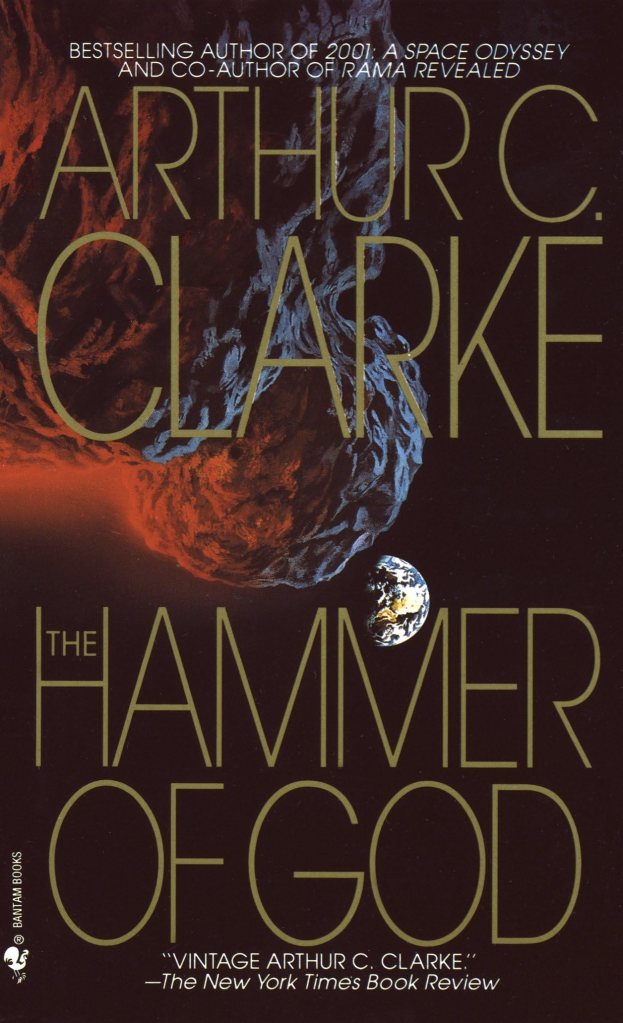
The Hammer Of God will bore you to death before it knocks your socks off

In Arthur C. Clarke’s The Hammer of God, which takes place in 2109, humans are living not just on Earth, but on the moon and Mars. One of the world’s fastest growing religions combines Christianity and Islam into something new. When Earth receives what appears to be a radio signal from another star system, Chrislamists preach it’s a message from God. In the same way paranormal investigators unwittingly construct tools to give themselves false positives, Chrislamists employ similar methods of woo to ensure they can interpret the signal in any way that supports their agenda. More on these bozos later.

In this future, 90% of all asteroids and comets in the solar system have been successfully cataloged by SPACEGUARD and a wildly imaginative idea involving the use of a space-detonated nuclear bomb. If SPACEGUARD sounds familiar, it’s because Clarke initially made the program up in Rendezvous with Rama, but in the years between that novel and this one, the initiative became a reality. Curiously, for all the backstory Clarke takes the time to weave about SPACEGUARD, it’s an amateur astronomer living on Mars who detects the titular asteroid that’s on a collision course with Earth.

Fortunately, there’s a spacecraft within rendezvous distance of the doomsday rock, which scientists dub Kali, after the goddess of destruction. Astronauts plan to touchdown on the asteroid and attach a thruster system known as ATLAS, which will nudge Kali out of its current trajectory. Easy peasy.

ATLAS, however, requires a mind-boggling amount of fuel, which takes a month to acquire. By the time they get it, Kali has entered the orbit of Mars—frighteningly close to humanity’s home world. No worries, though, because things are smooth sailing once they get their fuel. The astronauts land on Kali, attach ATLAS, turn the system on and—surprise-surprise: it’s been sabotaged by Chrislamists. It turns out the fundamentalist assholes believe only God should decide whether or not the asteroid collides with Earth.

This is when the book gets good and I mean really good. The astronauts devise one plan after another, only to encounter unforeseen issues left and right. The scientists and politicians back on Earth decide to take out an insurance policy: a hastily constructed nuke which they plan to fire at the asteroid when all is lost. If the astronauts succeed, the scientists will simply send a deactivation signal. If the astronauts fail, they’ll allow the nuke to continue as planned. As you can imagine, things won’t be as simple as that when the time to make the decision comes.

The latter half of the novel is exciting stuff, but Clarke crams too many of his ideas into the front half to make it engaging (I haven’t even mentioned the life-extension technology, artificial intelligence, chaos theory and detailed economics he writes about at length). I caught glimpses of the world-building that made Rendezvous with Rama such a compelling read, but for the most part it’s a meandering slog until things finally go tits up. I think Clarke could have cut as much as 50% out of the earlier sections, but even with all its filler, it’s an unusually short novel.

I’m tempted to tell readers to skip the first half because it’s the second half that likely interested Steven Spielberg when he optioned the book into a movie. Why his production company made the criminally boring Deep Impact instead, I’ll never know.

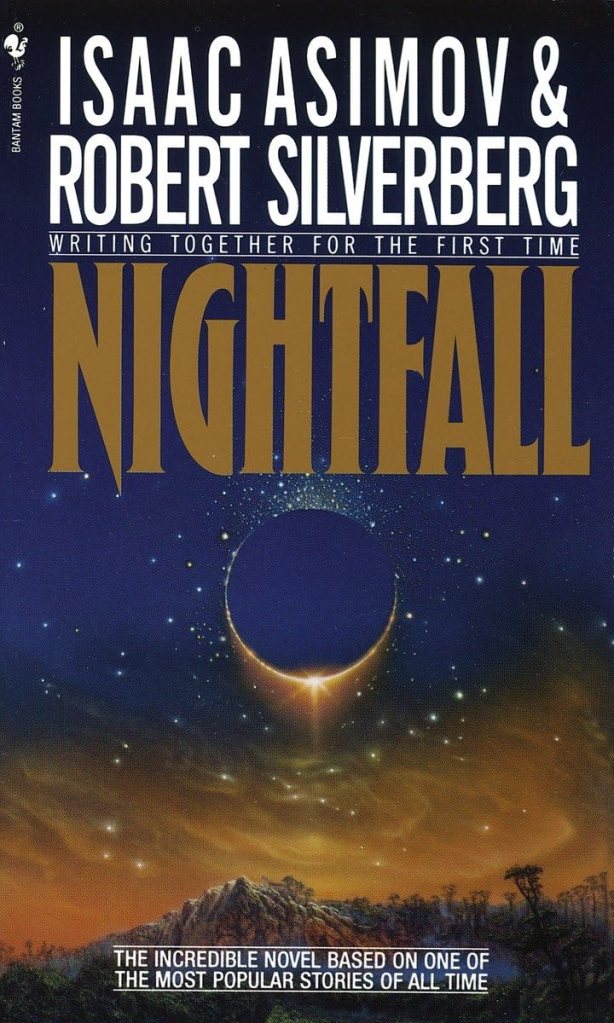
Nightfall by Isaac Asimov

If the stars should appear one night in a thousand years, how would men believe and adore, and preserve for many generations the remembrance of the city of God!

—Ralph Waldo Emerson

In 1941, Astounding Science Fiction editor John W. Campbell suggested Isaac Asimov should write a short story inspired by the quote above. What if humanity had never seen the stars? In both the famous short story (anthologized over fifty times in various collections) and the lesser known novel, Nightfall proposes the idea that the night sky could drive one literally insane.

The short story takes place on a planet orbiting six suns. At any given time, the six suns light every inch of the world’s surface. A group of scientists make a terrifying discovery: once every two thousand years, a celestial event plunges the planet into darkness. Much like the “psychohistorians” in Asimov’s Foundation, the scientists in Nightfall know their civilization is quickly coming to an end because the inhabitants of the planet are not prepared to see the heavens.

The story is unsettling. It doesn’t play on the fear itself, but the fragile nature of sanity when faced with the unknown. The last line of the story is chilling.

You could say the novel version, co-written with Robert Silverberg in the 1990s, dilutes that final line by telling us what happens next. That isn’t to say it’s not worth your time; Asimov and Silverberg mange to conjure unforgettable images of mass hysteria, including the widespread conflagration that naturally results from this brand of madness. When darkness reveals the stars, the people of the story burn everything they can get their hands on in an effort to make it light again.

The novel begins years before the events outlined in the short story. We get to know many of the characters: a psychologist who is treating patients who have been exposed to darkness, an archaeologist who discovers several civilizations in the past have burned to the ground with remarkable regularity, and the astronomer who realizes nightfall is coming.

The titular event takes place about midway through the book, more or less exactly as it happened in the short story. The last third of the book is about the aftermath, in which most of the world’s survivors are irreversibly insane. At one point, one of the main characters observes a group of men desperately trying to uproot a tree with their bare hands. That’s an image that sticks.

The original title of this post was Nightfall VS Nightfall, but it wasn’t fair to compare the two. They are separate entities written at different times in Asimov’s life. The novel will likely never be considered a classic if only because it retreads familiar territory. I highly recommend reading the short story first, then trying out the novel years after you’ve ruminated over the original ending.

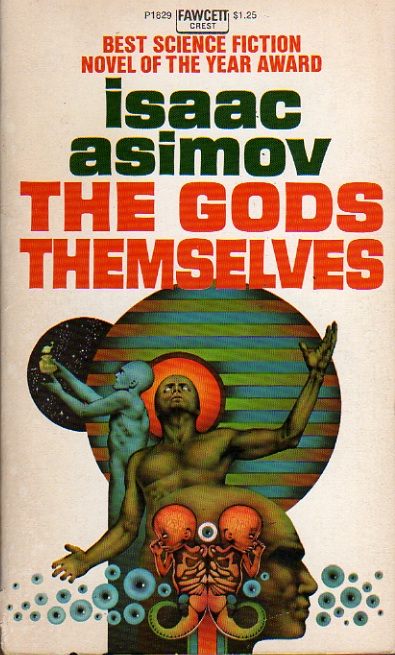
The Gods Themselves by Isaac Asimov

In Isaac Asimov’s The Gods Themselves, which curiously begins with Chapter 6, chemist Frederick Hallam has discovered plutonium-186… sitting on a desk in his laboratory. It turns out that aliens from a parallel universe have discovered that plutonium is a powerful source of energy whereas tungsten steel is a powerful energy source in theirs. What the human characters set up with the aliens (“para-men”) is a free energy trade: they get our tungsten, we get their plutonium. Although there is the distinct possibility that pumping resources back and forth will lead to disaster, humanity is too addicted to care. Who’d want to give up free energy?

Isaac Asimov, like many golden age science fiction writers, is known for relying on a utilitarian narrative to convey grand ideas, but here he steps out of his comfort zone and creates something unusually literary. In his memoirs, he refers to it as “writing above my head.” For the first time he writes something which belongs to the new wave science fiction of the 60s and 70s. New wave was experimental, risque, and anything but golden age.

Following Chapter 6: Chapter 1, more of Chapter 6, Chapter 2, and so on. When Chapter 6 finally concludes, you understand why Asimov arranged the novel this way. Just when you get comfortable with the human characters—poof!—Asimov shifts gears and focuses entirely on the gods themselves: the so-called para-men who occupy roughly one third of the novel’s attention. This is the best part.

The abstract para-men are not your run-of-the-mill aliens. They come in two categories: the hard ones and the soft ones. The soft ones are divided into three sexes: parental, emotional, and rational, and mating requires no fewer than all three. The good doctor does something he’s never done before: he writes about sex, though their sex is vastly different than ours. (Asimov himself complains about his sometimes laughable characterizations of sexuality in the aforementioned memoirs.)

Despite Asimov’s departure from his usual style, you never forget he’s the man who masterminded it. He’s far too modest when it comes to the quality of his writing, but with The Gods Themselves he shouldn’t be. Asimov is a great science fiction writer. He has said this is his best novel. I can see why.

I Learned Science from Arthur C. Clarke

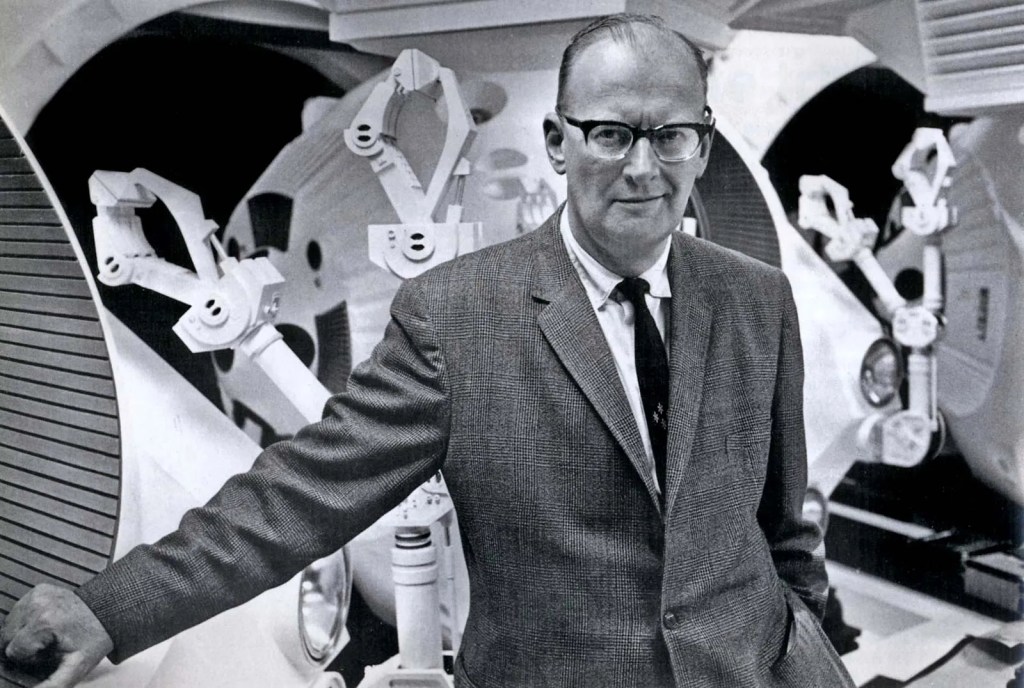
Two years ago today, the last living member of science fiction’s “Big Three” died. It was Arthur C. Clarke, whose prose was never what anyone else would call masterful, but it was sufficient. That wasn’t the point. He was an ideas man and his imagination was both awe-inspiring and troubling, grounded and mystical.

Clarke often had science on his side—real science—which is why I believe that science fiction is important. Consider how many real-life scientists say they were initially inspired by books, TV shows, etc. The inventor of the cell phone was inspired by the communicators on Star Trek, Paul Krugman became the world’s most famous economist after reading Asimov’s Foundation, and Robert Goddard, the inventor of the world’s first liquid-fueled rocket, cited The War of the Worlds as his inspiration.

Rendezvous with Rama

Rendezvous with Rama, which won both the Hugo and the Nebula, was equal parts haunting and mysterious. It’s primarily an adventure story told without the prerequisite heroes and damsels in distress (the main character isn’t just married, he’s got two wives which is, uh, apparently a thing space travelers like to do in the future), yet it’s every bit as entertaining as, say, Jack Vance’s Planet of Adventure. Science is often the cause of the characters’ dilemma, such as when they realize the weather inside the alien spacecraft will turn dangerous as it approaches the sun, but in Clarke’s world, science is usually the solution to the problems as well.

Clarke’s seminal work begins: “Sooner or later, it was bound to happen.”

On September 11th, 2077, a meteorite strikes Earth and kills six hundred thousand people. This plot point is foreshadowed by Clarke’s narration of real-life events: in June of 1908, he writes:

Moscow escaped destruction by three hours and four thousand kilometers—a margin invisibly small by the standards of the universe. On February 12, 1947, another Russian city had a still narrower escape, when the second great meteorite of the twentieth century detonated less than four hundred kilometers from Vladivostok, with an explosion rivaling that of the newly invented uranium bomb.

And about the fictional meteorite of 2077:

Somewhere above Austria it began to disintegrate, producing a series of concussions so violent that more than a million people had their hearing permanently damaged. They were the lucky ones.

The incident spurs the creation of SPACEGUARD, a program to ward against such catastrophic collisions. Fifty years later, SPACEGUARD discovers what scientists will soon call Rama: an enormous cylindrical spacecraft which has mysteriously entered the solar system and will soon leave. This gives humans a small window to study the alien craft. I was instantly hooked and spent a very long night inhaling the novel beneath my covers with a flashlight.

Rendezvous introduced me to conceptual physics. Rama, constantly spinning about its axis, generates the illusion of gravity for its occupants via centripetal force. Inside, separating the two halves of the cylindrical craft is an ocean in the form of an equatorial band. Perhaps I struggled with this imagery at first: a giant band of water that “sticks” to the inside of the cylinder’s continuous wall. When the characters ride a boat in the middle of this ocean, they can look up and see more of the ocean ahead and above them.

Sure, this type of setup has been a staple of science fiction many times before and since, but it was likely my first brush with the concept. In an interesting subplot somewhere in the middle of the book, the explorers want to get a look at the device at the far end of the craft, which they assume is some sort of a space drive. You see spaceships in movies that don’t have any visible means of propulsion all the time, but in an Arthur C. Clarke story, this is particularly curious because it violates Netwon’s third law of motion.

2001: A Space Odyssey

Some time after inhaling the entire Rama series (only the first one is essential), I found the book version of 2001, which was more or less written concurrently with the film’s production. It expanded on the Dawn of Man stuff seen in the opening of the film, which was perhaps the first time I considered human evolution and our prehistoric ancestors. The novel also expands on how Hal 9000 tries to kill the main character, which in some ways is scarier than the movie. The sequence as designed by Clarke was probably too expensive for Kubrick’s budget.

The Early Stuff

Some of Clarke’s earlier works may seem lackluster compared to mainstream classics like 2001 and Rama, but the science is still fairly hard and the stories are charming if nothing else. Some of the things he dwells on is now common knowledge for SF fans (we don’t need to be frequently reminded “There’s no up or down in space”), but I think it’s interesting to note he was writing this stuff before humans ever went to space.

An excerpt from Islands in the Sky, a novel aimed at teenagers in which the narrator wins a trip to space:

There were also, I’d discovered, some interesting tricks and practical jokes that could be played in space. One of the best involved nothing more complicated than an ordinary match.

What happens is the other astronauts play a prank on the boy: they tell him the way you make sure you have a fresh supply of oxygen is the same way miners do it back on Earth: you light a match. (Never mind why astronauts have matches on board.) If the match goes out, “well, you go out too, as quickly as you can!”

One of the astronauts demonstrates by lighting a match which promptly extinguishes itself, much to the boy’s dismay.

It’s funny how the mind works, for up to that moment I’d been breathing comfortably, yet now I seemed to be suffocating.

The narrator panics before he realizes that, in the absence of gravity, smoke has nowhere to go and suffocates the flame.

Childhood’s End

Childhood’s End is possibly the most loved of Clarke’s earlier novels. At one point in the story, the characters successfully use a device that’s essentially a spirit board, which is disappointing to those who love Clarke’s hard science. Beyond the detailed explanations of time dilation at relativistic speeds (possibly the first time I was introduced to that concept), the only thing about Childhood’s End that really sticks out in my mind is the introduction included in my edition (1990, Pan Books LTD.). There, Clarke admits that he was impressed by evidence for the paranormal when he wrote Childhood’s End, which would not hold true later in his life.

When Childhood’s End first appeared, many readers were baffled by a statement after the title page to the effect that “The opinions expressed in this book are not those of the author.”

This was not entirely facetious; I had just published The Exploration of Space, and painted an optimistic picture of our future expansion into the Universe. Now I had written a book which said, “The stars are not for Man,” and I did not want anyone to think I had suddenly recanted.

Today, I would like to change the target of that disclaimer to cover 99 percent of the “paranormal” (it can’t all be nonsense) and 100 percent of UFO “encounters.”

At any rate, I just thought I’d use this anniversary of Clarke’s death to geek out about him.