

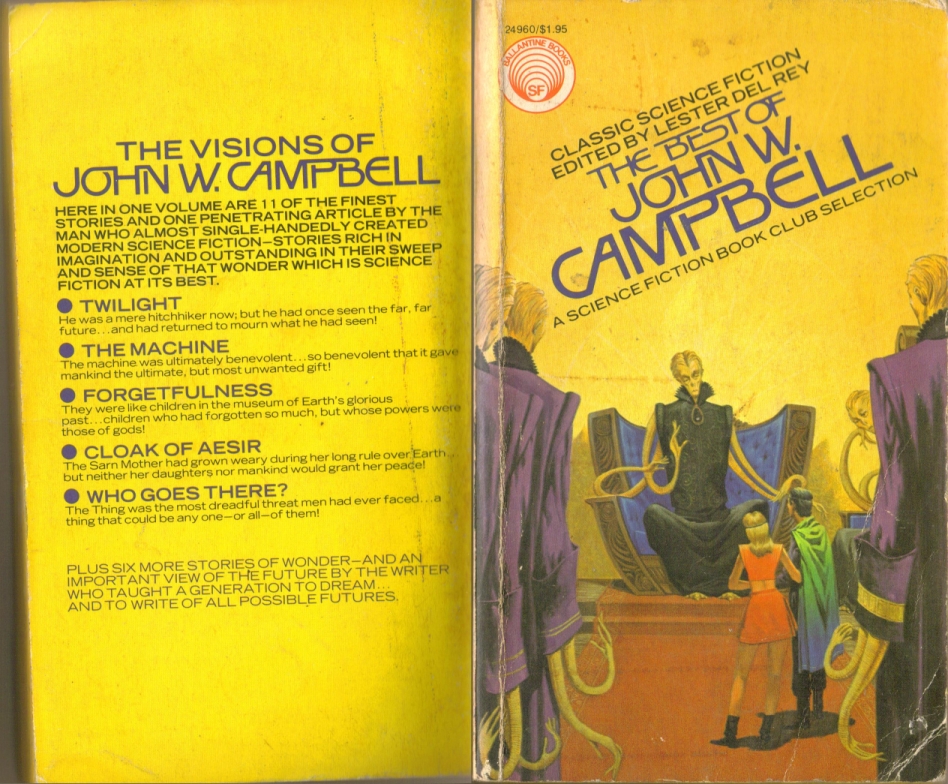
This collection, which I purchased from a used book store for a whopping dollar, contains Twilight, the short story originally published under the pseudonym Don A. Stuart. Editor Lester del Rey states in the intro that Campbell originally wrote pulpy stories under his real name. He then briefly developed the pseudonym Don A. Stuart to write stories of a more serious nature. The first story in this collection, The Last Evolution, isn’t of much interest as it’s one of his more pulpy efforts, but the other stories, starting with Twilight and (almost) concluding with Who Goes There? (the inspiration for The Thing From Another Planet and John Carpenter’s The Thing) provides a nice cross-section of his contributions to the genre.
In his memoirs I, Asimov, the good doctor talks favorably of Campbell for the most part, but later expresses dismay over the man’s decision to buy into L. Ron Hubbard’s Dianetics, the original book of Scientology. Many of the writers who had been loyal to Campbell, then the editor of Analog Science Fiction and Fact (formerly Astounding), turned their backs on him. In his introduction to this collection, Lester del Rey only briefly mentions Campbell’s foray into pseudoscience, stating, “His eternal quest for undiscovered fields of knowledge led him into what I considered cultist beliefs, and I fought against those both privately and publicly.”
Although I was previously aware of his role in spreading Scientology, it wasn’t until after I read these stories that I learned Campbell was a racist, writing articles in support of segregation; writers such as Samuel R. Delaney and Harlan Ellison publicly spoke out against him. I did not feel, at the time of reading these stories, that any of that baggage made its way to the page, but it’s clear that when such a man writes about alien threats, it is often with the subtext of, “I think you know who I’m really talking about.”
So I wouldn’t recommend this collection to anyone who’s only interested in good yarns and cares little about the history of golden age science fiction. Having said that, I also find the personal views of Heinlein to be detestable (though he was not, as far as I know, a racist) and still thoroughly enjoy much of his fiction.
 The Goug' Blog