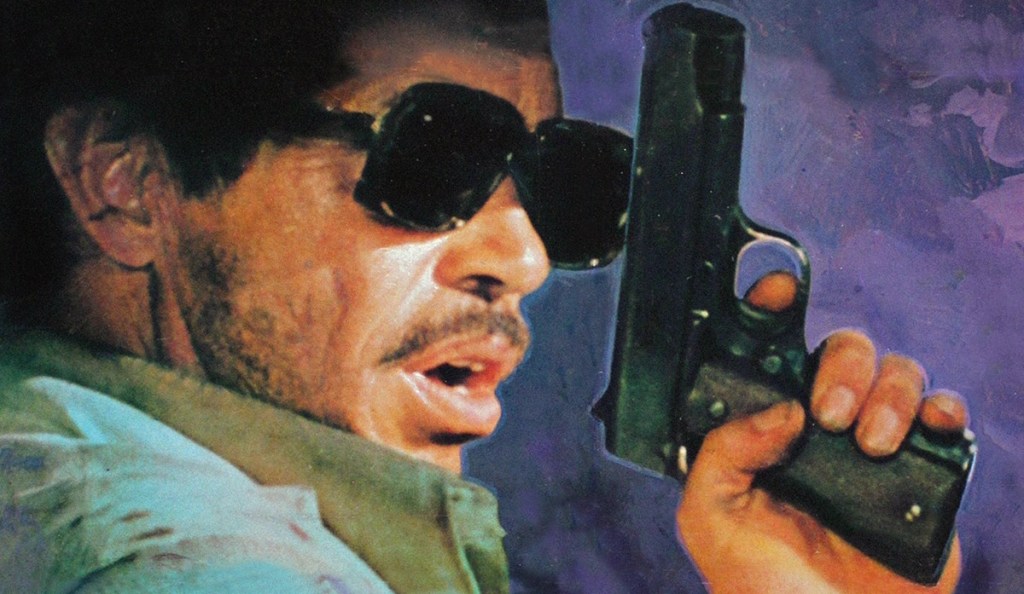
Midnight Movie: Bloodsport (1988)

Bloodsport kind of has an identity crisis. It’s not so bad it’s good (cheesy montages and poor dubbing notwithstanding), but it’s almost good enough to be… well, good. It wasn’t Jean Claude Van Damme’s first movie, but it’s probably the one which put him on the map. Van Damme plays a U.S. Army Captain who goes AWOL to participate in the underground kumite (“koo-muh-tay”), a tournament in which thirty martial artists gather in Hong Kong to face off until there’s only one left. One character describes it as “cockfighting with humans.”

Along the way, he meets Donald Gibb (Ogre from Revenge of the Nerds) who provides so-so comic relief until the film’s villain smashes his skull in. At that point, the stakes have been raised and Van Damme’s character not only has to fight for his own honor, but for… oh, who cares? If you haven’t seen Bloodsport, all you want to know is: Is the fighting any good? Sort of. Sometimes Van Damme’s moves are so plodding, I wonder why the director employs slow motion at all.

There’s a curious lack of blood for a movie that has “Blood” right there in its title. Still, the film’s extremely watchable, I guess because it’s so rarely boring. Cannon was good at making cheap movies look expensive. Consider the fact this was made for around four million dollars, adjusted for inflation, and a modern studio wouldn’t get this kind of production value for anything less than fifty million or so.

The character Van Damme plays in Bloodsport was a real guy who was full of shit when he convinced the filmmakers to tell his story. That doesn’t matter at all.

Midnight Movie: Invasion U.S.A. (1985)

Kick the Dog: When a character does something evil for no apparent gain, because the author wants to demonstrate that he’s not a nice guy and shift audience sympathy away from him.

—TVtropes

Richard Lynch, who plays the cartoonishly cruel villain in Invasion U.S.A., does an awful lot of dog-kicking. In the opening scene, he poses as a U.S. Coast Guard who rescues a dozen Cuban refugees, helplessly adrift at sea, before gunning them all down. (It’s later revealed he even gunned down the men who helped him gun down the refugees.) In another scene, he throws a badly injured woman out the upper-floor window of a building after shooting Billy Drago’s pecker off. For his next act, he blows up a suburban neighborhood with a rocket launcher while apparently using an infinite ammo cheat.

Lynch’s plan involves flooding the United States with hundreds of terrorists who will then pose as policemen and civilians in between random acts of unkindness, mainly bombings and mass shootings. No reasons, no motives. Just pure terrorism.

Chuck Norris is our reluctant hero, this time playing a retired CIA agent living in the Everglades. He’s asked to come back for one last mission, but refuses on the grounds he’s perfectly happy doing… whatever it is he’s doing. As far as I can tell, his life mostly involves driving around in an airboat, trapping gators, and watching an armadillo drink milk from a dog bowl. What’s great about director Joseph Zito is he’s smart enough to limit these necessary but boring scenes; it won’t be long until Lynch’s men show up to kill Chuck’s only friend and blow up his house.

Back then, we all knew exactly what we were getting from the latest Chuck Norris film. Few of them ever promised anything deeper. They did so well because they appeased moviegoers’ desire to see something stupidly entertaining, the operative word being “entertaining.” There’s something pure about Invasion U.S.A., which has amazing stunts and action sequences, even if the logic leading up to them is inexplicable.

Consider the shootout in a mall. Two bad guys come crashing out of a plate-glass window in a pickup truck. You’d think after hearing all the gunfire and explosions inside, most pedestrians would’ve scattered long ago. Yet a woman walking along the sidewalk stops to scream at the henchmen for nearly running her over. The passenger takes a handful of her hair and the men drive off with her hanging from the side of the truck. Meanwhile Chuck Norris pursues in a commandeered convertible. 

The logical thing for the bad guys to do? Simply toss the woman onto the street in front of Norris’s car, forcing him to screech to a halt. Instead, the bad guys drive a couple of miles with the woman screaming the entire way. You get the feeling that screenwriters Chuck and his brother, Aaron Norris, were sitting around a typewriter (or maybe Crayons and paper), saying things like, “Wouldn’t it be cool if…?”

And it is cool. Just because Chuck Norris has the emotional complexity of a turd, it doesn’t mean his absurdly violent fantasies aren’t valid forms of art. Invasion U.S.A. is probably my favorite Chuck Norris film. The director also made my favorite Friday The 13th film: The Final Chapter. Those two films won’t seem like anything special to the casual viewer, but to those of us who indulge in fine cheese, he’s a master.

Western Wednesday: La Resa dei Conti (The Big Gundown)

Grindhouse Releasing’s rich packaging for The Big Gundown is immediately inviting, which is strange because I rarely care about such things. I expected two or three discs, but four? With this edition, you’ll get the American version of the film on Blu-Ray and DVD, the Italian-language version of the director’s cut, La Resa dei Conti, with optional subtitles as opposed to dubbed voice work, and a CD containing Morricone’s score. I’ve listened to the soundtrack five times now. I’m listening to it as I write this.

The movie opens on a trio of outlaws trying to outrun the famous bounty hunter Jonathan Corbett (Lee Van Cleef in his first leading role at the age of forty-one). What they don’t know is he isn’t following them. He’s actually well ahead of ’em. When they fall into his trap, he tells them they either get the gun or the rope as he calmly chooses a single a bullet for each of the men. A few days later, Corbett is attending a wedding party where a Texas railroad tycoon (Walt Barnes) convinces him to run for senator. Corbett agrees it’s time to settle down, but only after going on one last bounty: to apprehend a child murderer.

Soon after the manhunt begins, Corbett thinks he found the guy. The suspect draws on him and Corbett guns him down with ease. Corbett confesses disappointment, saying, “I thought he’d be smarter.” Naturally, the movie can’t end there, so it turns out Corbett killed the wrong guy (conveniently enough, the wrong guy was wanted for murder anyway). We learn the guy he’s really after is smarter when he successfully gives Corbett the slip.

The name of the bounty is Cuchillo and he’s played by Cuban actor Tomás Milián. The filmmakers want you to believe Cuchillo is a master escape artist, but here’s one of my few complaints: Corbett becomes uncharacteristically incompetent whenever he catches up to Cuchillo. The tricks Cuchillo plays on Corbett just wouldn’t work on the kind of godlike bounty hunter who can arrange a trap ahead of the outlaws who think he’s behind them. There’s a line later in the movie that kind of explains why Corbett gets downright stupid at times, but it’s a bit of a cheat.

Leonard Maltin called The Big Gundown the best spaghetti western without Leone’s name on it. I wouldn’t agree, but it’s up there—like, way up there—among the absolute best. There are plenty of great scenes, beautiful camera work, and a ton of production value. I am unconditionally in love with this film and Grindhouse Releasing’s presentation. It’s worth every penny.

Midnight Movie: Bring Me the Head of Alfredo Garcia (1974)

Bring Me the Head of Alfredo Garcia isn’t exactly what I had in mind when I started this feature, as the film is entirely lacking in cheese, but it’s got everything else I love about exploitation films: physical conflict, urgent characters, quick women, and tons of senseless violence. On this dreary cold day, I was simply in the mood for Peckinpah.

When the powerful El Jefe (Emilio Fernández) finds out who impregnated his teen daughter, he puts a million dollar bounty on the man’s head (literally). Months later, a couple of the tie-wearing goons end up in a rundown bar in Mexico City, asking questions about Garcia. It’s there they meet the American piano player, Bennie (Warren Oates), who plays stupid. He really doesn’t know where Garcia is, but he suspects his prostitute girlfriend, Elita (Isela Vega), just might.

Not only does Elita know where Garcia is, she’s been planning on leaving Bennie for him. Alfredo Garcia has promised to marry Elita, while Bennie remains reluctant to commit. None of that matters, though, as he comes to realize Garcia’s been dead and buried for a few days now. Armed with this new information, Bennie blows off Elita and seeks out the goons in their hotel room. He agrees to bring them the head of Alfredo Garcia in exchange for ten grand, not knowing the original bounty is much, much higher than that. They agree, giving him a deadline of a few days. They probably don’t have to mention it, but they do anyway: if he runs out on the deal, they’ll have his head.

The night before his journey into the Mexican countryside, Elita visits Bennie in the middle of the night to make up. In the morning, he’s merrily disinfecting crabs with bedside booze. Later, he proposes marriage, but neither he or Elita seem entirely convinced by his newfound enthusiasm. Nonetheless, he brings her along for the trip, which proves to be a mistake when they run into a couple of motorcycle-riding rapists, one of whom is played by Kris Kristofferson. If anything illustrates the stark contrast between the gritty realism of 70s and the almost entirely PG-13 rated present, it’s that music/movie stars used to cameo as despicable thugs. Try to imagine Will Smith or Justin Timberlake doing the same for their careers.

My favorite thing about movies like Bring Me the Head of Alfredo Garcia, and crime films in general, is they can take otherwise decent people and put them in soul-altering situations. Bennie, a U.S. Army vet, has no qualms about gunning down criminals, so it’s not taking a man’s life that threatens his soul. No, it’s the moment he digs Garcia up and looms over the corpse with a machete in hand. I believe that’s what plot-heavy screenwriters refer to as an “inciting incident.” Once he crosses that line, there’s no turning back. The descent has begun and the only way out is to continue downward.

Much of the last third of the movie is Bennie justifying his increasingly disturbing decisions to Garcia’s lifeless head, which has begun to draw flies as well as stares from the locals. These monologues, as Bennie continuously unravels, are like something out of an acid western. Warren Oates should’ve been the leading man in a lot more films, which makes Bring Me the Head of Alfredo Garcia more precious. It’s an exhilarating, completely unpretentious joyride with a mad man behind the wheel. And if you’re wondering if “mad man” refers to Peckinpah or the hero, take your pick. It hits hard and kicks ass.

Midnight Movie: Sonny Boy (1989)

Note: The version I saw is six minutes shorter than the unrated cut, which was only released in the UK. There’s a special place in hell for proponents of film censorship.

It’s been a long time since I’ve seen a movie modified for a 4:3 aspect ratio. Unfortunately, VHS or Laserdisc is the only way you can currently see Sonny Boy, a weird little film that never made the leap to modern formats. Pan and scan this terrible is like trying to watch a movie through a telescope. It’s a pain in the ass, but it’s worth watching it this way until the film is given a proper release.

Sonny Boy opens on a secluded motel where a young couple are being spied on by a desert thug named Weasel (Brad Dourif from the Child’s Play movies). Weasel murders the couple and takes off in their convertible, which he tries to sell to the local crime boss, Slue (Paul Smith, who played Bluto in Robert Altman’s Popeye). Slue lives in a junkyard with his wife, Pearl (David Carradine, who also sings the theme song of the film). As Slue and Weasel are negotiating the price of the stolen convertible, Pearl notices there’s a baby in the backseat who she immediately adopts as her own.

So what happens when a baby is raised by a trio of monsters? First, they give him “the gift of silence” by cutting out his tongue. Then, in a montage of Sonny Boy’s formative years, we see how Slue and Weasel physically torture the boy in order to toughen him up for the real world. These games of abuse culminate in Sonny Boy’s rite of adulthood, in which Slue ties the boy to a stake and Weasel lights a ring of fire around him. You’ll see Pearl desperately trying to put the fire out with a tiny bucket of water. She merely shakes her head as if to say, “Oh, boys will be boys.”

I know this sounds horrific, but it’s kind of sweet within the surreal, dark comedy context of the film. The director makes no excuses for the way his characters behave, but it’s clear this is the only way this group of people know how to raise a kid. You begin to wonder if the reason they lack a moral compass is the same reason Sonny Boy lacks one: perhaps they were raised like animals, too. Anyway, one day Sonny sees himself in the mirror for the first time, face covered with the blood of Slue’s enemy, which inspires the man-boy to begin the long, difficult process of deprogramming himself.

There’s a lot that’s wrong with the film (such as an overly explanatory voiceover, a cheat of an ending, and a hamfisted message about tolerance, acceptance, yatta, yatta, yatta), but it’s clear the movie is a labor of love. There’s creative cinematography, a great cast, and an unwillingness to make the film something it isn’t in order to satisfy more commercial audiences. According to some sources on the internet, the subject matter of Sonny Boy was so disturbing, theaters pulled it from showings within days of its release. I don’t buy that at all because the film simply isn’t that disturbing. I think the real reason it was pulled is couldn’t have been a crowd-pleaser in 1989, which was probably the biggest year for blockbuster films up until that point.

Ultimately, what’s most satisfying about Sonny Boy is its unusual restraint. You would expect crass comedy when the star of Kung Fu appears in a dress, but it doesn’t treat the crossdresser like a joke. Sure, there are people who get thoroughly blown to bits by artillery shells, but if you’re looking for a raunchy exploitation film to show a rowdy crowd, Sonny Boy isn’t it. That doesn’t mean it’s not worth a watch, though.

2016 Update: an unrated cut of the film has finally been made available on Blu-Ray by Shout Factory.