Highlander: There can be only one (and several sequels)

Highlander 1986

Suppose, for a second, you’re a Trans-Am-driving gun nut who happens upon a dark alley in which two complete strangers are sword fighting. Do you A) drive to the nearest payphone and call the cops or B) get out and shoot at these people who you don’t even know? If you chose B, you belong in this movie.

You know Highlander’s tagline even if you don’t know the franchise: There can be only one. But why must there only be one? When the French Christopher Lambert (playing a Scot) asks questions like that, the Scottish Sean Connery (playing an Egypt-born Spaniard) replies with another question: “Why does the sun rise?” That’s a cheat because even grade school children know why the sun rises, but no one seems to know why Immortals “must” fight. Considering how cool it is, I suppose it doesn’t matter. I mean, who doesn’t like sword fights that produce roughly as many sparks as a bumper car grid?

I’m getting ahead of myself. The year is 1985. Connor MacLeod (Lambert) is spectating a wrestling match at Madison Square Garden that gives him intense flashbacks to his life as a Scottish highlander in the 1500s. When he ducks out early to head to the parking lot, Connor is attacked by another Immortal. Connor beheads the mysterious attacker and absorbs his essence in a supernatural light show known as a quickening. Beheading is the only way to kill an Immortal and the quickening is the process which allows the victor to absorb the defeated party’s strengths and abilities.

Meanwhile, the “seven-foot tall” Kurgan (Clancy Brown) arrives in New York City. The Kurgan is Connor’s arch nemesis, having killed his mentor Juan Sánchez-Villalobos Ramírez (Connery). Don’t worry—through the magic of questionable screenwriting, Ramírez will return for a more significant role in the sequel. At any rate, the Kurgan has spent the last four hundred years quickening as many Immortals as he can. According to Ramírez, if someone like the Kurgan wins this ancient contest, the world will be plunged into eternal darkness.

The pacing is a little rough. The acting is good enough. You will be forgiven for scratching your head or making MST3K-style quips here and there. My mother tells me this was one of the first movies I ever fell in love with and that she would often hear me, from the other room, popping it into the VCR to watch it again and again. I was so young I don’t remember, but it certainly is up my alley.

When the movie was over I slipped Westworld into the Blu-Ray player and all but forgot about Highlander. But when I went to bed later that night, distant memories of the infamous sequel began to haunt me. When I was eight or nine years old, I had rented it on Pay-Per-View and recorded it to VHS. I still have the tape to this day.

I remembered Sean Connery was in it and just had to know what kind of movie magic they spun to bring his character back to life. I had frequently read how awful the movie was, which was at odds with how much I enjoyed it as a kid. So I bit the bullet and decided to watch Highlander 2 for the first time as an adult.

I may never be able to enjoy another movie again.
Highlander 2 (1991)

Forty years after the conclusion of the last film, Connor MacLeod is not just mortal, but an elderly and extraordinarily wealthy individual, as immortality no doubt reaps some great compound interest. He’s devoted himself to science-based philanthropy. One of the projects he helped fund was an artificially generated shield around the planet after corporate greed destroyed the ozone layer. Unfortunately, the shield has permanently blocked sunlight and created a runaway greenhouse effect. It’s also controlled by the very corporation that helped destroy the atmosphere in the first place. As it turns out, the ozone layer has recovered since the shield went up and the project’s executives will stop at nothing to keep this inconvenient (for them) truth suppressed.

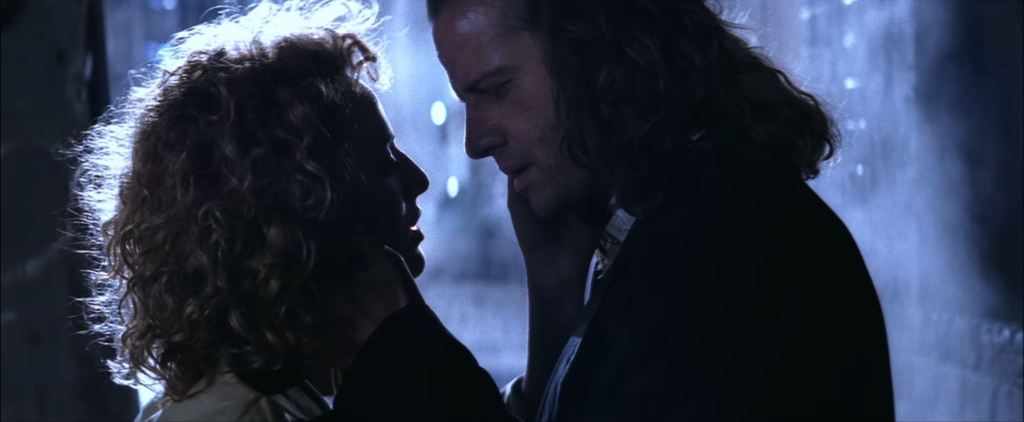
Enter Louise Marcus (Virgina Madsen) who seeks to expose the truth by bringing the shield down. Within minutes of meeting Connor, two Immortals from the distant past (or another planet, depending on which version you’re watching) arrive on bitchin’ hover technology to assassinate the former contest winner. Despite his advanced age, Connor manages to decapitate one and quickens, restoring his youth and immortality. Shortly after hopping on a hover board to dispatch the other assassin, Connor and Louise have passionate sex, right there on the grimy streets.

If you’re wondering how they contrive to resurrect Sean Connery’s Ramírez, it doesn’t make any sense… nor does it matter. All that matters is he’s back, he gets a lot more screen time, and the actor seems to be having the time of his life elevating an otherwise standard fish-out-of-water role. Connery alone is worth the price of admission. Ramírez reunites with Connor and helps him and Louise take on the corporate powers that be.

Siskel & Ebert said only brain-dead moviegoers could enjoy Highlander 2. Some regard it as the worst film ever made (those people have yet to see Now you See Me). If you find the utterly ambitious and genuinely creative Highlander 2 more offensive than the plethora of soulless cash grabs coming out of Hollywood nearly every month, I ask you to reexamine your standards. You cannot call this film boring. You cannot call it passionless. Insane? Well, I’ll give you that one.

Highlander 2 is set in a dystopian cyberpunk future. For the most part, it’s a visually convincing setting. Somehow director Russell Mulcahy managed to squeeze better world-building out of his budget than Freejack, Johnny Mnemonic, and Cyborg combined. The theatrical cut of the film (which is what I initially saw on Pay-Per-View twenty years ago) even visited another planet, but the infamous alien subplot has since been reworked and retconned in subsequent editions.

Granted, the theatrical cut of Highlander 2 ruined the mythology of the original film within the first few minutes. It asserts the Immortals were (surprise!) aliens all along. Luckily, this revelatory dialogue had been filmed with characters who spoke telepathically; the obvious fix was to simply rerecord the voice-over dialogue. In the subsequent versions, all verbal references to the alien planet Zeist are edited out of the dialogue even though the visual references more or less remain, albeit visually altered. This way audiences are led to believe (if they’re still paying attention) that it’s not an alien planet, but in fact Earth a long time ago.

These changes don’t really help the film, though, as it still suggests that Connor and Ramírez knew each other prior to their meeting in the original film. If anything, the changes made the movie more confusing. For instance, when the past assassins are given their orders to kill Connor, they say, “But he’s an old man now.” “Now,” even though the scene is set far in the past?

And you know what? Who cares? Just keep slathering on the 90s cyberpunk aesthetic and sparky sword fights. Highlander 2 is incapable of demonstrating restraint in its crusade for awesomeness. You get hover boards. You get bad guys who look like they’re straight out of a Hellraiser film. And you will never see a hero have sex with the heroine so quickly after they meet… and, uh, I do stress the word “quickly.” (Perhaps that’s the quickening.)
Zardoz: The gun is good. The penis is evil.

The year is 2293. Zed (Sean Connery) is a part of a post-apocalyptic group of barbarians who worship a floating head statue called Zardoz. Zardoz shows up from time to time and commands Zed’s group to rape and kill the peasants who live on the countryside. The god even supplies the weapons and ammunition in exchange for sacrifices. This goes on for several decades until, one day, Zardoz commands them to start agriculture. The Brutals begin to question their god, so Zed smuggles himself aboard the floating head to get answers. He soon finds himself whisked away to The Vortex, a domed city where the Eternals live.

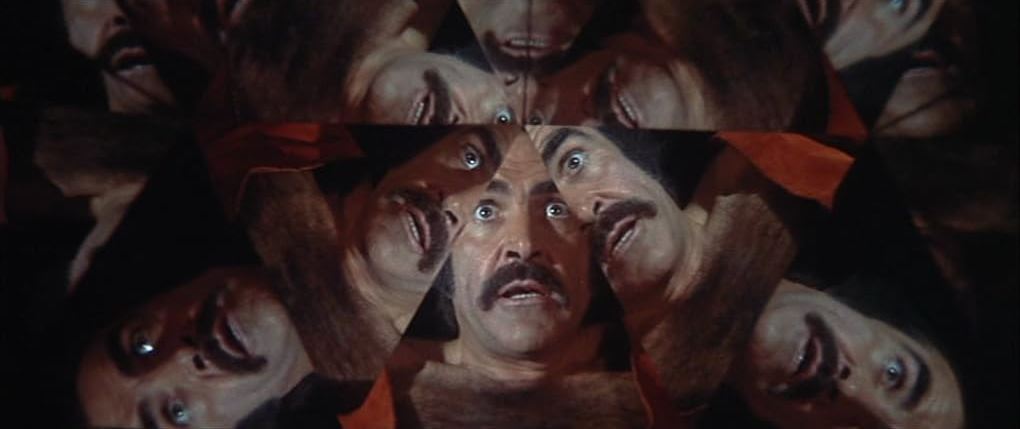
This is when things get weird… well, weirder. The Eternals don’t like life anymore. As their advanced technologies have eliminated the need—and subsequently the desire—for sex, one can easily see why they’re so bored. Many of them are thrilled to find Zed has infiltrated their compound as it’s the only exciting thing in ages. At one point the Eternals decide to test exactly what kind of stimuli gives Zed an erection… the scene is hilarious, mostly thanks to Sean Connery.

I’m often accused of liking bad movies, but this isn’t true. Last night I tried watching Ice Pirates for the first time in two decades. That’s a bad movie. What makes Ice Pirates bad and the eighties version of Flash Gordon good is simple: one’s a Star Wars cash-in which tries too hard to be funny; the other is a genuine love letter to its source material. Zardoz is in the same camp as Flash Gordon in the sense there is passionate filmmaking on display here. Casual moviegoers may snicker, but then again casual moviegoers are the reason superhero movies are getting churned out every other week.

Director John Boorman made Zardoz after his plan to follow up Deliverance with a live action adaptation of The Lord of the Rings fell through. After Zardoz bombed, he made Exorcist II: The Heretic, which was… well, you can’t win ’em all, I suppose.

Zardoz is weird at its finest. It’s 2001: A Space Odyssey if directed by Fellini. It’s psychedelic, ambitious, blasphemous, pessimistic, and optimistic. Speaking of Kubrick’s 2001, cameraman Geoffrey Unsworth turns in cinematography here that could’ve won an Oscar. And where else are you going to see a movie star of Sean Connery’s stature in a red diaper and knee-high boots? (Before Connery signed on, the role was supposed to be played by Burt Reynolds, but he got sick… I’m sure he’s not kicking himself over this one.)

Young, fun, and dead before 31: Logan’s Run

In the otherwise utopian future of Logan’s Run, humans are required to die at the ripe old age of thirty. Most people who reach the cut-off age believe the execution ritual is in fact transferring their immortal souls to a higher plane of existence even though all the spectators can clearly see their bodies fucking explode. Those who try to escape their birthday spankings are called runners. The men who hunt them down are called sandmen.

One such sandman is Logan Five (Micheal York). Logan loves the chase. He and his work partner toy with terrified targets before dispatching them violently. The glee on Logan’s face is truly vile; the way he dispenses the word “runner” is analogous to the way white supremacists scream their favorite slur.

One day Logan is forced to go undercover in order to find Sanctuary, the safe haven where runners attempt to go. Unfortunately, Logan’s partner thinks he really went on the lam so Logan must actually run. (I believe Spielberg’s Minority Report owes some unpaid homage to this.) The next thing you know there’s an oddly placed cameo by Farrah Fawcett, a lot of fiery deaths (because sandmen use flare guns instead of pistols), and a “big reveal” that pales in comparison to the one in Planet of the Apes. As you probably guessed, Logan will slowly have the wool pulled from his eyes.

Logan’s Run posits that people under the age of thirty are idiots. The film’s young and insanely attractive citizens mill about their dome city in slinky costumes with sex-crazed mindsets. I’ll be the first to admit these kind of movies are an acquired taste, but I just love this kind of shit. As far as movies go, it’s the closest you can get to the kind of bizarre science fiction that truly insane novelists like Philip Jose Farmer and Roger Zelzany unleashed in yellow DAW paperbacks. You’re going to see an unbelievable amount of sex, violence, and gratuitous nudity for a PG-rated film, and sheer awesomeness in the truest sense of the word.

It’s a hell of a spectacle, yes, but not a seamless one. Analog future technology is adorable when watched in the digital age. The miniature effects look as realistic as toys. There’s a robot effect so painfully obvious you can actually see the lips of the actor who’s wearing the costume.

Logan’s Run is far too goofy to be considered a classic, but you’ll probably grin an awful lot.

How much man could The Omega Man man if The Omega Man could Omega Man man?

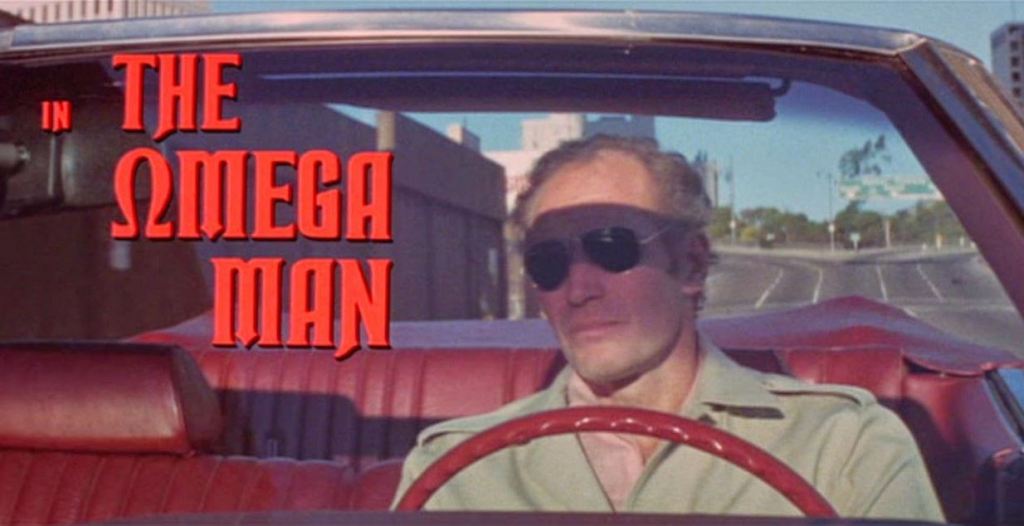
Dr. Neville (Charlton Heston) is driving his convertible through deserted Los Angeles. It’s a pleasant day and he’s just vibing, listening to Theme from a Summer Place on an 8-track player. When Heston spots movement in a window, the machine gun comes out and he releases a barrage of bullets. This is two years after a biological apocalypse has rendered nearly everyone else on the planet dead. According to the poster, “The last man alive… is not alone!” That’s because most of the people who survived the plague are now mutants who specifically want to kill Neville.

If this sounds vaguely familiar, it’s because it’s a 1970s retelling of Richard Matheson’s 1954 classic novel, I Am Legend, in which the bad guys are vampires, not mutants. It also served as the basis for Vincent Price’s The Last Man on Earth, which is a fairly standard but watchable B-movie, and a 2007 Will Smith vehicle which bore the same title as the novel even though it entirely missed the point. Matheson’s novel depicted Dr. Neville as a man so badly isolated that when the vampires came to his home to taunt him nightly, he often fantasized about opening the door and stepping out.

The Omega Man scales back the isolation-horror and becomes one of the very first tough guy films, complete with witty one-liners (which mega Omega Man fan Tim Burton has pointed out in interviews). While browsing a car lot, Neville has a humorous conversation with an imaginary car salesman who’s trying to screw him over. After being captured by the bad guys, Heston asks, “Are you fellas really with the Internal Revenue Service?” When it’s revealed that Neville is not, in fact, the last person alive, his love interest decides to go shopping, referring to her shotgun as a “credit card.”

The film’s so hip, in fact, the mutant ghouls wear mirrored shades with their sacramental robes. This may have seemed a little silly in the 70s, but in the time since it’s managed to age like a fine wine. The last woman alive is sassy black Lisa (Rosalind Cash), who’s not the only prominent character in the film who wears a bitchin’ afro. The first time she meets Heston it’s with perfect comedic timing: she catches him caressing the curves of a department store mannequin.

The Blu-Ray looks great, though it’s painfully obvious whenever motorcycle-driving Charlton Heston transforms into a stunt double with a bad toupee. Also shitty is the inclusion of the same special features which appeared on a DVD version ten years ago. Nonetheless, I haven’t enjoyed the picture more. Watch it before Tim Burton inevitably remakes it.

Never Sleep Again: The Elm Street Legacy

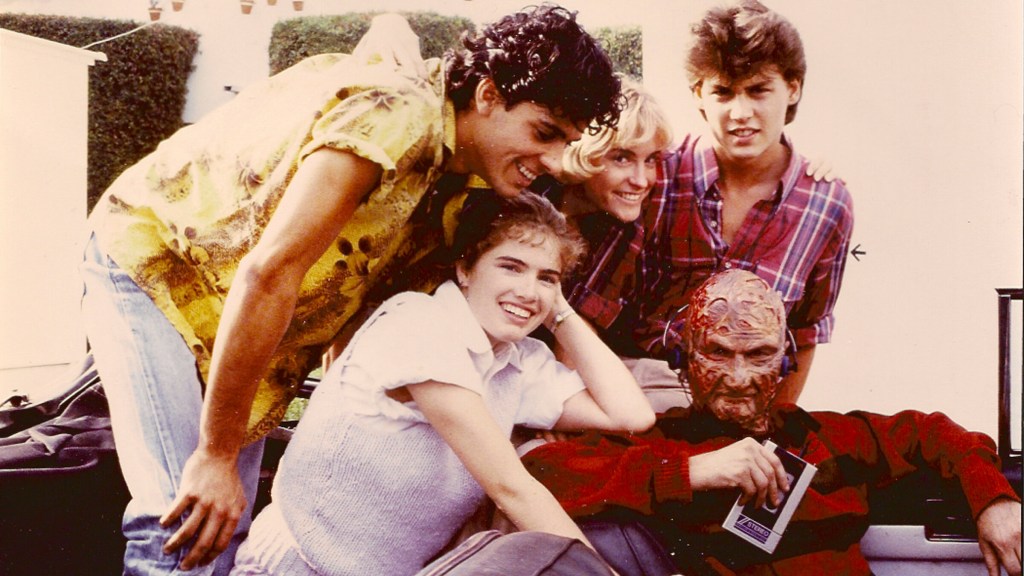
I never expected to sit through all of Never Sleep Again, the four-hour documentary about Freddy Kruger movies, in one go. I just wanted something to watch while I ate an ice cream cone and took a break from Watch Dogs. I loved Freddy movies when I was a kid (one of the first things I ever wrote was a Freddy fan fic about his estranged brother, Eddie Krueger… Evil Dead’s also Ash Williams made an appearance), but at this point I probably haven’t seen a Freddy movie in ten years.

Narrated by Heather Langenkamp, who was Freddy’s first “final girl,” Never Sleep Again is a surprisingly entertaining behind-the-scenes piece of fluff. Born from Kickstarter, I expected low-quality fan service, but it brings the goods. There’s a healthy portion of footage that was censored in the theatrical releases, a handful of deleted scenes, and information about an unproduced script co-written by Peter Jackson. Of the many interviews, Robert Shaye and Wes Craven are especially candid about what they liked and didn’t like in the series.

For me, the most perplexing and unintentionally hilarious scene has always been the exploding parakeet in A Nightmare on Elm Street 2: Freddy’s Revenge. See, a parakeet blows up in midair and the main character’s father (Clu Gulager) suspects a natural gas leak before blaming it on a cherry bomb. I always wondered how that came about. How does something so stupid get written, much less filmed? Never Sleep Again sheds some light on the scene, but not much.

The time devoted to Elm Street 2, by the way, is the high point of the documentary. Either I don’t remember picking up on the homosexual undertones or I was too young to notice. Cracked named it the most unintentionally gay horror movie of all time. The actor who portrayed the main character says his Risky Business homage is often looped in gay bars across the country.

My favorite had always been the third one. They brought Nancy back and included adult characters who weren’t just “angry parent” stereotypes who seemingly hated their children. The arm-tendon marionette scene is burned into my memory. To this day, I remember the cross-shaped faucet handle that grabs back every time I see such a fixture.

So how did they get Dick Cavett to do a cameo in their scrappy little horror movie? Easily. They simply told him Freddy would kill any celebrity of Cavett’s choice. Naturally, he chose the “stupid” Zsa Zsa Gabor. That’s exactly the kind of production detail that makes Never Sleep Again a very watchable film.

The best part is how every one of the interview subjects look back on their experiences with fondness. For many, Freddy was their only brush with Hollywood. Others have had success elsewhere, but not quite as big. Robert Englund, who one might suspect resents Freddy, says, “Freddy has been very kind to me” towards the end of the doc. You get the sense that almost everyone who worked on the series had a blast. I have a new appreciation for the films.

I (kind of) saw Godzilla 2014

Last night I went to see Godzilla at the drive-in during an intense thunderstorm. Because I am an Oklahoman, it was far from the first movie I watched in a thunderstorm—the first was when I was around sixteen years of age, sharing a plastic bottle of vodka with a couple of friends as we stood in the middle of the field, laughing at the way the hairs on our arms and necks were rising from all the static electricity in the air. As I went to the bathroom, the power suddenly went out. I cannot adequately describe the existential horror of being trapped in a drive-in bathroom as it’s darker than the Mariana Trench… and you really don’t want to touch anything to find your way out because it probably hadn’t been surface-cleaned since the 1950s.

Nonetheless, I really enjoyed Godzilla. At least, once the storm finally passed around halfway through.

Dual-wield sniper rifles in Wolfenstein: The New Order

You assume the role of William B.J. Blazkowicz, whose favorite pastime is killing Nazis. The game opens in 1946 and initially feels routine, like a retread of Return to Castle Wolfenstein. Then a laboratory explosion puts a chunk of shrapnel in B.J.’s skull and the character spends the next fourteen years in a coma. When Nazis are ordered to shut the hospital down, B.J. wakes up just in time to slay the bastards. In this alternate timeline, the Nazis have won the war after dropping an atomic bomb on New York.

Severely culture-shocked, B.J. interrogates a Nazi commander with a chainsaw to find out where members of the underground resistance are imprisoned. Naturally, he breaks them out and finds himself battling the Nazi bastards all over the world… and the moon. Yes, that’s right. The friggin’ moon.

B.J. is a surprisingly sympathetic killing machine. His love interest—the woman who took care of him while he was in a coma all those years—is believably realized in both appearance and voice. Having recently played the less-than-stellar Rage, I’m surprised by how realistic these characters are rendered by the id Tech 5 engine. Take, for instance, the paraplegic Caroline Becker. When she and B.J. are reunited in 1960, they take turns listing their injuries and injustices in an attempt to one-up the other. The pissing contest is concluded with a hug, at which point Caroline warmly says, “Good to see you, William.”

Which isn’t to say the game is flawless. You’ve no doubt heard a lot of reports the game isn’t as linear as the demo which journalists first saw a year or two ago, but those reports are misleading. You’re constantly told what to do in great detail by another character (e.g., “B.J.! Get up to that ventilation shaft and try to ambush the bastards!” etc.). On top of that there’s almost always a little beacon pointing you to an easy-to-miss objective. I understand many gamers don’t have the patience for getting stuck, but the hand holding is a little strong.

As for the multiplayer? There isn’t any. Perhaps that’s just as well as I can’t say I had a whole lot of fun in DOOM 3’s multiplayer and what they tacked onto Rage wasn’t even worth the bandwidth. The developers focused on what really counts: a kick-ass game with very little fat.

What makes the game really special is the way it feels, something that doesn’t translate well to gameplay videos. You’ve gotta try it yourself to truly appreciate it.

Nebraska: Be somebody.

The entirely black and white Nebraska begins on a bridge that could be anywhere in the Midwestern states. The elderly Woody Grant (Bruce Dern) appears disheveled as he walks towards our point of view. A sheriff pulls up and asks where he’s headed. Woody points ahead. The sheriff asks where he’s coming from. Woody points behind him.

Woody’s son David (Will Forte), a stereo salesman who just got dumped by a painfully average woman, picks Woody up at the police station. Woody, as it turns out, has been suckered by a million-dollar sweepstakes, which only exists to sell magazine subscriptions; this is the second time he attempted to walk to Lincoln, Nebraska to collect his winnings. Says Woody’s wife, played by June Squibb: “I didn’t even know the sonuvabitch wanted to be a millionaire. Should’ve thought about that years ago and worked for it.” We later learn Woody married her because he had nothing better to do at the time.

In typical Alexander Payne fashion, it slowly becomes apparent why these people are the way they are and how they became permanent fixtures in each other’s lives. The director reveals new details in every interaction within the large cast of supporting players, including Stacy Keach, Bob Odenkirk, and June Squibb. Will Forte of Saturday Night Live fame may sound like the odd one out in this powerhouse cast, but his face perfectly emotes his sad clown character.

What’s the best way to make a legitimately touching movie? Be honest about your characters and where they end up. Don’t prime the audience with overcooked music and manufactured drama. It takes confidence to show this kind of restraint, but Nebraska manages. Low key as it is, I still found myself laughing a lot more than I did during Anchorman 2. And though I loathe “feel-good movies,” I felt pretty damn good when this movie was over.

I would say I’m not a fan of road trip movies, but on the other hand I loved Albert Brooks’s Lost in America and Alexander Payne’s earlier Sideways, both of which are all-time favorites of mine. Come to think of it, Payne has made a few road trip movies. Maybe no one makes them better.

Nebraska isn’t a movie for everyone, but I found it to be a very entertaining flick, at times hilarious when it wasn’t content with being merely funny. Born and raised in Oklahoma, I really dig the Midwestern vibes of this picture. Design a scene around an air compressor and you’ve got my attention.

Splice isn’t what you think it is

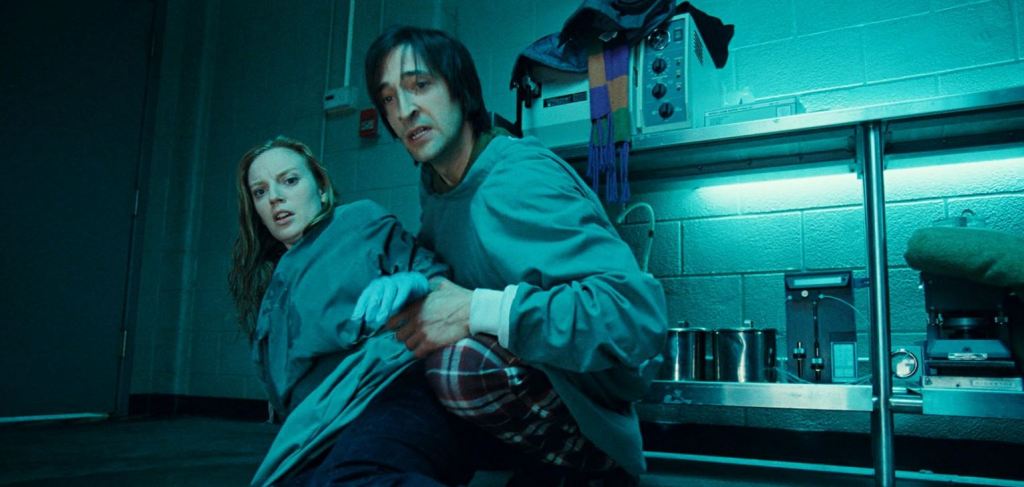
Behold: the birth of a human-designed creature! It’s the second of its kind—a gross, slimy monstrosity about the size of a football. The scientists responsible, who happen to be dating, are Elsa and Clive (Sarah Polly and Adrien Brody). They drive a Gremlin. They eat pizza at work (because movie scientists always eat pizza). They think their designer creature is cute. And this will become relevant later on: Clive wants kids while Elsa doesn’t mind waiting.

The scientists are on the cusp of curing all the bad things that tend to happen to the human body. Naturally, bureaucrats conspire to take the project away. The scientists’ lofty goals simply aren’t profitable to the company’s investors. Polly pushes forward with the research anyway. It results in something that resembles a human fetus outside the womb. Now they’ve got something on their hands that was highly unethical to make in the first place. Getting rid of it is even more so.

The scientists attempt to keep the creature a secret, but this causes one complication after another. And if you’re anything like me, you’ll be waiting for the routine horror stuff to begin any second. Thankfully, the movie doesn’t become routine until the last seven minutes or so. By then, it’s earned it. Its horror is bizarre, cerebral, and wonderfully gross a lá David Cronenberg’s The Fly. The “monster” (and I’m really trying not to give too much away here) has more in common with Frankenstein’s than you might suspect.

So do you like body horror? This picture’s got it. You like dance scenes? There’s a pretty unique one, I guess you could say. You like movies that really aren’t for the faint of heart? Then step right up. Sure, sometimes you kinda know where it’s going, but that’s part of the fun: watching characters on a slow motion collision course with outcomes that could have been easily avoided earlier, but can’t be avoided now.

You control your farts well: South Park: The Stick of Truth

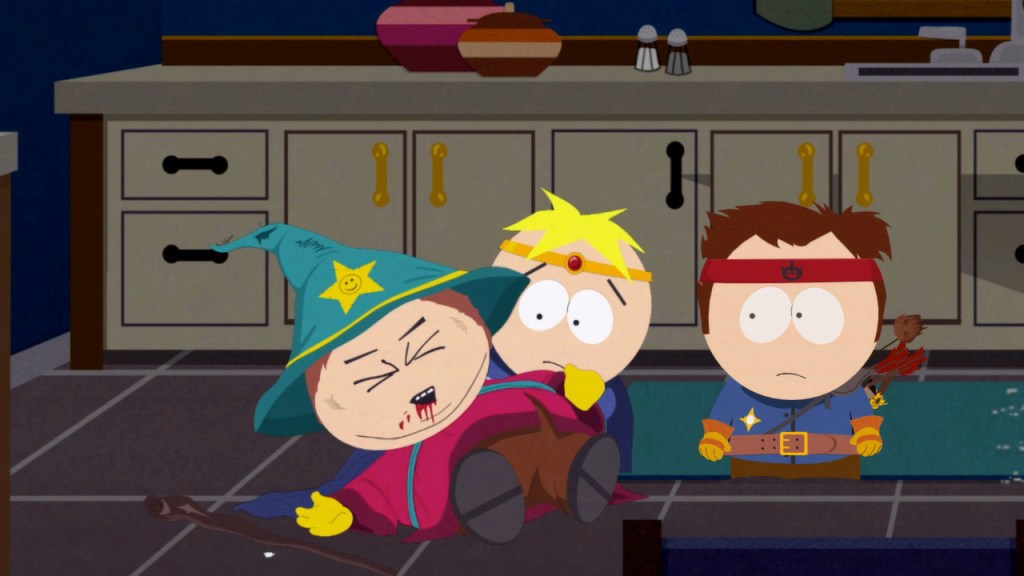
A game of pure imagination is in full swing in the quiet little mountain town of South Park, Colorado. All the neighborhood boys are wearing the best costumes they could cobble together with household items. They’ve split into two warring factions: the drow elves and the humans, the latter of which is led by The Wizard King, Eric Cartman. It is the humans who initially recruit you, the new kid in town, to protect the titular Stick of Truth. “For whoever controls the stick, controls the universe.”

Back in the 90s, there were a few Beavis & Butt-Head games. The Sega Genesis version wasn’t bad, but when burping and farting are your primary attacks, the novelty wore off quick. I had concerns Stick of Truth would end up in the same category—once again, burps and farts are part of your arsenal. I’m not above toilet humor (to this day, Beavis & Butt-Head are still deeply ingrained in my heart), but few games can do it with charm.

South Park is nothing if not charming. Take, for example, Mr. Hankey the Christmas Poo. He lives in the sewers. His wife is an angry alcoholic. One of his kids was born with a nut in his head. Yet Mr. Hankey simply has the right attitude about life, you know? I know a lot of people who are a lot less pleasant to be around than Mr. Hankey. You could say they’re bigger pieces of shit than an actual piece of shit. The pearl clutching critics of the 90s who accused South Park of being vapid simply weren’t paying attention.

Yeah, I just I wrote an entire paragraph about turds. That’s South Park, for ya: gross, but charming. Cartman is my generation’s Archie Bunker, the most politically incorrect, irredeemable idiot since Al Bundy. Meanwhile, The Simpsons have lost steam and Family Guy was never my cup of tea in the first place. Despite occasional misfires, South Park as a whole remains fresh, no doubt because the turn-around for each episode is so short they can be as topical as a weekly newscast.

The Stick of Truth isn’t topical, but neither was the movie, Bigger, Longer & Uncut. Considering how long it takes to produce large movies and video games, it’s understandable. Luckily, South Park remains funny without its trademark, hot-off-the-presses references. It may even be funnier than the movie, which I’ve seen numerous times. More to the point: if you like South Park, you’ll like the game.

Despite being in their mid-forties, Trey Parker and Matt Stone, the co-creators of South Park, appear to be more in touch with their childhoods than most twenty year olds. Whereas so many describe the duo as “irreverent,” it’s obvious there’s a special place in their hearts for the days when kids could play outside for all hours of the day, making up the rules as they go along. It’s played for laughs, but I’ll be damned if it doesn’t work.

As for authenticity, cutscenes are virtually indistinguishable from the show. The gameplay blends in seamlessly. We’ve come a long way since the 2000s, when the obligatory games that licensed the IP operated more or less independently of the showrunners. I can’t imagine a better case scenario for a South Park game. At a little longer than ten hours long, The Stick of Truth leaves me wanting more. I’ll keep my fingers crossed for many sequels.

Now, if you’ll excuse me, I have to go work on my sneaky squeeker.