The Howling (1981) | 31 Days of Gore

It’s the tenth anniversary of 31 Days of Gore, in which I feature one horror movie each day for the month of Halloween.

I’m in love with the way director Joe Dante opens The Howling: in the fast paced world of a television news station. Behind-the-scenes personnel are rushing around as the on-air talent get into makeup. Meanwhile, Karen White (Dee Wallace) is nervously walking down the scuzzy, neon-lit streets of Los Angeles’s grindhouse district, wired with a radio that’s transmitting her voice to the police. We have no idea what’s going on at first, but it’s instantly engaging as Dante drip-feeds the information to the audience.

We eventually learn that Karen has agreed to take part in a sting operation to catch a serial killer (an exceptionally effective Richard Picardo) who has become infatuated with her. The killer instructs her to meet him in the back of an adult video store containing a private movie booth. Once there, the killer forces her to watch a snuff film of his own making before the cops manage to shoot him dead. Karen is so traumatized by the event, her therapist suggests she should vacation at the countryside resort where he treats patients in a group setting.

While Karen finds trouble connecting with her husband intimately (whenever he tries to kiss her, she flashbacks to a close-up of the killer’s flickering tongue), her newsroom buddies discover the killer’s body has gone missing from the morgue. Their investigation leads the reporters to an occult bookstore run by Dick Miller who, as far as I’m aware, has never not appeared in a Joe Dante film. Miller tells the reporters they may be dealing with a werewolf and suggests they buy a box of silver bullets. When they ask him if he really believes in that kind of stuff, he replies, “What am I, an idiot? I’m makin’ a buck here!”

I don’t want to spoil who’s a werewolf and who’s not, but I will say the reveal is amusingly macabre. There’s a huge cast of character actors including Christopher Stone (who Dee Wallace married in real life), Kevin McCarthy, John Carradine, and Slim Pickens. Dante also packs the film with uncredited cameos by his buddies: Roger Corman, Forrest J. Ackerman, John Sayles (this film’s writer), and Mick Garris were the ones I recognized. I’m sure I missed others.

While I think the showdown between Karen and the killer should have been a bigger deal (and a little less routine), the finale does not disappoint. We also see what has to be the longest werewolf transformation ever captured on film, the effects of which are provided by Rob Bottin, who would later go on to work on The Thing. Rick Baker is also credited for the effects, though he jumped ship (with Dante’s blessing) to work on John Landis’s An American Werewolf in London, which is overall the inferior werewolf film in my book.

By my count, there are two similarities between this picture and Romero’s Dawn of the Dead: both films open in a news station and both films feature unusually strong character work in their middle sections. In this film, John Carradine’s character watches two young lovers on the beach with a sense of longing and regret that’s expressed entirely without words. It’s a moment that’s extremely rare in these types of movies, elevating it to one of my favorites.

The Toxic Avenger (2025)

Winston Gooze (Peter Dinklage), the janitor at a corrupt drug manufacturer, has just been given six months to live. That night, the single parent gets drunk and roams the streets as he wrestles with the fear of leaving his stepson (Jacob Tremblay) alone. How he ends up in a tutu is less believable than how his counterpart, Melvin Junko, ended up in a tutu in Lloyd Kaufman’s original film of the same name. (This time around, the Toxic Avenger’s origin story isn’t part of a cruel prank, so one wonders: Why didn’t he just take the tutu off before leaving the house?) Ultimately, Winston decides to rob his employers and finds himself in the factory’s toxic runoff, which hideously deforms him, but gives him superhuman strength.

The large cast of villains (I especially like the henchman who never misses an opportunity to do a flip) are led by the corporation’s evil CEO, played by Kevin Bacon, who surprisingly understands the kind of movie he’s making, but at no point tries to hams it up as Hollywood actors tend to do in these kind of films. His runt of a little brother is played by Elijah Wood, who seems to genuinely enjoy appearing in oddball genre affairs ever since securing his massive fortune in The Lord of the Rings trilogy. Meanwhile Peter Dinklage perfects the right amount of grounded acting and comedic timing.

As a lifelong fan of the original, I went into The Toxic Avenger fully expecting it to suck as reboots of cult classics almost always do. I was surprised to find the most competently paced of the five films and, overall, I’d place it second only to the 1984 original… and if you were to rate it higher, I wouldn’t feel the need to fight you. Recently, there’s been much hullabaloo about The Naked Gun reboot potentially resurrecting the spoof film. Here’s literally the same type of cathartic laughter.

The trailers don’t convey how solid the movie is; Lloyd Kaufman’s films flew in the face of Hollywood conventions while the reboot prefers to satirize and indulge in them equally. In some ways it feels like a throwback to the superhero film of the 90s, before they became monotonously noisy and bloated with clap-bait for nerds. I know the competition is extremely incompetent, but director Macon Blair has crafted one of the least insulting reboots I’ve ever seen. This is as good as a mainstream Troma movie can possibly be.

My only complaint is they didn’t kill the cat. What’s a Troma movie without a handful of “that’s so wrong” deaths played for shameless entertainment? In the original you had old ladies beaten to death and children’s skulls crushed by moving cars. You could say this one pulls its punches in that respect, but that doesn’t feel like its intention. It’s just doing its own thing, in its own way, and it does it especially well.

31 Days of Gore: The Unnecessary Reboot! (10th Anniversary)

I haven’t done 31 Days of Gore in years, but I’d be remiss if I didn’t do it again for the 10th anniversary. In search of the best gore flicks, I’ll feature one horror movie a day, every day, from October 1st to Halloween. In order to recapture the thrill of being a pre-internet kid with an unrestricted membership to a mom & pop video store, I’ll be choosing movies based solely on their covers. I have no clue which movies I’ll feature yet, but there are a few traditions during this pointless exercise in endurance:

  1. A shot-on-VHS flick
  2. A melt movie
  3. An anthology film (usually several).
  4. Italo-horror (my favorite).
  5. Slasher films (often combined with Italo-horror).
  6. Empire/Full Moon movies

Returning this year is The Gore Meter, which assigns each movie a rating between 1 and 4 based on the satisfaction level of the gore effects, as determined by yours truly. The ratings are rarely indicative of the movie’s overall quality as there have been plenty of movies I loved that ranked low on the meter. I know, it’s a strange (stupid) rating system, but the gore angle was the only thing that made this feature feel worthwhile as there are already several content creators doing 31-day movie challenges for the month of October (I imagine more than ever now).

In other news, I finally got a stupid Letterboxd. The reason I’ve avoided that site for so long is because Goodreads was like crack to me until I finally kicked the habit and deleted it (and promptly started a new account before deleting that one, too). At any rate, follow me on Letterboxd and I’ll follow your dorky ass back.

So mark your colanders, spaghetti-heads. 31 Days of Gore returns in thirty-one days and I already regret committing to this!

1759323600

  days

  hours  minutes  seconds

until

31 Days of Gore

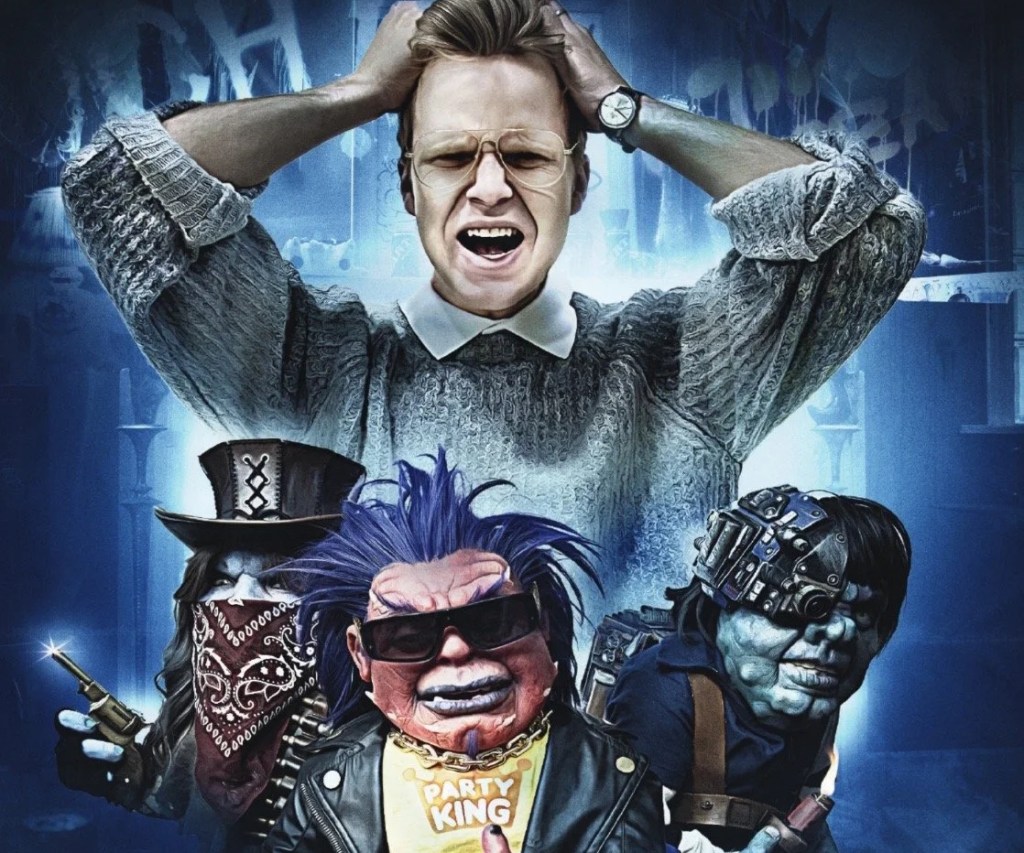
Frankie Freako (2024)

When Conor’s wife gets dolled up in lingerie for date night, she tells him she was thinking that maybe they could do a little more than hold hands for a change. “What more is there?” Conor asks incredulously. There are many movies (most of them) in which I simply wouldn’t accept a joke as lame as that, but it’s less about the joke and more about the way it’s told. In his previous film, Psycho Goreman, director Steven Kostanski included a scene that had me laugh uncontrollably for several minutes straight; it involved a telepathic connection taking place, without warning, in a bathroom.

In an even earlier picture of his, Manborg, Kostanski crafted an entire feature held together by a few hundred bucks, duct tape, and a load of guerrilla creativity. That movie relied heavily (and charmingly) on the kind of CGI that wouldn’t convince a toddler, but boy was it fun. The bigger his budgets get, the less he relies on CGI and the more he employs the kind of practical effects that tickle me to pieces. In Frankie Freako, I’m thrilled to report the creature effects are obvious puppets.

Conor, frustrated by the fact that even his boss thinks he’s a hopeless square, decides to call a party hotline as advertised on TV. Perhaps it’s more of a Canadian thing, but I ate, slept, and breathed late night television in the states and I absolutely do not remember any such advertisements for party lines that didn’t promise scantily clad women would call you, but I digress. Upon waking up the following morning, Conor discovers he blacked out while partying hard the night before. His trashed home is now inhabited by three prankster creatures of the Ghoulies variety who refuse to leave until Conor learns to lighten up permanently.

It’s not long before the evil corporation that subjugated Frankie Freako’s entire planet catches wind of the creatures’ whereabouts and kidnaps them along with Conor. The bad guys are voiced by the Red Letter Media regulars, which was particularly surprising as I clocked Rich Evans’ voice in Psycho Goreman immediately, but in this one, I had no idea he had such a large role (the main villain, in fact) until the credits rolled. At any rate, Conor must let his freak(o) flag fly in order to get back to earth and rekindle his relationship with his wife. All the while, Kostanski has fun with the kind of absurd plot conventions that were only routine in the coked-up 80s.

As of this writing, the movie is available on Shudder.

28 Years Later

I can’t remember the last time a trailer gave away so little plot information. It advertises a man and his twelve year old boy will leave the safety of their fortified island community to explore the mainland, which has been overrun by those infected by the psycho-virus Rage for twenty-eight years. This accurately represents perhaps twenty minutes of the film’s runtime. What happens next feels like truly uncharted territory… which is fitting for the crazed subject matter.

The enigmatic trailer also gives us only a fleeting glimpse of Ralph Fiennes, looking absolutely insane with his bald head and red skin. His mysterious character is spoken about in hushed whispers throughout the first half of the film, adding to the suspense of his eventual reveal. You think you have a pretty good idea of who he is and what kind of role he’ll fulfill, but you probably don’t. To say I was hyped to see this character is an understatement. I wasn’t let down in the least as he’s the best part of the movie.

As with 28 Weeks Later, this movie opens with a flashback to the first year of the virus’s spread. The opening isn’t as intense as the one which featured Robert Carlyle making an impossible decision, but it’s comforting to see Danny Boyle hit the ground running for his return to the series. You’d think the director’s Oscar might’ve gone to his head, steering this sequel straight into “elevated horror” territory; instead he has a group of infected psychopaths shred through a roomful of helpless children before descending on a hysterically laughing priest. Anyone who’s spent any time reading this blog will know this is exactly the kind of horror I cherish: the kind that isn’t embarrassed of the genre’s roots.

In more than one interview, Danny Boyle has tried to make the case that the 28 series aren’t zombie movies. In this movie, screenwriter Alex Garland has a Swedish soldier wash up on shore and flat-out refer to the infected people as “zombies,” perhaps jokingly. This is a jarring thing to hear when actual zombie movies typically go out of their way to avoid the “Z” word (which is even riffed on in Shaun of the Dead), as if they take place in a universe in which George Romero never existed. Speaking of the soldier, I previously pointed out that these movies are at their best when the military forces are absent. I’m happy to report the military presence in this one is applied even more sparingly than it was in the original picture.

In his genre movies, Danny Boyle has had a strange tendency to go off the rails in the final act (28 Days Later, Sunshine, Trainspotting 2) with wildly uneven results. This time Boyle tempers his tendencies… until the final two minutes, at which point he gloriously doubles down. Before that, however, 28 Years Later delivers the most emotionally satisfying conclusion, which relies less on spectacle and more on character and performance.

Movies like this tend to grow on me with time as I forget all but the most memorable scenes. It will likely be another ten years before I can honestly say which I enjoyed more: the original or this one. I would not be a bit surprised if it’s this one. There’s so much I want to discuss here, particularly the effortlessness of Jodie Comer’s performance, but I wouldn’t dream of spoiling what the trailer didn’t.

28 Weeks Later (18 years later)

The best part of 28 Weeks Later is its unforgettable opening, which is set during the events of the first film. In case you haven’t seen it, I won’t spoil the first ten minutes by discussing them here. It’s interesting that this film is at its best when it’s treading familiar waters, which proves how good the original was. When the story jumps twenty-eight weeks after the Rage virus initially spread, we learn that American military forces have moved into Britain to restore order. Survivors are now living in fortified safe zones where work and play has more or less resumed, albeit heavily surveilled.

I won’t tell you how all hell manages to break loose, either, as that would also spoil key events of the opening. When U.S. soldiers are ordered to start shooting infected and uninfected peoples alike, Sergeant Doyle (Jeremy Renner) deserts his sniper perch to help a band of survivors escape the rapidly collapsing city. One of those survivors is conveniently a research scientist who has discovered a breakthrough regarding the disease (Rose Byrne). The escape is the second most compelling scene of the movie, which adequately establishes Doyle as the right guy to lead the characters to safety.

Not that there’s much safety to be had beyond the walls of the safe zone. With the horde hot on their trail, the survivors scramble to reach an LZ where one of Doyle’s helicopter buddies may or may not be willing to pick them up. One of the many reasons I loved the first picture is because it does what so few of these types of films do: it solved problems without guns (until its oddly disconnected third act). Doyle is certainly an extremely likable character, but nearly every problem is a nail and his gun is the hammer. I don’t know. I just find these movies more interesting without the military elements.

Yesterday, I asserted that 28 Days Later was not a zombie movie as Danny Boyle didn’t bring the baggage of zombie movies to the table. I suspect director Juan Carlos Fresnaldillo was, in fact, modeling his film after zombie movies whether he intended to or not. While I wouldn’t call 28 Weeks Later a conventional movie, it’s a lot more conventional than its predecessor. It’s not at all bad, mind you, just more of what we’re used to. I think it’s worth anyone’s time, but especially fans of the original.

The cast also includes Robert Carlyle, who gives the best performance of the entire movie, Harold Perrineau from HBO’s Oz, and Idris Elba.

28 Days Later (22 years later)

My favorite horror movie of all time is George Romero’s Dawn of the Dead. I’ve waxed poetic about it many times on this blog, but long story short: I love everything about it. When a film becomes exemplary of its genre, I don’t clamor for more. I don’t want endless knock-offs and sequels. Which isn’t to say I did not thoroughly enjoy a handful of other zombie flicks like Day of the Dead, Return of the Living Dead and Shaun of the Dead, but in general, the last thing I actively want for is another zombie movie because—let’s face it—I’m at least halfway to dead myself and I’d rather just watch Dawn again.

When 28 Days Later came along, early internet forums were rife with Negative Nancies confidently stating, “Zombies do not run.” Simon Pegg later poked fun at running zombies, stating, “Death is not an energy drink.” A particularly snide critic in a local paper wrote, “If you can’t afford to make a movie with a decent camera, you can’t afford to make a movie.”

I think the problem with those naysayers is simple: 28 Days Later isn’t even trying to be a zombie movie. 28 Days Later shares more in common with George Romero’s The Crazies than Dawn of the Dead. The distinction is small, but apposite; when Quentin Tarantino said he admired Umberto Lenzi’s Nightmare City as a zombie film, the Italian filmmaker took offense, shouting, “Zombies?! What zombies?! It’s an infected peoples movie!” (Incidentally, here’s my review of Nightmare City, which I think you’ll agree is not a zombie picture even though that’s what producers hired Lenzi to make.) Danny Boyle himself has said his movie is not a zombie movie and he hardly seems like the type who’d watch many of them.

So if 28 Days Later is not a zombie movie, why, then, did I choose to reiterate my affection for George Romero’s 1978 zombie masterpiece at the top of this piece? For one: I can’t resist taking every opportunity to talk about it. Two: Because 28 Days Later is the Dawn of the Dead of infected people movies. It’s exemplary of its genre.

In the opening scene, well-meaning activists break into a Cambridge laboratory. They aim to free the chimpanzees who are undergoing cruel experiments there. What they don’t know is the primates are infected with a virus known as Rage. The moment one gets loose, Rage rapidly spreads across Britain, turning its hosts into primal psychopaths. For all the survivors know, it may have even spread across the entire world.

Jim (Cillian Murphy) wakes up from a coma twenty-eight days after the infection destroyed modern civilization. As he roams the empty British streets, he bumps into a couple of survivors, Selena and Mark, who catch him up to speed. They agree to take him to his parents’ house even though they warn him they’re likely dead (or worse). When Mark is bitten at Jim’s childhood home, Selena doesn’t hesitate to kill him. What’s especially striking about a post-apocalypse picture set in the UK is the relative lack of guns; there’s not always a merciful way to kill an infected companion.

Continuing on, Jim and Selena happen upon two survivors who are holed up in a high-rise apartment: a daughter and her father (Brendan Gleeson). The group of four decide to take a road trip to investigate the source of a radio signal promising salvation. I won’t tell you what happens when they get there, as the climax proves nearly as divisive as Boyle’s third act in Sunshine, but there’s a hopeful middle section in which the survivors bond with one another and even have some fun.

The sequence in Dawn of the Dead that sets it apart from so many horror movies in my mind is after the heroes have successfully fortified the shopping mall. It’s the first time we see them relax since the movie began—the first time there’s a glimmer of hope in the bleak situation. Boyle allows his characters a similar reprieve in his picture. For a brief moment they allow themselves to believe things may be alright, which only makes the subsequent horrors all the more impactful.

This was my first time watching the movie since I saw it in theaters twenty-two years ago. The prosumer camera Boyle’s crew used for most of the picture really did look like shit on the silver screen. It looks much better on televisions as that’s what the camera was made for. The brain is convinced that what it’s seeing is real because it feels less like a polished movie and more like civilian-shot war footage. Now that I hear there’s a 4K UHD on the way, I call shenanigans; you can’t “restore” footage of a movie that was originally shot in 480p, the resolution of a standard DVD (4K has sixteen times the resolution). I fear that whatever method this new edition employs will sacrifice the very identity of this movie. Is Sony really the distributor you trust to archive this flick?

The 2025 Blog Restoration

I’m making some changes around here. You may have already noticed the new dark theme. Considering how often I complain about websites that don’t have night mode, I don’t know what took me so long to do this.

Older pages of this blog are undergoing an extensive though time-consuming effort to combat link rot and to clean up some strangely broken HTML artifacts created from the multiple platforms and text editors I’ve used since I started this blog in 2008. If you see anything broken in the archived posts, I will fix it… some day. The broken content is, for the most part, readable, but it just looks messy and it’s been bugging me ever since I moved from Blogger to WordPress a lifetime ago.

I’m starting with the oldest post and working my way forward, one entry at a time. This typically involves opening the post in the current editor, converting it to use the newest editing tools, then copying and pasting it all into a plain text converter so I can paste it back here. The problem is so many of the links I referenced now point to 404s and deleted videos. The links can rarely be found in The Wayback Machine. And it’s a pain in the ass trying to source newer links that—let’s face it—are just as likely to die in the foreseeable future.

It’s depressing to think how much information is lost every day. After all, parental figures always warned us that you can never delete anything from the internet. Maybe they were right, but you can’t reasonably ensure you can archive anything, either.

At any rate, I won’t be relying on embedded YouTube videos quite as much anymore, though I’ve already been making a conscious effort to reduce my reliance on them for years. Sometimes it can’t be avoided, unfortunately. Not only has there never been a worthwhile competitor that focuses on exploiting what YouTube did best, even YouTube seems to be shifting its focus from what it did best by pushing their garbage short content. (To be clear, I actually like TikTok… I do not like YouTube Shorts.)

I’ve got a couple of posts that are nearly finished and you can expect another Death Mage Tale soon. Here’s the first one.

Final Destination 6: Destination Finaler

The Final Destination franchise is the rare example of a horror formula done right. In the first act, the hero has a premonition of a freak accident that will kill a large group of people. Armed with this knowledge, the character can avoid (but not always stop) the tragedy, saving loved ones in the process. Unfortunately, it won’t be long until Death returns to finish off those who were “supposed to die,” usually in a predictable order.

I find the concept irresistible. If we can have hundreds of movies about vampires, zombies, and superheroes, why can’t Final Destination be a genre? The films still have a lot more steam in ’em than Freddy or Jason had by their sixth installments.

Final Destination Bloodlines is a lot more creative than its generic title would suggest. The film begins in 1968 at the grand opening of Skyview Tower, a preposterously tall restaurant that resembles Seattle’s Space Needle on growth serum. There’s a single elevator and a narrow set of hard-to-find stairs (nobody knows they exist until an employee points them out) which leads me to believe fire marshals must not exist in the Final Destination universe. A young woman named Iris foresees that the glass dance floor will crack as the restaurant nears capacity, which will kick off a hilarious chain of events that has victims being roasted alive, crushed by pianos, and impaled left and right.

This is thrilling stuff. It usually is, but the humor’s been turned up a skosh. The producers wisely stop just short of jumping the shark entirely, but manage to give the audience more of what they want. Consider how “Raindrops Keep Falling on My Head” plays from a tinny radio as the diners come falling out of the sky on the valet attendants. I really believe the first stories our prehistoric ancestors ever told was probably “Things That Can Kill You” and the Final Destination films tap into that primal excitement in a darkly funny way.

Fast forward to modern times and we learn that the premonition has in fact become a recurring nightmare for Iris’s college-age granddaughter, Stefani, whose grades are beginning to slip because of her intrusive visions. In an attempt to banish the thoughts and get her life back on track, Stefani travels homeward to meet Grandma Iris, who convinces her their entire family is cursed; Death will come for them in order of oldest to youngest.

You’ve seen this before. You already know that everybody who escaped Death the first time will gather with varying levels of skepticism while the hero struggles to convince them of the danger they’re in. Because they’re dealing with a faceless enemy which can’t explain its motivations (the franchise’s biggest strength), there will be some wild assumptions and leaps of logic that rarely prove right for the characters. In order to get scant insight into their predicament, they’ll have to speak to someone who actually knows what’s going on.

That knowledgeable character is usually the mysterious undertaker played by Tony Todd, who this time around gets a brief origin story. I rolled my eyes at the news that this installment would flesh the character out. Thankfully, his backstory is handled about as well as it could have been. But the rest of his scene? Not so much. I’m sure a lot of fans will appreciate Todd’s real-life send-off, but the way he verbalizes the previously unspoken moral of the Final Destination films comes off so hackneyed that I kinda expected him to turn to the camera and say, “And that’s the final destination.” Wink.

That doesn’t matter. I’m nitpicking a great movie. In a post last year, I said Final Destination may be my favorite horror franchise of all time. That’s still true. I’m looking forward to future installments (so long as soulless studio execs don’t go down the dreaded “reimagining” route). If the filmmakers keep it simple and only innovate just a little in each installment, this franchise could go on forever as far as I’m concerned.

See it with a crowd.

DOOM: The Dark Ages [First Impressions]

If you had told 10-year-old me that I’d still be playing DOOM thirty-two years after the original… well, I would have believed you, but that’s only because kids are stupid. What’s amazing is the series is still relevant. Consider: the legend of Halo has wilted in the absence of Bungie; every new edition of Call of Duty looks suspiciously like the last; and the latest Far Cry earned mixed reviews at best.

DOOM 2016 was a huge hit in the era of dwindling nostalgia. This was unexpected because, in the months leading up to its release, it had more red flags than a Trump fanatic. For one, it was the first game in id’s flagship series to be made without co-founder John Carmack. Secondly, gamers were rightfully skeptical of the ironclad review embargo in place until the day of release. Rumors of poor quality ran rampant during the lead-up while many gamers (myself included) prepared for another rushed release in the vein of Duke Nukem Forever. What we got was one of the very best games of the twenty-first century.

DOOM Eternal was more of the same magic, focused on refining rather than innovating. It was a better game at any rate, with improved action and an asymmetrical multiplayer mode that’s sadly underrated. As gamers naturally wondered what a third entry would look like, id Software tempered expectations by suggesting that the new timeline was intended to be a duology rather than a trilogy, though later created a two-part DLC intended to provide closure.

Which is why it came as a surprise when the company announced The Dark Ages in 2024. In addition to surprise, that old skepticism resurfaced: developers assured players that the new game would feature “more grounded gameplay,” which reeked of the Call of Duty devs trying to pass off “boots on the ground” as a revolutionary idea. I also had trouble accepting the bio-mechanical look of the previous games would be substituted by… a medieval fantasy world? Meanwhile, pre-release videos of the gameplay seemed a little slow and clunky compared to the predecessors which had you zipping through the air during a rapid-fire chain of glory kills.

All these worries were unfounded. DOOM: The Dark Ages is probably the best single player campaign I’ve ever played. I suspect it looks slow in the promotional materials because the actual gameplay is so frenetic, it has to be slowed down for the potential consumer to read what’s happening—reviewing my own gameplay recordings is even hard to follow at times. It hadn’t helped expectations when id said this iteration of the Doom Slayer moves more like a tank; they should have elucidated that by saying “a tank manufactured by Lamborghini and weaponized by Lockheed Martin.”

It seems that most FPS game devs create powerful weapons, then nerf them in the earlier levels so that the player feels a sense of artificial progression as they’re drip-fed upgrades. The Dark Ages, on the other hand, stocks the player with the most powerful video game weapons ever devised from the get-go and still lets the player upgrade the power at a remarkably frequent place. This strategy necessitates the need for some seriously overpowered enemies, which quickly grow more powerful (and plentiful) as the game progresses. The end result in an ultra-satisfying flow of dopamine as you unlock one weapon after another with plenty of upgrades sprinkled throughout.

It literally never gets boring.

The physics have been overhauled, too. The Doom Slayer in The Dark Ages is so satisfyingly weighty, he will accidentally clip environmental objects that come crumbling down or splintering into pieces. (This, in combination with wind effects that appear around the edges of the screen at sprinting speeds, adds to the glorious sensation of being a brutish killing machine… as do the Robocop-like sound of ka-clunking footsteps.) Tossing the shield saw (yes, that’s a Captain America-style shield with a toothy chainsaw blade running around its circumference) will hurdle the discus through any number of destructible objects before it slices fodder demons in two and ultimately embeds itself in the head of a more powerful foe.

DOOM: The Dark Ages doesn’t just contain the DNA of the previous DOOM titles (and the connection seems strongest in the little details), but the 90s as a whole. There are enemies and formations which remind one of Serious Sam. The weapon designs and the heavy-metal-album visuals hearken back to Painkiller. The freedom of movement found in the wide open levels is reminiscent of the first three Halo games.

If there’s one thing I want to impart about this latest entry, it’s this: this is the most fun you can have sitting at a computer playing with yourself… er, uh, by yourself. I will expand my review as I get closer to the end because there’s a lot to talk about this one and pretty much all of it is good.