Midnight Movie: Chuck Norris vs. Communism (2015)

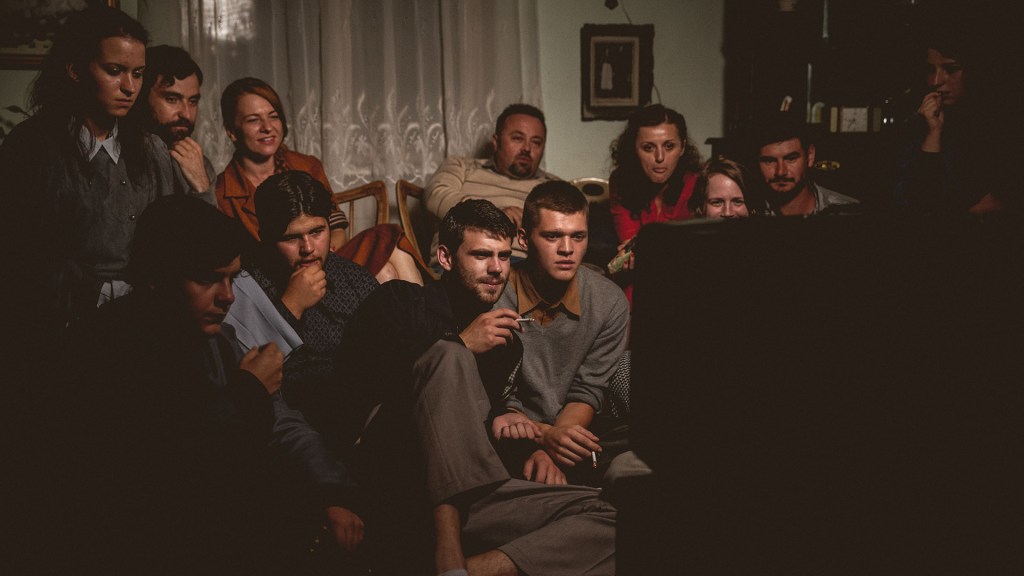
Following in the wake of American Grindhouse, Corman’s World, Machete Maidens Unleased!, and the highly watchable Electric Boogaloo: The Wild, Untold Story of Cannon Films, Chuck Norris vs. Communism represents yet another slice of history dealing with the cultural significance of B-movies. This time the focus is Irina Nistor, a translator who dubbed three thousand bootleg videotapes in spite of her country’s oppressive regime. According to one of the film’s subjects: “For regular people, video nights were the one thing that helped us survive.” Another bit of insight: “The films changed what you thought, what you were looking for, what you were interested in. You developed through films.”

Set toward the tail end of the Cold War, Nicolae Ceaușescu is the General Secretary of the Communist Party and shit generally sucks for common folk in Romania. Censorship is so extreme, Ceaușescu’s lackeys are going over every second of television programming with a magnifying glass. They delete anything which might even begin to suggest that life might be better elsewhere. 

Although VCRs can cost as much as a car there, people are buying them and showing western films to their friends and family despite frequent raids by the secret police. After the movies, the children go outside to make believe they’re Jean-Claude Van Damme, Sylvester Stallone, and Chuck Norris. Meanwhile, the adults draw comparisons between the movie’s injustices and their own. One interviewee points out that they couldn’t talk about these movies on the bus the next day. There was no telling who might be listening. No telling who’d turn them in.

The well-shot reenactments, which make effective use of brutalist architecture, are part political thriller and part espionage (think: The Secret Lives of Others). These taut scenes are sandwiched in between interviews about how films change people for the better. This is one of the leanest documentaries about film I’ve ever seen. If you love movies of any type, you’ll probably love this one. Cinema obviously wasn’t the only force pressing for revolution, but it was an integral one.


Millennium (1989)

Without giving too much away, Millennium is a time travel movie. The year (in one timeline) is 1989. A midair collision causes a jumbo jet to plunge rapidly toward earth. When the flight engineer checks the situation in the back, he discovers the passengers are already dead. Seconds before impact, the black box records the man’s final words: “They’re all burned up!”

The black box is one of several juicy mysteries for the investigators, led by Bill Smith (Kris Kristofferson). Another mystery: all the digital watches which survived the crash are now ticking backwards. I wanted the movie to explain why and how the watches tick backwards, but it never does. When it does explain things, it explains too much, often at the expense of the story. For example, there is absolutely no reason seasoned time travelers should need ideas like paradoxes and nonlinear timelines explained to them in excruciating detail. You’d think that stuff would be taught on the first day of Time Travel 101.

The film imagines a future phenomenon called “timequakes.” Unlike Vonnegut’s terrifying interpretation of the term, the timequakes in Millennium occur in the story’s present (a thousand years from now) whenever one of the time travelers change something in the past (1989). It’s disappointing that the phenomenon has less to do with temporal dimensional stuff and more to do with boring ol’ earthquakes, but after the time travelers experience one, they’re relieved that, “We haven’t changed much.” Which, like much of the movie, doesn’t make a lick of sense. If their actions in the past changed their present selves, how the hell would they know? Look, I’m not knocking a time travel movie for having plot holes. I’m knocking it because better time travel movies know how to skate by the problems all time travel movies have. Millennium is a lot like a magician who hasn’t mastered the art of misdirection yet.

What I like about the movie is the way it plays with perspective. In Back to the Future 2, Marty returns to events depicted in the first movie, but we see them from entirely different viewpoints. In Millennium, and maybe this is due to budget limitations and/or laziness, the movie wraps around to expand on earlier scenes, sometimes using the exact same shots as before. Sometimes it’s boring, sometimes it’s mildly interesting how nothing more than additional context could change a scene’s tone. Investigator Bill Smith is the focus for the first half of the movie and then… someone else becomes the main character.

Meanwhile the chemistry between Kristofferson and Cheryl Ladd tries too hard to be “future Casablanca.” Anyone who’s ever worked as a real life airline pilot or a safety inspector will scream at the screen frequently. My biggest complaint is the movie would have been a lot more interesting had it explored what happens after its final shot. That climax, by the way, is full of unintentional laughs, but the film is more or less believable as a whole. It’s just one of those movies that’s too odd for me to dislike. For instance, the all-seeing council is a direct descendant of Flash Gordon and Zardoz while the future sets, though utterly unconvincing, have a cyberpunk flair about them.

Here’s what John Varley has to say about the production, according to Wikipedia:

“We had the first meeting on Millennium in 1979. I ended up writing it six times. There were four different directors, and each time a new director came in I went over the whole thing with him and rewrote it. Each new director had his own ideas, and sometimes you’d gain something from that, but each time something’s always lost in the process, so that by the time it went in front of the cameras, a lot of the vision was lost.”

Millennium isn’t great, but it’s a helluva lot better than its 11% on Rotten Tomatoes.

Midnight Movie: Southbound (2016)

A couple of men, covered in blood, are driving down an old desert highway. The passenger glances out the window and spots something sinister hovering in the distance. When the driver asks him what’s wrong, the man brushes away his friend’s concern. Whatever’s after these two guys isn’t natural, but they’ve been dealing with it long enough that they’ve grown used to its presence.

Following the conclusion of that scene, the movie shifts focus to a group of travelers. And over the course of the next hour or so, we’ll be drifting from one character’s point of view to another, on or near the same desolate highway. Although these are some of the same people who brought us the V/H/S series, to call Southbound an anthology film is misleading. I prefer to call it “protagonistically challenged.”

What a time to be alive. After a decade or so of mostly terrible horror, 2015 has been the best year for the genre since the eighties. We Are Still Here paid homage to Fulci, It Follows to Carpenter, Deathgasm to Raimi and Jackson, and now Southbound seems to be influenced by everyone from Lovecraft to Craven. The kids raised on Video Nasties are the ones making movies now. Thanks to them, the genre is successfully making up for the 2000s, when all the films either looked too shitty or too slick.

A lot of horror movies don’t make a lot of sense because they don’t have to. There are times Southbound feels like it doesn’t make sense, but it’s not to the film’s detriment. You get the feeling early on that its madness is intentional, while the jarring nature of its sudden focus-shifts gives it the qualities of a nightmare. Just short of ninety minutes, the film’s brevity also feels dreamlike. Most horror films drag on a little too long while this one gets in, gets out, and leaves you wanting more.

If you’re wondering if it’s better than V/H/S, it is. This time the tone remains uniform throughout. It doesn’t feel like a bunch of short stories with only superficial connections. This is a bonafide movie and a damn good one at that.

Dude Bro Party Massacre III is the new standard for YouTube-to-feature success

Following Robert Rodriguez’s Planet Terror there was a rash of low budget movies which had been digitally aged to look like overplayed film prints. Efforts like Hobo with a Shotgun and Father’s Day succeeded—kind of—but the charm of authentic older movies was rarely present. Worse, the effort to disguise digital cameras in film grain and scratches was almost always more distracting than convincing. Dude Bro Party Massacre 3, which sounds like it’s going to skewer its inspirations more than it ultimately does, is cut from the same cloth. Instead of settling for the rarely passable “film-look,” it layers a VHS “modified to fit your television set” visual style on top of its fake film artifacts. The heavy-handed effect is convincing enough that you’ll wonder if they ran the final cut through a dual-VCR a dozen times.

The movie opens with a fictional note: the film was banned in several countries including the United States. The filmmakers ask us to believe the copy we’re watching was taped from its only broadcast on public access television. This deceit allows the filmmakers, members of the Five Second Films comedy troupe, to squeeze in short films during the hastily edited commercial breaks under the guise of retro TV ads. Although the snippets are only five seconds a piece, they’re some of the funniest gags in the movie, provided you remember what late night commercials looked like back then (think: the advertisements which aired during USA’s Up All Night).

Dude Bro Party Massacre 3 uses its opening sequence to establish the story so far. We learn that in the first film, a woman “who never learned how to open doors” was trapped in a sorority house which was set ablaze during a college prank gone wrong. Horribly disfigured, she exacted revenge on her victims one by one, only to predictably meet her demise by the end of the picture. In the sequel, her daughter took up the mantle and continued the killing spree until she, too, was dispatched as these movies require. The third film, which genuinely feels like the third in an actual movie series, opens with the sole survivor from the last picture getting himself killed five minutes in. Now there’s a new killer and she’s going to pick off the latest group of expendable frat boys who decide to party at a cabin in the woods.

Having recently reviewed Space Cop, I was skeptical about 5 Second Films’ ability to produce a feature-length title. Many of Red Letter Media’s problems with the format seemed to be a matter of length even though they’re known for some of the longest popular videos on YouTube. So how could a comedy troupe known for five-second sketches make the jump to feature-length? Pretty well, it turns out.

The gore gags, although transparently and purposely cheap, are every bit as creative and distasteful as the stuff in Lloyd Kaufman’s Poultrygeist. The background music sounds as if it may be fan-submitted, garage-quality tracks. Because it’s only ninety minutes long, it doesn’t overstay its welcome. Yes, Dude Bro Party Massacre III is a pretty good movie even though I’m still not entirely on board with young filmmakers making fun of slasher films as an excuse to make one themselves.

I’ve been disappointed that the only standard I really had to compare these fan-funded projects to was the Angry Video Game Nerd movie, not only because it wasn’t very good. Well, here’s the new standard as far as I’m concerned. These regular joes made a movie and so can you… provided you have a humongous subscriber base on YouTube to help fill out a $200,000 Kickstarter campaign. Nonetheless, the end result is a gross-out spectacle that didn’t need studio approval to get made. Very fun stuff.

(Cameos include Larry King, veteran pornstar Nina Hartley, Andrew W.K., Patton Oswalt and a few familiar faces from YouTube.)

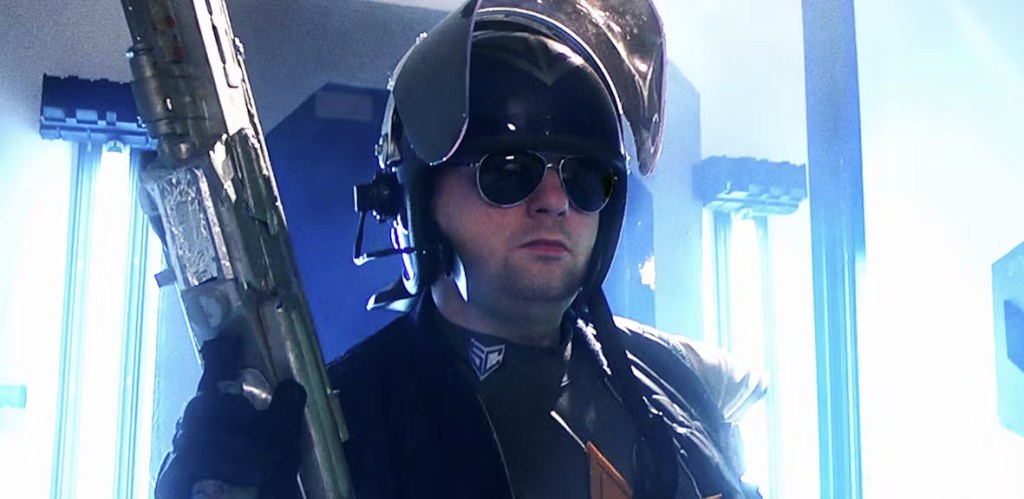
Space Cop is a terrible movie so… success?

Do you know how family videos are only funny to people in the family? That’s probably what Red Letter Media’s Space Cop is like. If you’re a fan of these guys, you’ll probably enjoy their movie. When the promotional material suggests it would someday be a contender for RLM’s own Best of the Worst series, they weren’t kidding. It’s a bad movie, but that’s their expertise, isn’t it? Expecting them to make anything else is like asking Mike Tyson to figure skate.

I’m no stranger to crowdfunded films so I knew what I was getting into… in other words, I wasn’t expecting much. Space Cop is A) better than I thought it would be and B) a lot more entertaining than the Angry Video Game Nerd movie, even if that one had a lot more production value (and still looked like shit). Space Cop starts off promising enough and feels like an authentic movie for the first few minutes despite soap opera lighting. Then it quickly descends into the non sequitur jokes and politically incorrect humor which work, if I’m being kind, roughly half of the time.

As for the plot, a gung-ho policeman from the future (Rich Evans) is accidentally transported to 2007 after he chases aliens into some kind of time-space vortex. During a modern day shootout in a cryogenics lab, the future cop accidentally thaws a cop from the past (Mike Stoklasa). They’ll have to team up to save the world from a devious plot involving aliens and a brain in a jar… or something. I don’t know and it doesn’t really matter.

The two main characters are only about as good as a memorable Saturday Night Live sketch, stretched to feature length. The actors’ decision to speak in “funny” voices from beginning to end is, at best, easy to look past, while at worst I can see it grating on the uninitiated. When Patton Oswalt makes a cameo, it’s pretty clear the boys were reluctant to trim their only star’s footage because it goes on and on. The length then becomes part of the joke.

My biggest issue with the movie is a complaint RLM have voiced themselves: the best bad movies are the ones that aren’t intentionally bad. Movies that set out to be bad just can’t capture the charm of bad movies trying to be good. Space Cop isn’t a good bad movie, but it’s a decent bad movie, at least when the jokes hit their target. If you’re a veteran of bad movies, and you like RLM—really like them—then you probably want to support them in this venture.

The Great Silence (1968) [Western Wednesday]

My favorite stories tend to put the heroes and the bad guys in the same room long before the final showdown. Early on in The Great Silence, Sergio Corbucci places his three most combustible characters in the same stagecoach, which will take them to the little town where the final shootout will go down. And boy, I do mean brutal: the resolution is so alien to what casual audiences are used to, Corbucci was forced to shoot an alternate ending. Any copy you can track down today will have the original ending in all its hard-hitting glory.

The hero of the film is Silence (Jean-Louis Trintignant) who had his vocal cords cut when he witnessed his parents’ murder as a kid. Legend says they call him Silence because the silence of death is the only thing that remains in his wake. His holster is a wooden box, which can also be attached to the end of his pistol like a makeshift rifle stock. Instead of killing bad guys, he shoots their thumbs off so they can never hold a pistol again. Corbucci supposedly got the idea for a silent gunslinger from Marcello Mastroianni, who always wanted to make a western, but couldn’t speak English worth a damn.

Then there’s the sheriff who’s played by Frank Wolff, an American-born actor who made his career out of foreign films and westerns. He’s an honest, scared, and competent lawman who’s investigating the town over allegations that its bounties aren’t ethical, even though they’re technically lawful. The character immediately distrusts the latest addition to his stagecoach: a bounty hunter named Loco who cheerfully ties his victims’ corpses to the roof. It’s obvious Loco is a man who didn’t give a damn about the law until it became corrupted enough to protect him.

Here’s the thing about Loco: when you create a hero as bad ass as Silence, you’ve gotta work hard to come up with a worthy villain. So Corbucci cast none other than the legendarily mad Klaus Kinski. When Loco kills the husband of Pauline (the beautiful Vonetta McGee of Blackula fame), she sells her house to the banker who’s responsible for creating the corrupt bounties. She plans to use the money to hire Silence so that he can set things right. Silence, who’s fallen in love with Pauline, tries and fails to goad Loco into a shootout. The problem is, Loco is as clever as he is sneaky. He refuses to partake in a shootout until the conditions favor him.

It’s a slow burn to the explosive ending, which makes it clear the filmmakers are unwilling to dilute their message for commercial viability. This is probably the reason the film never saw a proper release in the United States until a few years after DVD players came along. What I just watched was one of those earlier DVDs and it only makes me wish more for a proper Blu-Ray release.

Ultimately, I’ve enjoyed other Corbucci films a little more for keeping true to the entertainment-over-art style of spaghetti westerns, but few have been as masterful—or risky—as this one. It’s a great movie because it’s harder to digest than simple westerns. Love it or hate it, you won’t be unaffected.

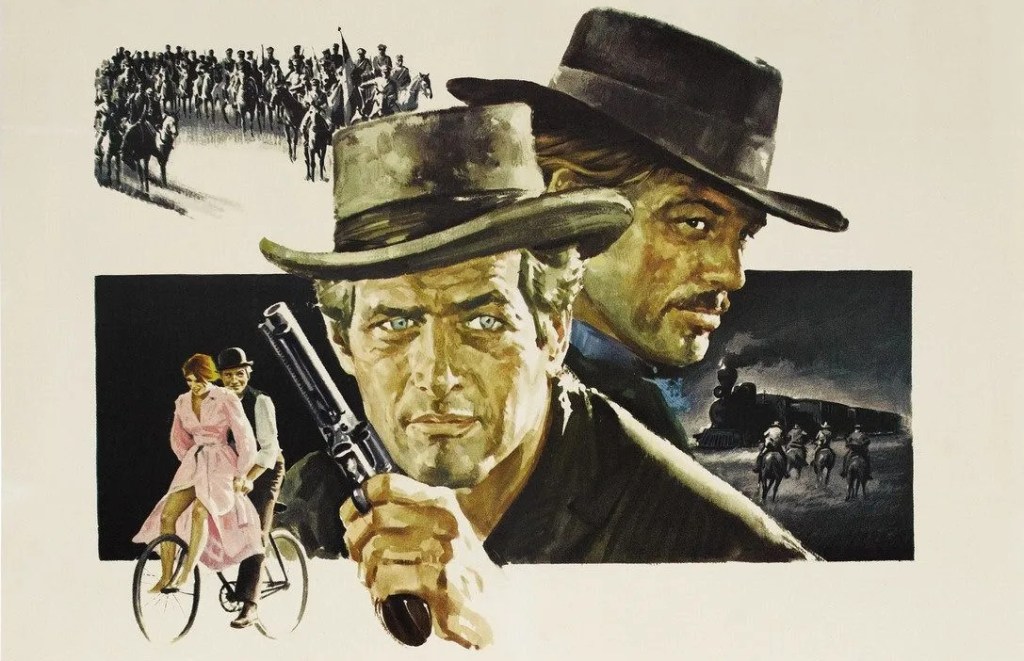
Western Wednesday: Butch Cassidy and the Sundance Kid (1969)

I used to know this movie like the back of my hand. Unfortunately—and here’s a good case for never watching a movie more than twice in a single decade—I saw it so many times I eventually grew bored of it. That was right around the time I discovered The Wild Bunch, which made this film seem a little too sleek in comparison. Fast forward to my thirties and I’ve forgotten just enough of it to enjoy it again, but not quite love it.

Like many westerns, Butch Cassidy and the Sundance Kid is set in a time when the gunslinger is becoming obsolete. In The Wild Bunch, the main characters knew it the moment they laid eyes on their first car. In this film, Butch (Paul Newman) and Sundance (Robert Redford) should have known it from the moment they acquired their first bike. After botching a train robbery, the duo realize the rules of the west have changed, but they didn’t get the memo.

Knowing there’s no way they’ll be able to survive if they continue their outlaw ways, Butch and Sundance find themselves at a crossroads. They reluctantly discuss their options around a table owned by Sundance’s patient love interest (Katharine Ross), who probably would have been Butch’s love interest if he’d been the one to meet her first. Butch, who’s always the know-it-all of the duo, suggests they should pack up and head for greener pastures in Bolivia. When they arrive, they find their destination is little more than abandoned farmland and dust.

There’s a reason William Goldman’s screenplay is analyzed to death in screenwriting classes. The story, which indulges in and pokes fun at the idea of myths and legends, has a lean simplicity to it. The banter is a not-very-distant ancestor to the kind of humorous dialogue that appears in Hollywood blockbusters as recent as The Force Awakens. The plot quickly establishes the main characters, the female lead, and the gang, whose leadership is hanging by a thread. It won’t be long until Butch and Sundance are on the run, chased down by an all-star team of man-hunters whose faces we never see.

The first half of the film deserves its classic status and then some. Unfortunately, the best scenes dry up in the second half. Everyone loves the long sequence of chase scenes in which they’re desperately trying to throw the unseen antagonists off their trail, crossing desert, rock, and water to do it. They occasionally pause to watch their pursuers from afar with an even mixture of dread and awe. “Who are those guys?” they ask repeatedly. Nothing else really compares until, of course, that iconic freeze frame at the end.

Despite its bottom-heaviness, Butch Cassidy and the Sundance Kid is a hugely entertaining popcorn flick. That’s pretty much all I feel like saying about it at this point in my life, which is part of the reason I like movies so much—sometimes they change as much as I do. Maybe I’ll love it again the next time I see it, but I don’t plan on watching it again for a very long time.

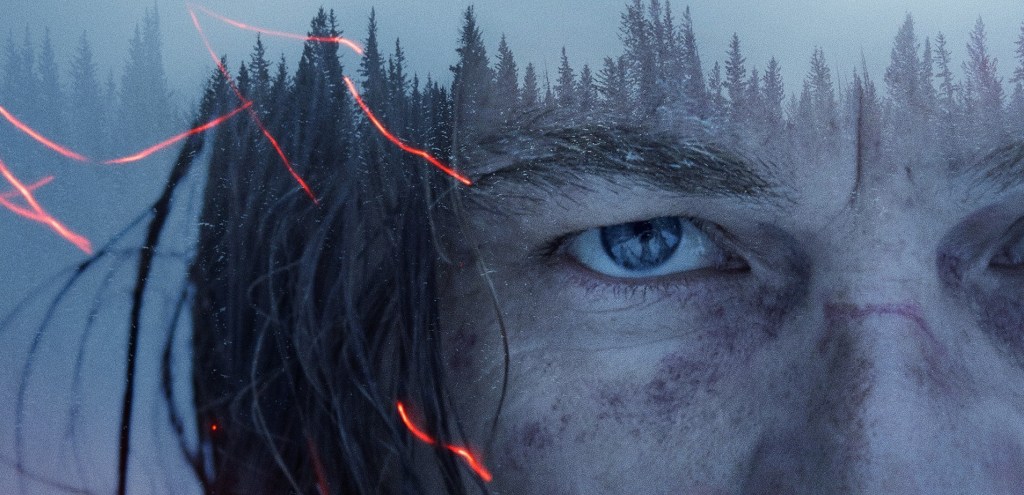
Western Wednesday: The Revenant (2015)

I’ve always wondered why we’re drawn to stories in which a relatable hero is put through absolute hell. I assume the first stories ever told were about rival tribes, untrustworthy people, and dangerous predators—the very things The Revenant is about.

What makes it more compelling than most movies is Leonardo DiCaprio’s willingness to get the shot. He actually plunges into ice cold water and crawls through real snow naked. There is so little cheating here and director Alejandro González Iñárritu, who won the Oscar for Best Director last year, wants us to know it’s all real, too; he doesn’t bother using a different take when his actor’s breath—or blood—gets on the camera lens. I’d say DiCaprio will probably win Best Actor if I didn’t think the Oscars has some illogical vendetta against him.

In the early 1800s, Hugh Glass (DiCaprio) and his “half-breed” son are trackers in a fur trapping outfit. Fellow trapper John Fitzgerald (Tom Hardy) is the kind of blowhard who has a problem with everyone, especially Glass. Fitzgerald is, without a doubt, the biggest movie asshole of the year. You don’t love to hate him like a lot movie villains, you just hate him, period, in the way you hated Nurse Ratched and Dolores Umbridge. After Glass is gruesomely mauled by a bear, what Fitzgerald thinks best is suffocating him so that he can no longer slow the others down.

The Revenant is a beautifully nasty movie, shot on lenses so wide the vast landscapes curl around the edges. There’s at least one ham-fisted visual metaphor, which you wouldn’t expect from a director of this caliber, but overall I enjoyed it, if only because Iñárritu forces himself to step out of his comfort zone yet again. But other than its lead performances, the only thing The Revenant really has going for it is its admittedly breathtaking technical accomplishments. I don’t think it will win Best Picture, if only because Iñárritu’s last film did, and it’s not my first (or even second) favorite western of the year.

Western Wednesday: City Slickers

“All America lies at the end of the wilderness road, and our past is not a dead past, but still lives in us. Our forefathers had civilization inside themselves, the wild outside. We live in the civilization they created, but within us the wilderness still lingers. What they dreamed, we live, and what they lived, we dream.” 

— T.K. Whipple (As quoted in the beginning of Larry McMurtry’s Lonesome Dove.)

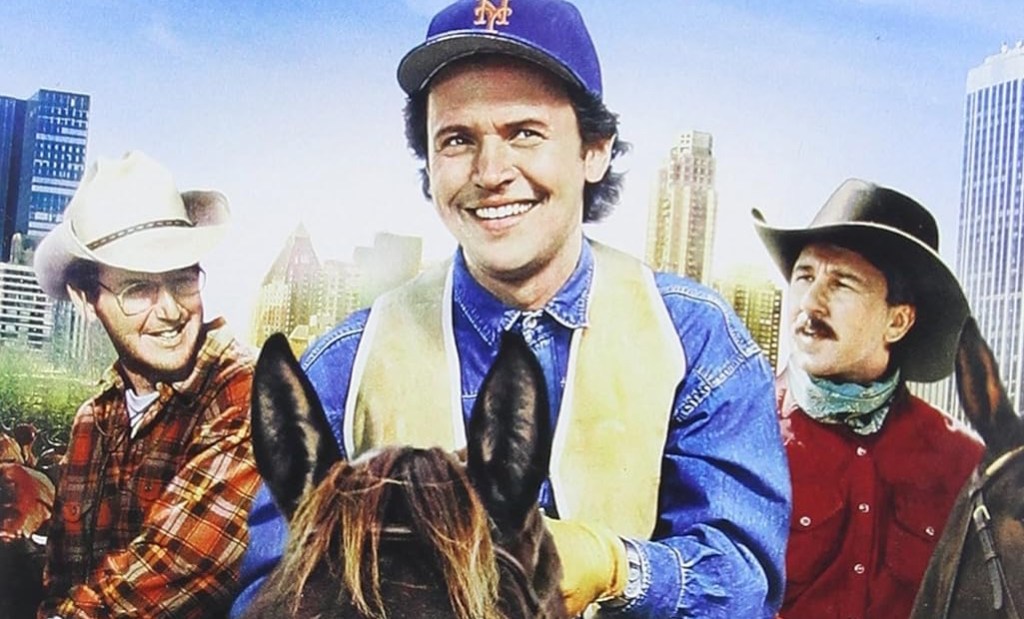
Billy Crystal’s character is thirty-nine, an age which seemed ancient when I first saw City Slickers at the drive-in theater twenty-five years ago. Like Logan’s Run, it’s a movie I can better appreciate now that I’ve gained perspective on this funny thing called age. I’m going through a phase in which I’m drawn to reading and watching westerns almost exclusively. Taking a couple of weeks off to drive cattle actually sounds more attractive than a trip to Disney World (though to be perfectly honest, this city slicker would prefer to do neither).

It’s suggested that every year, Crystal’s less neurotic friends (Daniel Stern and Bruno Kirby) concoct semi-idiotic vacations and drag him along. Their latest scheme indulges a western fantasy, in which well-to-do city folk can pay for the opportunity to become temporary cowpunchers. Crystal is reluctant to go until his patient wife points out that he’s forgotten how to smile. She thinks this goofy adventure might be good for him.

City Slickers isn’t terribly successful at being a comedy, but it’s a surprisingly deep character story. The three friends are much more than their archetypes would suggest. Stern, for instance, pretends he’s fallen asleep so he doesn’t have to speak to his overbearing wife; he possesses more wants and fears than the two-dimensional characters in most comedies. Kirby, who’s an even better actor than Crystal, proves to be more interesting than the playboy owner of a sporting goods shop we’re initially introduced to—particularly when he reveals why he’s so weird about women. A lot of comedies would have mined his strange job for cheap laughs. This one doesn’t.

Then you have Curly, who’s played by Jack Palance. Palance is one of my all-time favorite actors due to his uncanny ability to chew scenery in a believable way (I still think he would have made a better Joker than Jack Nicholson). In lesser comedies, he would have parodied his former screen persona for a cheap laugh. Thankfully, City Slickers isn’t content with being “just a comedy” because he warms up to these guys about halfway through. It’s refreshing what the filmmakers do with Palance, despite the fact they completely undo all that hard work in the inferior sequel.

So yeah, as a comedy it’s kind of slow—the goofy music can be as insistent as a bad laugh-track while a lot of the minor characters are unbelievably over-the-top, particularly Stern’s wife, whose face is often filmed with a bit of a fishbowl lens, which is a comedy technique that’s never been funny. Although I’ve seen much funnier comedies than City Slickers, few of them were as good. I feel prepared for thirty-nine.

Western Wednesday: The Hateful Eight (2015)

While I still think Pulp Fiction is probably my generation’s most influential film, Quentin Tarantino’s most entertaining film for me is Inglourious Basterds. That opening scene, between Hanz Landa and the poor dairy farmer, is one of the tensest, funniest, scariest, and most beautifully patient things ever burned to celluloid. With The Hateful Eight, Tarantino attempts to sustain that note for nearly two hours in the snow-covered scenery of Wyoming.

The film opens on Major Marquis Warren, a bounty hunter played by Samuel L. Jackson. He’s sitting on a saddle which is mounted to a pile of dead bounties. The cold weather has killed his horse and the pile of frozen corpses amount to a few thousand dollars—if he can get them back to town. A stagecoach comes his way and he finagles a ride with the man in the back: John “The Hangman” Ruth (Kurt Russell), who’s handcuffed himself to Daisy Domergue (Jennifer Jason Leigh), a vile woman wanted for murder. She doesn’t seem to mind much when Ruth beats the shit out of her, which is often. Hell, she may even like it.

Along the way they pick up another suspicious traveler, Chris Mannix (Walton Goggins), who claims he’s the new sheriff. Ruth—who starts out paranoid and becomes increasingly so by the minute—reluctantly agrees to take the man into the stagecoach. Unable to beat a blizzard, they hole up at Minnie’s Haberdashery, a cozy outpost with a stocked bar and a chess game by the fireplace. Ruth begins to suspect that at least one of the eight people in the haberdashery is planning to free his prisoner. When they ask Domergue herself, she says, “You’re right! Me and one of them fellas is in cahoots! We’re just waiting for everybody to go to sleep… that’s when we’re going to kill y’all!” The way she says it is both hilarious and chilling and manages to tell her captors nothing more about their predicament.

There’s a reason Tarantino uses Kurt Russell and music which was originally produced for John Carpenter’s The Thing. Surprisingly, that film has more influence on The Hateful Eight than the spaghetti westerns that so heavily inspired Django Unchained. Imagine The Thing, without the alien, and a western setting. That’s The Hateful Eight.

Russell plays the kind of confident dork he was in Death Proof, but it’s Jennifer Jason Leigh who steals the show with her over-the-top villainy, hilarious in the way she only gets meaner the more she’s used like a punching bag. I don’t think Samuel Jackson is quite as good as he was in Unchained, but that was a role of a lifetime; in this one he gets the most substantial monologue of the entire movie. The rest of the cast, including Demián Bichir, Tim Roth, and Michael Madsen, are perfectly suspicious. With any luck, Tarantino will do at least one more western before his career is over, but topping his first two will take more than skill.

The Hateful Eight is long, slow, and gratuitously violent. My kind of movie.