Doctor Mordrid (1992) [Midnight Movie]

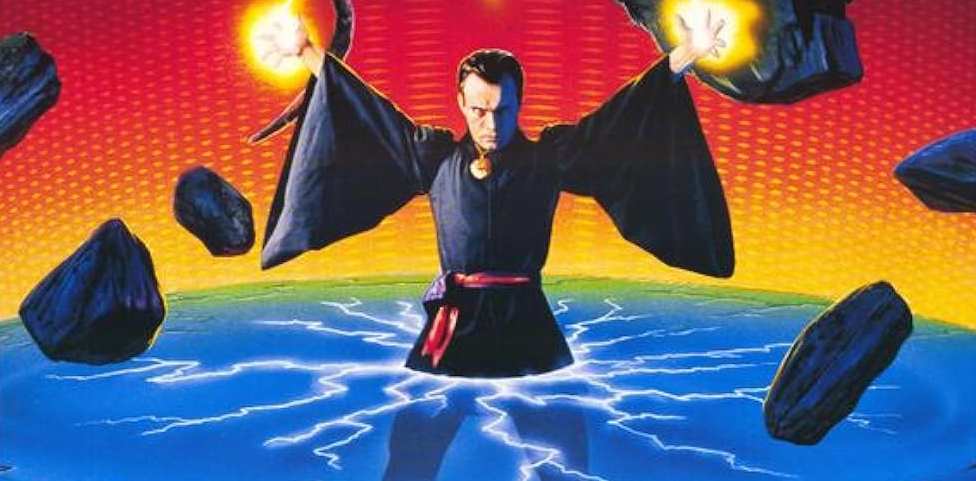
Doctor Mordrid entered production as an official Doctor Strange film until directors Albert and Charles Band let their option expire. That didn’t stop them from making the movie anyway (I wouldn’t expect any less from Full Moon Pictures). The character names have been changed. The filmmakers are legally obliged to inform you that absolutely no part of their movie takes place in the Sanctum Sanctorum. This is a film about an alchemist—not a wizard, not a magician, and certainly not a sorcerer. Any similarity to Marvel characters, living or dead, is purely coincidental.

The “alchemist’s” name is Anton Mordrid (Jeffrey “The Re-Animator” Combs) and he’s in charge of protecting the film’s MacGuffin: the Philosopher’s Stone. He and his brother Kabal (Brian “Cobra” Thompson) were taught all manner of wizardry—er, I mean alchemy—when they were children. Kabal is breakin’ bad now that he’s all grown up and he plans to unleash demons from hell… or something. I didn’t really follow that part, but if he succeeds, Earth is all kinds of fucked. He leaves a rash of murders in his wake, which begs the attention of Samantha Hunt (Yvette Nipar), the policewoman who just happens to live in Mordrid’s apartment building.

What develops between Mordrid and Samantha is one of the mildest romances in movie history. You won’t even know they’re attracted to each other until the last scene in the movie—and even then you won’t know for sure. What Mordrid suggests to her, out of the clear blue, is the equivalent of popping the question to a neighbor you occasionally see when you go for a walk. I love Combs to death, but his chemistry with actress Nipar is nonexistent. Considering they appear quite at ease with one another in this behind-the-scenes video, I’m not sure how the ball was dropped, but I suspect it had something to do with Full Moon’s speedy production schedule.

Look, Full Moon made tons of movies. They’ve managed to produce more memorable features than you would expect from a fledgling studio, so you can’t be surprised whenever they make a dud like this one. The directors, at that point in their careers, were such experienced filmmakers you can’t even laugh at the movie in a so-bad-it’s-good way. Technically, it’s a well-made film, it just happens to stink. Even if you go into it seeking the “so bad it’s good” factor, you’re bound to be disappointed.

Midnight Movie: Starship Troopers (1997)

“If I tell the world that a right-wing, fascist way of doing things doesn’t work, no one will listen to me. So I’m going to make a perfect fascist world: everyone is beautiful, everything is shiny, everything has big guns and fancy ships, but it’s only good for killing fucking bugs!” — Paul Verhoeven

At first glance, the cast looked like it belonged in a television drama for teenagers. The jingoistic satire didn’t translate well to newspaper ads and 30-second TV spots. The goofy marketing made it look like a straight-to-video movie had somehow wormed its way into a theatrical release. And yet, I still went to see Starship Troopers on opening night, shuffling into the theater with the lowest of expectations. There were maybe six other people there including, I think, a local film critic who occasionally shone a penlight on his notes and impatiently touched the illumination dial on his wristwatch.

In Paul Verhoeven’s Robocop, the narrative is frequently interrupted by satirical advertisements and news segments, as if the film has commercial breaks baked right into it. Likewise, Starship Troopers opens with over-the-top war propaganda, simultaneously establishing its irreverent attitude and the premise: in the future, humans really hate bugs: the arachnid alien combatants who’ve thrown a wrench in humanity’s plan to colonize every nook and cranny of the galaxy. In fact, humans hate bugs so much that young men and women everywhere can’t wait to give up everything and fight the bastards.

Enter Johnny Rico (Casper Van Dien) and his dimwitted high school friends. Amusingly, the first act plays like a futuristic teenybopper drama before jerking the rug out from under the heroes’ feet. Rico has a hot girlfriend (Denise Richards), a hunky rival (Patrick Muldoon), a dangerously flirty gal pal named Dizzy (Dina Meyer), and an ultra-nerdy best friend played by Neil Patrick Harris, whose appearance in an R-rated romp was mildly scandalous at the time (Verhoeven had employed similar stunt casting with Elizabeth Berkley in his trash-masterpiece Showgirls, two years prior).

Rico’s girlfriend is sent to the space navy, his brainy best friend gets absorbed by the military’s science sector, and Rico ends up in the most elite squad of ground troops in existence. His drill sergeant is played by Clancy Brown, who always takes genre projects seriously and the same can be said of Michael Ironside (Total Recall’s Richter), who plays the lieutenant of Rico’s group. There Rico makes new friends for the first time in his adult life, including Jake Busey, whose maniacal appearance instantly washes away the Dawson’s Creek vibe from the earlier portion of the picture.

Just when Rico’s finally begins to gel with his new life, who of all people will suddenly transfer to his squad? Dizzy, the hot little baddie who’s been pursuing Rico since high school. Here’s something I really love about Starship Troopers: in practically every movie in which the leading character is pursued by two love interests, he or she inevitably ends up with the sickeningly wholesome, less attractive option. Not my boy Rico. Soon after his boring girlfriend dumps him via a video call, Rico hooks up with the considerably more exciting Dizzy.

The score by Basil Poledouris is as rousing as anything he’s ever done while the early CGI is somehow much more convincing than most digital effects today. As for the action, it’s exciting, well-paced, and comically bloody as per Verhoeven’s style. If you held a gun to my head and asked me to choose my favorite film of Robocop, Total Recall, and Starship Troopers, I literally couldn’t do it.

I had friends in high school who were even bigger science fiction readers than I. Two of them were dead-set against the idea of a Hollywood adaptation of Robert Heinlein’s source material. There are still critics who assert Verhoeven “ruined the book” by choosing to parody its values (though a lot fewer of them exist today as the general consensus of the film only seems to improve with time). Yes, Isaac Asimov wrote in his memoirs that Heinlein grew more conservative and militaristic with age. Though this is certainly true, Heinlein has suggested he was merely exploring such a society as a possibility, not necessarily promoting it.

Then you have modern SF writers like John Stalzi, who are about as liberal and anti-war as they come, writing military fiction in nearly the same vein as Heinlein. Long before the Sad Puppies (an extreme right-wing group of close-minded assholes who attempted to manipulate the Hugo Awards) I used to enjoy reading science fiction from a wide swath of political and philosophical backgrounds. To like Heinlein’s version and Verhoeven’s isn’t contradictory, but exemplary of what I loved about the brainy genre in the first place. In fact, Joe Halderman’s The Forever War, itself a direct counter-argument to Heinlein’s novel, is among my favorite SF novels of all time.

Though I wish the movie version had gotten the jet packs that Heinlein imagined in the novel, I’m going with Verhoeven’s version all the way.

The Disaster Artist [Book Review]

Here are a few facts about vanity filmmaker Tommy Wiseau:

  1. He shot The Room on film and video using side-by-side cameras. Why? No one knows.
  2. He built the infamous rooftop set in a parking lot despite having access to at least two real-life rooftops.
  3. He built an alley set in a building which had a perfectly usable alley outside.
  4. He’s mysteriously rich.
  5. Whenever questioned about his bizarre creative decisions, he often replies, “No Mickey Mouse bullshit.”
  6. He maintained a billboard of his face on Highland Avenue for five years at five grand a month.

When it was clear Hollywood wasn’t going to give him the role of a lifetime, Tommy Wiseau decided to take matters into his own hands. He wrote, directed, and produced The Room, which is today considered one of the greatest bad movies of all time. This thing has such a cult following that James Franco purchased the movie rights to The Disaster Artist, which will feature Franco himself as Wiseau, Dave Franco, Seth Rogen, Hannibal Buress, Kate Upton, Zac Efron, Alison Brie, Sharon Stone, and Bryan Cranston.

The Disaster Artist is a 2013 book by working actor Greg Sestero, The Room’s co-star. In the book, Sestero details the unlikely friendship he forged with Wiseau who was at least twenty years his senior (Wiseau’s exact age is unknown). It quickly becomes apparent the reclusive filmmaker is a deeply guarded person despite his dreams of megastar fame. Whenever he does open up about his past, the contradictory stories are unlikely at best. To this day people are still trying to piece together the clues about his origins. He’s like the Jack the Ripper of independent cinema, a guy who stormed out of obscurity and plunked down a ridiculous amount of cash to make himself a star.

Not only did The Room cost six million dollars to make, but Wiseau maintains homes in both San Francisco and Los Angeles, the latter of which he hadn’t visited in so long he couldn’t remember the code to the alarm system (1234, as it turns out). The story is mostly about Sestero—because there’s so much we’ll never know about Wiseau—and his own quest as a Hollywood hopeful. It’s at an acting class where he first meets Wiseau, who is last picked when the students are instructed to pair up. Sestero, at the time, thinks Wiseau’s madness is charming. Despite the protests of friends and family, who suspect Wiseau is either mafioso or possibly the Zodiac Killer, Sestero agrees to move out to LA with his new buddy.

When Wiseau meets Sestero’s concerned mother for the first time, as the men are headed out to LA, she warns Wiseau not to hurt her son. Sestero writes:

I put my hands over my eyes. The worst thing Tommy could do in response to this request, I thought, would be to chuckle creepily. 

“I would not,” Tommy said, chuckling creepily.

The Disaster Artist is so funny at times my laughter woke my partner up even though she was in a separate room. Most readers will probably come to this book seeking the same answers I did, hoping for a shred of insight into Wiseau’s bizarre mind. Yet by the end of the book you won’t know much more about why Tommy Wiseau made the movie he did. If the book had shed light on these matters, The Room, and Wiseau himself, may have lost their allure.

I’m thrilled the story behind the scenes is as curious as the movie itself. There are a lot more questions than answers, which makes it all the more fun. The best answer you’re going to get? “No Mickey Mouse bullshit.” Ha ha ha, what a story, Greg.