Western Wednesday: The Hateful Eight (2015)

While I still think Pulp Fiction is probably my generation’s most influential film, Quentin Tarantino’s most entertaining film for me is Inglourious Basterds. That opening scene, between Hanz Landa and the poor dairy farmer, is one of the tensest, funniest, scariest, and most beautifully patient things ever burned to celluloid. With The Hateful Eight, Tarantino attempts to sustain that note for nearly two hours in the snow-covered scenery of Wyoming.

The film opens on Major Marquis Warren, a bounty hunter played by Samuel L. Jackson. He’s sitting on a saddle which is mounted to a pile of dead bounties. The cold weather has killed his horse and the pile of frozen corpses amount to a few thousand dollars—if he can get them back to town. A stagecoach comes his way and he finagles a ride with the man in the back: John “The Hangman” Ruth (Kurt Russell), who’s handcuffed himself to Daisy Domergue (Jennifer Jason Leigh), a vile woman wanted for murder. She doesn’t seem to mind much when Ruth beats the shit out of her, which is often. Hell, she may even like it.

Along the way they pick up another suspicious traveler, Chris Mannix (Walton Goggins), who claims he’s the new sheriff. Ruth—who starts out paranoid and becomes increasingly so by the minute—reluctantly agrees to take the man into the stagecoach. Unable to beat a blizzard, they hole up at Minnie’s Haberdashery, a cozy outpost with a stocked bar and a chess game by the fireplace. Ruth begins to suspect that at least one of the eight people in the haberdashery is planning to free his prisoner. When they ask Domergue herself, she says, “You’re right! Me and one of them fellas is in cahoots! We’re just waiting for everybody to go to sleep… that’s when we’re going to kill y’all!” The way she says it is both hilarious and chilling and manages to tell her captors nothing more about their predicament.

There’s a reason Tarantino uses Kurt Russell and music which was originally produced for John Carpenter’s The Thing. Surprisingly, that film has more influence on The Hateful Eight than the spaghetti westerns that so heavily inspired Django Unchained. Imagine The Thing, without the alien, and a western setting. That’s The Hateful Eight.

Russell plays the kind of confident dork he was in Death Proof, but it’s Jennifer Jason Leigh who steals the show with her over-the-top villainy, hilarious in the way she only gets meaner the more she’s used like a punching bag. I don’t think Samuel Jackson is quite as good as he was in Unchained, but that was a role of a lifetime; in this one he gets the most substantial monologue of the entire movie. The rest of the cast, including Demián Bichir, Tim Roth, and Michael Madsen, are perfectly suspicious. With any luck, Tarantino will do at least one more western before his career is over, but topping his first two will take more than skill.

The Hateful Eight is long, slow, and gratuitously violent. My kind of movie.
Western Wednesday: My Name is Nobody (1973)

In 1973, the year before Blazing Saddles released, the spaghetti western was dead. Sergio Leone had already made what many consider to be the greatest western of all time. His assistant director on the first two Dollar films, Tonino Valerii, went on to direct Day of Anger with Lee Van Cleef. So it was surprising that Leone arranged to have Valerii direct My Name Is Nobody, a send-up of the subgenre they had defined.

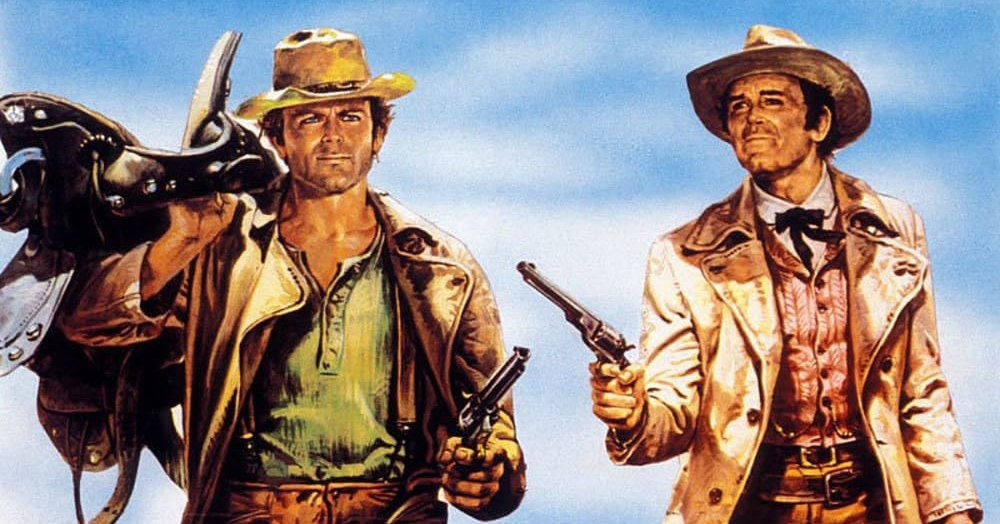
Jack Beauregard (Henry Fonda) is a bit of a legend in the gunslingin’ world, which means he frequently has to dispatch the men who’ve come to kill him for rep. In the aftermath of his latest shootout, a bystander asks, “Is there anyone faster?” The reply: “Nobody.” Enter Nobody, a childlike wanderer played by Terence Hill.

Three bad guys attempt to dupe Nobody into delivering a booby trapped picnic basket to Jack. Nobody agrees. When Jack asks what’s in the basket, Nobody says, “Oh, this? I reckon it’s a bomb.” To which Jack replies, “I reckon you’re right.” Nobody tosses the basket back to the bad guys and yells, “He didn’t want it!” as the basket explodes.

Meanwhile, a group of bandits known as the Wild Bunch (an intentional reference to Sam Peckinpah, whose name also appears on a grave marker) are laundering stolen gold by passing it off as the production of a dummy mining operation. Although Jack assumes Nobody is just another gunslinger who’s come to kill him for a shot at fame, Nobody reveals that he idolizes the gunslinger; he actually wants Jack to take on the gang single-handedly so that his name can go down in history books. Jack just wants to quietly retire to Europe.

Like Two Mules for Sister Sara, My Name is Nobody is not what I’d call a classic, but it’s more memorable than most movies. Then again, maybe it’s only memorable because we’ve seen some of these scenes a hundred times before, only this time Leone and Valerii have turned them into gags. Also in on the joke: Ennio Morricone, whose score plays like a parody of his own works. You get the feeling these guys weren’t mourning the death of the spaghetti western, but merrily digging its grave.

Midnight Movie: Invasion U.S.A. (1985)

Kick the Dog: When a character does something evil for no apparent gain, because the author wants to demonstrate that he’s not a nice guy and shift audience sympathy away from him.

—TVtropes

Richard Lynch, who plays the cartoonishly cruel villain in Invasion U.S.A., does an awful lot of dog-kicking. In the opening scene, he poses as a U.S. Coast Guard who rescues a dozen Cuban refugees, helplessly adrift at sea, before gunning them all down. (It’s later revealed he even gunned down the men who helped him gun down the refugees.) In another scene, he throws a badly injured woman out the upper-floor window of a building after shooting Billy Drago’s pecker off. For his next act, he blows up a suburban neighborhood with a rocket launcher while apparently using an infinite ammo cheat.

Lynch’s plan involves flooding the United States with hundreds of terrorists who will then pose as policemen and civilians in between random acts of unkindness, mainly bombings and mass shootings. No reasons, no motives. Just pure terrorism.

Chuck Norris is our reluctant hero, this time playing a retired CIA agent living in the Everglades. He’s asked to come back for one last mission, but refuses on the grounds he’s perfectly happy doing… whatever it is he’s doing. As far as I can tell, his life mostly involves driving around in an airboat, trapping gators, and watching an armadillo drink milk from a dog bowl. What’s great about director Joseph Zito is he’s smart enough to limit these necessary but boring scenes; it won’t be long until Lynch’s men show up to kill Chuck’s only friend and blow up his house.

Back then, we all knew exactly what we were getting from the latest Chuck Norris film. Few of them ever promised anything deeper. They did so well because they appeased moviegoers’ desire to see something stupidly entertaining, the operative word being “entertaining.” There’s something pure about Invasion U.S.A., which has amazing stunts and action sequences, even if the logic leading up to them is inexplicable.

Consider the shootout in a mall. Two bad guys come crashing out of a plate-glass window in a pickup truck. You’d think after hearing all the gunfire and explosions inside, most pedestrians would’ve scattered long ago. Yet a woman walking along the sidewalk stops to scream at the henchmen for nearly running her over. The passenger takes a handful of her hair and the men drive off with her hanging from the side of the truck. Meanwhile Chuck Norris pursues in a commandeered convertible. 

The logical thing for the bad guys to do? Simply toss the woman onto the street in front of Norris’s car, forcing him to screech to a halt. Instead, the bad guys drive a couple of miles with the woman screaming the entire way. You get the feeling that screenwriters Chuck and his brother, Aaron Norris, were sitting around a typewriter (or maybe Crayons and paper), saying things like, “Wouldn’t it be cool if…?”

And it is cool. Just because Chuck Norris has the emotional complexity of a turd, it doesn’t mean his absurdly violent fantasies aren’t valid forms of art. Invasion U.S.A. is probably my favorite Chuck Norris film. The director also made my favorite Friday The 13th film: The Final Chapter. Those two films won’t seem like anything special to the casual viewer, but to those of us who indulge in fine cheese, he’s a master.

Western Wednesday: Bone Tomahawk (2015)

For a film that shows up this quietly on VOD after a limited theater release, Bone Tomahawk is much better than it has any right to be. Twenty years ago, the same film would have been advertised extensively before dominating the box office for a week or two—maybe more depending on the competition. There’s a scene so shocking, people would have talked about it the way they talked about the big reveal in The Crying Game or the leg-cross in Basic Instinct. Nothing about its quality suggests it was made by a first-time director, either.

A couple of outlaws, played by Sig Haig and David Arquette, stumble onto the sacred burial ground of the “trogdolytes,” a small sect of inbred cannibals. The trogdolytes promptly kill Haig as Arquette flees to a nearby town. Samantha (Lili Simmons) is recruited to operate on the outlaw’s injured leg while her husband, Arthur (Patrick Wilson), stays at home recuperating from a leg injury of his own. The following morning, the sheriff (Kurt Russell) discovers the outlaw, Samantha, and even the deputy have been kidnapped in the middle of the night. The sheriff gathers a search party and sets out to find the cannibals’ cavern. It’s in the agoraphobic expanses of the wild west that this group stumbles into horror movie territory.

I can probably count the number of movies that legitimately unsettled me on one hand. Bone Tomahawk is one of them. A lot of horror films coddle the audience to the point that even a child can reliably predict who’ll be left standing by the end. No one’s safe in this film. When the hero starts out with a bum leg, you already know it’s not the kind of story in which differences can be solved by a routine shootout.

That shocking scene I mentioned earlier is something so sick and jarringly twisted, Bone Tomahawk will likely spread through word of mouth until it’s a household name. I just can’t imagine a movie this incendiary can come and go so quietly. See it today and recommend it to everyone you know so that it can obtain its cult status sooner rather than later.

Midnight Movie: Elves (1989)

“You’ve got fucking big tits and I’m going to tell everyone I saw them!” — 7 year old boy to his sister.

Three edgy teenage girls who call themselves “the sisters of anti-Christmas” convene in the woods to “bemoan Christmas as a petty, over-commercialized media event.” One of them asks, “What’s ‘bemoan?'” The ringleader replies: “It means I didn’t get any good presents last year.” I unironically love shit like this.

One of the girls cuts her hand when a candle holder inexplicably shatters. Spooked by the strange occurrence, the girls freak out and run, but not before dripping blood on what’s presumably the burial spot of a demonic elf… or something. Honestly, I’m not sure exactly what’s going on in the preliminary scenes, but it doesn’t matter. What matters is there is now a monstrous elf lose in the world. Calling the monster a puppet would be too kind. It’s more like a barely articulate torso, which the special effects crew merely shoves into frame from time to time.

Before we go further, I have to point out that the den mother’s little shit of a brother spies on her in the shower. When she catches him, he says, “I’m not a pervert, I like seeing naked girls!” Later the boy is attacked by the troll in the middle of the night. When the mother tries to convince him it was only a nightmare, he responds with poetic delivery: “No, it was a fucking little ninja troll!” The mother decides it was the family cat who scratched the kid, so she drowns the pet in the toilet.

Enter Dan Haggerty—yes, Grizzly Adams. He’s a recovering alcoholic, ex-homicide detective who just so happens to have a bit of knowledge of the occult. He falls into the role of a department store Santa after the previous one is repeatedly stabbed to death in the nards. To make matters worse, Grizzly Adams has just been evicted from his camper trailer. Soon after, he discovers a clue the homicide detectives missed and follows the trail.

Meanwhile, the teenage main character and her airhead friends decide to have an after-hours party in the department store, which is coincidentally where Grizzly Adams is sleeping nowadays. They invite their born-to-die-in-a-movie-like-this boyfriends who arrive shortly before three Nazi goons appear, who’re hunting the elf for reasons you won’t fully understand until later on (if it at all).

Not only is the plurality of “Elves” bullshit, it’s hardly about the singular elf, either. The film is so thoroughly messed up on a technical level, the laughs are frequent. My biggest complaint is the film’s insincerity: there are several hints that indicate the filmmakers were trying to make a bad movie, including a Chinatown parody, an obvious Mommy Dearest reference, and the pulpy integration of Nazi mythology (“The Fourth Reich,” as Grizzly Adams calls it). It’s not quite as obnoxious as modern attempts at self-aware cheese, which makes it entertaining enough to watch with an audience, especially when the wheelchair-bound grandfather professes… eh, best not to spoil it.

I love Elves. Haggerty may not have been the best actor, but he’s got a unique screen presence, which makes me wish he had ended up in more movies like this. Sure, it’s a gimmick, but gimmicks can be fun, too.

Several internet sources claim this film is rated PG-13. There’s no way the version I saw would get a PG-13 rating, so there may be a censored version floating around. There’s a good amount of blood, a close-up of a cokehead getting stabbed repeatedly in the crotch, full frontal nudity, and a kid who cusses roughly as much as a comic on Def Comedy Jam. If any of those elements are absent in your copy, you might as well just turn it off and find a better source wherever you can. Who knows, maybe the full movie is on YouTube?

Western Wednesday: La Resa dei Conti (The Big Gundown)

Grindhouse Releasing’s rich packaging for The Big Gundown is immediately inviting, which is strange because I rarely care about such things. I expected two or three discs, but four? With this edition, you’ll get the American version of the film on Blu-Ray and DVD, the Italian-language version of the director’s cut, La Resa dei Conti, with optional subtitles as opposed to dubbed voice work, and a CD containing Morricone’s score. I’ve listened to the soundtrack five times now. I’m listening to it as I write this.

The movie opens on a trio of outlaws trying to outrun the famous bounty hunter Jonathan Corbett (Lee Van Cleef in his first leading role at the age of forty-one). What they don’t know is he isn’t following them. He’s actually well ahead of ’em. When they fall into his trap, he tells them they either get the gun or the rope as he calmly chooses a single a bullet for each of the men. A few days later, Corbett is attending a wedding party where a Texas railroad tycoon (Walt Barnes) convinces him to run for senator. Corbett agrees it’s time to settle down, but only after going on one last bounty: to apprehend a child murderer.

Soon after the manhunt begins, Corbett thinks he found the guy. The suspect draws on him and Corbett guns him down with ease. Corbett confesses disappointment, saying, “I thought he’d be smarter.” Naturally, the movie can’t end there, so it turns out Corbett killed the wrong guy (conveniently enough, the wrong guy was wanted for murder anyway). We learn the guy he’s really after is smarter when he successfully gives Corbett the slip.

The name of the bounty is Cuchillo and he’s played by Cuban actor Tomás Milián. The filmmakers want you to believe Cuchillo is a master escape artist, but here’s one of my few complaints: Corbett becomes uncharacteristically incompetent whenever he catches up to Cuchillo. The tricks Cuchillo plays on Corbett just wouldn’t work on the kind of godlike bounty hunter who can arrange a trap ahead of the outlaws who think he’s behind them. There’s a line later in the movie that kind of explains why Corbett gets downright stupid at times, but it’s a bit of a cheat.

Leonard Maltin called The Big Gundown the best spaghetti western without Leone’s name on it. I wouldn’t agree, but it’s up there—like, way up there—among the absolute best. There are plenty of great scenes, beautiful camera work, and a ton of production value. I am unconditionally in love with this film and Grindhouse Releasing’s presentation. It’s worth every penny.