
31 Days of Gore: Scalps (1983)

It’s October. Time to talk horror. This year I’m reviewing a different horror movie each day of the month.

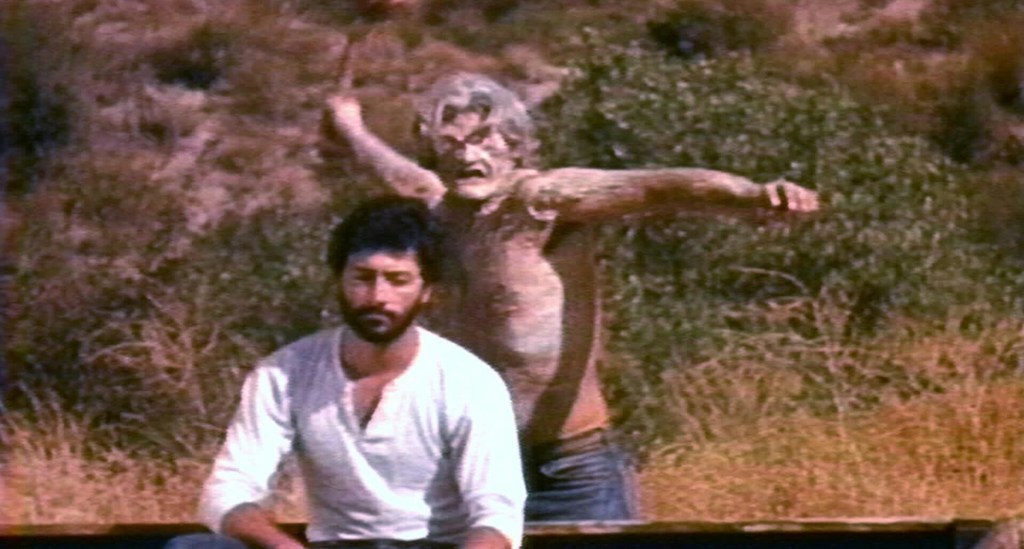
My DVD copy of Scalps opens with an apology. The filmmakers regret to inform us that this is a partially lost film. According to the director’s commentary, they’ll never be able to make the definitive cut because the footage simply doesn’t exist. To recreate the original theatrical release, which was butchered by the distributor, they had to pull from a variety of sources. Most of the movie is pieced together from excessively blown-up and washed-out film. At other times, they had to pull snippets from VHS tapes, including all the death scenes, because their main sources (a German print and a Canadian print) had heavily censored that stuff.

I’ve heard about the legendary badness of Scalps and expected to enjoy it in a Mystery Science Theater 3000 kind of way, but even those guys wouldn’t touch it because there just isn’t enough dialogue to rip on. There’s only so many times you can make fun of the awkward pauses and clumsy transitions between scenes. Long sections of it are like watching a stranger’s vacation footage on Super 8 film. At one point, during an extended scene of a car driving down a desert road, my girlfriend got up to let the dog out. When she got back, they were still showing the same scenery. At which point she decided to go to bed.

There’s one Native American in the entire movie and, according to the director, he was a Scientologist. This actor, who could be a stand-in for Keith Richards, gets perhaps two minutes of screen time, which is hilariously misguided when your movie’s moral is “white people should respect Indian culture.” Taking an obvious inspiration from Evil Dead, the spirit of a “renegade Indian” possesses one of six whiny white people who are on an archaeological vacation in the desert. The evil spirit then proceeds to pick off the rest of the camp one by one. One of the actresses, while running, takes care to adjust her shirt for the camera even though her back is full of arrows.

The filmmakers claim the movie they shot is not the movie you see. While the movie was intended to be a slow burn until the climactic carnage, the distributor edited the movie to maximize the shocks per reel, which was done at the sacrifice of continuity. There’s a human-lion hybrid who watches the campers from afar, but has nothing to do with the rest of the movie. One character manages to watch himself arrive to the area. At various points, you see characters’ dead bodies before they get killed.

I should probably point out that the gore effects are surprisingly… well, I was going to say “good,” but let’s say “not bad.” The scalping looked realistic enough. A decapitation was satisfyingly bloody, even though the head came off before the blade struck the neck. I’ve seen much worse so I’ll take what I can get.

I have no idea how Scalps would have played to a large audience, but I’m sure there was no shortage of snickering. The best part about the DVD is the candid nature of the commentary. Right off the bat, the director admits he hasn’t seen this movie in a long time because it’s just not something you show off proudly. Aspiring filmmakers will probably love listening to him talk about his troubles. It actually does sound like there was a better movie than what we got and he’s not just shifting the blame.

Sometimes you’ve just got to make something to get somewhere in the film business. Sometimes it turns out to be Scalps.

Come back at midnight Central Time for the next movie.

31 Days of Gore: Brain Damage (1988)

It’s October. Time to talk horror. This year I’m reviewing a different horror movie each day of the month.

An elderly couple keep a mysterious pet in their bathtub. The woman proudly shows her husband the brains she’s just picked up from the butcher, exclaiming, “He’s going to love these!” But when she tries to feed the pet, she discovers it’s flown the coop. As the couple go from door to door, barging into people’s homes and inspecting bathtubs, the film introduces us to Brian (Rick Hearst), the “hero” of the story. He’s fevered and passed out in the apartment he rents with his brother and we never learn why he’s so sick. (I’ve read there were supposed to be earlier scenes featuring the character, but were never shot due to budget constraints.)

The missing pet finds its way into Brian’s bed and, concealed by the covers, slithers up his body to attach itself to his neck. This marks the first of many psychedelic sequences depicting the high Brian gets whenever the parasitic creature latches into him. Naturally, Brian thinks the far-out images are pretty cool. As he comes down from his trip, the thing detaches to introduce itself. Through a charming mixture of puppetry, stop-motion, and (briefly) rotoscope-animation, we see the leech-like monster in all of its miniature glory.

The thing’s name is Alymer (sounds kind of like “Elmer”) and it has a smooth tenor voice, provided by John Zacherle (uncredited), the horror host of an old show along the lines of Svengoolie and Elvira. Alymer asks Brian if he’d like to go for a walk. When Brian asks where to, Alymer says, “Anywhere.”

They end up in a scrapyard where Brian gets so high on Alymer’s secretions that he screams about how beautiful all the junk is. This gets the attention of the night guard who comes to inspect the commotion, and Alymer eats the man’s brains while Brian looks on in sick, drug-addled satisfaction. It’s not long before Brian’s addiction starts turning bad, however, and while a lot of directors would have fumbled the ball at this point, director Frank Henenlotter always keeps it entertaining. Unlike lesser horror directors, who heavily pad the filling in between kills, Henenlotter never dwells, never dawdles. All his movies, which include Basket Case and Frankenhooker, are fresh from start to finish.

Find the uncut version or nothing at all. There’s a scene so sleazy the crew allegedly refused to help the director to shoot it. You’ll know what scene I’m talking about when you see it, but let’s just say it involves the act of fellatio. I think the biggest mistake, considering the movie is about the horrors of drug addiction, is that Brian is on the receiving end of that blowjob.

P.S., there’s a cameo that’ll tickle horror fans to death.

Come back at midnight Central Time for the next movie.
31 Days of Gore: Nightmare City (1980)

It’s October. Time to talk horror. This year I’m reviewing a different horror movie each day of the month. 

While watching an interview with director Umberto Lenzi, it occurred to me he’s legitimately fucking insane. Here’s what Lenzi had to say about Nightmare City:

  • The script was horrible.
  • Hugo Stiglitz was a stiff actor.
  • Franco Nero or John Saxon should have been cast in the lead instead.
  • The producer wanted zombies in the tradition of Romero and Fulci.
  • The film is based on reality.

Yeah, you read that last bullet point right. Everything that happens in Nightmare City, Lenzi suggests, is reality. He talks about media cover-ups and exploding chemical plants before going on to compare the importance of his own movie to Tom Hanks’ Philadelphia. Either Lenzi’s English translator is having a little fun on our behalf or Lenzi has genuinely lost his mind.

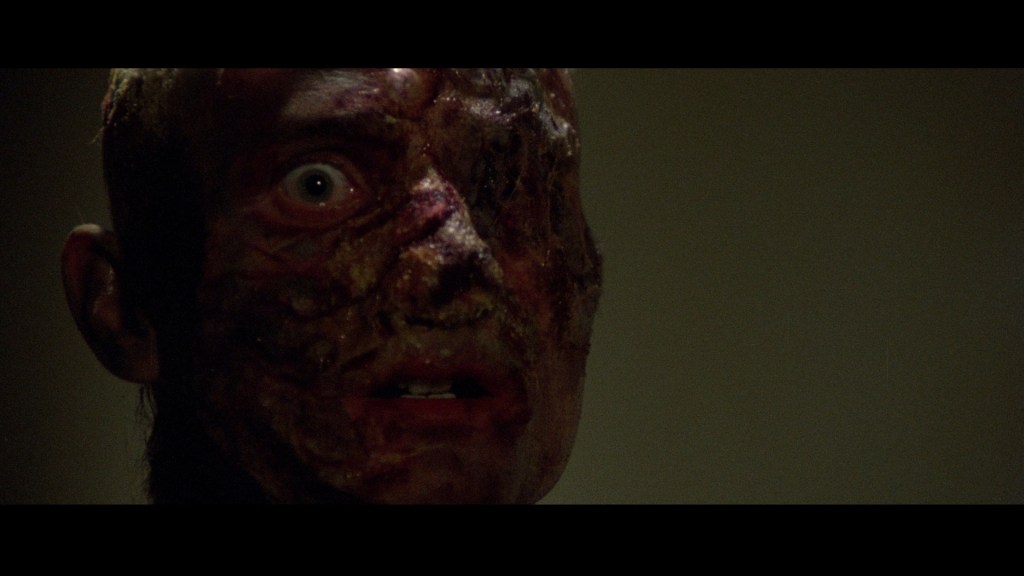
It takes a crazy person to make a movie like Nightmare City, aka City of the Walking Dead. The “infected people” don’t just stumble around, waiting for dinner to enter their line of sight, but actively hunt their prey with Thompson machine guns and hatchets. Whereas most horror films spend an eternity getting to the good stuff, Lenzi opens his picture with a surprisingly tense scene involving an unauthorized plane landing. The plane violently births a hundred bloodthirsty psychopaths.

What’s great about it is there’s no bullshit—at least if you’re a fan of mindless exploitation—and there’s remarkably little filler. It’s just ninety ridiculous minutes of crazy shit and Hugo Stiglitz kicking ass in a tweed suit. And I stress “kicking,” as kicking seems to be his move of choice. Why, exactly, is this television reporter such a bad ass? Beats me. But after watching Fear the Walking Dead and its characters’ reluctance to do anything of interest, Hugo’s sense of agency is a welcome change of pace.

Watch it with a group of friends who love this kind of shit. The more booze, the better. It’s a hell of a lot of fun with the right mindset. I would have said it was the basis for 28 Days Later if I believed Danny Boyle had ever seen this movie, which I don’t.

Come back at midnight Central Time for the next movie.
31 Days of Gore: Mahakaal (1993)

not ready for prime time, bitch!

It’s October. Time to talk horror. This year I’m reviewing a different horror movie each day of the month.

Do you know what Freddy films are missing? Singing and dancing, that’s what. Leave it to Bollywood to address this oversight. I haven’t watched a lot of Hindi reduxes because they can be much longer than their Hollywood counterparts. Awara Paagal Deewana, which remakes both The Whole Nine Yards and action sequences from The Matrix, is nearly three hours long. Mahakaal, despite condensing the kills from several Nightmare on Elm Street films into one movie, is mercifully only a little over two hours long.

The film is made by the Ramsay brothers, who I’m led to believe are a big deal in Bollywood. According to Wikipedia:

The Ramsey Brothers have made more than 30 horror films in India, which epitomize the lower depths of 1980s Bollywood sleaze and gore, but which have secured their place in Hindi cinema’s hall of fame as the pioneers of horror.

So it’s safe to say you can expect some dance numbers here. What you might not expect is a Michael Jackson impersonator who incorporates mime routines into his act. He’s not very good at it, either. Whether or not that’s the joke, I honestly don’t know. I’ll be the first to admit that Indian humor is a bit lost on me.

The first act of Mahakaal is almost a carbon copy of the original Freddy film. Instead of high school teens, the leading characters are college students who are played by full grown adults. The biggest deviation, other than the dancing, is the inclusion of a street gang which attempts to rape the main character. The crime is averted by a hilariously choreographed martial arts scene, which leaves the young woman understandably shaken. Don’t worry, though: the booger-picking Michael Jackson impersonator is quick to cheer her up with his silly antics, just as any woman would want following such an intense trauma.

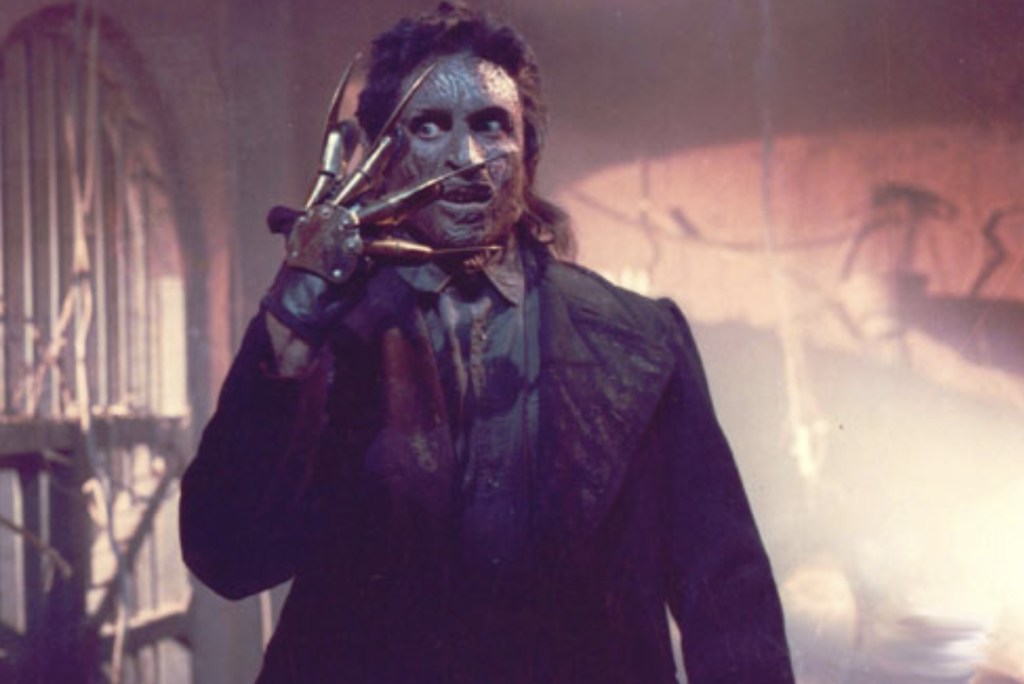
Seconds later you can expect to see a gratuitous dance number set during a picnic on the beach. Somehow their pickup truck ends up in the water and then they wonder why it won’t start. Stranded in the middle of nowhere, they decide to check into a nearby hotel. That’s where their nightmare really begins. It turns out Shakaal, an evil magician with a familiar bladed glove, is killing these young adults to… well, I don’t know why, but it sure is entertaining.

Even when Mahakaal doesn’t jell with my American sensibilities, the movie is downright charming. Which isn’t to say it won’t be funny to Americans. Mahakaal can be a lot of fun with the right group, and not all of the laughter will come from the low production values and bizarre dance sequences. Even though this version of Freddy Kruger looks as if his makeup consists of oatmeal and shoe polish, there’s still something creepy about the way his scenes are shot.

So don’t call it a ripoff. Call it a tribute to Freddy’s greatest hits. Even the trademark nursery jingle is here, replicated just a few notes short of a lawsuit.

Come back at midnight Central Time for the next movie.
31 Days of Gore: Intruder (1989)

It’s October. Time to talk horror. This year I’m reviewing a different horror movie each day of the month.

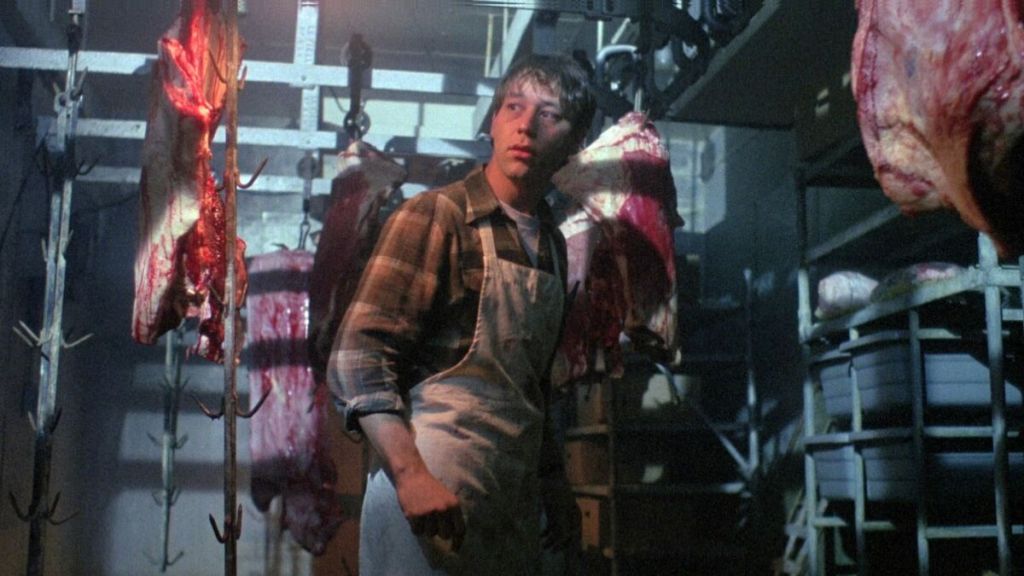
What do you think of when you hear the word “intruder?” Do you think about a homicidal bum breaking into your house? A grotesque alien borrowing human heads so he can pass as one of us? A clueless house guest who just won’t leave? Intruder is none of those things. It’s about a maniac killing the night crew at a grocery store. Okay, sure. I guess the title kind of works until you find out the deranged killer isn’t someone who wanders into the store after hours, but a guy who’s always been there.

That’s not a spoiler because you won’t be surprised anyway. When a horror film takes this much care to foreshadow its trash compactor, its meat hooks, its ticket spike, and literally everything else that can kill someone in a grocery store, there simply isn’t time for surprises. The only thing that surprises me is I’ve heard splatter fans talk about Intruder as if it’s some kind of forgotten masterpiece. Maybe that’s why I’m disappointed.

The poster art for Intruder prominently features the names of Bruce Campbell and Sam Raimi as if they’re the stars of the picture. They’re certainly the biggest stars in it, but they play very minor roles. Campbell shows up about three minutes before the credits roll while Raimi spends most of his time hanging lifelessly from a meat hook. Dan Hicks, who played the hillbilly in Evil Dead 2, offers the best performance in Intruder, but even he can’t save it.

Whenever the camera ends up in a shopping basket or hovers over the actors at extreme angles, it’s obvious director Scott Spiegel learned how to direct from his pal, Sam Raimi. While there are some good gags and a few good special effects by KNB EFX Group, Intruder is just mediocre at the end of the day. It’s a shame because I really thought I was going to like this one.

Come back at midnight Central Time for the next movie.
31 Days of Gore: Death Spa (1990)

It’s October. Time to talk horror. This year I’m reviewing a different horror movie each day of the month.

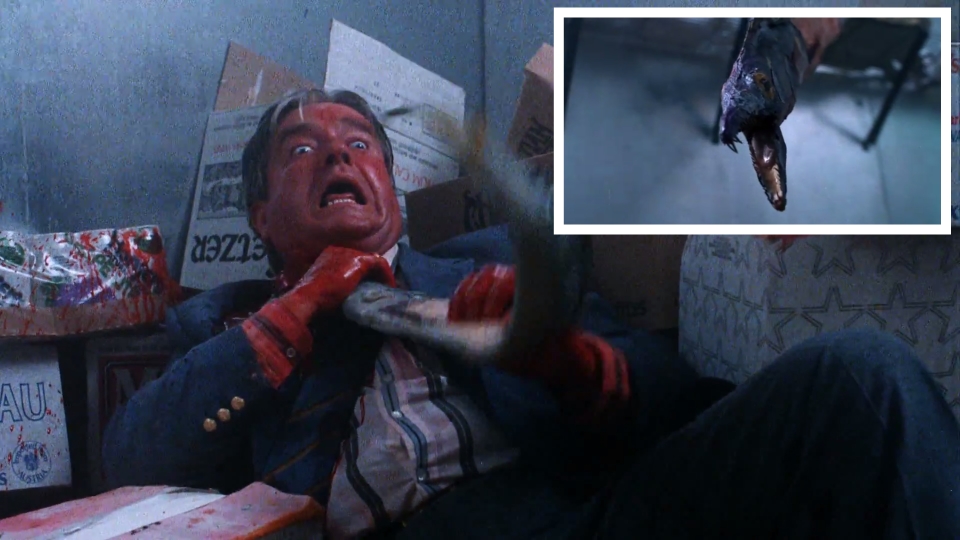
It’s the late 80s/early 90s and strange things are happening at Starbody Health Spa, an inexplicably futuristic club run entirely by computers and card readers. Within minutes of its opening, Death Spa boils Laura Danvers (the unusually gorgeous Brenda Bakke) alive in a steam room. At least I thought she was being boiled, but later its revealed someone dumped a toxic dose of chemicals into the steam. The incident leaves her blind at the brink of death.

Laura is the girlfriend of Micheal (William Bumiller), the club’s owner who’s still recovering from the trauma of his wife’s suicide. See, one day his wife rolled her wheelchair into the garden and self-immolated. I’m sure the film explained why at some point, but I never paid that much attention to it. The filmmakers initially want you to believe Micheal’s wife is haunting the gym, but then they try to convince you the high-tech computers and a cross-dressing hacker are to blame. When they can’t decide what kind of movie they want Death Spa to be—supernatural or technological—they decide it’ll be both. And it’s just weird enough that it works.

I watched this scene twice and I still have no clue what happened to that dude’s head

In yesterday’s review, I said City of the Living Dead wasn’t incoherent enough for MST3K-style mockery. Get your drinking buddies together because Death Spa is a riot. Unlike Evilspeak and Shrunken Heads, I’m not entirely convinced all the cast were in on the joke. Ken Foree is obviously aware this ain’t Shakespeare. Rosalind Cash, playing one of the two investigators, understands the assignment as well. There are others who clearly know what kind of film they’re making, but I can’t say the same about all of the cast… or the director, for that matter.

The gore is so incompetently filmed, you often can’t tell what’s going on. At one point the villain merely touches a victim’s face and you hear what sounds like someone biting into an apple. The next time you see the victim, his face looks like a ball of freshly squeezed Silly Putty. In another scene, a client straps his arms into a fly machine. When the machine inevitably attempts to kill him, you expect it to rip his arms right out of their sockets. Instead, a Capri Sun-sized amount of blood spills out of his left flank.

The editing, too, is nonsensical. When Michael’s girlfriend Laura finds herself trapped in the aforementioned steam room, she’s falls toward the floor in such a manner the back of her neck will hit first. At the exact moment of impact, however, they jump-cut to her lying on the floor, her legs where her head should be according to the previous shot. In other scenes, the editor cuts to reaction shots of the actors not reacting whatsoever, which adds to the campy incompetence.

As usual, it’s another film which rewards the viewers for sitting through the boring parts by tossing them the occasional bone or severed limb. If ever you needed a reason to set a movie in a health club, it’s this: there are very attractive people in this movie, including Chelsea Field, in skimpy workout gear. Why they chose a leading man who could have appeared in Quest for Fire without the need for makeup, I’ll never know.

At only 88 minutes long, it’s brief enough not to outstay its welcome and you don’t have to wait long for the payoff. Any horror film which stocks its cast with a paranormal investigator who carries a Luger is essential viewing as far as I’m concerned.

Come back at midnight Central Time for the next movie.

31 Days of Gore: City of the Living Dead (1980)

It’s October. Time to talk horror. This year I’m reviewing a different horror movie each day of the month.

I’m a huge fan of Fulci, probably more than Argento. While Lucio Fulci’s quality perhaps dipped towards the end of his career, it didn’t dip nearly as much as Dario Argento’s did (I dare you to sit through Dracula 3D). Nonetheless, Argento was the first to win favor with international film critics. Fulci, on the other hand, has been more or less relegated to the margins of “serious” analysis.

City of the Living Dead, a.k.a. The Gates of Hell, (not to be confused with Umberto Lenzi’s City of the Walking Dead, which will be featured later this month) opens on a priest who’s taking a stroll through an idyllic cemetery. Seconds after the opening credits, he tosses a noose over a branch and hangs himself. Cut to a woman screaming in a candlelit room: she saw the entire thing play out during a seance. The image is so disturbing she has a heart attack and dies. There’s more than one fear-induced heart attack in this movie, by the way.

A news reporter (Christopher George), is investigating the psychic’s mysterious death (slow news day, I suppose). He visits her grave and hears her screaming to get out. It turns out she’s not dead after all, but what’s even more disturbing is wondering how she survived the embalming process. Trying to make sense of Italian horror is the wrong way to watch Italian horror. The films, especially in Fulci’s case, are designed more like dreams than coherent narratives; the plot details aren’t important.

So the reporter does what absolutely no one else would do: he grabs a pickax and begins hacking at the coffin lid indiscriminately, the flimsy surface of which is mere inches from the woman’s face. These characters are completely incompetent, but again: that’s okay. It’s about the mood, the atmosphere, and the style. It’s about bending your suspension of disbelief so that Fulci can squeeze in as many common fears as possible (such as being buried alive) so that the audience gets the best bang for the buck. If that’s not a noble cause, I don’t know what is.

The reporter learns from the woman that the priest’s suicide has opened the gates of hell (just go with it) and if his body isn’t laid to rest, his zombie-creating superpowers (I said just go with it, damn it!) will destroy the world. Did I forget to mention City of the Living Dead is a zombie picture and a ghost story? In fact, it’s Fulci’s first horror film since Zombie (a.k.a Zombi 2). That film famously portrayed a zombie fighting a shark, a scene I still have no idea how they pulled off. While there’s nothing as cool as that here, I may prefer this one as it’s the second best film in Fulci’s Gates of Hell trilogy.

Fulci crafts a genuinely spooky atmosphere while the lingering shots of terrified faces are rarely done better by anyone else. The film is not coherent enough for the casual moviegoer, but it’s not nonsensical enough to laugh at in a MST3K way, either. It’s a haunting picture with expert cinematography and a gorgeous color palette. Definitely one of Fulci’s best and most entertaining.

At one point, Fulci attempts to top the eye-gouging scene in Zombie. In this film, a spinning drill bit is shoved through a man’s skull. It’s essentially the ol’ arrow-through-the-head gag, but the special effects team somehow makes the tip of the bit spin on the other side of the victim’s head. It’s a really neat take on an old effect. I love stuff like that.

Come back at midnight Central Time for the next movie.
31 Days of Gore: Evilspeak (1981)

It’s October. Time to talk horror. This year I’m reviewing a different horror movie each day of the month.

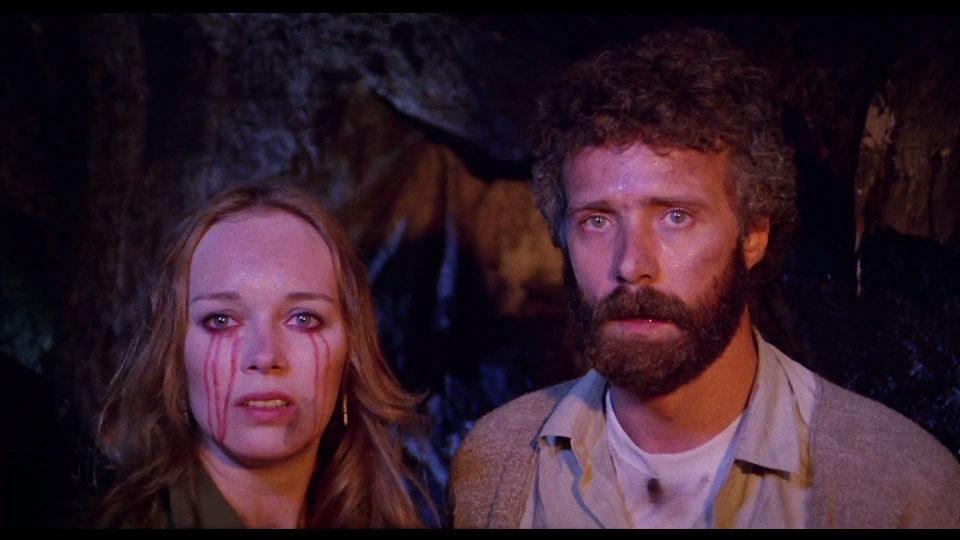
When you hear Evilspeak was not only one of the UK’s Video Nasties, but the studio had to cut seven minutes of footage to get an R-rating in the states, you expect bucket-loads of blood. Unfortunately, these facts speak less about how much gore you’re going to get and more about how absurdly silly things were in the era of Thatcher and Reagan. Violence-wise, Evilspeak is surprisingly tame for a horror movie in which the Carrie-like protagonist uses Satanic rituals and an Apple IIe computer to summon demonic revenge.

I’m not saying you shouldn’t pay the twenty bucks for Scream Factory’s awesome Blu-Ray edition, I’m just saying it’s not the film gore gurus probably expect. Yeah, there are some really great practical effects in there, but the promotional material makes you believe you’re in for something more splatter-heavy like the original Evil Dead. You’re not.

Richard Moll (yes, the bald guy from Night Court) plays Father Estaban, the long-dead leader of a cult of Satan worshipers. In the opening scene we see him disrobe an attractive woman before chopping her head off with a sacrificial sword. The effect looks suspiciously crunchy, like—I don’t know—maybe a department store mannequin filled with red food coloring and corn syrup. I’m pretty sure people’s necks don’t shatter like plaster when struck with a sharp blade. And believe me: I’m really not knocking the effect. It actually looks cool in the sense you’ve never seen anything like it before.

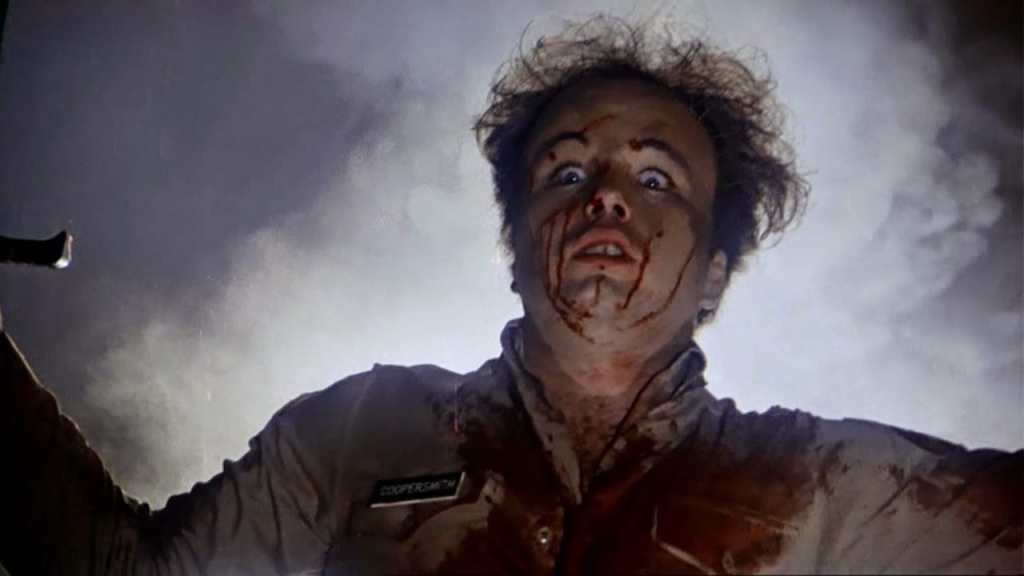
Fast-forward a few hundred years later to a modern military academy. The orthodox church on the grounds was inexplicably built on top of Father Estaban’s Satanic church. This isn’t rediscovered until Stanley Coopersmith (the insanely awesome and awesomely insane Clint Howard) finds a hole in the cellar’s brick wall. I’m surprised to learn middle age Europeans were practicing Satanism in what would later become the United States. Hell, the fact that Estaban’s church still exists at all raises more questions than answers, but I’m willing to go with it. Why? Because this movie is awesome, that’s why.

Coopersmith, who’s referred to as “Cooperdick” by his classmates, is the quintessential outcast. The first time we see him he gets his ass smeared across the soccer field. The next time we see him, a prank makes him late for class. His tardiness, of course, leads to the administration bullying him, too. Coopersmith’s only refuge is the computer lab and the secret church beneath the church. This is pretty much all the movie has to offer for the next seventy minutes or so, but it feels less like padding and more like a satisfying slow burn.

When a secretary steals one of Coopersmith’s books, I legitimately felt bad for him. When the other kids destroy Coopersmith’s catapult, I felt bad for him. And when they discover the dog he’s been hiding in the secret church, I really felt bad for him. Thing is, the movie doesn’t fail at anything it tries to do, it just sustains the same note for a little too long. That is until the glorious ending.

The climax isn’t just satisfying, it’s better than Carrie’s rampage. To see Clint Howard levitating around the church, terrorizing his bullies with a giant sword, is cheese of the finest sort. All Evilspeak promised to do was entertain me. Well, mission accomplished. I don’t know why nearly half the characters are in it, especially Haywood “What’s Happening!!” Nelson (who escapes the carnage as well as most of the movie), but man, that ending makes all the little flaws worth it.

The special features on the Blu-Ray are a little more than bare minimum. The retrospective offers some amusing anecdotes; it was fun to learn Clint Howard had to wear a hairpiece for this film. In an even better video on YouTube, Howard says the film was special to him because he lost his virginity during the production. It’s a film that’s special to me, too, and not only because it got one of my favorite character actors laid.

Come back at midnight Central Time for the next movie.

31 Days of Gore: Shrunken Heads (1994)

It’s October. Time to talk horror. This year I’m reviewing a different horror movie each day of the month.

I like Full Moon Productions. When I was a kid I loved that Dollman vs. Demonic Toys not only served as an all-encompassing sequel for two films, but for Bad Channels as well. When I saw the awesome, hand-painted advertisement for Puppet Master 3 in the back of a Fangoria, I went straight to the video shop and sought out the entire trilogy. I never really cared much for Subspecies, but I confess an unusual fondness for Tim Matheson’s Jack Deth of the Trancers franchise and the whip-cracking Musetta Vander in 1994’s Oblivion. What was really cool about Full Moon is they did crossover films two decades before mainstream Hollywood caught on.

As Shrunken Heads opens, a street gang makes life hell for a trio of young boys who just want to read their comic books in peace. The kids are murdered when they get caught stealing gambling slips from the gang’s hideout; without those slips, the gang won’t know who actually won their bets and who didn’t. In theory, the gang will have to pay everyone who gambled that week. (Because we all know kid-killing street gangs have a reputation for being honest.)

That’s when a voodoo priest (veteran character actor Julius Harris) goes to the funeral parlor with a hacksaw and decapitates the boys’ corpses. He shrinks the heads, revives them with magic, and spends a year training them how to fly and develop their superpowers so that they can get their revenge. The special effects during this sequence are surprisingly good.

It’s easy to see why Charles Band (the founder of Full Moon Productions) was so good at making straight-to-video films feel more expensive than they actually were: he was a master at calling in favors. The opening credits are scored by none other than Danny Elfman and it’s probably no coincidence the film’s directed by the composer’s unknown brother. “You wanna make a movie? Get your brother to do the theme and we can talk.”

Big Mama, the leader of the gang, is played by Meg Foster. Foster is among my favorite B-movie actresses. Unlike Zach Galligan, who once tried to distance himself from genre films, Foster fully embraced the nature of her career, playing everything from cyborg cops to the traditional love interest. You probably remember her as the female lead in They Live. Her unusually pale eyes are recognizable from space.

Which is why I was taken by surprise when I did not initially recognize her in Shrunken Heads. I initially thought she was a man and those oddly colored eyes are concealed by contact lenses. Her unusual look is only heightened by the strange creative decision to put her in drag. Something about her look in this film reminds me of the characters from a Fallout game.

Shrunken Heads is a feel-good movie for horror hounds. It’s light on the gore, but heavy on the charm. The unlikely relationship between the fifteen year old girl and one of the shrunken heads is initially creepy (Intentionally so… I think?), but against all odds, it’s endearing by the end. And speaking of the ending, it doesn’t disappoint.

So, do you want to see three children murdered in the streets, only to be resurrected as discombobulated heads? No? Then you don’t want to see this movie. But if the answer is yes, you’re gonna have a great time. Stick around for the post-credits scene.

Come back at midnight Central Time for the next movie.
The Martian: NASA’s answer to Top Gun

Andy Weir’s novel begins:

I’m pretty much fucked.
That’s my considered opinion.
Fucked.

Early on, the movie adaptation drops the F-bomb twice, which is the maximum allowed for a PG-13 film, given there’s not much violence or nudity. Through the use of clever cutaways, the filmmakers manage to preserve the unfiltered character nicely. And no, these workarounds are not nearly as insulting as sanitizing the word with a perfectly timed gunshot, à la Live Free and Die Hard.

I’m glad, too. Mark Whatley (Matt Damon) is an endearing character whose cursing is integral to his personality. He’s the only human on Mars, stranded by a mission which went tits up. His diet, consisting mostly of microwaved potatoes, is in constant peril. Worst of all, he just ran out of ketchup. That he only says (and types) “fuck” a handful of times is kind of amazing, really.

The thing that struck me most about The Martian are the landscapes. None of it is obvious CGI and none of it looks like rose-filtered Earth locations, either. The horizons and the sun look just about right. Having just seen the trailer for Ron Howard’s In the Heart of the Sea, whose liberal use of bad CGI verges on obscene, I couldn’t believe my eyes. The Martian has some of the most subtle special effects I’ve ever seen. Every minute is visually believable.

The film wastes no time setting up the comradery among the martian astronauts, whose mission is jeopardized by a freak storm. The commander (Jessica Chastain) makes the hard decision to return to Earth prematurely. Moments later, she has to make the even harder decision: leaving Whatley behind when he’s struck by a flying satellite dish. Everyone believes he’s dead because the component which relays his life signs to the ship has been impaled by shrapnel.

Cleverly, the film trades first person narration for the video diaries Whatley keeps to entertain himself, which involve ransacking his coworkers’ personal effects and making fun of the things he finds. He tells the GoPro cameras stationed around the habitat what he’s up to every step of the way. The first order of business is setting up a crop a of potatoes. Then he’ll have to “science the shit out of the situation” in order to send an SOS back home. In his first message, he says in a comically weak voice, “Surprise.”

Unfortunately, Murphy’s Law is in full effect on Mars. You always know something is about to go wrong, but you never know what or how. It’s the same kind of suspense which made Apollo 13 so tense even though we all knew the characters make it back home. Like that movie, The Martian doesn’t try too to make its audience teary-eyed. It’s primary mission is to entertain, which is exactly what elevates it above the endless supply of movie directors trying to mimic 2001: A Space Odyssey by infusing artificial mysticism into their space films (see: the incredibly insulting Mission to Mars and the merely okay Red Planet).

The Martian has everything I wanted from Gravity and Interstellar. This is real science fiction and not the Hollywood bastardization of the genre. Sure, a few of the things that happen are unlikely (Weir said he wishes he had chosen a different disaster to kick off the story as a storm of that nature is unlikely on the red planet), but there are plenty of scenes which contain more science than all the previous martian movies combined.

This is all to say The Marian is easily the best science fiction movie of the 21st century. It’s no wonder why the NASA program is promoting it like their version of Top Gun, which was a boon to the Navy’s recruitment efforts. The PG-13 rating is wise because there will be countless children pursuing careers in science and aeronautics after seeing it. We need more movies like it—exactly like it. In fact, Hollywood should just go ahead and commit to adapting every novel Andrew Weir ever publishes from here on out.