


By the end of Melacholia, the world will be destroyed. That’s no spoiler—it’s shown first thing so the audience won’t hold out for an unlikely Hollywood ending. Although the classical music and imagery begs comparison to 2001: A Space Odyssey, to call this science fiction is both an insult to Lars Von Trier’s intentions and to science fiction itself. The idea that such a rogue planet exists is a “serious” subject of countless conspiracy theories; frankly, the concept is too preposterous to take seriously.
Indeed, there was a Father Sarducci joke in which the comedian asserts there is a planet on the other side of the sun. There, everything is just as it is on Earth… only the inhabitants eat their corn on the cob vertically. In Melancholia, the vertical corncob planet is on a collision course with Earth. There’s no last ditch effort to save humanity. Nothing can stop it.
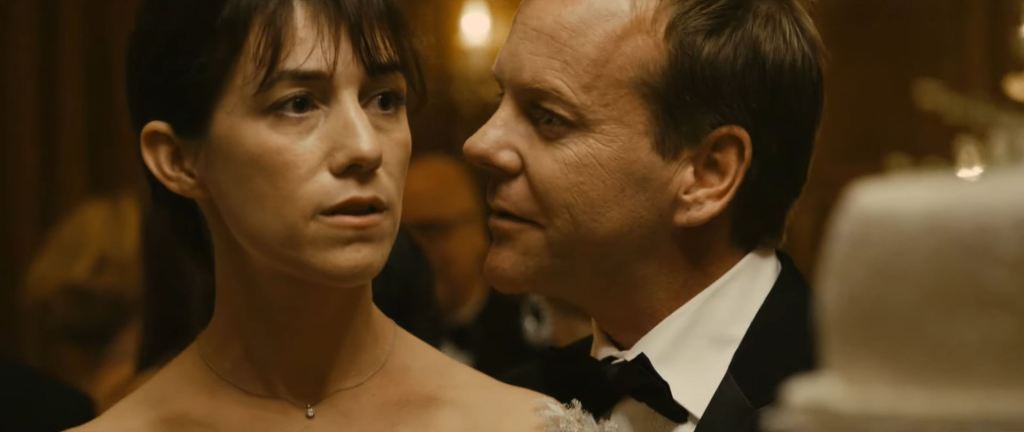
The most impressive shots are in the overture, before the title card is ever shown. Von Trier plays with the same high speed cameras he employed in Anti-Christ, giving us a taste of the themes and motifs to come. Then the film abruptly switches to hand-held photography as it focuses on Justine (Kirsten Dunst), a hyper-depressed individual who is struggling to deal with a dysfunctional family on the day of her wedding. It’s hard to believe nearly everyone in her family can be, as one character puts it, “stark-raving mad,” but Von Trier always exaggerates to show us how people like Justine (and himself) actually feel.
Despite her many blessings, including a wedding that may have cost as much as a Bugatti, Justine cannot be happy through little fault of her own. John, her brother-in-law (Kiefer Sutherland), comes to her and threatens, “You better be goddamn happy.” Justine’s sister Claire (Charlotte Gainsbough) initially comes off as a snotty bitch, but we soon intuit just how far Justine has pushed her. Claire loves her sister, warts and all. She’s a lot more stable and caring from her own point-of-view scenes than she is from Justine’s. When it’s clear the planet’s days are numbered, the roles swap: Claire becomes a mess while Justine stabilizes.

It’s hard to review a film like this. It’s not a crowd pleaser, it’s a deeply challenging and exhausting piece of cinema with real and unlovable characters. Yet I see parts of myself in Justine and I can relate to those around her. There’s a brutal but refreshing honesty which is more interesting to watch than a ragtag group of unlikely heroes flying around in spaceships to save the world. You’re either going to love it or hate it. Frankly, I’m far more offended by mediocre movies than polarizing ones. I can confidently say I will see it again someday, but I’m not in any rush to do so… as with Anti-Christ, I need time to recover.
 The Goug' Blog