

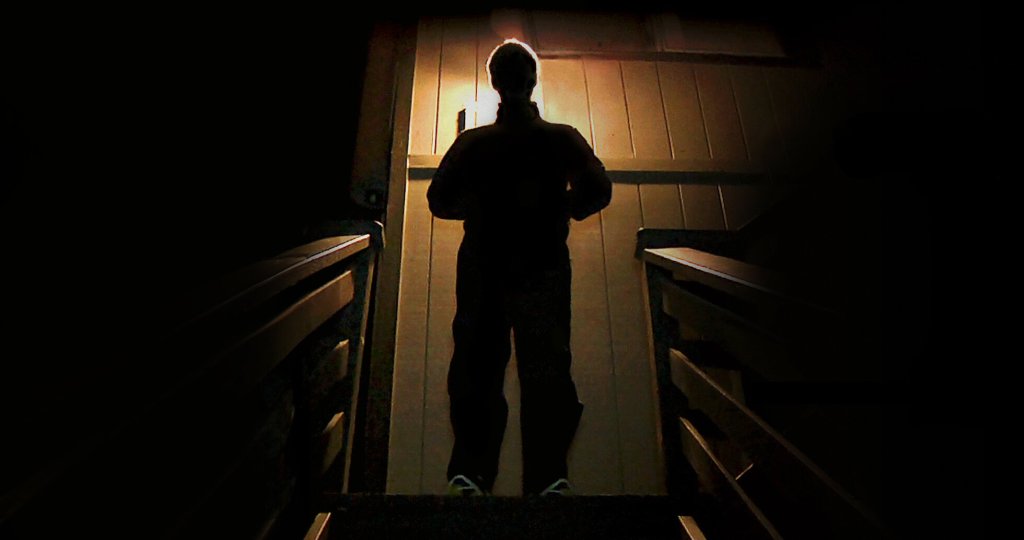
I’ve said I dislike found footage movies, but it’s because they usually suck for reasons having little to do with the way they’re shot. Creep, despite a run-of-the-mill trailer, doesn’t suck. It’s a simple movie, which involves a secluded house, a sympathetic protagonist, and a creep of epic proportions. There’s also an ax and a werewolf mask at play, insisting immediately that we probably won’t get a happy ending.
I’m not very familiar with Mark Duplass, who plays the titular creep, but great character actors are good at embracing the qualities which separate them from genetically-blessed movie stars. Duplass looks so much like a real-life creep he was born to play this role. It’s a lot of fun watching him enjoy a character who’s anything but glamorous.
The setup? Aaron (director Patrick Brice) is an out-of-work videographer who answers a Craigslist ad placed by Josef, the creep. Josef says doctors have given him only three months to live so he wants to shoot a video diary about his daily life. That way, his unborn son (yet to be conceived) can see what he was like. Josef confesses he was inspired by the schlocky melodrama My Life, which starred Michael Keaton and Nicole Kidman. If that isn’t particularly amusing to you, Creep probably isn’t up your alley.
Aaron’s job is to follow Josef and record him going about his daily routine, but nobody else on the planet has a routine as bizarre as Josef’s. The first thing Josef wants to do is have Aaron shoot footage of him taking a bath. Reluctantly, Aaron agrees. Whereas many horror films make their characters too stupid to get themselves out of harm’s way (because otherwise the movie would be over then), Aaron’s cast from a different mold. Aaron doesn’t lack self-preservation just because it’s convenient to the plot, but because he’s a habitual people-pleaser. Josef, on the other hand, is a psychopath who loves to prey on people like Aaron, constantly testing limits for his own amusement.
We all know people who are too polite to say no to overbearing strangers with sob stories. Aaron is the kind of person who would loan deadbeats money knowing full well it isn’t actually going towards rent. Because of this, Aaron will make you scream at the screen—not because he’s stupid (though you could make that argument), but because he’s buying into Josef’s manipulative personality. For people like Aaron, being used is the path to avoiding confrontation… that and he kind of needs the money.
Josef’s antics eventually escalate to the point even Aaron has had enough. To say anymore would give away what happens next. The movie’s biggest strength, other than its diabolical simplicity and unusually strong performances, is the fact you never quite know what kind of movie it is, where it’s going, or how Josef and Aaron’s relationship is going to develop. If you’re expecting a slasher film, you’ll probably be disappointed. If you loathe slasher films, you’ll probably be disappointed, too.
I did not completely buy the ending and there’s a weak epilogue which attempts to put a lampshade on the climactic absurdity. It’s as if they only realized how unbelievable the conclusion was after they shot it, and instead of reshooting the scene, they decided to offer a weak explanation as to why it went down the way it did. That doesn’t really matter because movies like this rarely have good endings, anyway. Creep brings the goods just the same.
You get the feeling Brice and Duplass are two friends who had the idea for Creep over drinks one night and decided to shoot it with little more than a vague outline. There’s an unpredictable energy to it that’s exciting. It’s made all the more impressive when you take into consideration that a movie born of such simplistic elements has no right to be as enjoyable as this is. If there’s any justice, both of these filmmakers will swiftly move up the Hollywood ladder.

 The Goug' Blog