

Millennium is a little time travel movie which seems mostly forgotten these days. Here are my thoughts.
Category: My Favorite Movies
Western Wednesday: Django (1966)
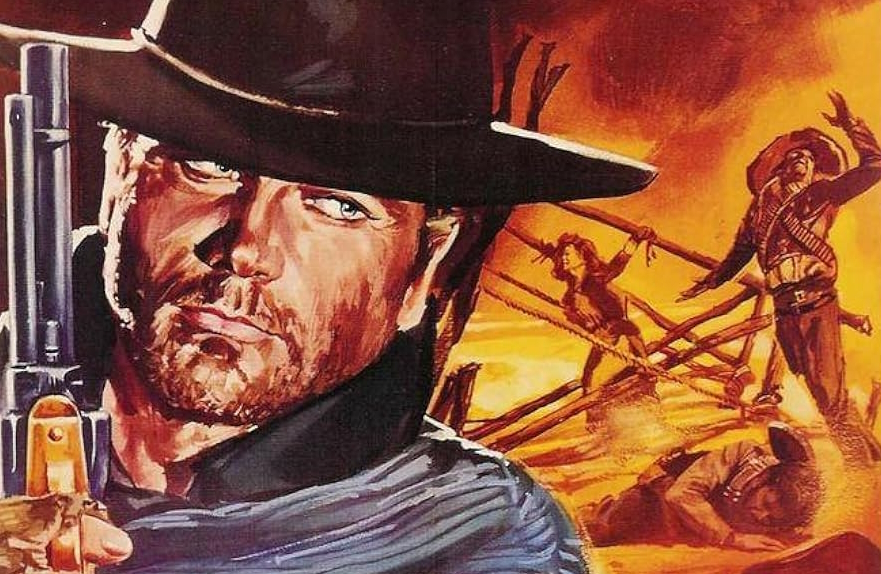
Django begins with the titular gunslinger (Franco Nero) dragging a coffin through all manner of terrain. Later, when he finally makes it to a saloon, someone asks him if there’s a body in the box. Django replies, “Yeah. His name is Django.” I won’t tell you who’s actually in the box. You’ll find out about a third of the way into the picture.
Seconds after the opening credits, Django happens upon a gruesome scene: a gang of bandits are preparing to bludgeon a prostitute to death. You expect Django to intervene, but he doesn’t. Instead, he watches from afar as a second gang swoops in and lays waste to the first. You think the prostitute’s life has been spared until you realize they’re only untying her to retie her to a cross, which they intend to torch. “Burnin’s a lot better than getting beaten to death,” they assure her. (Is it, though?)
You get the feeling Django has been hoping he doesn’t have to get involved. Then it’s clear it’s no longer his decision to make; he’s operating on autopilot when he approaches the men and says in his dubbed voice, “If I bothered you, would you accept my apology?” A split second later his pistol comes out, blazing hellfire, and drops five men in the blink of an eye.
After saving the prostitute’s life, Django takes her to town, finds a room, and meets the leader of the local Klan, Major Jackson. Jackson gets his rocks off on hunting innocent Mexicans for sport. After gunning down over forty of Jackson’s men, Django finds himself at the center of a war between Jackson’s gang and bandits.
It sounds a lot more clichéd than it is. Django’s the real deal—a character of such popularity and charm he’s been portrayed by a dozen different actors in dozens of movies following this one. Like a lot of legends, the details change depending on who’s telling it, but overall the important stuff remains the same. Sure, it’s mostly style over substance, but Django is tragic, shamelessly entertaining, and absurdly violent for its time. If you’ve never seen it before, be prepared to get amped.
Outland: High Noon in space

William T. O’Niel (Sean Connery) is a space marshal who’s been assigned to a mining outpost on IO, one of the many moons of Jupiter. His wife has left him, disillusioned with the space life. Whereas most boys hide girlie mags under the bed, their son has been caught hiding pictures of Earth.
Peter Boyle plays Mark Sheppard, the crooked operations manager. When the marshal introduces himself to Sheppard’s crew, he’s welcomed by the roughnecks warmly. Sheppard, on the other hand, makes it clear he intends to be the one calling the shots. Meanwhile, some of the miners have been experiencing deadly hallucinations. The marshal discovers an import drug is to blame and, surprise-surprise, Sheppard may be involved in the scheme.
As the investigation unfolds, the marshal makes friends with the infirmary’s head doctor, played by the extremely likable Francis Sternhagen. The banter between these two is often funny and very endearing. Peter Boyle is exceptional, too. “If you’re after more money,” he tells the marshal, “you’re very smart. But if you’re serious, you’re very stupid.” The marshal isn’t after money at all, of course. While the film doesn’t make it clear why he’s so motivated, it doesn’t need to because it uses the shorthand of classic westerns. He’s simply a man with a strong sense of right and wrong; the audience doesn’t question it because he’s played by Sean Connery.
And the marshal really puts his life on the line. In the last quarter of the movie, hitmen are on their way to assassinate the marshal. The minutes to their shuttle’s arrival are counting down on the loud flip clocks that are stationed throughout the facility, grating on the marshal’s anxiety with every click and clack. The marshal fails to deputize any help because the odds he’s facing are suicidal. No, it isn’t a rip-off of High Noon. It’s a loving remake.
Director Peter Hyams is very good at making solid films like Outland. Mechanical plots have always been one of his strong suits and his technical abilities provided him steady work in Hollywood. Some filmmakers are simply good at working within the system while others can only exist outside of it. Both are admirable when they produce films as good as this. Think about it: Hyams managed to make a good sequel to 2001: A Space Odyssey, which must have been a job no one envied. So maybe he isn’t what anybody would call an artist with a capital A, but he’s often the right guy for the job.
Highlander: There can be only one (and several sequels)

Highlander 1986
Suppose, for a second, you’re a Trans-Am-driving gun nut who happens upon a dark alley in which two complete strangers are sword fighting. Do you A) drive to the nearest payphone and call the cops or B) get out and shoot at these people who you don’t even know? If you chose B, you belong in this movie.
You know Highlander’s tagline even if you don’t know the franchise: There can be only one. But why must there only be one? When the French Christopher Lambert (playing a Scot) asks questions like that, the Scottish Sean Connery (playing an Egypt-born Spaniard) replies with another question: “Why does the sun rise?” That’s a cheat because even grade school children know why the sun rises, but no one seems to know why Immortals “must” fight. Considering how cool it is, I suppose it doesn’t matter. I mean, who doesn’t like sword fights that produce roughly as many sparks as a bumper car grid?
I’m getting ahead of myself. The year is 1985. Connor MacLeod (Lambert) is spectating a wrestling match at Madison Square Garden that gives him intense flashbacks to his life as a Scottish highlander in the 1500s. When he ducks out early to head to the parking lot, Connor is attacked by another Immortal. Connor beheads the mysterious attacker and absorbs his essence in a supernatural light show known as a quickening. Beheading is the only way to kill an Immortal and the quickening is the process which allows the victor to absorb the defeated party’s strengths and abilities.
Meanwhile, the “seven-foot tall” Kurgan (Clancy Brown) arrives in New York City. The Kurgan is Connor’s arch nemesis, having killed his mentor Juan Sánchez-Villalobos Ramírez (Connery). Don’t worry—through the magic of questionable screenwriting, Ramírez will return for a more significant role in the sequel. At any rate, the Kurgan has spent the last four hundred years quickening as many Immortals as he can. According to Ramírez, if someone like the Kurgan wins this ancient contest, the world will be plunged into eternal darkness.
The pacing is a little rough. The acting is good enough. You will be forgiven for scratching your head or making MST3K-style quips here and there. My mother tells me this was one of the first movies I ever fell in love with and that she would often hear me, from the other room, popping it into the VCR to watch it again and again. I was so young I don’t remember, but it certainly is up my alley.
When the movie was over I slipped Westworld into the Blu-Ray player and all but forgot about Highlander. But when I went to bed later that night, distant memories of the infamous sequel began to haunt me. When I was eight or nine years old, I had rented it on Pay-Per-View and recorded it to VHS. I still have the tape to this day.
I remembered Sean Connery was in it and just had to know what kind of movie magic they spun to bring his character back to life. I had frequently read how awful the movie was, which was at odds with how much I enjoyed it as a kid. So I bit the bullet and decided to watch Highlander 2 for the first time as an adult.
I may never be able to enjoy another movie again.
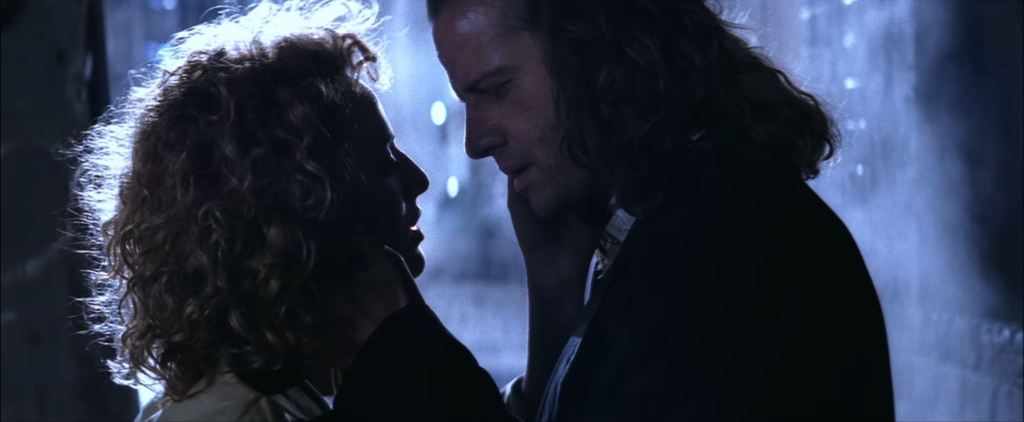
Highlander 2 (1991)
Forty years after the conclusion of the last film, Connor MacLeod is not just mortal, but an elderly and extraordinarily wealthy individual, as immortality no doubt reaps some great compound interest. He’s devoted himself to science-based philanthropy. One of the projects he helped fund was an artificially generated shield around the planet after corporate greed destroyed the ozone layer. Unfortunately, the shield has permanently blocked sunlight and created a runaway greenhouse effect. It’s also controlled by the very corporation that helped destroy the atmosphere in the first place. As it turns out, the ozone layer has recovered since the shield went up and the project’s executives will stop at nothing to keep this inconvenient (for them) truth suppressed.
Enter Louise Marcus (Virgina Madsen) who seeks to expose the truth by bringing the shield down. Within minutes of meeting Connor, two Immortals from the distant past (or another planet, depending on which version you’re watching) arrive on bitchin’ hover technology to assassinate the former contest winner. Despite his advanced age, Connor manages to decapitate one and quickens, restoring his youth and immortality. Shortly after hopping on a hover board to dispatch the other assassin, Connor and Louise have passionate sex, right there on the grimy streets.
If you’re wondering how they contrive to resurrect Sean Connery’s Ramírez, it doesn’t make any sense… nor does it matter. All that matters is he’s back, he gets a lot more screen time, and the actor seems to be having the time of his life elevating an otherwise standard fish-out-of-water role. Connery alone is worth the price of admission. Ramírez reunites with Connor and helps him and Louise take on the corporate powers that be.
Siskel & Ebert said only brain-dead moviegoers could enjoy Highlander 2. Some regard it as the worst film ever made (those people have yet to see Now you See Me). If you find the utterly ambitious and genuinely creative Highlander 2 more offensive than the plethora of soulless cash grabs coming out of Hollywood nearly every month, I ask you to reexamine your standards. You cannot call this film boring. You cannot call it passionless. Insane? Well, I’ll give you that one.
Highlander 2 is set in a dystopian cyberpunk future. For the most part, it’s a visually convincing setting. Somehow director Russell Mulcahy managed to squeeze better world-building out of his budget than Freejack, Johnny Mnemonic, and Cyborg combined. The theatrical cut of the film (which is what I initially saw on Pay-Per-View twenty years ago) even visited another planet, but the infamous alien subplot has since been reworked and retconned in subsequent editions.
Granted, the theatrical cut of Highlander 2 ruined the mythology of the original film within the first few minutes. It asserts the Immortals were (surprise!) aliens all along. Luckily, this revelatory dialogue had been filmed with characters who spoke telepathically; the obvious fix was to simply rerecord the voice-over dialogue. In the subsequent versions, all verbal references to the alien planet Zeist are edited out of the dialogue even though the visual references more or less remain, albeit visually altered. This way audiences are led to believe (if they’re still paying attention) that it’s not an alien planet, but in fact Earth a long time ago.
These changes don’t really help the film, though, as it still suggests that Connor and Ramírez knew each other prior to their meeting in the original film. If anything, the changes made the movie more confusing. For instance, when the past assassins are given their orders to kill Connor, they say, “But he’s an old man now.” “Now,” even though the scene is set far in the past?
And you know what? Who cares? Just keep slathering on the 90s cyberpunk aesthetic and sparky sword fights. Highlander 2 is incapable of demonstrating restraint in its crusade for awesomeness. You get hover boards. You get bad guys who look like they’re straight out of a Hellraiser film. And you will never see a hero have sex with the heroine so quickly after they meet… and, uh, I do stress the word “quickly.” (Perhaps that’s the quickening.)
Young, fun, and dead before 31: Logan’s Run

In the otherwise utopian future of Logan’s Run, humans are required to die at the ripe old age of thirty. Most people who reach the cut-off age believe the execution ritual is in fact transferring their immortal souls to a higher plane of existence even though all the spectators can clearly see their bodies fucking explode. Those who try to escape their birthday spankings are called runners. The men who hunt them down are called sandmen.
One such sandman is Logan Five (Micheal York). Logan loves the chase. He and his work partner toy with terrified targets before dispatching them violently. The glee on Logan’s face is truly vile; the way he dispenses the word “runner” is analogous to the way white supremacists scream their favorite slur.
One day Logan is forced to go undercover in order to find Sanctuary, the safe haven where runners attempt to go. Unfortunately, Logan’s partner thinks he really went on the lam so Logan must actually run. (I believe Spielberg’s Minority Report owes some unpaid homage to this.) The next thing you know there’s an oddly placed cameo by Farrah Fawcett, a lot of fiery deaths (because sandmen use flare guns instead of pistols), and a “big reveal” that pales in comparison to the one in Planet of the Apes. As you probably guessed, Logan will slowly have the wool pulled from his eyes.
Logan’s Run posits that people under the age of thirty are idiots. The film’s young and insanely attractive citizens mill about their dome city in slinky costumes with sex-crazed mindsets. I’ll be the first to admit these kind of movies are an acquired taste, but I just love this kind of shit. As far as movies go, it’s the closest you can get to the kind of bizarre science fiction that truly insane novelists like Philip Jose Farmer and Roger Zelzany unleashed in yellow DAW paperbacks. You’re going to see an unbelievable amount of sex, violence, and gratuitous nudity for a PG-rated film, and sheer awesomeness in the truest sense of the word.
It’s a hell of a spectacle, yes, but not a seamless one. Analog future technology is adorable when watched in the digital age. The miniature effects look as realistic as toys. There’s a robot effect so painfully obvious you can actually see the lips of the actor who’s wearing the costume.
Logan’s Run is far too goofy to be considered a classic, but you’ll probably grin an awful lot.
How much man could The Omega Man man if The Omega Man could Omega Man man?
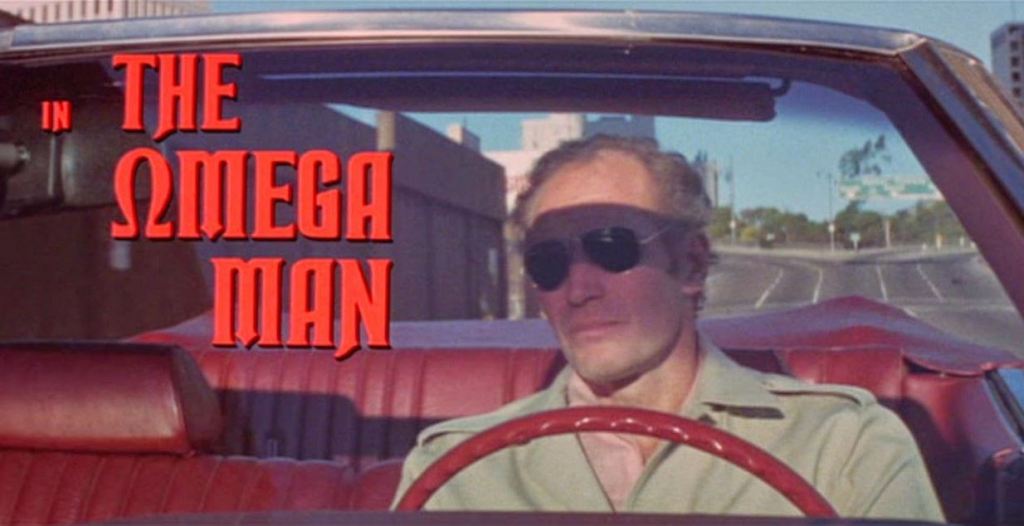
Dr. Neville (Charlton Heston) is driving his convertible through deserted Los Angeles. It’s a pleasant day and he’s just vibing, listening to Theme from a Summer Place on an 8-track player. When Heston spots movement in a window, the machine gun comes out and he releases a barrage of bullets. This is two years after a biological apocalypse has rendered nearly everyone else on the planet dead. According to the poster, “The last man alive… is not alone!” That’s because most of the people who survived the plague are now mutants who specifically want to kill Neville.
If this sounds vaguely familiar, it’s because it’s a 1970s retelling of Richard Matheson’s 1954 classic novel, I Am Legend, in which the bad guys are vampires, not mutants. It also served as the basis for Vincent Price’s The Last Man on Earth, which is a fairly standard but watchable B-movie, and a 2007 Will Smith vehicle which bore the same title as the novel even though it entirely missed the point. Matheson’s novel depicted Dr. Neville as a man so badly isolated that when the vampires came to his home to taunt him nightly, he often fantasized about opening the door and stepping out.
The Omega Man scales back the isolation-horror and becomes one of the very first tough guy films, complete with witty one-liners (which mega Omega Man fan Tim Burton has pointed out in interviews). While browsing a car lot, Neville has a humorous conversation with an imaginary car salesman who’s trying to screw him over. After being captured by the bad guys, Heston asks, “Are you fellas really with the Internal Revenue Service?” When it’s revealed that Neville is not, in fact, the last person alive, his love interest decides to go shopping, referring to her shotgun as a “credit card.”
The film’s so hip, in fact, the mutant ghouls wear mirrored shades with their sacramental robes. This may have seemed a little silly in the 70s, but in the time since it’s managed to age like a fine wine. The last woman alive is sassy black Lisa (Rosalind Cash), who’s not the only prominent character in the film who wears a bitchin’ afro. The first time she meets Heston it’s with perfect comedic timing: she catches him caressing the curves of a department store mannequin.
The Blu-Ray looks great, though it’s painfully obvious whenever motorcycle-driving Charlton Heston transforms into a stunt double with a bad toupee. Also shitty is the inclusion of the same special features which appeared on a DVD version ten years ago. Nonetheless, I haven’t enjoyed the picture more. Watch it before Tim Burton inevitably remakes it.
American Hustle is a delightful con

1978. Christian Bale’s Irving Rosenfeld, a sleazy man with a beer belly and a penchant for cheap jewelry, is preparing what another character describes as “an elaborate comb-over.” The comb-over is less about his ego and more of a disguise. He doesn’t want most people to know anything about him, least of all the truth. Thus is the life of a professional con artist.
Sydney (Amy Adams) explains that despite his physique and the aforementioned comb-over, she fell in love with Irving for one reason: his confidence. On their first date, he takes her to one of the dry cleaners he owns and lets her choose whatever she wants from the clothing that never got picked up. The scene is somehow just as sweet as it is funny. It isn’t long before Sydney is drawn into Irving’s world of running confidence scams. By the end of the movie, as Irving is worn down by the complexity of their schemes and the danger they find themselves in, she may be better at the game than him.
When the pair of criminals are caught by FBI agent Richie DiMaso (Bradley Cooper), the ambitious young man offers them a deal: help the Bureau entrap corrupt politicians or he’ll send them both to prison. The trio target Mayor Carmine Polito (Jeremy Renner) who, ironically, is probably the most honest person in the entire film. Dazzled by the con artists’ world, DiMaso slips from the straight-and-narrow path, believing he’s been accepted as part of the team. Meanwhile, Irving and Sydney are in fact running a separate con on him and everyone else who crosses their paths. As the Italian mafia enter the picture, Sydney tells Irving, “We’ve got to get over on all these guys.”
Amy Adams is so fucking good in this scene, she gives me chills. Jennifer Lawrence, playing Irving’s disgruntled and hilariously bad-tempered wife Rosalyn, is almost as good. There’s a scene in which Rosalyn sees Sydney for the first time and just knows, intuitively, she’s the woman who keeps Irving out all hours of the night. Meanwhile Louis C.K., playing DiMaso’s supervisor at the FBI, has a great running gag involving the world’s most pointless story about ice fishing.
American Hustle is as quickly paced and entertaining as any Scorsese movie, though with surprisingly little violence. I suspect the reason Irving and Sydney love Duke Ellington so much is because that’s how this film moves: like jazz. The beats aren’t always where you expect them. Director David O. Russell is unconcerned with comforting rhythms as he seemingly improvises the film’s style on the fly.
I watch movies obsessively. American Hustle may not seem like much to the casual moviegoer, but it’s a lightning rod for those of us who savory every detail, no matter how small. The characters do immoral things, but they’re far from bad and they’re downright lovable. This is my favorite movie of the year.
WarGames

The human personnel in a missile silo are faced with the task of maintaining a launch station. They never thought they would actually get the order to launch. To them it’s just a routine job: monitoring the blinking lights while they make idle chitchat. What human could possibly accept what it means to actually push The Button? When men are ordered to fire, unaware that it’s an attack drill, they fail to do so. This convinces the brass at NORAD to take humans out of the equation all together. A super computer, they reason, would have all the capabilities of a human, with none of the pesky conscience.
Following the suspenseful opening is a conventional introduction to our protagonist. Seventeen year old David Lightman (Mathew Broderick) is a high school kid who spends too much time in his bedroom, messing about with his modem-enabled Imsai 8080 computer. His girlfriend’s character is never really fleshed out, but that doesn’t matter because she seems like a real girl and her interest in David never came off phony.
One day David is leafing through a magazine when he discovers an advertisement for a mysteriously marketed video game that won’t be revealed until Christmas. David refuses to wait. He commands his computer to dial every phone number within the game studio’s area code so that he can create a list of every modem in the area. When David accidentally connects to the super computer at NORAD, he thinks he found the studio he’s looking for and launches a game called Global Thermonuclear War. The super computer is more than willing to play, as it’s an artificial intelligence that plays war games 24/7, constantly learning, constantly improving. Unfortunately, David soon learns that he may have inadvertently started the ball rolling towards World War III.
WarGames occasionally insults the intelligence (micro-cassette recorders can be hacked to open keypad-protected doors), but it’s fun and cleverly so. If anything, it really captured the attitude of real life hackers who, though often vilified by the media, are the people who gave us affordable computers and created the internet in the first place. There are some things I didn’t like about the movie, notably the stereotypical computer specialists who help David crack NORAD’s backdoor password, but the climax of the film is unlike any I’ve ever seen. It hit me hard and it stuck with me.
 The Goug' Blog