John Wick: Chapter 2 (2017)

I just re-watched the original John Wick in preparation for the sequel and enjoyed it as much as I enjoyed Dredd and Fury Road, similarly old fashioned action flicks. Both of those movies have a lot in common with John Wick’s fictional universe, the world-building of which is more suggestive than fleshed out. The fact that the sketchy people who live there have their own laws and currency makes the setting fascinatingly mysterious, much like Wick himself. Yet my favorite thing about the movie is that when characters say things like, “John’s not exactly the boogeyman… he’s who you send to kill the boogeyman,” you don’t snicker as you would in a movie which takes itself too seriously.

The entire point of John Wick is to entertain. As is such, a lot of it is style over substance, but it’s not all style, and unlike Tony Scott’s Domino era there’s not so much style it resembles a music video more than a movie. I think what I’m saying is John Wick is a damn near perfect film for my particular tastes. Besides, aren’t you getting sick of little goody two-shoes like Jason Bourne and all the other PG-13 action heroes?

In the first film, a grieving John Wick murdered everyone even remotely connected to the death of his puppy, which was his deceased wife’s final gift to him. At the end of the movie he broke into an animal shelter and stole a pit bull, then walked off into the sunrise. And when Chapter 2 comes along, it’s really good to see John Wick and that pit bull are still together, even though you can estimate the dog’s plot armor around 50%… 75 if you don’t believe they’d kill two dogs in the same franchise and somewhere around 25 if you remember how graphic the first dog slaying was… that long streak of blood was some fucked-up shit, after all.

Chapter 2 expands on the same criminal underworld as seen in the first movie, this time revealing the existence of a blood contract signed by Wick sometime before the events of the first film. The beneficiary of the contract has complete control over Wick, and Wick will never be free until he performs an impossible task. When Wick politely asks for the deal to be rescinded, his house explodes, which leads you to wonder what else he’ll get taken from him.

So here was my worry going into the movie: nobody wants to see John Wick put through as much hell as he was put through in the first movie. Yet if they don’t put him through the ringer, would we lose the satisfaction of seeing him shoot dozens of people in their faces and heads? As it turns out, they don’t put Wick through the same level of shit they put him through in the first movie… at least not up front. (Let’s just say—extremely vague spoiler—he doesn’t exactly walk into the sunrise at the end this time.) There’s a slower burn leading to Wick’s ultimate melting point, but the action scenes are no less exciting. In fact, they’re a little more creative this time around, which you’ll see during the very first stunt sequence of the movie.

And holy shit this movie is beautiful.

If you’re a fan of the original film, you’re almost certainly going to like this one just as much if not more. I don’t think I’ve been this pumped up since I saw Fury Road. If you want them to keep making these kinds of movies for adults, then go see it instead of whatever other bullshit they’ve got coming out right now. Hell, see it twice.

True Lies (1994) [Midnight Movie]

True Lies was the most expensive movie ever made when it came out (I remember a rumor that theaters were going to charge higher ticket prices just for this movie, but that never came to be). Unlike other big budget films of the era (Waterworld comes to mind), you can actually see where all the money went. Its action scenes are among the richest I have ever seen, the stunts are legendary, and it hurts to think we may never see actual fighter jets and helicopters interacting with actors ever again.

I’m not exaggerating here: True Lies has some seriously spectacular action. It’s disappointing to realize just a few years later Nicholas Cage was pretending to drive a CGI car while Jedi were becoming digitized dummies. You just can’t cheat your stunts and expect the audience to be wowed. The action sequence on a Florida Keys bridge blows most movies out of the water… and that’s not even the finale.

Arnold Schwarzenegger’s character, Harry Tasker, is a spy who masquerades as a computer salesman. His wife Helen (Jamie Lee Curtis) doesn’t have a clue what her husband really does for a living, but she longs for excitement in her dull life. Meanwhile their teenage daughter thinks her father’s a massive tool because, outwardly, he is. Why a boring white collar worker would have a bodybuilder’s body isn’t important. No one in the movie bothers to notice.

What’s strange about True Lies is the fact it forgets it’s an action movie about midway through. Early on, Harry and his partner (Tom Arnold) are hot on the trail of jihadists who’re attempting to smuggle nuclear warheads into the States. But when Harry discovers Helen is seeing another man (Bill Paxton) he diverts every bit of his team’s intelligence to finding out the man’s identity. Without spoiling too much of it, Helen is subjected to a cruel prank by a stranger, only to be subjected to another cruel prank by the very man she married. The morality of it all is questionable, but, uh, I don’t go to the movies to see saints. I enjoyed it even though the long, action-free middle of the movie might feel like a derailment to some.

And it’s hard to top the last forty minutes. Most movies which combine action and comedy suck at one or the other (often both, as almost every Lethal Weapon rip-off will prove), but True Lies is the rare action film with perfect comedic timing. In one scene Schwarzenegger is hanging from the reins of the horse which flung him over the side of a high-rise building. He glances up to the horse and begs it to save his life. Somehow, the filmmakers goad the horse into smiling back at him. In another scene, in which Schwarzenegger is injected with a truth serum, Helen asks if they’re going to die. He replies, “Yep!”

This isn’t just routine comedy squeezed into the film because audiences expect it to be there. This is genuinely funny stuff, and the timing of it—as well as the editing of the action scenes—reaches a musical quality. Not only was True Lies the glorious swan song of the 80s and early 90s action film, it satirizes the genre at the same time. In Terminator 2, director James Cameron took care to show why his vehicles exploded so as not to disturb our suspension of disbelief. In True Lies, vehicles explode because he’s indulging in gleeful absurdity. And my god it’s infectious.

I watch True Lies practically every time I make adjustments or upgrades to my home theater, but I don’t think I’ve ever enjoyed it more than I do now.

Two-Lane Blacktop (1971) [Midnight Movie]

If you’re looking for a high-octane chase movie like the original Gone in Sixty Seconds, Two-Lane Blacktop isn’t the movie you’re after. There’s a drag race at the beginning of the movie which is cut short by cops, a short drag toward the end of the movie, and a drag at the very end of the movie that’s cut short by the filmmakers themselves (or their lack of a million-dollar budget). The final destination’s a little too avant-garde for my tastes, but the trip through post-60s America just about makes up for it. 

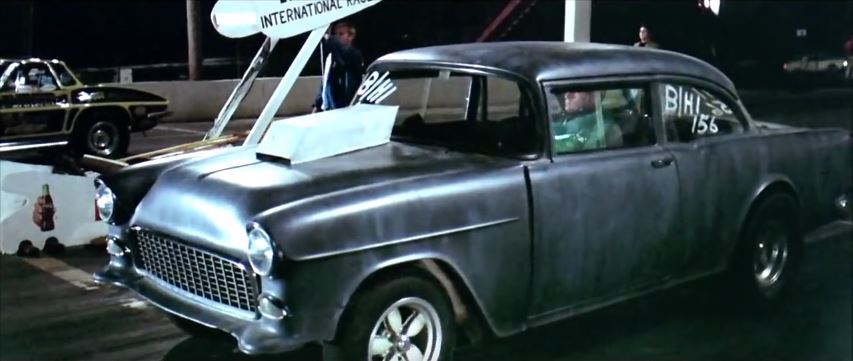
Real-life musicians James Taylor and Dennis Wilson play The Driver and The Mechanic dispassionately, as if they’re auditioning for 2001: A Space Odyssey. While I appreciate what they did here I almost wish they took a backseat role to the mean ’55 Chevy their characters drive, which seems to be the real star of the film for the first twenty minutes or so. We get a glimpse into the boys’ street racing lifestyle shortly before they pick up a hitchhiker who’s simply named The Girl.

The Girl is played by model Laurie Bird, who probably would have gone on to become a household name if she hadn’t died at the age of 25. She only appeared in two other movies, one of which was Annie Hall, the other of which was the director’s follow-up, Cockfighter. Like Blacktop, it also featured Warren Oates and Harry Dean Stanton.

Oates’ character is called G.T.O., because that’s what he drives, and he likes to pick up hitchhikers so he can tell them his life story. Yet G.T.O. has a different story for each of his hitchhikers and we only get a hint of his real identity when he briefly ends up drunk in the passenger seat of the Chevy. Early on in the movie, The Driver and The Mechanic goad G.T.O. into racing across the country for pink slips, but G.T.O. is so unsuited for the race that the Chevy drivers frequently pull over to let him catch up. It’s no fun for them to get a huge lead on the G.T.O.

What Oates has done here is something quietly nutty and often humorous. He’s a big reason to watch the movie, which might be disappointing to anyone watching Blacktop for the thrills. Go into it expecting more Easy Rider than The Fast and the Furious and you’ll probably like it. I picked up the Criterion Collection Blu-Ray, but I wouldn’t have been terribly disappointed had I settled for the much cheaper DVD version… it just doesn’t take much advantage of 5.1 sound and HD.

Demolition Man (1993) [Midnight Movie]

Demolition Man is a movie I watched so many times on HBO, I started watching it in the network’s secondary audio program to mix things up a bit. (I think that probably taught me more Spanish than the class I took, too.) It’s been at least a decade since the last time I saw it, so I was surprised to discover all the lines were still bouncing around in my head. I was also surprised it was a little more clever than I remembered it.

This isn’t to say Demolition Man is a brilliant movie, only that it isn’t mindless. John Carpenter’s Escape from New York, which shares similar frustrations with the fact Americans prefer safety to freedom, feels a lot more genuine by making its lead character an apathetic anti-hero. Stallone tends to get on a soapbox when he’s not delivering questionable one-liners. It’s not as heavy as it was in Cobra, and Stallone has mellowed out a lot since that film, but it’s still apparent. Speaking of forgoing subtlety: not only is Brave New World flat out mentioned, but Sandra Bullock’s character is named Huxley.

The movie opens four years in the future—1997 to be precise—and Stallone plays a bad ass, door-kickin’ policeman by the name of John Spartan. When we first see him, he’s hovering in a helicopter high above an urban war zone in the middle of Los Angeles. Just before repelling down to the scene, he adjusts his beret and mutters, “Send a maniac to catch a maniac.” The ensuing stunt is good, as are most of the film’s stunts, but the way the editors cut it together would have broken any human’s back… not that I mean to suggest Stallone is merely human.

The maniac Spartan wants to catch is Simon Phoenix (Wesley Snipes) who manages to murder a group of hostages before framing Spartan for manslaughter. Both men are arrested and, since this is the future, they get placed in cryogenic storage which has replaced traditional prisons altogether. Fast forward to the year 2032, in which crime has been reduced to the point policemen don’t even know how to arrest people anymore. Phoenix manages to escape the cryo facility during a parole hearing, at which point John Spartan has to be awakened to stop his murderous rampage. A smarter science fiction story would have explored the implications of sentencing a human being to cryo-prison, but Demolition Man just wants to entertain. It does a good job of it, too.

Never mind the fact the setup is stupid. The setup doesn’t matter because it’s a conceit to see two 20th century men in a future setting where most people listen to shitty music, eat shitty health food, outlaw everything they don’t like, and bury their heads in the sand rather than acknowledge the inconvenient truths underlying their superficial lives. And yeah, the film’s message wallops you over the head, but you probably won’t find a modern action film even beginning to lift a corner of that veil.

Another surprising aspect of the film is that it actually deals with Spartan’s culture shock quite a bit. Yeah, it chooses to do it with a lot more humor than drama, but it’s there. There is one scene about midway through in which Huxley begins to look up Spartan’s daughter and he stops her. He stops her because he knows what kind of world his daughter grew up in, and it’s a world that’s completely incompatible with someone like him. Something about that short scene strikes me as honest, and it’s another reason I would have preferred a story that dove headfirst into the implications of freezing criminals.

And then there’s the three seashells, also played for laughs, that demonstrates just how weird the future might be to someone who ended up there against their will. No, I don’t think the filmmakers were shooting for anything more than a cheap laugh, but the character’s conundrum did stimulate me in exactly the way I want to be stimulated by science fiction. I’m not entirely sure we won’t do away with toilet paper by 2032.

Even though it came out near the fall of the Tough Guy Movie, Demolition Man is a pretty good example of the subgenre. It feels like Joel Silver’s attempt at a John Carpenter film, at least in terms of subject matter. And all the principal actors are great, in particular Snipes who obviously had a blast filming his scenes. Also good here is Dennis Leary who more or less does his stand-up routine, but hey, he’s good at it and it works, so I ain’t complaining.

Commando: The Director’s Cut (1985) [Midnight Movie]

No, Commando isn’t as good as Terminator, Predator, or Total Recall, but it’s better than just about any Schwarzenegger vehicle which came out after True Lies. It’s better than his comedies, too, but I’m biased because I’m not a huge fan of Twins or Kindergarten Cop. (I appreciate the effort, but I get it already: he’s playing against his masculine image… is that really funny enough to carry multiple movies?)

All you really need to know about Arnie’s role in Commando is he’s a special forces type whose daughter (Alyssa Milano) has been kidnapped by Dan Hedaya, who plays a pretty good bad guy. In fact, most of the bad guys in this movie are pretty good bad guys. You won’t believe any of them are appropriate matches for fist fights with Schwarzenegger, but that’s beside the point. The point is Schwarzenegger’s going to kill them all and that’s enough for me.

It’s been so long since I’ve seen the original cut of Commando I’m not entirely sure what the uncensored cut reinstates. If I had to guess, it’s probably the brutal scene in which a handful of henchmen trap Schwarzenegger in a garden shed and he comes out hacking and slashing with circular saw blades and a sling blade. It’s a flurry of insanity and Savini-level gore effects which seem to be taken straight out of a Friday the 13th movie. Brief as it is, I doubt I’m going to see anything as awesome from any movie which comes out in 2017.

No, I’m not here to lament about how awesome movies were in the 80s because, overall, they really weren’t. Commando, like so many of the other movies I feature here, is an exception to the rule. I’m perfectly happy that we still get great exceptions like Ex Machina, Arrival, and The Witch—three movies I think we’ll also remember in thirty years. Every decade has exceptions in the overwhelming pool of shit and I happen to think this decade is the best for exceptions in a long time.

Having said that, you just can’t dispute the fact Commando contains an absurd amount of entertainment value, which makes me all the more likely to watch it again instead of the movies I mentioned above. And I’m not even ignoring the fact that Commando is a dumb movie… really dumb. In one scene, Schwarzenegger is tackled by a dozen security guards who he casts off of him with Superman-strength. He rips seats out of cars, carries trees on his shoulder, and easily rights flipped sport cars. Bad guys who clearly have the tactical advantage conveniently can’t shoot worth a shit, even when they get the drop on him, and when one bad guy finally manages to clip him, it’s only a flesh wound. Then you’ve got Rae Dawn Chong’s character, who has absolutely zero motivation and proves completely pointless until she has to fly a plane, but she’s actually pretty great at doing nothing.

It’s easy to look past the movie’s faults because it’s is an unstoppable machine with one function and it performs that function very well: dazzling its audience with great explosions and decent stunts. Legendary producers like Joel Silver hadn’t yet figured out Schwarzenegger could carry smarter roles (perhaps he couldn’t yet), but he was getting better with almost every movie he made and it’s always fun to see him at the various points of his career.

I’ll be first in line for John Wick 2, but that’s just a throwback. Commando is the real deal.

The Specialist (1994) [Midnight Movie]

Sylvester Stallone and James Woods used to be explosive experts for the CIA, specializing in assassinations. Yet when James Woods attempts to blow up a vehicle which will claim a little girl’s life, the two split ways. Stallone becomes a freelance assassin while James Woods falls in with a crime syndicate run by Rod Steiger and his son, Eric Roberts. One day, Stallone is contacted by a mysterious woman (Sharon Stone) who wants to put a hit on the men who killed her parents, who happen to be the aforementioned criminals. And if that sounds a little too clunky to you, you’re right, but at least things explode.
The difference between the deaths in a PG-13 and an R-rated movie are usually minor. The Specialist, which isn’t cram-packed with wall-to-wall action, features violence which could have easily passed in a PG-13 movie if not for its perfectly timed (and briefly executed) close-ups. In one scene, a booby trapped door blows a bad guy across the room, which would have been tame enough for a Jason Bourne movie, only there’s a blink-and-you’ll-miss-it close-up of the victim’s head smashing through an aquarium. In another scene, you don’t just see a car blow up, you can actually see the detail on the driver’s face as he tumbles out of the fireball.
These are tiny creative decisions, but they make all the difference in the world. It’s why action movies today just don’t have the same bite to ’em. (I’m reminded of the comically timed cutaway of a bullet-riddled corpse in Schwarzenegger’s Total Recall getting trampled by bad guys and panicking pedestrians alike… and yet studio executives still wonder why no one went to see the PG-13 remake.) And although the action sequences in The Specialist are few and far between, they’re more exciting—if not a lot more ludicrous—than the kind of movies which are too eager to blow their loads. There’s an unexpected restraint on display here, an effort to rise above the usual reckless pace and non-stop violence. Unfortunately, the questionable plot twists and far-fetched feats drag the movie right back down again.
For instance, Sylvester Stallone is wearing nothing more than a towel when he’s informed the bad guys are on their way up to his hotel room to kill him. He not only manages to get dressed (in a suit, no less), but he rigs up a complicated booby trap which surgically blows the room off the side of the hotel without causing any collateral damage whatsoever. Never mind the fact the interior and exterior shots of the hotel are completely at odds with one another (the doorways seen in the hallway would have to be on an outside wall), it’s a pretty dazzling sequence which climaxes with a bad guy’s death that seems brutal even by Stallone’s standards.
Then there’s James Woods’ character, who strolls right into the police station and builds a bomb to convince the department he should lead the manhunt for Stallone’s character. Completely unbelievable, yes, but Woods is so nutty in the role it’s better to let such absurdities slide. Stallone might be the one who calls the shots and makes all the money in his movies, but the villains have more fun.

Let’s not gloss over the real reason people went to see The Specialist: the love scene between Sly Stallone and Sharon Stone was hyped through the roof shortly before release… and the hype is real, my friends. The filmmakers don’t gloss over it with blurry images or bullshit dissolves, either—it’s where they really earn the R-rating. I love memorable screen couples and this is a surprisingly great one, hampered only by a cheesy montage and some poorly worded dialogue, both of which feel like leftovers from Cobra. Doesn’t matter. The scene itself is the kind of stuff you’d expect to see roped off in a museum. It’s as if they filmed The Vitruvian Man and The Birth of Venus getting it on.

Manhunter (1986) [Midnight Movie]

Silence of the Lambs is one of my favorites—easily in my top twenty—yet I almost always hate movies about serial killers. It’s not the subject matter so much as the sloppy way its handled. On the other hand, the first three Hannibal Lector novels were like crack to me and I inhaled them in a single week. (I never bothered with the newer stuff that dug into Lector’s childhood because I don’t want that particular mystery ruined.) The way Lector turns the tables on his captors in Silence was one of the earliest moments I can remember in which I knew I wanted to tell stories.

Before Anthony Hopkins immortalized the character in Jonathan Demme’s 1991 masterpiece (I rarely use that word so don’t accuse me of being hyperbolic), there was Michael Mann’s lesser known Manhunt, based on the original Lector novel, Red Dragon. Simultaneously an unmistakable product of the 80s and somehow timeless, the movie looks unbelievable in HD. It might even be the best looking film of the series, and the synthy soundtrack gives it a meaner edge than its much more conventional remake (which I also enjoyed).
While Hopkins probably makes a better Hannibal Lector than Brian Cox, overall I prefer Manhunter’s cast to the remake. William Peterson plays Will Graham, the FBI agent who captured Lector and almost got killed in the process. Brian Cox plays Lector a little more brutishly than Hopkins while Tom Noonan (who was born to play psychopaths) plays Francis Dollarhyde, the Red Dragon killer. Then you’ve got Dennis Farina as the old colleague who drags Graham back into the FBI, and Joan Allen as the blind woman to whom Dollarhyde unexpectedly warms up.
Manhunter is remarkably faithful to its source material until the action-packed finale, but Dollarhyde’s affair with Allen’s character is so rushed it’s a wonder why they included it at all. The movie quickly stumbles through these scenes (and I suspect there was a better cut at some point), which are ultimately resolved by a cheat. It’s one of the few aspects the remake did better.
Nonetheless, Manhunter is exactly the kind of movie I live for, the kind of electric stuff that makes routine thrillers and police procedurals sickening to the stomach. It’s the reason lesser movies like Kiss the Girls are so unimpressive. We’ve seen what this kind of movie is capable of accomplishing, so why do we have to suffer through bottom-of-the-barrel shit like Tyler Perry playing Alex Cross?

Silence of the Lambs is still the absolute best of these films, but Graham, who managed to catch Lector because he’s haunted by thoughts only serial killers should have, is almost as complex as Clarice… almost. Even if you’ve seen Red Dragon, it’s worth seeing it done from Michael Mann’s perspective. Manhunter is a fantastic movie.

Cobra (1986) [Midnight Movie]

Around this time last year I featured Chuck Norris’s Invasion U.S.A., a gloriously stupid Cannon film which takes place around Christmas. This year I’m featuring Cobra, another gloriously stupid Cannon film which also takes place around Christmas. I’m not going to lie: I fucking loved this movie growing up. To this day I still think chewing on a match looks kind of cool.

Here’s the story, if you can call it that: a cult of maniacs, whose motivation is not explained well at all, are going around killing people at random. One day Brigitte Nielson’s character, a supermodel, sees the bad guys’ faces and now they’ll stop at nothing to kill her. (It’s important to point out she never actually saw the bad guys committing a crime and thought nothing of the incident until after they targeted her.) Never mind the number of witnesses increases the more they try to kill her—they’re not the brightest, these maniacs. By the end of the film, it’s implied they have to murder an entire town of witnesses because their last ditch effort to take her out involves at least a dozen conspicuous motorcycles.

And I’m not complaining. If you’re a filmmaker and your villains don’t ride motorcycles, what the hell is wrong with you? (Double points if they’re bike-riding ninjas.)

Enter Marion Cobretti (Sylvester Stallone), better known as Cobra, a member of the police department’s so-called Zombie Squad. What’s the Zombie Squad? Since Cobra is pretty much the only member of the squad we ever get to see, I assume it’s a unit of plainclothes police officers who can get away with everything from vehicular homicide to assaulting reporters and other cops. In the cold opening, Cobra manages to deliver the worst one-liner (“Go ahead, I don’t shop here” in response to a maniac’s threat to blow up a store) shortly before delivering one of the best: “You’re a disease and I’m the cure.”

Stallone, who recycled ideas he had when he was attached to Beverly Hills Cop, has written a script which acts as a big fat soapbox for some extreme ideas about how crime should be handled in the United States. I’m sure all of the big action stars at the time shared similar stances, but Stallone’s sincerity as he spouts this naive bullshit is a hilarious good time. Naturally, his script has the hot chick agreeing with him while all the strawman characters (Andrew Robinson in particular) oppose him.

I still enjoy this movie a lot, but it just doesn’t cross the line nearly as gratuitously as Invasion U.S.A. did. Still, Brian Thompson makes a great villain and Brigitte Nielsen is hotter than a firecracker here. It is what it is.

Beyond the Gates (2016) [Midnight Movie]

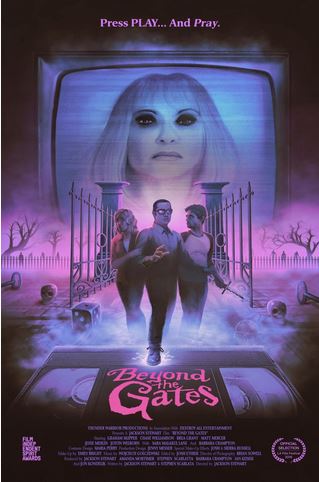
Beyond the Gates is like Jumanji if the titular game of that movie required a VCR to play. In it, a couple of estranged brothers meet up to close down their father’s video store after he turns up missing. They’re not too concerned about his absence because he’s an alcoholic who’s dropped out of their lives before, on and off ever since the boy’s mother died. The oddly unemotional hero of the film was a bit of a drinker, too, until the day he grabbed his girlfriend’s wrist a little too hard. Now he’s sworn off the stuff, a subplot which seems superfluous in the end.

An obvious influence on Beyond the Gates is the subgenre of horror films which were made for children in the 80s, such as Gremlins and The Gate. The movie is deliberately paced to reflect the slow-burn nature of those films, but I think the filmmakers miscalculated a little bit because a lot of the excuses to postpone the action are flimsy. For example, the boys now possess the key which unlocks the secret room in the back of their father’s shop, a room he forbade them from ever entering. You’re telling me that’s not the first place these guys would go snooping?

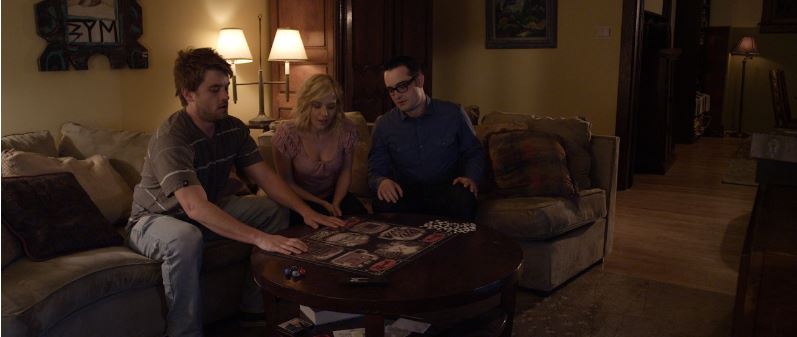
It’s in this room where they find the titular board game, which proves to be supernatural as the trailer promised. I’m not sure how much more I should give away about how the game operates. All the juicy stuff happens much, much later.

Unlike the aforementioned horror films made for children, this one is extremely bloody. It’s as if it were made for the kind of kids who grew up on movies like that, bearing in mind those children are adults now. The bloody bits are good, but few and far between. You might be saying, “Hey, Gremlins and The Gate were slow like that, too,” but I just watched the trailers for those films after watching Beyond, and they serve as a good reminder of just how much action those older movies actually had in ’em. In other words: a lot more happened in each of those films than this one.

This isn’t to say I didn’t like Beyond the Gates because I did, I just want you to know what you’re getting yourself into before you splurge on the $7 VOD price. Once again, Barbara Crampton (who takes a producer credit) proves she was born for movies like this and, despite routinely appearing in genre flicks, she’s played a bigger variety of character types than most A-movie stars have.

I wasn’t crazy about Beyond the Gates, but I found it to be pleasant to watch. I’m just not sure horror movies should be pleasant. Either way, I think these are all talented people and I’m excited to see what they do next.

The Exorcist (1973) [Midnight Movie]

Have you ever had an old friend you didn’t care much for until a chance meeting, years later, made you realize you’re head over heels in love with them? Me either, but that was what watching The Exorcist last night was like for me.

Yeah, I know. I should have always loved this movie. But I didn’t. Sue me.

In my defense, the only other time I saw the film in my adult life would have been around the time the director’s cut showed up on TV, a cut which doesn’t improve the film at all. In fact, it does exactly the opposite. I was too distracted by the cheap attempts at subliminal imagery, superimposed over otherwise flawless shots, and the inclusion of deleted scenes which were better left on the cutting room floor. I think they even touched up Regan’s vomit with CGI, if memory serves me correctly.

Long story short, my previous viewing had me repeating, “Are you fucking kidding me?!” I know it’s an old tune to sing, but aging movie directors shouldn’t be allowed to “improve” the films they made when they were young unless it’s an effort to undo changes made by third parties such as censorship groups or studio executives. It’s depressing to think the director’s cut is probably the only thing that gets shown in theaters anymore.

Unlike the original Star Wars trilogy, the theatrical cut of The Exorcist still exists and it looks amazing in HD. The first time I saw the movie was on VHS, which can’t replicate the grain and shadows the film wears so well. (If I ever get a chance to see an actual print of the film properly projected in a theater, I’ll take it in a heartbeat. It feels almost blasphemous to watch it digitally no matter how good home HD technology becomes.) The one and only problem seeing the film this clearly is the seams in Max von Sydow’s old age makeup become a little more apparent than they ever were on VHS.

I talked about the story elements in my review of the book yesterday, so I’ll skip to what makes the movie special. In the novel, it’s heart-wrenching when Chris MacNeil is taking little Regan to one medical specialist after another, but it has a slightly bigger impact in the movie even though that section of the story is reduced in length. Director William Friedkin reportedly hired real doctors and specialists to perform the procedures on Linda Blair’s character, which makes it all the more realistic and traumatizing. Actually seeing and hearing all those loud and crunchy machines is almost as visceral as the scenes of Regan’s possession manifesting itself.

The cast is top notch, too. The three adult leads (James Miller, von Sydow, and Ellen Burstyn) all embody the characters as they existed on the page. And I prefer Lee J. Cobb’s detective to George C. Scott’s portrayal of the same character in the third film. (Scott seemed a little to serious in contrast to Cobb’s geniality.) Casting a real life Jesuit in the role of Father Dyer is a stroke of genius, and I feel like I don’t even need to mention how good the 14 year old Linda Blair is in the movie, considering her performance has become legendary. (Come to think of it… why does she have so much trouble finding big movie roles these days? Did she play the part too well?)

Look, I was always wrong about The Exorcist… and I’m glad I was wrong because my most recent viewing feels like it was the first time. It’s one of the greatest movies ever made.