Witchboard (1986) | 31 Days of Gore

Despite seeing the terrible sequel twice, I had never seen the first Witchboard… or so I thought. About twenty minutes into the movie—too far along to abort—I remembered I had seen it and it wasn’t even that long ago. It later dawned on me that I must have watched it on The Last Drive-In, at which point an internet search revealed I had seen it as recently as 2023. This says less about how forgettable the film is and more about how many cocktails I drink whenever Joe Bob’s on. Don’t get me wrong: it’s probably forgettable to sober viewers, too, but it’s not terrible.

The film opens on a house party which introduces us to the heroine, Linda. Played by Tawny Kitaen, the gorgeous redhead from Bachelor Party, I always suspected she might have found greater fame if she had been a supermodel instead of an actress. Kitaen certainly punches above her weight here, coming off surprisingly natural despite a cast full of stiffs. What’s also surprising: the lofty ambitions of the screenplay, which assigns a backstory to both of the dimwitted male leads. Most films like this wouldn’t have bothered.

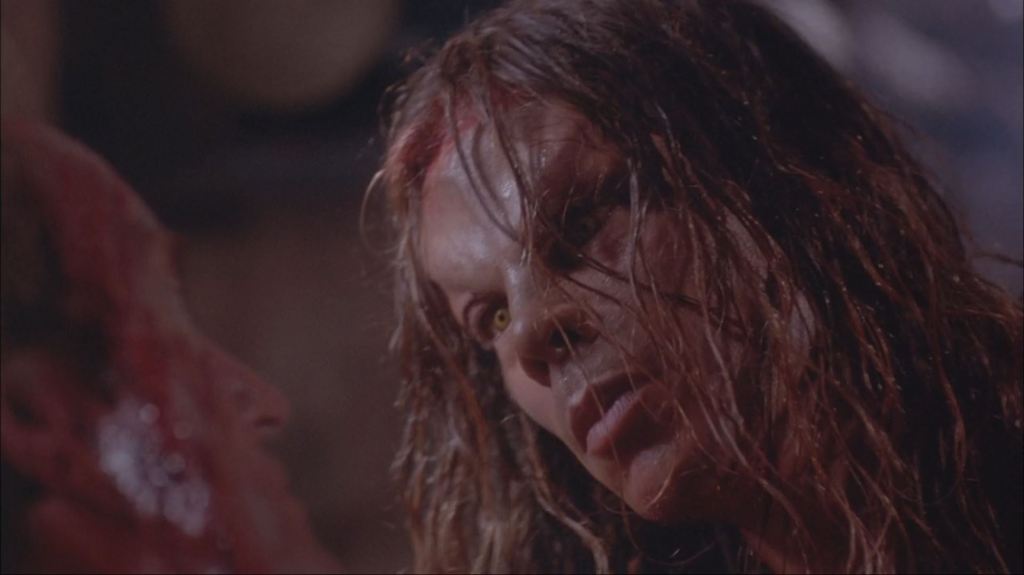
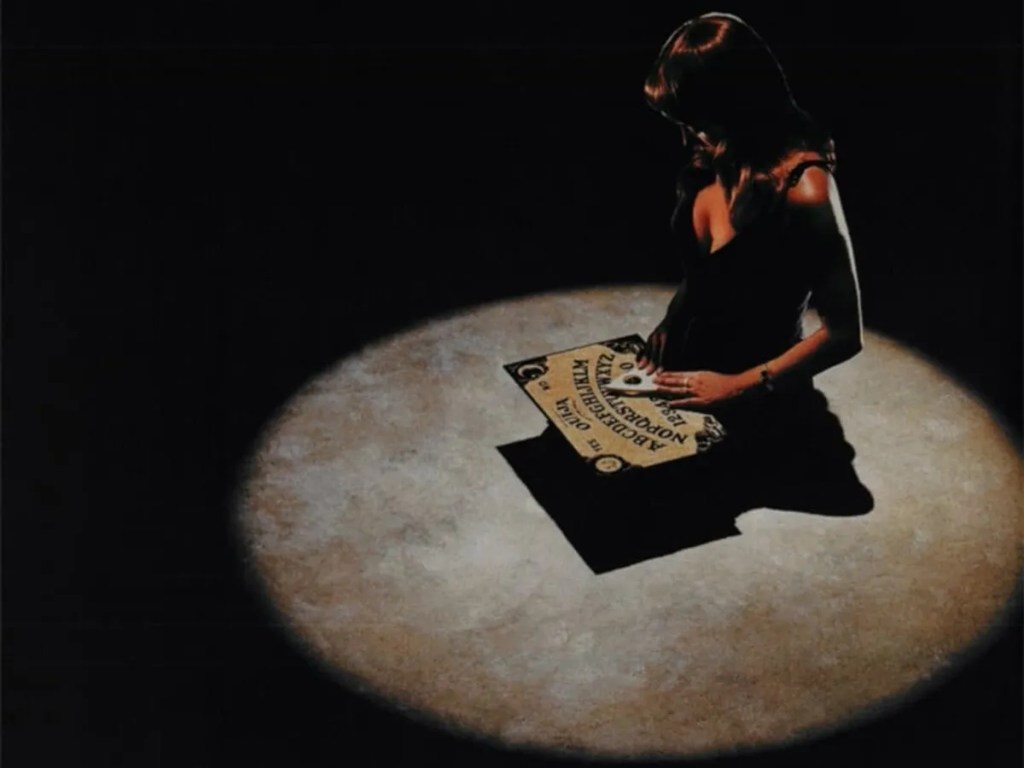
Linda’s boyfriend Jim is an alcoholic who ended up working in construction despite going to med school. Brandon is a smarmy socialite who thinks his former best friend took the path of least resistance. The two begin the movie at odds and ultimately team up to save Linda’s life. The reason they must save her: she’s become helplessly addicted to a Ouija board, convinced she’s communicating with the spirit of a ten year old boy. In reality, she’s unwittingly inviting a demonic presence to possess her body.

As the demon occasionally murders people peripheral to Linda’s friend group, Brandon recruits a psychic medium who’s gotta be in the running for the most annoying character ever put to film. The medium’s name is Zarabeth and the actress tries way too hard to be funny. I refuse to believe no one on the cast and crew realized this role was so obnoxious. It’s just that in the breakneck pace of low budget movies, you’ve kinda gotta commit to your decisions for better or for worse.

Despite the lack of gore, I don’t hate the movie and fans of 80s horror should find enough substance to entertain them. Unfortunately, there are only a few unintentionally funny moments and precisely zero intentionally funny moments that elicit laughter instead of eye rolls.
Hell Night (1981) | 31 Days of Gore

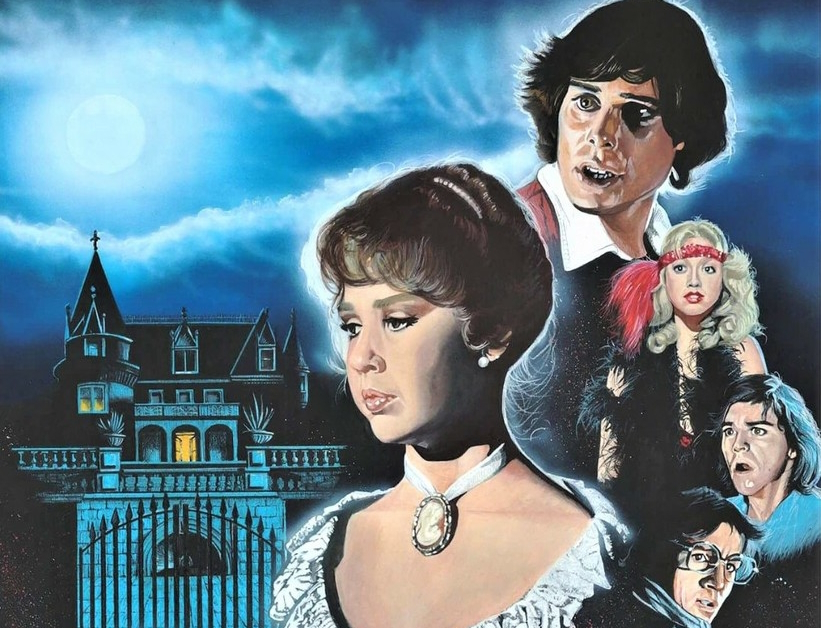
Hell Night opens with a bloodcurdling scream. The next shot reveals the cause of distress: a bevy of young women have just been soaked in a wet T-shirt contest. This is but one facet of the impressive party scene. The camera tracks along the street in a surprisingly technical one-shot, which ultimately settles on Alpha Sigma Rho, where coeds are hanging out of the windows and off the roof like drunken Muppets. It’s immediately clear this isn’t your run-of-the-mill slasher flick, shot in the woods for a scant hundred-thousand dollars. The film’s budget, north of a million bucks, puts it in the esteemed company of Friday the 13th, Nightmare on Elm Street, and Hellraiser.

The cause for celebration is the fraternity’s initiation ritual, in which pledges will be forced to spend the night locked in Garth Manor, a palatial estate whose gates, as one character puts it, “are nearly impossible to climb!” The pledges are a rich boy, a surfer dude, a party chick, and Linda Blair. I’ve long been fascinated with Blair’s post-Exorcist career, in which exploitation filmmakers desperately tried to pivot her into a wide range of roles before her stardom cooled. The filmmakers beg us to believe this cherubic young woman would turn more heads than the abundance of conventionally attractive babes at the party. You certainly couldn’t accuse Blair of ever being typecast, though, if only because she immediately aged out of the type that made her famous.

Just so we’re clear on what kind of movie Hell Night is, Garth Manor has been shuttered for decades, yet none of the college kids wonders why there are a hundred candles already burning when they arrive. After such a wonderful party scene, it’s disappointing that the film will focus on the four pledges, which greatly reduces the victim pool. Thankfully, three more characters will sneak back in to play pranks on the main characters. These pranks involve speakers, wired doors, and projection technology that’s clearly superior to the hologram that brought Tupac back to life more than thirty years later.

Someone begins picking off the dimwits as they inevitably find ways to split off from the group. Yes, it becomes a lot more routine at that point, but it’s worth noting that these tropes had yet to become old hat by the film’s release in 1981. Even if you won’t give it leeway for that, give it leeway for being better acted and better filmed than ninety-percent of these things. Hell Night is no classic, but I wouldn’t look at you sideways if you owned it on physical media. There are actually a couple of scenes that are surprisingly tense, one involving a character discovering that the aforementioned gate is topped with razor-sharp spires.

If you’re wondering why the horrors of Garth Manor have long remained dormant, only to reawaken on this particular night, who cares? A film like Hell Night doesn’t owe us logic, only thrills, and it pretty much delivers the goods even though it’s a little light on the gore.

Howling II (1985) | 31 Days of Gore

The full title is Howling II: Your Sister is a Werewolf. In some territories, it was Stirba—Werewolf Bitch, referring to the villain of the picture, played by Sybil Danning. I can sum up what kind of movie Howling II is by describing the end credits: a second-rate 80s song plays while the editors slap together a kinetic highlight reel, repeatedly including a shot of Stirba baring her breasts to the beat of the music. I am simply not objective enough to review a movie as shamelessly goofy as this. I literally could not dislike it.

My brain is telling me Joe Dante’s original picture is the better film with its ensemble cast of seasoned actors. My heart, however, is infatuated with this undeniably dumb blood-and-tits feature, which coasts on the singular presence of Christopher Lee as an occult private investigator. Any movie which concocts to portray Lee and Sybil Danning as siblings is immediately endearing, so it’s with a heavy heart I must report that Lee considered the film an embarrassment; he later confessed he only took the role because he had yet to do a proper werewolf picture despite appearing in a dozen vampire flicks.

Spoilers for The Howling follow….

At the end of The Howling, we saw Karen White transform into a werewolf and sacrifice her life on live TV to warn the world that lycanthropy is real. In this film, nobody seems to remember that this was clearly broadcast on live TV. Her brother, Ben (Reb Brown), is shown mourning what he believes was a senseless murder. At the funeral, werewolf-hunter Stefan Crosscoe (Lee) approaches Ben and informs him his sister is not really dead as the silver bullets were removed during the autopsy. Ben is understandably skeptical, but one of Karen’s news buddies (Annie McEnroe), convinces him to hear the hunter out. It’s not long before the three of them head to Transylvania to find the werewolves’ leader: Sirba, the werewolf bitch herself.

This isn’t your grandpa’s werewolf flick. When they aren’t feeding on innocent victims, the hyper-sexualized werewolves spend most of their free time throwing orgies (in and out of their hairy wolf forms) and preparing virgin sacrifices to maintain Stirba’s youthful appearance. Whenever Stirba is dressed, which is rarely, it’s in a costume that’s equally goofy and gorgeous, like something out of Flash Gordon. Danning is amazing in this movie, even going so far as to hold her own with Christopher Lee in the hilarious showdown at the end. It’s not that she’s rises to the occasion so much as Lee lowers himself to it.

Okay, it may not be better than the original picture, but it is a little more entertaining in some places. And if hairy tits are your thing, you’re gonna love this movie.

The Video Dead (1987) | 31 Days of Gore

The Video Dead is an amusing horror-comedy with better-than-average special effects and lower-than-average acting, though incidentals like that don’t matter when your movie is as charming as this. In it, a couple of latchkey kids move into their new house, days ahead of their parents who are currently living abroad. The boy gets the hots for the neighborhood blonde while the sister doesn’t do much of anything until the final act of the movie, at which point it’s suddenly revealed she’s our main character.

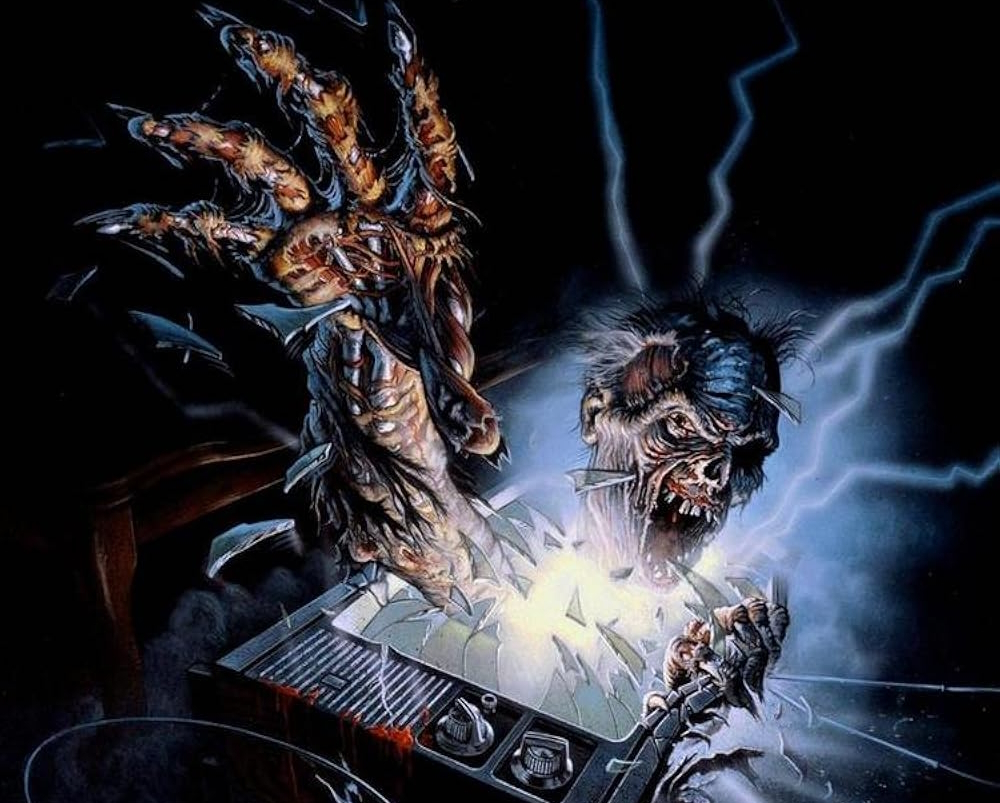
What the kids don’t know is there’s an evil television in the attic that’s capable of summoning the zombies from a generic horror movie. A Texas rancher arrives on their doorstep one day, having tracked the television set to their location. It turns out he’s the previous owner of the TV, which conjured the zombies that killed his wife. He warns the boy that he should place the television in the basement with the reflective side of a mirror strapped against its screen. Isn’t that a fun bit of world-building?

The DIY special effects are the biggest reason to watch this movie. What they lack in budget they make up for in design: every one of the zombies is distinct from the others. Taking a cue from the rambunctiousness of Gremlins, the zombies playfully enter their victims’ houses to try on wigs, glasses, hats, etc. Whenever one has her head sawn off, she picks it up and carries on without missing a beat. Another zombie has a clothes iron permanently lodged in his skull. This is the same rule cartoonists employ in their character designs: make sure the silhouettes are instantly recognizable and the audience will never confuse them with one another.

Also fun is the Texan’s expository dialogue, which conveys the mythological rules of the video dead: they don’t like mirrors, they only attack those who show fear, and burial doesn’t keep them down. Instead, one must dismember the Video Dead and leave the remains where they lie, letting nature reclaim them over time. Otherwise, they’ll just keep getting right back up and attacking over and over again. And instead of fortifying their home with garlic and crucifixes, the characters hang shards of mirror they can find on the front door.

The Video Dead has a “have camera, make movie” attitude. While it’s only slightly more than satisfactory, nothing in it is egregious or particularly insulting. It’s a pleasant watch for cult movie aficionados. I love that it exists. I’ll watch it again someday.

Piranha (1978) | 31 Days of Gore

Long before Joe Dante directed Gremlins and the vastly superior Gremlins 2 (fight me), he made Piranha for Roger Corman’s New World Pictures. Corman was hesitant to make a Jaws rip-off, as that movie was so good, but had no qualms about making a Jaws 2 rip-off, as that movie was so bad. Universal Studios considered suing Corman, but legend has it that Steven Spielberg himself intervened, having seen and loved an advance showing of the film; he would later hire Dante to direct a segment of The Twilight Zone movie and Gremlins.

In Piranha, a school of genetically modified piranhas are making their way down an unspecified North American river, eating everyone who’s unfortunate enough to be swimming in the their path. As luck would have it, the bloodthirsty fishies are on a direct course to a summer camp downstream, which just so happens to be holding swim-team tryouts that day. When even Friday the 13th films are reluctant to harm children, you can typically roll your eyes whenever most filmmakers employ children-in-peril scenes to build suspense… but this is a Roger Corman production, by god, and the legendary film producer is well aware that his fans would feel cheated if at least a few children didn’t die.

A spunky young private investigator (Heather Menzies), an alcoholic living off grid (Bradford Dillman), and the mad scientist responsible for the mutant fish (Kevin McCarthy) must race downstream to warn the camp counselors before the piranhas reach them. Unfortunately, the military arrests the heroes as part of a cover-up operation. I’m not going to dwell on why the military’s involved because the movie doesn’t care that much, either. Dante is only concerned with giving the audience exactly what it wants to see: girls in bikinis, bloody violence, and a stupendously fun climax that goes above and beyond what’s required of it.

It’s an acquired taste, to be sure, but few B-movies have embodied Roger Corman’s unique blend of subtle humor and self-awareness. He and the many filmmakers who got their start with him made these films for the love of the craft… so long as it the pursuit of art didn’t get in the way of a profit. I would describe Piranha as one of the quintessential Corman productions, right up there with Death Race 2000.

Dick Miller is fantastic as always and I’m always thrilled to see cult icon Barbara Steele in literally anything, but Kevin McCarthy’s mad scientist is chewing the scenery with the same gusto as Jack Palance in his later flicks. The novelty has worn off for the modern day imitators—the cocaine bears, the meta anacondas, the hybrid animal-disasters with loads of horrible CGI and too much winking at the camera. The B-movie used to be a sacred thing, the only place you could get cheap thrills and fucked-up laughs, but there used to be an art to it. I can think of few examples better or more authentic than Piranha.

Mind Ripper (1995) | 31 Days of Gore

Mind Ripper supposedly began as a sequel to The Hills Have Eyes II. Wes Craven, who produced this film (co-written by his son), apparently had a last minute change of heart, removing all references to those other films. I’m going to guess it was because he didn’t want to smear the reputation of his duology once he saw how poorly this project was shaping up.

A group of research scientists, led by Lance Henriksen’s character, discover a John Doe in the desert outside their secret facility, left badly injured from a failed suicide attempt. It just so happens the scientists are developing a regenerative tissue serum that is the man’s only shot at survival. After wrestling with the moral implications for all of sixteen seconds, the scientists inject the serum into their unwitting test subject. Sometime in the following months, Henriksen grows a conscience and quits his job to spend more time with his kids: a young Giovanni Ribisi and a daughter whose boyfriend is constantly trying to screw her, even when her dad’s in the room.

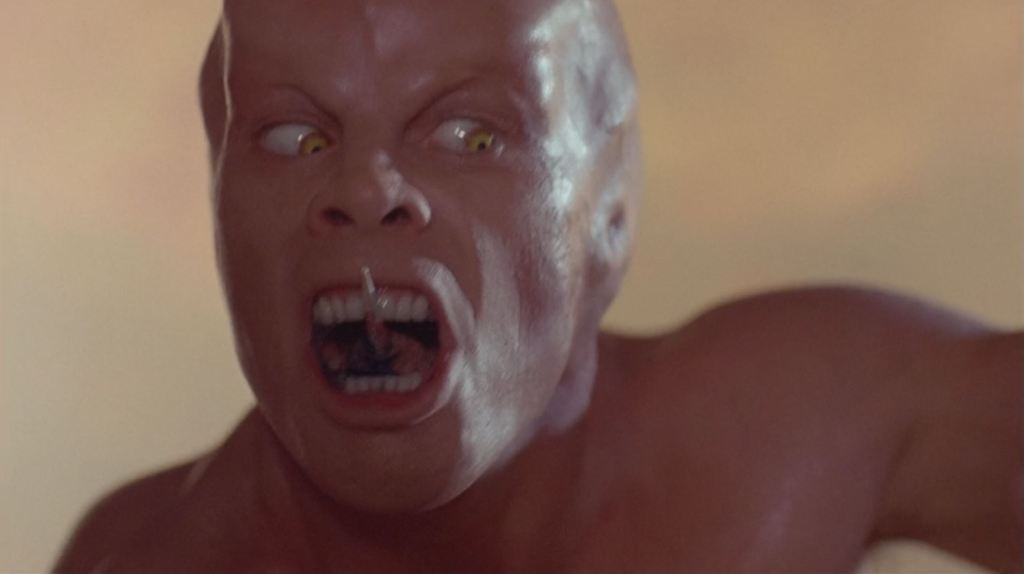
As expected, the John Doe breaks free of his confines and hides in the shadows of the ventilation shafts, picking off the scientists one by one. We’ve all seen this monster-in-a-facility movie a hundred times before (this my second one this month!), only this time the monster is played by a rather human-looking young man, nicknamed THOR (trans-human something-or-‘nother), until the filmmakers finally slap a pair of yellow eye contacts on him. THOR is played by Dan Bloom, a long-haired fella who has a number of credits playing the hunky bimbo on shows like Married with Children, Baywatch, and HBO’s Dream On.

THOR’s ineffectiveness as a movie monster is not a failure of the actor. In fact, Bloom brings a surprising amount of physicality to the role, lending the film its best scenes. Late in the movie, he’ll undergo a tame metamorphosis in which his ears and hair fall off while a sufficiently gross tentacle occasionally emerges from his mouth to suck his victim’s brains out of their skulls. The gore scenes are few and far between, but they are up to snuff whenever the camera doesn’t cut away prematurely.

The biggest groaner: THOR catches our heroes, kills all but one, then awakens from a nap. It turns out it was all just a dream, deep in the third-quarter of the game—much too late for such a play. It’s the first time during this year’s 31 Days of Gore that I call shenanigans. Yellow flag on the field. 25 yards to the away team.

Mind Ripper is one of the more competent Alien rip-offs, but that’s not saying much. It’s too long, too bland, and stiffly acted. There’s nary a reason to watch it, even for horror junkies. I confess a certain nostalgia for this era of cheap brain candy, but even I was unmoved for much of it. I was on the fence on giving it a passing grade for the gore, but unfortunately there just isn’t enough to justify it. I don’t hate it, but I don’t like it very much, either.

The Rule of Jenny Pen (2024) | 31 Days of Gore

Geoffrey Rush is Stefan Mortensen, a proudly independent judge who suddenly ends up in an assisted living facility after suffering a stroke. The staff encourage the curmudgeon to make friends with the other residents, but he insists he’ll only be there long enough to recover the ability to walk. He thinks of himself as too good for the situation as a way to distance himself from his new reality. Even as others extend an olive branch, he quickly pushes it away.

Enter John Litghow’s character, Dave Crealy, who terrifies the other residents into submission. Despite his advanced age, Dave is a dimwitted bully, forcing his way into the community dance to step on toes and collide with the other residents to ruin their fun. With a clear understanding of the facility’s bureaucracy, he wears the guise of senility so that he can get away with his psychopathic antics. Lithgow has been relishing villain roles for more than forty years and he’s at his nastiest here. It’s as if his mean-spirited character from Cliffhanger entered assisted care.

A permanent fixture of Dave’s wardrobe is his hand puppet, which he named Jenny Pen for reasons unexplained. Whenever he’s feeling especially cruel, he flips the puppet upside down and forces his elderly victims to “lick Jenny’s ass,” or in other words: his wrist. What’s especially effective about Dave’s puppet is the fact it has no eyes; as light shines through the rubber skull, it makes the void beyond Jenny Pen’s eye sockets turn an unsettling shade of pink. Dave and his puppet’s antics are cruel, darkly funny, and terrifying at the same time.

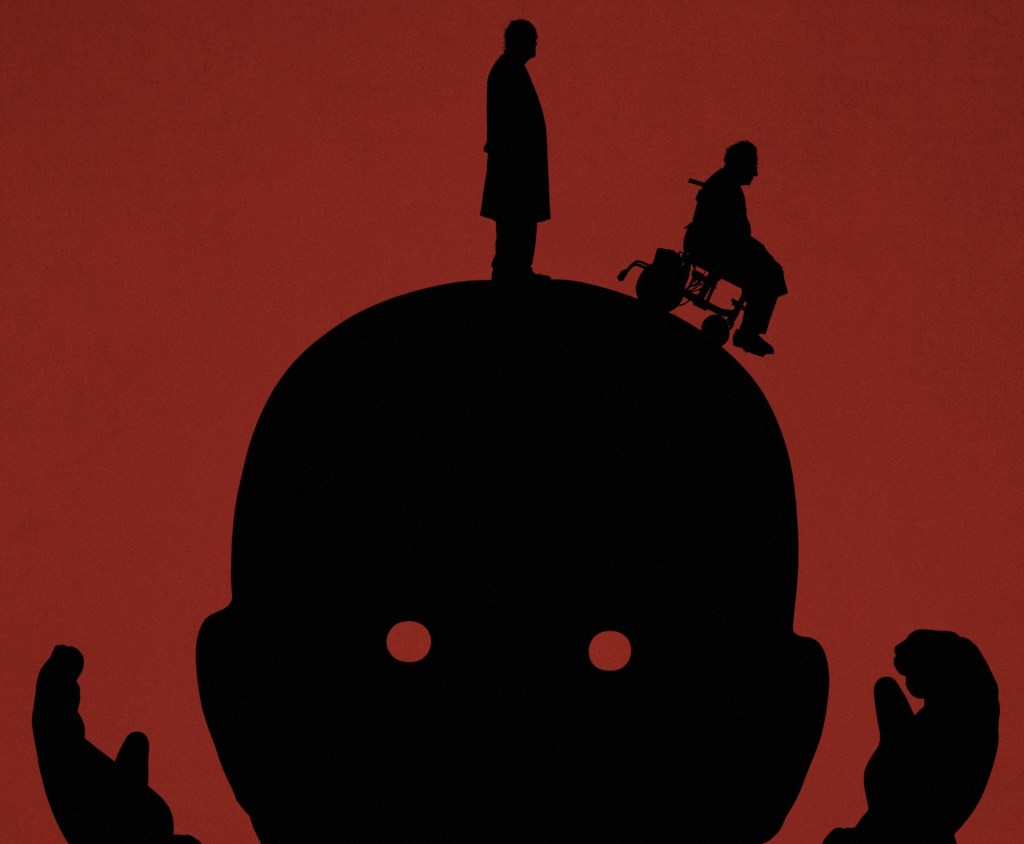
It’s not long before Dave targets the cantankerous judge as he’s the only one of the residents whose will hasn’t been broken. Dave enjoys free range of the coop as no one else will corroborate the judge’s stories in fear of what Jenny Pen will do in retaliation. Worse, the staff believe the judge is suffering from night terrors and possible dementia as his condition worsens; whereas lesser horror movies often go for the “no one believes the main character” angle in the face of logic, this movie goes to lengths to prove Dave is cunning enough to get away with his antics. What unravels is a cat-and-mouse game in which the mouse is confined to a wheelchair.

It’s rare to have performers as great as Rush and Lithgow slumming it up in a genre movie. This isn’t elevated horror and it doesn’t have anything Important to say… in other words, its greatest strength is pure storytelling (which in my opinion is how you make a movie on hard mode). Years ago, I wrote that the reason Child’s Play is such an effective film is because there are few scenarios as unsettling as a mother unknowingly tucking her child in with a serial killer every night. That’s exactly the kind of diabolical writing on display in The Rule of Jenny Pen.

Dead Space (1991) | 31 Days of Gore

Dead Space (no relation to the awesome video game of the same name) is a movie for those of you who thought Forbidden World was too exciting. It’s a routine Alien knock-off that at times aspires to be The Thing, but in the words of Butt-Head, “These effects aren’t very special, huh-huh.” There are numerous reaction shots of the actors watching the monster scurry across the room, but it feels like the second unit forgot to shoot all the pickup-shots of the monster itself. The monster constantly evolves throughout the mercifully short runtime, but the metamorphoses typically take place off camera.

The film opens as Commander Krieger and his robot sidekick pal around the galaxy, battling space pirates. The exterior shots of the opening battle are lifted directly from Roger Corman’s Battle Beyond the Stars, so incompetently edited that I initially thought the hero’s ship exploded at one point. Badly needing repairs, Krieger and his robot buddy head to the nearest planet. Thus ends the most exciting scene of the movie.

The scientists who reside on the planet are led by a thirty-five year old Bryan Cranston, who refuses to pull the plug on the dangerous lifeform they’ve created. Mere seconds after showing the pint-sized creature to Krieger, the creature escapes and kills one of the scientists. Wisely, the scientists band together until it’s time to split into pairs for casual sex. The monster attacks again and we’re treated to plodding shots of the heroes looking for the monster and fleeting shots of the monster itself.

Briefly, the monster breaks free from the confines of the cheap set. Krieger and his faithful robot companion hunt it across the alien landscape, which looks suspiciously like Vasquez Rocks disguised with a blue filter and fog machines. At one point, Krieger falls forty feet from a cliffside and lands on the rocks below. Regardless, he’s up and attem after a minute of masculine grunting.

The film’s most grating habit is the half-baked technobabble. The screenwriter clearly has little knowledge of infectious diseases, but insists on having the scientists talk about virology at length. They call the creature itself a virus, long after it has evolved past the point of requiring a microscope to be seen. And if you’re wondering what the scientists were up to in the first place, their plan was to create a virus to counter another virus ravaging the galaxy, which is clearly supposed to be Space AIDS. I’m not sure their science checks out.

If, like me, you thought the novelty of seeing a young Bryan Cranston in a cheesy B-movie sounds fun, you’ll be massively disappointed. Dead Space is far too bland to be “so bad it’s good.” It’s dull and run-of-the-mill in every way. I’ve had paper cuts more enjoyable than this movie.

Dolls (1987) | 31 Days of Gore

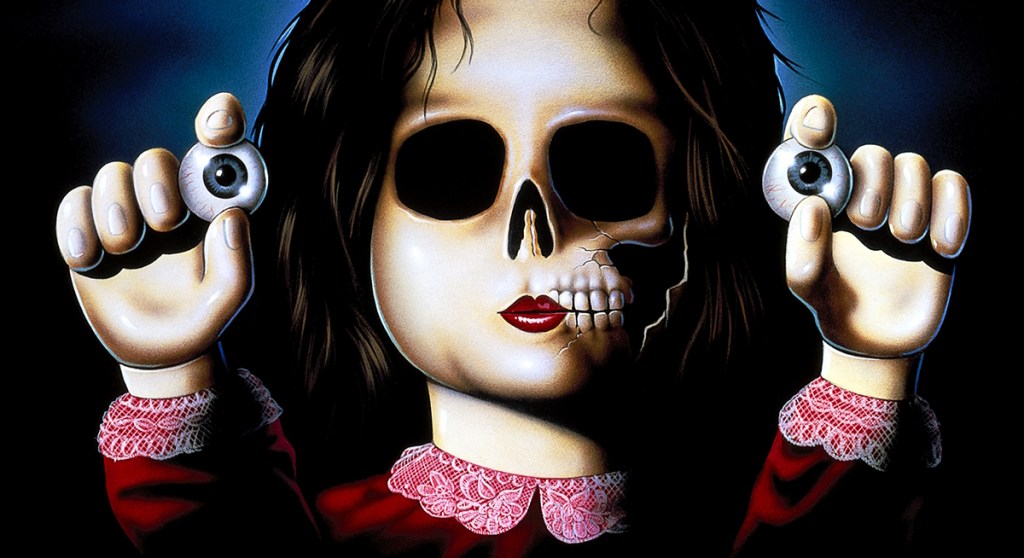
My favorite thing about killer dolls is the amount of effort they have to put into killing you, what with their tiny weapons and all. The mental image conjured by Richard Matheson’s 1969 short story Prey, in which a relentless doll tries to stab the heroine’s feet through the crack beneath her bathroom door, has stuck with me for life. You will find no shortage of forum posts proclaiming that “the scariest doll of all time” as it was later adapted in one-third of the Karen Black anthology film, Trilogy of Terror.

Look, toys that kill are irresistible. I don’t think there’s a kid in the world who didn’t wonder if the silhouettes of their toys were watching them after bedtime. The only thing that unnerved me more was spending the night at a friend’s house who had that Bo Jackson poster, the eyes of which seemed to be looking at you no matter where you were in the room.

In Stuart Gordon’s Dolls, a family of three end up stranded by a thunderstorm that leaves their car stuck in mud. The little girl’s name is Judy and she’ll be our main character. Her father’s a mentally abusive alcoholic and her step-mother (played by Gordon’s wife, Carolyn Purdy-Gordon) is a cartoonishly evil bitch. When they finally decide to abandon the car, the step-mother takes Judy’s teddy bear and flings it into the shadows of the woods, just to see the girl’s distraught expression.

The family then seeks cover at a nearby mansion, which resembles a spooky castle. The elderly owners (Guy Rolfe, of Puppet Master fame, and Don’t Look Now’s Hilary Mason) are hospitable to the unwitting guests who—surprise-surprise—were expected all along. Three more hapless visitors wander into the house that night: a couple of punk rock chicks and Ralph, the naive schlub who was dumb enough to pick them up on the side of the road. The homeowners invite all six of the visitors to stay the night while they weather the storm.

As the punks scheme to rip off the old couple’s valuables, the estate’s patriarch takes a liking to Judy and the childlike Ralph as they’re the only ones who don’t roll their eyes at his love for toys. See, Guy Rolfe’s character is a doll maker and, although it isn’t officially revealed until the end, it’s not really a spoiler to reveal his wife is a witch. Together, the two of them craft animated dolls that defend their home from the ne’er-do-wells who (for reasons unexplained) are attracted to it like magnets.

Par for the course, the killer dolls mostly operate in the shadows until the second half of the film, at which point dozens of the suckers will come to life through David Allen’s smooth stop-motion effects, reminiscent of those on display in Gordon’s Robot Jox and the early Puppet Master films. I’m not sure what proprietary magic Allen employs in his animations, but I suspect there are dissolve cuts between frames like an early implementation of interpolation… or something? Beats me, but it’s pretty distinctive.

Dolls is a pleasantly paced horror movie along the lines of Tourist Trap and Motel Hell. There’s a gentle upward curve to the awesomeness at the end and there are plenty of characters you can’t wait to see die along the way. While it’s not quite as enjoyable as Stuart Gordon’s Re-Animator or From Beyond, I don’t think you have to be a competitionist to find joy in this flick.

The Howling (1981) | 31 Days of Gore

It’s the tenth anniversary of 31 Days of Gore, in which I feature one horror movie each day for the month of Halloween.

I’m in love with the way director Joe Dante opens The Howling: in the fast paced world of a television news station. Behind-the-scenes personnel are rushing around as the on-air talent get into makeup. Meanwhile, Karen White (Dee Wallace) is nervously walking down the scuzzy, neon-lit streets of Los Angeles’s grindhouse district, wired with a radio that’s transmitting her voice to the police. We have no idea what’s going on at first, but it’s instantly engaging as Dante drip-feeds the information to the audience.

We eventually learn that Karen has agreed to take part in a sting operation to catch a serial killer (an exceptionally effective Richard Picardo) who has become infatuated with her. The killer instructs her to meet him in the back of an adult video store containing a private movie booth. Once there, the killer forces her to watch a snuff film of his own making before the cops manage to shoot him dead. Karen is so traumatized by the event, her therapist suggests she should vacation at the countryside resort where he treats patients in a group setting.

While Karen finds trouble connecting with her husband intimately (whenever he tries to kiss her, she flashbacks to a close-up of the killer’s flickering tongue), her newsroom buddies discover the killer’s body has gone missing from the morgue. Their investigation leads the reporters to an occult bookstore run by Dick Miller who, as far as I’m aware, has never not appeared in a Joe Dante film. Miller tells the reporters they may be dealing with a werewolf and suggests they buy a box of silver bullets. When they ask him if he really believes in that kind of stuff, he replies, “What am I, an idiot? I’m makin’ a buck here!”

I don’t want to spoil who’s a werewolf and who’s not, but I will say the reveal is amusingly macabre. There’s a huge cast of character actors including Christopher Stone (who Dee Wallace married in real life), Kevin McCarthy, John Carradine, and Slim Pickens. Dante also packs the film with uncredited cameos by his buddies: Roger Corman, Forrest J. Ackerman, John Sayles (this film’s writer), and Mick Garris were the ones I recognized. I’m sure I missed others.

While I think the showdown between Karen and the killer should have been a bigger deal (and a little less routine), the finale does not disappoint. We also see what has to be the longest werewolf transformation ever captured on film, the effects of which are provided by Rob Bottin, who would later go on to work on The Thing. Rick Baker is also credited for the effects, though he jumped ship (with Dante’s blessing) to work on John Landis’s An American Werewolf in London, which is overall the inferior werewolf film in my book.

By my count, there are two similarities between this picture and Romero’s Dawn of the Dead: both films open in a news station and both films feature unusually strong character work in their middle sections. In this film, John Carradine’s character watches two young lovers on the beach with a sense of longing and regret that’s expressed entirely without words. It’s a moment that’s extremely rare in these types of movies, elevating it to one of my favorites.