Never Sleep Again: The Elm Street Legacy

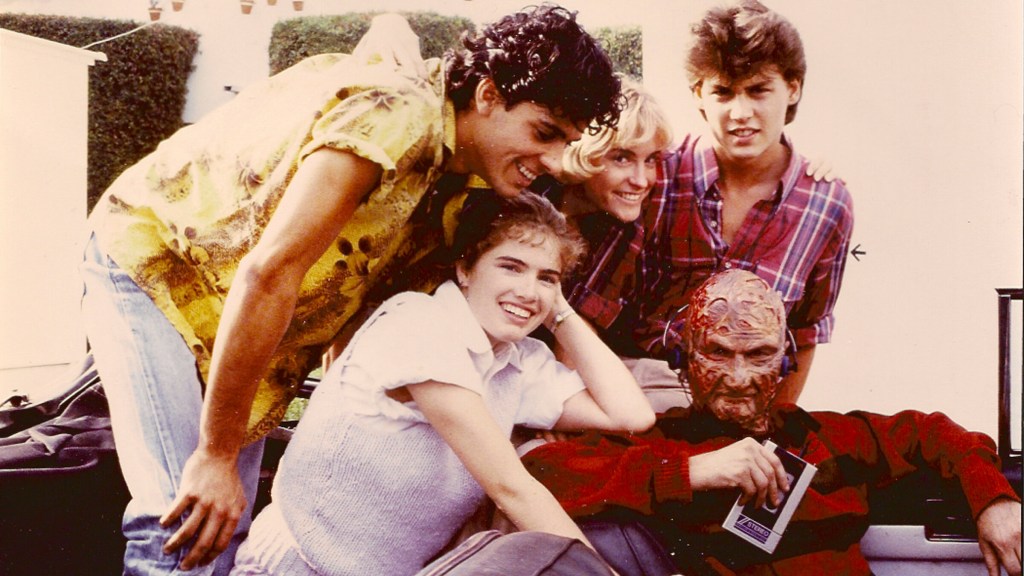
I never expected to sit through all of Never Sleep Again, the four-hour documentary about Freddy Kruger movies, in one go. I just wanted something to watch while I ate an ice cream cone and took a break from Watch Dogs. I loved Freddy movies when I was a kid (one of the first things I ever wrote was a Freddy fan fic about his estranged brother, Eddie Krueger… Evil Dead’s also Ash Williams made an appearance), but at this point I probably haven’t seen a Freddy movie in ten years.

Narrated by Heather Langenkamp, who was Freddy’s first “final girl,” Never Sleep Again is a surprisingly entertaining behind-the-scenes piece of fluff. Born from Kickstarter, I expected low-quality fan service, but it brings the goods. There’s a healthy portion of footage that was censored in the theatrical releases, a handful of deleted scenes, and information about an unproduced script co-written by Peter Jackson. Of the many interviews, Robert Shaye and Wes Craven are especially candid about what they liked and didn’t like in the series.

For me, the most perplexing and unintentionally hilarious scene has always been the exploding parakeet in A Nightmare on Elm Street 2: Freddy’s Revenge. See, a parakeet blows up in midair and the main character’s father (Clu Gulager) suspects a natural gas leak before blaming it on a cherry bomb. I always wondered how that came about. How does something so stupid get written, much less filmed? Never Sleep Again sheds some light on the scene, but not much.

The time devoted to Elm Street 2, by the way, is the high point of the documentary. Either I don’t remember picking up on the homosexual undertones or I was too young to notice. Cracked named it the most unintentionally gay horror movie of all time. The actor who portrayed the main character says his Risky Business homage is often looped in gay bars across the country.

My favorite had always been the third one. They brought Nancy back and included adult characters who weren’t just “angry parent” stereotypes who seemingly hated their children. The arm-tendon marionette scene is burned into my memory. To this day, I remember the cross-shaped faucet handle that grabs back every time I see such a fixture.

So how did they get Dick Cavett to do a cameo in their scrappy little horror movie? Easily. They simply told him Freddy would kill any celebrity of Cavett’s choice. Naturally, he chose the “stupid” Zsa Zsa Gabor. That’s exactly the kind of production detail that makes Never Sleep Again a very watchable film.

The best part is how every one of the interview subjects look back on their experiences with fondness. For many, Freddy was their only brush with Hollywood. Others have had success elsewhere, but not quite as big. Robert Englund, who one might suspect resents Freddy, says, “Freddy has been very kind to me” towards the end of the doc. You get the sense that almost everyone who worked on the series had a blast. I have a new appreciation for the films.
Splice isn’t what you think it is

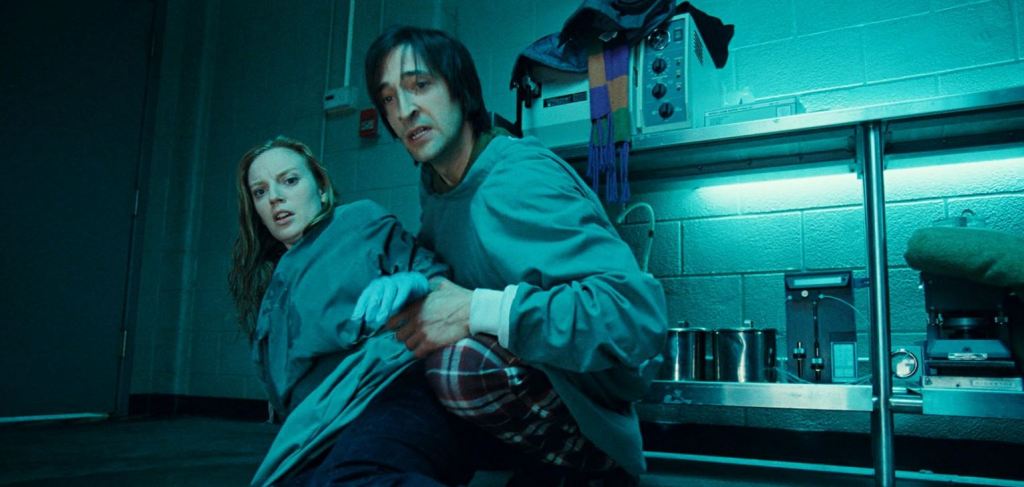
Behold: the birth of a human-designed creature! It’s the second of its kind—a gross, slimy monstrosity about the size of a football. The scientists responsible, who happen to be dating, are Elsa and Clive (Sarah Polly and Adrien Brody). They drive a Gremlin. They eat pizza at work (because movie scientists always eat pizza). They think their designer creature is cute. And this will become relevant later on: Clive wants kids while Elsa doesn’t mind waiting.

The scientists are on the cusp of curing all the bad things that tend to happen to the human body. Naturally, bureaucrats conspire to take the project away. The scientists’ lofty goals simply aren’t profitable to the company’s investors. Polly pushes forward with the research anyway. It results in something that resembles a human fetus outside the womb. Now they’ve got something on their hands that was highly unethical to make in the first place. Getting rid of it is even more so.

The scientists attempt to keep the creature a secret, but this causes one complication after another. And if you’re anything like me, you’ll be waiting for the routine horror stuff to begin any second. Thankfully, the movie doesn’t become routine until the last seven minutes or so. By then, it’s earned it. Its horror is bizarre, cerebral, and wonderfully gross a lá David Cronenberg’s The Fly. The “monster” (and I’m really trying not to give too much away here) has more in common with Frankenstein’s than you might suspect.

So do you like body horror? This picture’s got it. You like dance scenes? There’s a pretty unique one, I guess you could say. You like movies that really aren’t for the faint of heart? Then step right up. Sure, sometimes you kinda know where it’s going, but that’s part of the fun: watching characters on a slow motion collision course with outcomes that could have been easily avoided earlier, but can’t be avoided now.

Event Horizon doesn’t affect the outside observer

When Sam Neill attempts to explain black holes to his crew members, they roll their eyes. One says, “Singularities? Speak English!” I can’t imagine a depressing future in which people who live in space are lost at the mere mention of singularities, but Paul W.S. Anderson apparently can. He’s the guy who made Mortal Kombat, Resident Evil, and Alien Versus Predator. He’s got as much taste as a toenail.

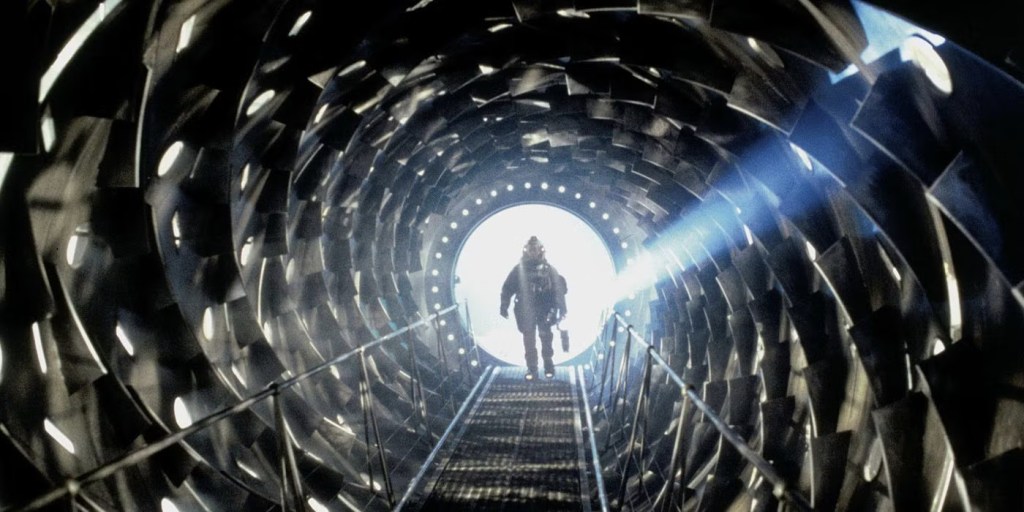
The Event Horizon, an interstellar ship with an experimental gravity drive, has vanished. Seven years later, it mysteriously reappears, orbiting Neptune. A second ship is sent to investigate. Sam Neill is the scientist who designed the Event Horizon, Laurence Fishburne is the captain, and Kathleen Quinlan looks great in a tank top. Due to unforeseen circumstances, the rescue vessel is damaged and the crew have to swap ships. Unfortunately, the Event Horizon begins to make the characters hallucinate. We’ll soon find out it’s been places it shouldn’t have been and brought something sinister back with it.

It’s fair to compare Event Horizon to Alien, even though that’s like comparing restroom graffiti to Picasso. On second thought, it’s actually among the better Alien rip-offs (and some of the official sequels, to be honest), because instead of yet another alien running around, it at least tries to do something different with the supernatural angle. I often see Event Horizon regarded with reverence in movie forums, and I certainly see why others love it, but I just wish it were a little more fun.

To be clear, it’s okay for horror films not to be fun, but those need to be exceptionally good in other ways. Event Horizon is not exceptionally good in any way. It’s not just joyless, it’s pointlessly joyless, partially because the director has the emotional complexity of a housefly. Compare it to another Sam Neill horror movie, one that’s also as serious as a heart attack: Possession. That’s a movie that actually has something to say and it’s even more unsettling than this one.

I’ll be the first to admit Event Horizon isn’t without merits. The set designs look fantastic, though there’s no logical reason for the maintenance lighting to turn eerie colors or for there to be a hundred headlights all over the wormhole generator. The CGI is terrible, but the rest of the special effects are top notch. I’ve heard tale that there’s a more graphic cut somewhere in the studio’s vault. I have the sneaking suspicion that’s a better film than this, the watered down theatrical version. I would be extremely interested to see it some day.

As is, Event Horizon just isn’t my cup of tea. Almost, but not quite.

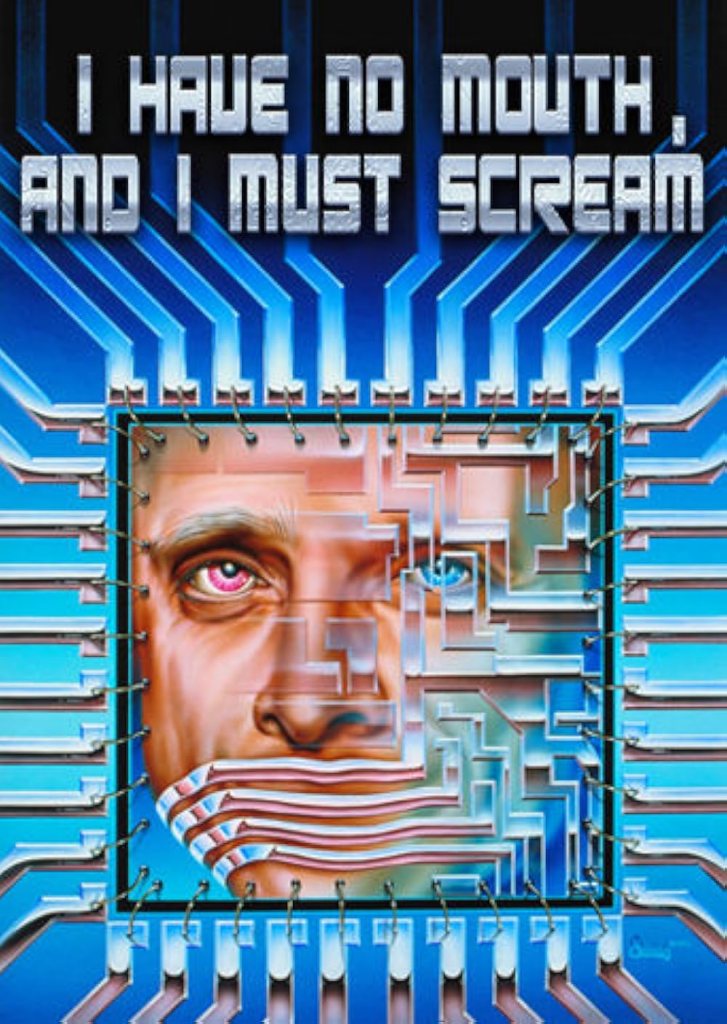
I Have No Mouth and I Must Scream: The Game (1996)

I miss The Sci-Fi Channel in the early nineties. It was weird and kooky, a far cry from the tamed content that occupies its programing today. The scrappy little station introduced me to Harlan Ellison when I was like ten or eleven years old. In those early days, Ellison had been hired as the channel’s version of Andy Rooney; his brief but audacious opinion pieces provided filler, often necessary as the oddball programming rarely conformed to 30-minute slots. The incredibly egotistical Ellison never had anything to say that wasn’t a hot take, and although he was often abrasively wrong, he was almost always right.

I actually remember the first time I saw a magazine advertisement for the video game adaptation of Ellison’s I Have No Mouth and I Must Scream. I had a similar reaction when I first heard the term “cyberpunk:” I didn’t know what it was at the time, but I instantly knew that I liked it. I am now thirty years old and I Have No Mouth is still on my short list of favorite stories of all time. It’s very much required reading before playing the game (and, luckily, it’s not hard to find on the internet in its entirety).

Ellison himself voices AM, the supercomputer which ultimately exterminates humankind, saving only a handful of humans it immortalizes for the purpose of torturing forever. In one interview for the game, Ellison insists AM is not evil, but an amplification of human nature itself. After all, humans are AM’s creator. It was our own shortcomings and self-hatred that ultimately took root and spun out of control in its circuitry.

The game deviates from the source material with Ellison’s input. Ellison initially told the lead designer he wanted a game you cannot possibly win, a game that taught you “that if you cannot win the game, at least you can lose better.” The designer pushed back, tampering Ellison’s famous disdain for his fans. I have not seen any of the good endings, but how good can they be when, at the end of the day, the player-character still lives in a world in which a computer has, for all intents and purposes, made humans extinct?

It won’t be long until the player is confronted with a “motivator switch,” just to find its sinister purpose: the torturing of six caged animals. The player-character reacts appropriately with shock, but it’s something you must do in order to progress. It’s grim choices like these that makes the game as uncomfortable as it is fun (Ellison said he wanted a game that “taught ethics”). Like a lot of games of this type, I Have No Mouth and I Must Scream requires some hit-and-miss puzzle-solving, but when you stumble onto a solution, you’ll often slap your forehead and say, “Of course!” It may seem silly removing the sheets from two bunks, but here’s a hint: they make a good rope.

The artwork and the music are fantastic. The voice work isn’t the best I’ve heard (Ellison really hams it up), but for some incredibly odd reason, it works.

Evil Dead 2013: Dead by Yawn

“It’s a few hours until dawn.”

“We’re not going to be alive to see it.”

When the credits rolled, many applauded. Teenagers were so engaged, I didn’t see a single phone screen light up. As I made my way out the doors, I overheard a much older woman tell a friend, “I didn’t care much for the gore, but I just loved the supernatural elements.” I don’t know if that says more about the movie or the changing times, but we’ve come a long ways since the original Evil Dead ended up on the infamous Video Nasties list. I felt somewhat baffled as I made my way out to the car. One thing kept repeating in my head: That’s it?

Look, I’m probably in the wrong here as this movie is doing gangbusters. Intellectually, I know Evil Dead 2013 isn’t a bad movie. It may be exemplary for the kind of horror we’ve been getting lately. The trailers played before the film can attest to the fact: Hollywood horror is in a dull, joyless rut at the moment. I always loved Evil Dead films (when I was a kid I went as Ash for Halloween two years in a row) so it’s disappointing to report I never felt moved—even as everyone around me reacted to the jump-scares. I think I would have enjoyed it much more if it weren’t an Evil Dead movie.

This time, most of the five characters who end up at the infamous cabin in the woods are cardboard cutouts. The main character, Mia (Jane Levy), is a heroin addict who’s trying to kick the habit through seclusion. As expected, an ancient tome is found, incantations are spoken, and an evil is unleashed via flying photography. Despite the great special effects (they promised no CGI, but I feel that’s not entirely true) I just don’t care when a character cuts her tongue in two or when someone dismembers a friend.

Chekhov’s Gun states: If a gun is shown in the first act, it must be fired by the end of the third. Here it’s a nailgun, an electric carving knife, and a cellar step that’s going to break exactly when we expect it to. I’m not giving anything away. You’ll see it coming from a mile away, too.

I feel like I just left a funeral. Bruce Campbell recently announced they’re making Army of Darkness 2, but I’ve heard that one so many times I won’t hold my breath. Their tentative plans to make an Evil Dead 2 in this universe and combine the subsequent sequel with Army of Darkness 3 (yes, part 3) isn’t clever, it’s confusing. And let’s face it: it’s not gonna happen, either.

I gotta admit, though: Mia picked a hell of a day to quit heroin.

The Frighteners is a mildly likable mess

I like rules in science fiction. Any kid knows Dracula shouldn’t walk around in the daytime without slathering on a gallon of SPF 100. When Isaac Asimov invented The Three Laws of Robotics, it didn’t restrict his work, but created a rich and believable universe for his stories. You don’t feed a mogwai after midnight, you never cross the streams, and you should always be careful what you wish for.

The problem with ghosts is they have no rules. Silver bullets don’t work. You can’t hammer a stake into their hearts. They don’t have a brain to destroy. In the 1999 remake of The Haunting, ghosts could do anything or nothing at all, depending on what was convenient to the plot. Some of the same problems are present in The Frighteners, in which ghosts fall through walls when they try to lean on them, but they can walk around on floors and ride in cars.

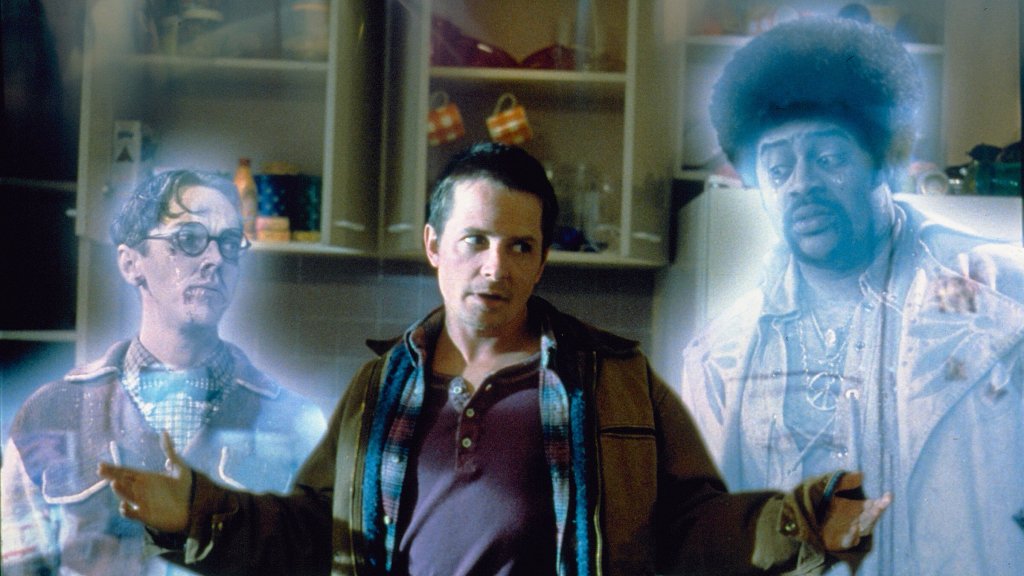
Michael J. Fox plays Frank, a former architect who got into a car crash which killed his wife. Somehow the near death experience gave him the ability to see ghosts. Now considered a crackpot in his community, his only friends are ghosts who haunt houses so that Frank can make a buck as a conman exorcist. One day Frank notices a spectral “37” written on the forehead of a man who later turns up dead; it turns out something otherworldly is killing people and only Frank can see who’s next.

I disliked The Frighteners when I originally saw it, probably because I was an edgy teenager who cherished director Peter Jackson’s ultra-gory Bad Taste and Dead-Alive. I decided to give it a second chance today. Though my opinion has definitely softened, it still doesn’t hold a candle to those aforementioned films. During my most recent viewing, I was even invested until the tiresome climax, which seems to drag on for far too long.

Touted as a horror-comedy, the humor feels like an afterthought. Someone with money on the line probably thought it was too dark and hired a script doctor to “make it funnier.” As a comedy it doesn’t work for me. Having an elderly ghost screw a mummy is a dumb joke, far beneath the talent who made Heavenly Creatures. It’s especially confusing that Frank’s maniacal driving is a running gag, when his driving his what killed his wife in the first place.

I’m a big fan of Jeffery Combs, but here he channels Jim Carrey just a little too much as he rips off Major Toht from Raiders of the Lost Ark. In that movie, there’s a wonderful gag in which you think Toht’s about to torture Marion with a mysterious device that turns out to be nothing more than a collapsible coat hanger. In this movie, Combs reaches into his jacket and, instead of the expected gun, he draws an inflatable donut. Hilarious.

So no, The Frighteners doesn’t work as a comedy. It barely works as a horror film, but it looks amazing. If you’re not watching it on a modern display, you’re missing out. The best shots are contained in the opening reel, but there are breathtaking views peppered throughout. Then there are the special effects, which must have been a logistical nightmare for the filmmakers, but they pay off in a big way. Wikipedia says:

The visual effects were created by Jackson’s Weta Digital, which had only been in existence for three years. This, plus the fact that The Frighteners required more digital effects shots than almost any movie made up until that time, resulted in the eighteen-month period for effects work by Weta Digital being largely stressed.

Also worth noting is Trini Alvarado, who doesn’t have a whole lot to do as the leading lady, but she does it exceptionally well. She’s simply one of those people you like to watch. And Michaeal J. Fox has always been underrated for the subtle physicality he brings to any role; that this is his last major performance elevates the picture to “must-see” status. As for Jake Busey… well, what the hell can one say about Jake Busey? He’s another one of those actors who command attention. While I didn’t buy his character in the slightest, it was interesting to see him paired with a brunette Dee Wallace.

The sum is much greater than its parts and it really is worth a watch despite my numerous issues with it. Pay attention to the opening shot, which floats through a window in a very familiar manner. What does that shot remind you of? If you had HBO in the nineties, you’ll probably place it in an instant. I’m guessing it’s no mistake the first credit is Robert Zemeckis Presents.

Dreamcatcher: The Cleopatra of horror movies

Dreamcatcher is fascinating—I’ll give it that. It deserves some sort of praise, considering how uniquely awful it is. It’s clearly a passion project. No one phones it in and no expense is spared (the movie cost $68 million). When you take the director of The Big Chill, the writer of Butch Cassidy and the Sundance Kid, and adapt the most popular novelist of the twentieth century, you don’t expect a spectacular failure, but here we are.

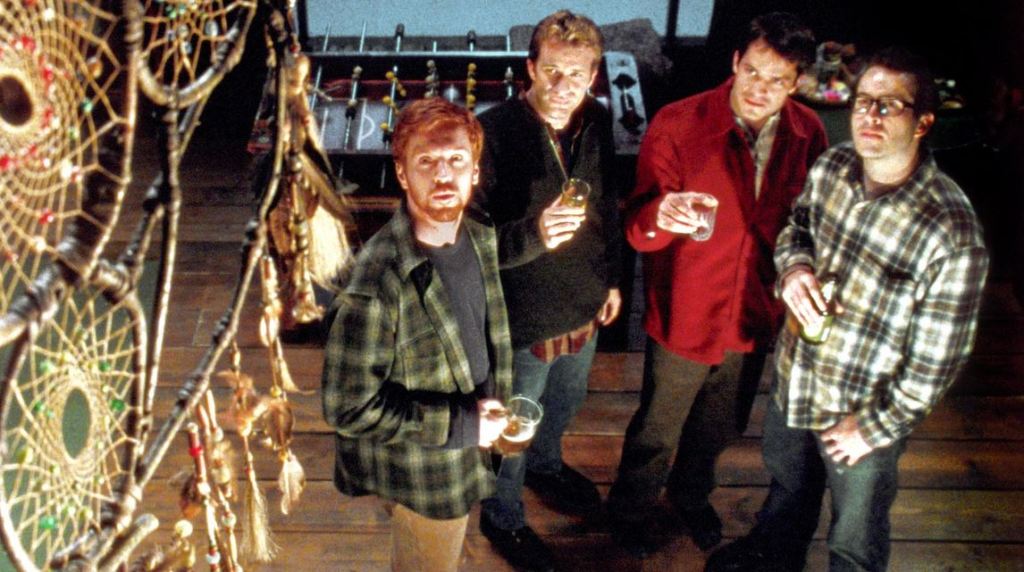
Four friends with psychic abilities have gathered for their annual vacation in a secluded cabin. What they don’t know is an alien spacecraft has crash landed nearby. When they come to the aid of a seriously ill man who they find wandering the woods, it’s revealed he’s the host of an alien parasite. Remember the chestburster from Alien? It’s like that, only this one is a, um… assburster. Meanwhile, a secret branch of the military, which apparently deal with these crash landings all the time, are willing to massacre civilians to keep the aliens contained. And if this all sounds a little scatterbrained, let me assure you that it is very scatterbrained.

I finished reading Stephen King’s source material the same day I re-watched the movie. While book fans usually complain about the stuff an adaptation left out, I’m boggled by what they left in. Consider the fact the novel takes around 20 hours to read. A screenwriter should think carefully about how to adapt such a thing to a two-hour format, but William Goldman’s solution involves reducing entire chapters to very brief scenes as if he’d rather water the novel down than alter it.

Director Lawrence Kasdan has admitted the film damaged his career. Directing must be a pretty stressful job as it only takes a single hiccup to jeopardize your future in the business. On top of that, you have to deal with the lame bloggers who rip your hard work apart (ahem). But these things need to be discussed—that’s just integral to the creative arts: the risk of negative criticism. People can’t truly appreciate the high wire act unless there’s a risk of the performer falling.

I’m glad they made Dreamcatcher. I don’t hate it and I’ll probably watch it again someday. It’s actually very entertaining, often for the wrong reasons, and I’ll be the first to admit there’s magic to be found, sprinkled throughout (as with big dumb disaster movies, the early scenes in which the characters have no clue what’s going on are the most compelling). Where else can you see what is essentially a big budget splatter film with aliens and body horror and shades of Stand By Me? I have nothing but praise for the crazy sons of bitches who made it.

One scene that sums up how stupid the movie is takes place in a bathroom. I don’t care how much you set it up—and the movie certainly tries—I will never believe (much less like) a character who gets himself killed so that he can pick up a toothpick from the bathroom floor and stick it in his mouth. Or how ’bout the part when a character is skiing very slowly and falls for no apparent reason? Or when Morgan Freeman’s character, Colonel Curtis, sincerely tells Tom Sizemore, “Okay, you just drove over the Curtis line!” My favorite moment is when one character telepathically answers a pistol like a phone.

Our Hausu, in the middle of our street

Yesterday I was asked, “What’s the most absurd horror movie you’ve ever seen?” I was surprised how quickly the answer came to me. It was obviously Hausu.

Sure, there’s bound to be more absurd movies that I’ve either forgotten or haven’t seen. But when someone asks questions like that, the person isn’t asking for shitty recommendations. Hausu is as close as you can get to full blown insanity without sacrificing a cohesive and enjoyable experience. It’s fast, it’s funny, and it’s ridiculously out of its mind.

Hausu is among the best times I’ve ever had watching a movie. To this day, I still don’t know exactly what it’s about. To avoid confusing this masterpiece with the numerous other movies called House, I will refer to it as Hausu. Yes, I just called Hausu a masterpiece. It should appeal to anyone with a pulse.

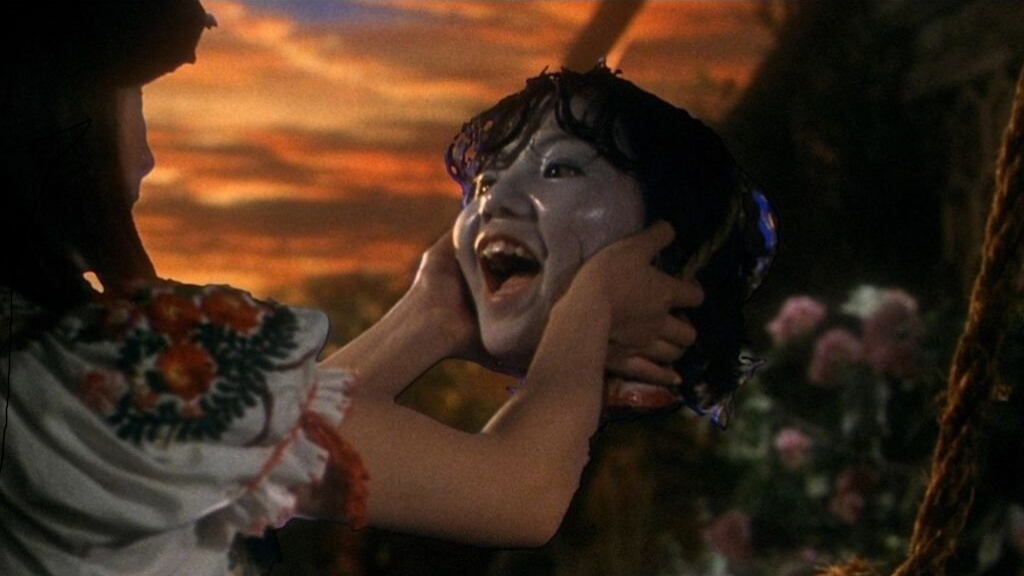
I’d typically mention something about the plot by now. What’s the point? There’s a house. It’s haunted. There’s a cat. It’s crazy. Heads will fly. Literally.

‘Nuff said.

Nightbreed: The Cabal Cut

I haven’t seen Nightbreed in at least a decade, but I saw it a lot and I remember that sometimes I liked it, sometimes I didn’t. If there’s anything my multiple viewings had in common, it was this: the movie is confusing. Said one of my friends, “I love that movie, but it really doesn’t make any sense!”

There’s a reason the theatrical cut doesn’t make a lick of sense: the studio panicked when the film performed poorly for test audiences. The execs ordered several weeks of re-shoots and attempted to turn a monster movie into a slasher film (slashers were more commercial at the time) and predictably failed. Instead of releasing the film around Halloween of ’89, the studio moved it to February of the next year because nothing says “Valentine’s Day” like monster/slasher mayhem. Needless to say, the movie bombed.

I remember hearing rumors about missing footage some time ago. I didn’t think much of it—these things usually just get your hopes up. According to an excellent article in the latest issue of Rue Morgue, however, the footage hasn’t just been found, there’s a new cut of the film. That’s the good news… the bad news is this long lost footage was found on VHS dubs of the master. The current state of The Cabal Cut (Cabal being the name of Barker’s original novella) is a patchwork of VHS scenes and DVD footage. Despite the alternating quality, the screenings of the project are reportedly doing well.

Apparently the studio is taking notice. These kind of movies typically perform much better years after they find their cult following. According to Clive Barker and the other guys involved with The Cabal Cut, Morgan Creek Productions gave them permission to screen the film as a way to gauge interest. So one day there could very well be an official version of The Cabal Cut, but I won’t hold my breath.