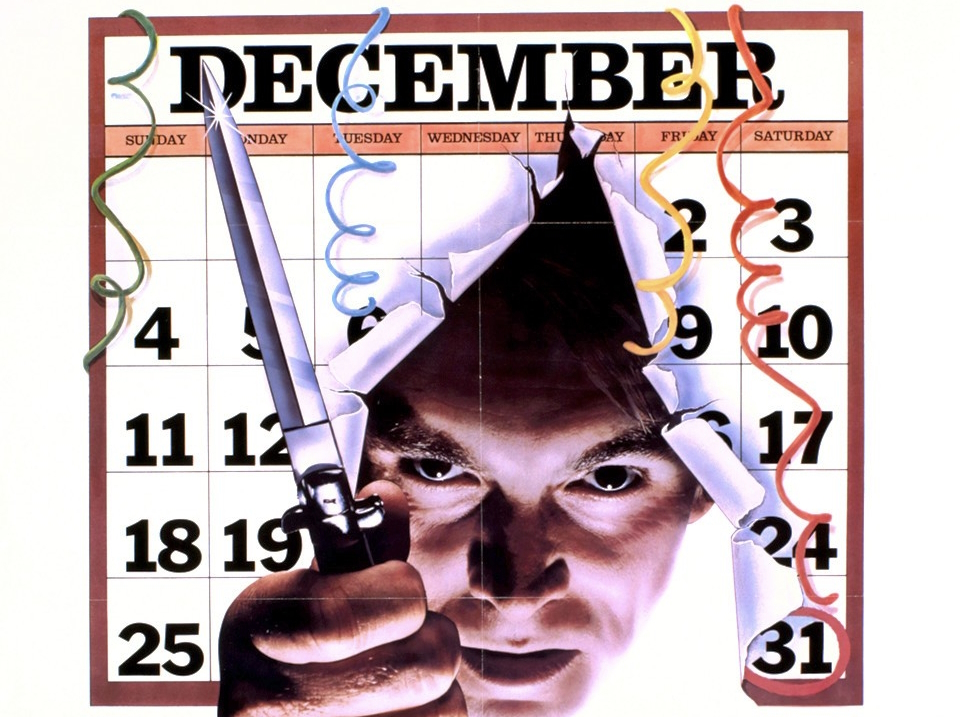
New Year’s Evil (1980)

“Shhhh… I can hear your heart beating. I don’t like that.”

Roz Kelly (Pinky Tuscadero from Happy Days) plays Blaze Sullivan, the VJ-like host of a televised New Year’s Eve bash. During one of the show’s call-in segments, a modulated voice promises to kill someone very close to her. The police quickly discover it’s not just a prank call: someone’s already dead. The man responsible refers to himself as Evil and he intends to murder someone every hour, on the hour, as each timezone in the United States welcomes the new year.

As per Cannon Film Group’s philosophy, everything in New Year’s Evil has been cranked up to 11. This ensures even the mundane scenes are sensational as absolute anyone in the picture might be packing a switchblade. Right off the bat we see a group of punk rockers drinking and driving down a Hollywood street in a convertible that’s pushing capacity. The televised party they’re heading to hosts a gaggle of similar delinquents as one presumably real life band after another plays fantastic-shitty 80s music.

Meanwhile, the killer paroles mental institutions and bars for his victims. Remember: his plan is to kill someone every hour on the hour until the clock strikes twelve. He’s capable of getting an awful lot done between attacks, including: finding his victims, arranging their dead bodies for cinematic reveals, changing disguises, sneaking into guarded buildings, and calling into the TV show. At one point he even gets into a traffic accident with a biker gang that leads to a foot chase through a drive-in movie. Yet he still manages to get to his next appointment on time.

Unless you’ve never seen a movie in your life, you’ll figure out the twist ending: the killer is actually Blaze’s oft-mentioned but curiously missing-in-action husband. Even if the repeated “Where’s Dad?” line doesn’t clue you in, you’ll start to suspect it the moment their son pulls his mother’s pantyhose over his head and pierces his ear with a needle. Here’s the best part: during a wonderfully cheesy soliloquy he looks into the mirror and tells himself, “I think I have a mental disorder.”

Don’t worry: there’s yet another twist at the end which I won’t spoil. Unfortunately, you’ll see that one coming from a mile away, too. Oh well, it’s still a fun picture.
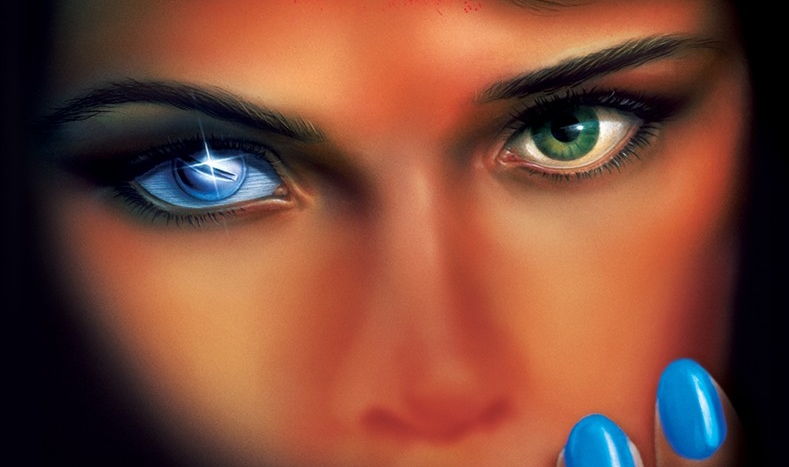
Midnight Movie: Deadly Friend (1986)

Paul, the teenage hero of Wes Craven’s Deadly Friend, not only designs advanced robots, but he teaches college courses, dissects human brains, and somehow finds the time to hang out with his friends. The robot he’s created, “BB,” looks like a robot from any other 80s movie. It can crack locks, shoot hoops, and move heavy furniture. The only thing his robot can’t do is dodge shotgun spray, which we learn when it ding-dong ditches the neighborhood crazy lady, played by Anne Ramsey from The Goonies and Throw Momma from the Train. Don’t you just love her?

Paul’s love interest (Kristy Swanson in her first leading role) is repeatedly abused by her alcoholic father. In one of the film’s three or four dream sequences, which are filmed Nightmare on Elm Street style, she stabs her dear old dad with a broken flower vase. What follows is a jarringly bloody scene. Jarring because watching Deadly Friend is like getting thirty minutes into Short Circuit before discovering it’s an R-rated horror movie.

And here’s where my objectiveness flies out the window. I love killer robot movies. Terminator, Runaway, Chopping Mall, Screamers… I can’t get enough of this shit. What’s disappointing about Deadly Friend is they dispense with the actual robot twenty minutes in. The movie then goes the Donovan’s Brain/Frankenstein route: after Swanson’s father accidentally kills her, Paul transplants BB’s brain to her body. As expected, the world’s first robo-girl doesn’t come in peace. How she got superhuman strength isn’t explained nor is it entirely important in a movie like this.

This is an 80s movie, through and through, no doubt conceived by coked-up movie executives who wanted a gorier E.T. The Extraterrestrial. I mention E.T. because that’s exactly what Deadly Friend’s plot structure seems to mimic. Genre movies back then simply moved at a different pace than they do now. While most “slow-burn” horror films bore, this one has a pleasant pace. It really takes its time, but never takes more than we’re willing to give it. It makes the absurd climax, which is cram-packed with unintentional laughs, all the more entertaining.

J.J. Abrams said he got the name for one of his The Force Awakens characters from Phantasm. I’m beginning to wonder if he lifted BB-8’s name from this movie.

Midnight Movie: The Vagrant (1992)

The Vagrant stars Bill Paxton, Michael Ironside, Marshall Bell, and Collen Camp. Killer cast, right? Unfortunately, each supporting character is compartmentalized. If you don’t see them interacting with the main character, you don’t see them interacting at all.

Paxton plays Graham Krakowski, which is pronounced “Crack-house-ski” by some characters. He has a stable yet mind-numbing job, which allows him to buy a fixer-upper from his nymphomaniacal real estate agent (Camp). Soon he’ll learn there’s a vagrant in the neighborhood (Bell) who’s squatting on a nearby lot. Krakowski takes out a second mortgage and fortifies the property with the best security money can buy, including a perimeter fence, stadium lights, and an automatic music player that makes intruders think someone’s at home when he’s away.

After spending every dime on this worthless stuff—worthless because it doesn’t stop the vagrant from letting himself into Krakowski’s house—he realizes he should have bought furniture instead of Pentagon-level security. So he has the inside of the house decorated at his girlfriend’s insistence and puts it all on his credit cards. Now that he’s ensured he’ll spend the rest of his life in debt, the vagrant’s antics drive him crazy, he loses his job, and an over-the-top homicide detective (Ironside) is trying to finger him for a murder the vagrant actually committed.

Did I mention this is supposed to be a comedy? I love horror-comedies, but this one isn’t scary and it isn’t very funny, either. The concept was ripe to become a cult classic and I’m a fan of all these actors. This is actually my second viewing and I was hoping I would notice satirical complexities I was too young to pick up on the first time around. Nope. It’s shallow and intentionally cheesy and pretty incompetent to boot.

The Vagrant isn’t a terrible movie, just mediocre, but it does entertain here and there.

Midnight Movie: Clown (2014)

I never thought clowns were scary, but I love seeing them in movies. It’s almost as if they were made for the screen. (For a recent example, see: Álex de la Iglesia’s The Last Circus.) Anyway, you remember that part in Parenthood in which Steve Martin has to dress up as a clown for his son’s birthday party? Imagine if he discovered the costume wouldn’t come off. Then, as his frustrations mounted, he developed urges to murder innocent children. That’s the premise behind Clown, a remarkably deadpan horror-comedy written by a couple of filmmakers who got Eli Roth to produce after they made a proof of concept trailer.

Kent McCoy, real estate agent, is stuck in an old clown costume he found. All attempts to take it off—which have involved hemostats, razor blades, and power tools—have only injured him. The costume is fusing to his body like reverse-molting. His skin turns white so he has to wear flesh-colored makeup to pass in public. Unfortunately, it’s clear he’ll never look normal again and his appearance is progressively devolving into something hideous.

While researching the origins of the costume, Kent contacts an expert played by Fargo’s Peter Stormare. Stormare’s character reveals the costume’s not made out of fabric at all, but it’s the hide of an ancient Icelandic demon. Ridiculous, right? Wisely, the film plays it with a straight face and never elbows you for a laugh, which is far funnier than a Sharknado-level farce. Getting trapped in a clown costume actually is a scary concept because it would be as embarrassing as accidentally showing up to school without pants on. Illogical, yes, but so are most nightmares.

The demon the skin belonged to was known for eating children, an urge which proves contagious to Kent. The filmmakers leverage that aspect of the plot into a moral quandary that comes into play towards the end of the movie. Without giving too much away, people often say they would do absolutely anything for their children. Clown explores the darker implications of an otherwise innocent statement like that.

While Clown’s promotional material suggests it might assault you with buckets of gore, it neither wants to push the envelope or shy away from the good stuff. It implies more than it shows, yet it makes sparing yet effective use of body horror. These guys sneak the crazy stuff into your blind spot and by the time it’s in your peripheral vision it’s too late.

I really liked this movie, which is bizarre and subtle at the same time. I was reminded of the shocking reveal at the end of Rosemary’s Baby, which is simultaneously the worst thing that could happen and somehow amusing. The acting is good and the characters seem real and grounded. They don’t even do anything especially stupid like make excuses for why they don’t call the police. I mean, if an Icelandic demon fused with your body, who you gonna call anyway?

If you ever wondered why I’m an Eli Roth fan, it’s because of his involvement in movies like this. We need more cheerleaders for the smaller voices in genre films. Roth’s enthusiasm is infectious.

Dead By Daylight: First Impressions

Dead By Daylight gives you the choice of playing a victim or a movie slasher. In order for the killer to win he must prevent the victims from escaping, which requires catching, disabling, and hanging them on meat hooks. Survivors only have to escape, but there’s a catch: the killer’s compound is entirely fenced in. The only way to open one of the gates is by repairing the generators, which are scattered about the map. It takes a long time to repair each one, adding to the suspense. The killer generally knows where the generators are at all times, but the victims have to actively search for them without the aid of a radar.

There’s also a point system. The more points you have, the more items and power-ups you can buy in between matches. The point system encourages the victims to help one another, as opposed to fending for themselves (which happens, too), while inspiring the lone killer to get creative with his traps and tactics. I’m actually surprised by how much teamwork is to be found in a title which doesn’t feature in-game chat.

What’s even more surprising is the simple concept’s longevity. There’s only the one game mode and all the maps look more or less the same beyond their drab color schemes. You’re either going to be one of three available killers (which requires hosting a game and sometimes waiting damn near forever for four other players to join) or one of the four survivors, meaning there’s not a whole lot to see beyond your first few matches. With so few combinations, I expected this one to get stale quick, but I find myself loading it up frequently. It’s very easy to jump in and out of it.

Matches last only a handful of minutes and, generally, don’t take long getting into. The overall boot time is fairly low, too, which is probably why I play CS:GO so often. Like that game, Dead By Daylight provides a surprising amount of replayability not in spite of its simplicity, but because of it. Meanwhile the graphics are more than acceptable and the sounds of blades and meat hooks puncturing flesh are crisp and satisfying.

Theme goes a long way and that’s the biggest thing Dead By Daylight has going for it. Unfortunately (for me) it doesn’t completely bring that 80s horror vibe which the upcoming Friday the 13th game promises. It just looks a little too much like a late 90s horror movie for my liking, while the victim roster is curiously lacking a teen heroine, a dimwitted jock, and a clueless police officer. Still, playing as the killer and stalking real-life players with a intimidating walk is even more fun than you may think.

If you’re not a fan of slasher movies, you should probably skip this one. Otherwise, I certainly don’t feel like I threw my money away as the twenty dollar price tag seems just about right. Besides, the thrill of finding a victim hiding in a closet is something I can’t convey with words. I find the game’s strengths more than makes up for the bugs, most of which aren’t game-breaking.

At the time of this writing, the game doesn’t have a serviceable party system. Players are constantly entering and immediately leaving lobbies in search of their friends, which sometimes makes soloing take longer than it should. The devs have tweeted they will address this issue soon, but a party system could potentially break a game that purposely omitted in-game chat because those players will no doubt be using VOIP software to coordinate against the killer.

Midnight Movies: The Toxic Avenger II & III

I originally saw the original The Toxic Avenger on USA Up All Night! when I was something like eight or nine years old. On my many repeat viewings of the worn VHS I recorded myself, I would laugh gleefully when, upon committing vehicular homicide, one of the evil punks announces he has to go to bed early “because I’ve gotta go to church.” Years later, at the beginning of Toxic Avenger Part IV, Stan Lee’s voiceover recounts the events of the first film before going on to say, “Then… two rotten sequels were made. Sorry about that!”

Curiously, I’ve watched the “rotten sequels” more than I saw the fourth movie. I actually prefer Toxie’s makeup and his John Candy-like demeanor in the two middle entries. The biggest problem with the back-to-back II & III is they were intended to be one film until director Lloyd Kaufman, realizing he had shot too much footage, had the idea to split the one movie into two. The problem is Kaufman overestimated just how much usable footage he had.

Following the events of the first film, Melvin the mop boy, aka Toxie, has successfully cleaned Tromaville of crime and pollution. He lives with his blind girlfriend Claire (even Kaufman has admitted he doesn’t know why they changed the character’s name from Sarah) and finds himself without purpose. So he sets off to Japan in search of his long lost father, only to find the man sets off his Spidey-Sense (uh, I mean “Tromatons”) because he is, in fact, an evil drug lord. Meanwhile, in Toxie’s absence, an evil corporation moves into Tromaville.

The good stuff is present, albeit smothered in the padding. Part II opens with a hilariously stupid fight before the promising pace trips on the overuse of voiceovers and the extended interlude in Japan. A lot of the footage that’s used in Toxic Avenger II is actually recycled in Toxic Avenger III, sometimes with replaced dialogue, sometimes unaltered, but always at the expense of fun. In other words, there’s a great Troma movie between the two pictures and if a skilled fan editor hasn’t made a singular supercut yet, I’d be very surprised.

When I was younger, I preferred Part II because I somehow liked the stuff in Japan. Now that I’m older, it’s clear the third film, The Last Temptation of Toxie, is the superior picture. The opening was obviously shot after Kaufman decided to split the film into two. The fight may not be as long and complex as the one which opened the previous movie, but its brevity helps solidify the pace and believe me: this movie can use all the help it can get.

Toxie’s relationship with Claire takes an unexpectedly cute turn. Toxie literally sells his soul to the devil to pay for the operation to restore her eyesight (and to get his mother a microwave oven). He does this knowing full well that once she can see, she may be repulsed by his hideously deformed nature. That’s our little Melvin—a selfless darling—and we can only hope the inevitable Hollywood remake will absorb the more subtle ingredients of the franchise rather than focusing solely on the exploitation stuff.

Nothing in these two films is half as wild (or gleefully politically incorrect) as the punks who squash a little boy’s head before beating an elderly woman to death. Nor is the dialogue ever quite as poetic as the thug who exclaims, “I’ve always wanted to cornhole me a blind bitch!” Unless you’re a completionist, or a die hard Troma fan, it’s probably acceptable to skip all the sequels. But there is some of that old magic here. It’s only in short bursts, few and far between.

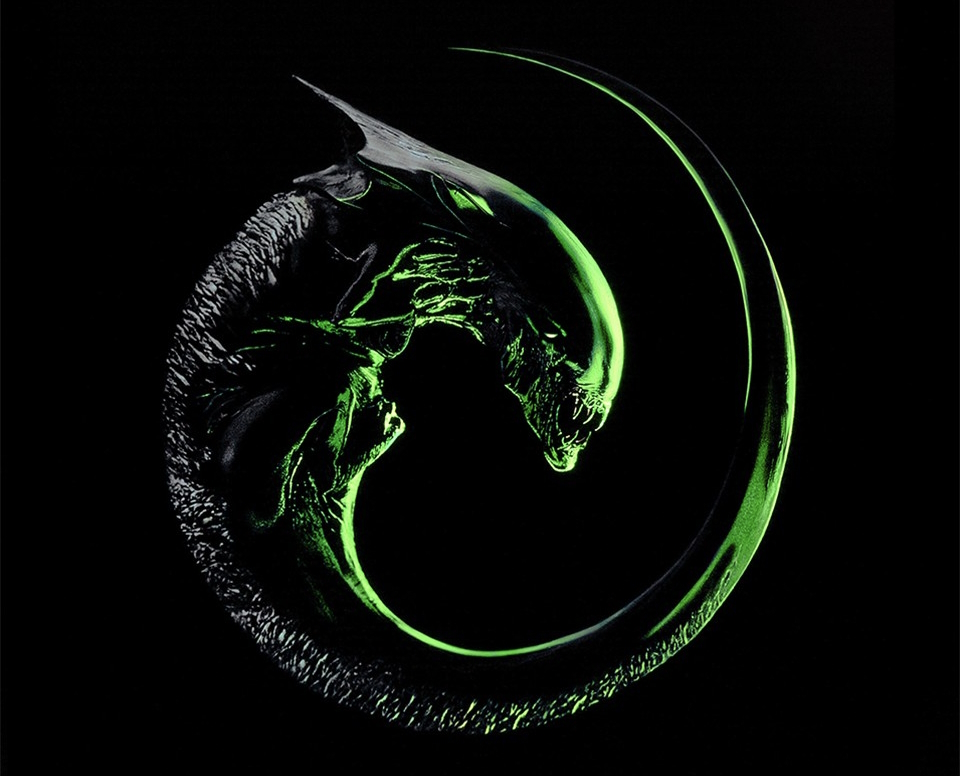
Alien 3: The Assembly Cut is a very different movie

For years I’ve heard about the so-called Assembly Cut of Alien 3, but didn’t expect much from it. I wouldn’t say I hated Alien 3 (although I would say that of Alien Resurrection), I just think Aliens’ version of Ripley is possibly my favorite movie character in history. I don’t know why I find her so endearing, I just do. I get chills whenever I merely think about her saying, “Get away from her, you bitch!” But in Alien 3 she just seems… off.

Those who claim Alien 3 was only disappointing because its critics were expecting more Aliens are mistaken. A lot of us loved the first sequel because it was so different from the original, not just because it was an action picture. Right out of the gate, Alien 3 makes the mistake of treading the same water as the original. It’s also important to remember Alien clones were a dime a dozen those days; the whole “we’re trapped in a spaceship/military complex/prison with an alien” thing was already severely played out by ’92. It was understandable audiences expected something different from a series which had yet to repeat itself.

Thankfully, the first forty minutes of The Assembly Cut feel like a completely different animal than the theatrical cut. In this edit, Ripley washes up on a beach after her escape pod crash lands on the penal colony known as Fury 161. Charles Dance’s character, whose best scenes are restored in this version, is out for a stroll on the beach when he discovers Ripley’s unconscious body. Many will oppose the idea that Ripley hops in bed with the first guy she sees, but I’ll be damned if it isn’t completely believable. It’s not, “We want you to believe these characters are suddenly in love,” but more like, “Sometimes, lonely adults have sex.”

Although there were so many lame alien clones at the time, The Assembly Cut makes it clear Fincher could have made the first truly skilled knock-off. Unfortunately, the special effects suck as bad as they did in ’92 and Ripley’s reaction to learning of Newt’s death still underwhelms. I was hoping the heavy-handed crucifixion imagery at the end of the movie was gone, and although that shot is improved in a way, it’s still stupid and pretentious. Other than that, The Assembly Cut is a decent end to the trilogy.

There are various other improvements I won’t spoil. I’ll just point out the alien’s entrance is much spookier than the one we initially got.

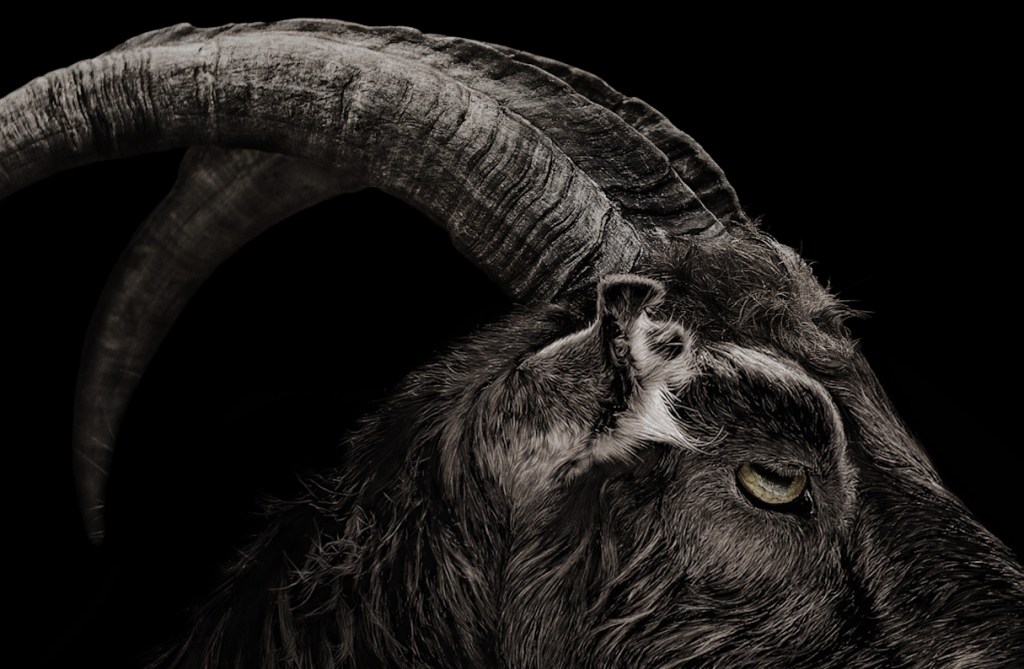
The VVitch (2016)

I love movies about witches, whether there’s an actual witch or it’s just hysteria. The latter is typically more terrifying than the former, but The VVitch gives us the best of both worlds. Patient and irresistibly atmospheric, it layers on the horrors experienced by a Christian family who have been outcast from their New England community.

Katherine, (Kate Dickie from Game of Thrones), is the mother of five children who spends the entirety of the movie grieving. Dickie’s acting is subtle for the most part and believably grand when necessary. William (Ralph Ineson, also from Game of Thrones) is the father of the family; he’s responsible for the sin which got his family exiled to the wilderness in the first place. The film wisely keeps his criminal indiscretion vague so we won’t pass judgment on him too early. Whereas his wife sobs herself to sleep, William stoically chops wood to cope with their hardships.

Their children include a newborn baby, creepy twins who spend their days playing with a goat, and Thomasin (Anya Taylor-Joy) who doesn’t seem to be aware her younger brother Caleb is developing feelings for her now that she’s becoming a woman. Because their father is a lousy hunter, Caleb and Thomasin secretly decide to hunt on their own despite the trouble they’ll get into when they return. It’s then that they stumble upon the witch’s hut in the woods. At this point, I wouldn’t dream of telling you what happens next.

The best thing about The VVitch, which already has plenty to like, is its unpredictability. I suspect first time director Robert Eggers felt himself veering dangerously off course while writing the script, but instead of correcting himself, he said “eh, let’s see where this goes” and barreled right off the intended path. I can’t imagine we’ll see a better horror film this year.

Midnight Movie: Southbound (2016)

A couple of men, covered in blood, are driving down an old desert highway. The passenger glances out the window and spots something sinister hovering in the distance. When the driver asks him what’s wrong, the man brushes away his friend’s concern. Whatever’s after these two guys isn’t natural, but they’ve been dealing with it long enough that they’ve grown used to its presence.

Following the conclusion of that scene, the movie shifts focus to a group of travelers. And over the course of the next hour or so, we’ll be drifting from one character’s point of view to another, on or near the same desolate highway. Although these are some of the same people who brought us the V/H/S series, to call Southbound an anthology film is misleading. I prefer to call it “protagonistically challenged.”

What a time to be alive. After a decade or so of mostly terrible horror, 2015 has been the best year for the genre since the eighties. We Are Still Here paid homage to Fulci, It Follows to Carpenter, Deathgasm to Raimi and Jackson, and now Southbound seems to be influenced by everyone from Lovecraft to Craven. The kids raised on Video Nasties are the ones making movies now. Thanks to them, the genre is successfully making up for the 2000s, when all the films either looked too shitty or too slick.

A lot of horror movies don’t make a lot of sense because they don’t have to. There are times Southbound feels like it doesn’t make sense, but it’s not to the film’s detriment. You get the feeling early on that its madness is intentional, while the jarring nature of its sudden focus-shifts gives it the qualities of a nightmare. Just short of ninety minutes, the film’s brevity also feels dreamlike. Most horror films drag on a little too long while this one gets in, gets out, and leaves you wanting more.

If you’re wondering if it’s better than V/H/S, it is. This time the tone remains uniform throughout. It doesn’t feel like a bunch of short stories with only superficial connections. This is a bonafide movie and a damn good one at that.

Dude Bro Party Massacre III is the new standard for YouTube-to-feature success

Following Robert Rodriguez’s Planet Terror there was a rash of low budget movies which had been digitally aged to look like overplayed film prints. Efforts like Hobo with a Shotgun and Father’s Day succeeded—kind of—but the charm of authentic older movies was rarely present. Worse, the effort to disguise digital cameras in film grain and scratches was almost always more distracting than convincing. Dude Bro Party Massacre 3, which sounds like it’s going to skewer its inspirations more than it ultimately does, is cut from the same cloth. Instead of settling for the rarely passable “film-look,” it layers a VHS “modified to fit your television set” visual style on top of its fake film artifacts. The heavy-handed effect is convincing enough that you’ll wonder if they ran the final cut through a dual-VCR a dozen times.

The movie opens with a fictional note: the film was banned in several countries including the United States. The filmmakers ask us to believe the copy we’re watching was taped from its only broadcast on public access television. This deceit allows the filmmakers, members of the Five Second Films comedy troupe, to squeeze in short films during the hastily edited commercial breaks under the guise of retro TV ads. Although the snippets are only five seconds a piece, they’re some of the funniest gags in the movie, provided you remember what late night commercials looked like back then (think: the advertisements which aired during USA’s Up All Night).

Dude Bro Party Massacre 3 uses its opening sequence to establish the story so far. We learn that in the first film, a woman “who never learned how to open doors” was trapped in a sorority house which was set ablaze during a college prank gone wrong. Horribly disfigured, she exacted revenge on her victims one by one, only to predictably meet her demise by the end of the picture. In the sequel, her daughter took up the mantle and continued the killing spree until she, too, was dispatched as these movies require. The third film, which genuinely feels like the third in an actual movie series, opens with the sole survivor from the last picture getting himself killed five minutes in. Now there’s a new killer and she’s going to pick off the latest group of expendable frat boys who decide to party at a cabin in the woods.

Having recently reviewed Space Cop, I was skeptical about 5 Second Films’ ability to produce a feature-length title. Many of Red Letter Media’s problems with the format seemed to be a matter of length even though they’re known for some of the longest popular videos on YouTube. So how could a comedy troupe known for five-second sketches make the jump to feature-length? Pretty well, it turns out.

The gore gags, although transparently and purposely cheap, are every bit as creative and distasteful as the stuff in Lloyd Kaufman’s Poultrygeist. The background music sounds as if it may be fan-submitted, garage-quality tracks. Because it’s only ninety minutes long, it doesn’t overstay its welcome. Yes, Dude Bro Party Massacre III is a pretty good movie even though I’m still not entirely on board with young filmmakers making fun of slasher films as an excuse to make one themselves.

I’ve been disappointed that the only standard I really had to compare these fan-funded projects to was the Angry Video Game Nerd movie, not only because it wasn’t very good. Well, here’s the new standard as far as I’m concerned. These regular joes made a movie and so can you… provided you have a humongous subscriber base on YouTube to help fill out a $200,000 Kickstarter campaign. Nonetheless, the end result is a gross-out spectacle that didn’t need studio approval to get made. Very fun stuff.

(Cameos include Larry King, veteran pornstar Nina Hartley, Andrew W.K., Patton Oswalt and a few familiar faces from YouTube.)