I just saw Blade Runner 2049 and even though I’m deep into this month’s 31 Days of Gore, I’ve kinda gotta talk about this one. I knew next to nothing about the sequel and was surprised immediately. Going into it, I knew Ryan Gossling played a blade runner and I knew Harrison Ford showed up for at least a cameo. That’s pretty much it. I saw the teaser trailer, but nothing beyond that.
I’m not going to spoil anyone else on the character details, either. I will say I love what was revealed two or three minutes in and I’m guessing the more recent trailers probably gave it away. It’s also nice how they handle the question at the end of the original film. I wasn’t in the mood for a three-hour movie when showtime came around, but mercifully, it certainly didn’t feel like three hours. I completely forgot just how tired I was until the credits rolled and I stood from my seat.
So many belated sequels look at odds with their 80s counterparts. This one not only looks like it was cut from the same cloth, there’s about thirty years of technology added to the futurism we got the last time around, making the worldbuilding all the more convincing. I’m glad they kept the Atari billboards in, too… there’s just something appealing about that logo. As far as belated sequels go, this one’s right up there with Fury Road.
The original Blade Runner wasn’t an instant favorite for me; it took several years and multiple versions until The Final Cut unexpectedly blew my mind one night. Blade Runner 2049, on the other hand, is an instant favorite. I may not like it quite as much as the original, but it’s pretty damn close and seems to incorporate more Phildickian themes than Ridley Scott did.
I have a problem… call it cyberpunk addiction. Not only is cyberpunk my favorite setting for a story, it renders me completely incapable of being objective. What this means for me, the afflicted, is I somehow love Freejack, Johnny Mnemonic, Highlander 2, dozens of B-movies which played heavily on 1990s Cinemax, and at least a few questionable Billy Idol videos. I’ve got a fetish for anti-heroes, chrome, Japanese uber-corporations, questions about consciousness, and bio-electric peripherals which plug directly into the brain.
I want to turn on, jack in, and drop out. (Timothy Leary, by the way, was a pretty big fan of William Gibson’s Neuromancer.)
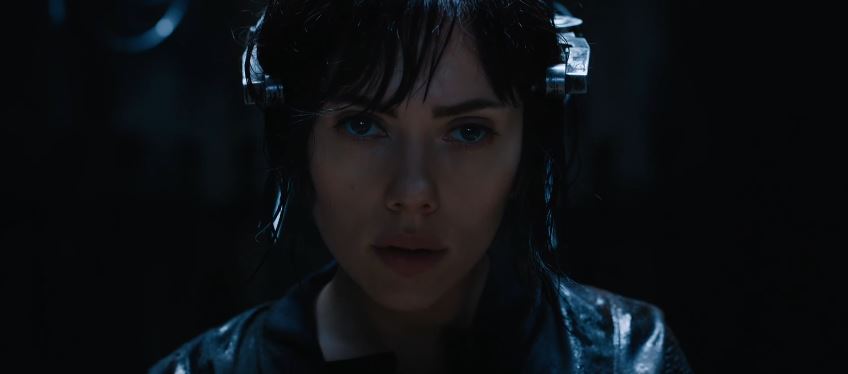
If that description reminds you of yourself, then stop reading this and go see Ghost in the Shell. Yeah, I know: remakes suck. Fortunately, this one feels more like an honest attempt at honoring the source material rather than a cheap cash-in (for what it’s worth, the original filmmakers seem to be giving this one their blessing). This ain’t Chips or Baywatch and, frankly, I want to see more cyberpunk in theaters (and more genre roles for Scarlett Johansson).
The original Ghost in the Shell is on my short list of favorite movies. The American remake, which initially sounded like a terrible idea (as all remakes do), looked surprisingly great judging from the abundance of promotional materials. For the record, I don’t mean it looked like a great movie; I mean it literally looked great, as in the trailer’s visuals were stunning. (I watched damn near every single one of the clips and trailers, and feel like they spoiled very little.)
And the movie itself is stunning to look at, too. The futuristic cityscapes just don’t feel like they were made with CGI… the neon, the towers, the holographic signs—every bit of it looks convincing in the way the camera and the characters move through it all. There are details here you simply wouldn’t see in most of today’s visions of the future: perfectly placed graffiti, realistic weathering, storm drains, antennas, cables, etc. (How often do you see window-unit air conditioners in futuristic movies? Not very often, I reckon.) If I had to guess, most of this stuff was actually photographed in real life and manipulated in post, rather than built from scratch like a phony-looking Star Wars prequel.
On the other hand, there are some aspects which come off a little wonky. Some of the things the actors do, particularly later in the movie, look a lot more believable in animation than they do in live-action. Meanwhile, the borderline Matrix-y stuff seems a little at odds with the movie’s serious, anti-fantastical tone.
So if you’re new to the franchise, all you need to know is Scarlett Johansson plays The Major, a mostly cybernetic agent for Security Section 9, which is kind of like a futuristic SWAT team that does a lot of work in cyber-intelligence and espionage. (When I say she’s “mostly cybernetic,” I mean she’s essentially a human brain in a robot’s body.) She and her optically-enhanced partner, Batou, are trying to track down a terrorist who’s hacking into the brains of the scientists who created The Major.
Whereas the original film (“original” to the degree it was based on the 1989 manga of the same name) was fairly dense and often ambiguous, the American version is unsurprisingly simplified and streamlined, though not insultingly so. A lot of the original questions and motifs remain, but the characters tend to dwell on them in dialogue (they say “ghost” and “shell” an awful lot, which kind of feels like Will Smith’s “suicide squad” line even when it’s coming out of the mouths of Juliette Binoche and Beat Takeshi). Other than that, I really don’t have any complaints. I really enjoyed this movie, though I don’t think the scripted content was as compelling as the visuals.
I honestly can’t tell if the average moviegoer would like Ghost in the Shell. I don’t even know if I would like it if I weren’t such a fan of the genre, and I tend to like damn near anything. This is old school cyberpunk, not the sleek, action-oriented post-Matrix stuff. Which makes it a shame that you can sometimes see the studio’s fingerprints on it… they obviously pushed for something more commercial than the original, but I have a feeling that and the watered-down rating are going to work against it finding the viewers who would appreciate it the most. Otherwise, it’s the rare remake which compliments the original… if you’re not automatically insulted by its existence, that is.
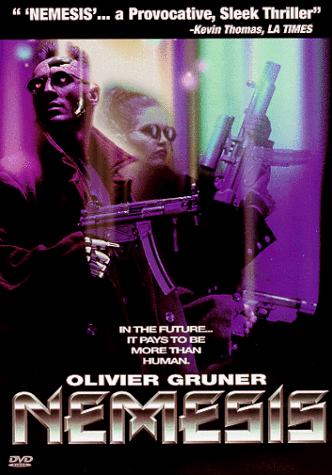
The opening credits aren’t even over by the time the bullets begin to fly in Nemesis, one of the better cyberpunk adventures of the early 90s. And boy do the bullets fly. In one scene the heroes and the villains alike are shredding through walls to pass from one room to another. Then the hero (Olivier Gruner) creates an escape hatch in the floor by firing his futuristic machine gun in a circle around his feet.
Yes, this is mindless action, but holy shit is it glorious.
Any character in the film can (and usually will) double-cross the hero without warning—to the point it stops making a whole lot of sense. And it’s not really clear why the action hops from one rundown location to the next, other than that’s just the way director Albert Pyun works. (In an interview with io9, Pyun sheds some light on his methods, which were often more practical than artistic.)
So it’s the future and just about anyone who’s anyone has had their bodies heavily modded with illegal implants. Some of the bad guys have faces which split open like nutshells to reveal automatic firearms concealed inside. Other characters exist as digitized ghosts in the machine to guide the hero through the complicated plot. Meanwhile the (presumably) human character can do back- and side-flips as well as the enhanced characters because fuck it, why not?
In the opening scene, Gruner’s character, a kind of blade runner, is ambushed by a group of cyborgs who leave his less-than-human body on the brink of death in a scene reminiscent of Murphy’s demise in Robocop. After a long recovery in the body shop, he tracks them down, shoots the ringleader, and ends up in a dank jail cell for reasons that are escaping me at the moment. A lot of spectacular shit happens and Gruner finds out his boss (Tim Thomerson) has implanted a time bomb in his heart. Gruner, whose ex-lover has been reduced to an artificial consciousness rivaling Siri, leads him through the web of deceit and explosions, insisting he make his way to the top of a volcano because… well, probably because the film crew had access to a volcano location.
The plot really doesn’t matter. What matters is you get beautiful stunt women, more explosions than you can shake a stick at, and early performances by Thomas Jane and Jackie Earle Haley, the latter of whom I didn’t realize was in the movie until I saw the credits. You should know by now if this is your kind of movie. I’ve enjoyed many of Pyun’s movies, which is why it sucks to read his most recent tweet:
Judging from his blog, the disease hasn’t stopped him from directing. Right on.
It’s the future. Rich people live on a space station called Elysium. Poor people live on Earth, oppressed by robots, working menial jobs just to survive. The factory that manufactures the robots is where Max (Matt Damon) works. After receiving a lethal dose of radiation on the job, Max is told he’s only got a few days left to live.
On Elysium, the rich have access to med-bays which can cure any ailment including radiation sickness. All Max has to do—in theory—is sneak onto Elysium and climb into one of the bed-shaped devices. Unfortunately, Jodie Foster’s defense secretary (basically the head of border security, the “border” being space itself) is on high alert and will shoot dead any trespassers. Max, growing sicker by the second, has to have a robotic exoskeleton surgically implanted on his body just to remain mobile.
Excitement is curiously missing from Neill Blomkamp’s much anticipated follow-up to District 9. Here’s a movie which is far from terrible, but nothing really clicks. There was a wide variety of action sequences and creativity in Blomkamp’s previous film. In Elysium, it’s all about the gunfights. When you have a giant space station in the shape of a wheel, you’re telling me the most the filmmaker can come up with is standard shootouts, the majority of which take place on desolate old earth?
Is there a reason why Jodie Foster speaks in a phony accent? Even William Fichtner, one of Hollywood’s most solid character actors, is off his game. Casting Sharlto Copley (the weenie hero of District 9) as bad guy Kruger is a stroke of inspiration, but his character just isn’t realized enough for us to believe his machine-like agency. Matt Damon absolutely feels at home in a movie like this, but there’s not much for him to work with, either.
At the end of the day, I wouldn’t say Elysium scars Blomkamp’s reputation. I’m still excited to see his next movie because I still think (hope) he’s Hollywood’s ace in the hole. Hell, I still want to see what he would do in the Halo universe, which was at some point the original plan for the breakout director. I just pray he’s not a one-hit wonder.
Elysium is a solid rental, but only if you don’t have something better to do tonight. It looks great, has some interesting ideas, but that’s about it.
The year is 2044. It’s thirty years before the invention of time travel. A voiceover tells us that as soon as time travel is invented, it’s outlawed. Naturally, that won’t stop the most powerful crime syndicates from using it. So where’s Timecop when you need him?
Joe (Joseph Gordon-Levitt) is a looper. Loopers are hitmen, but not the type who whack you in Scorsese movies. No, loopers simply wait in a field for a target to appear from the future. When the target arrives, hooded and bound, the looper shoots him. The only benefit of doing it this way is the body won’t be found in the future, when cops have access to higher tech forensic methods.
Before disposing of the body, the looper can find their payment strapped beneath the target’s clothes. The payment usually comes in the form of silver bars, which can be traded for their own timeline’s currency. Every looper knows full well that, one day, they’ll find gold bars strapped to a body instead of silver. The day that happens, the looper has just retired himself, which is so common it’s called “completing the loop.” When we see that Joe lives very well in a future where most live in squalor, we can see the attraction of the job despite its deadly retirement plan. He even admits that people in his line of work aren’t exactly forward-thinkers.
If you’ve seen the trailer, you already know that when Joe’s future self is sent back, young Joe fails to retire him. His future self is played by Bruce Willis, which is far less distracting than having Gordon-Levitt play dual roles—one in old-age makeup. You’re probably expecting a cat-and-mouse game to ensue. It’s actually more like a cat-mouse-dog-and-tiger game in which timelines tangle like pasta.
Does this sound convoluted to you? It’s a movie about time travel—of course it’s convoluted. Whereas so many of these movies try to make an unbelievable premise believable with endless technobabble, Looper leans into the problems of time travel with little explanation, which gives it room to do something fresh in the genre. Its interpretation of the rules leads to one of the most chilling death scenes ever filmed. The scene in question is truly the stuff of nightmares, but if you want to poke holes in it, you’re watching the wrong movie.
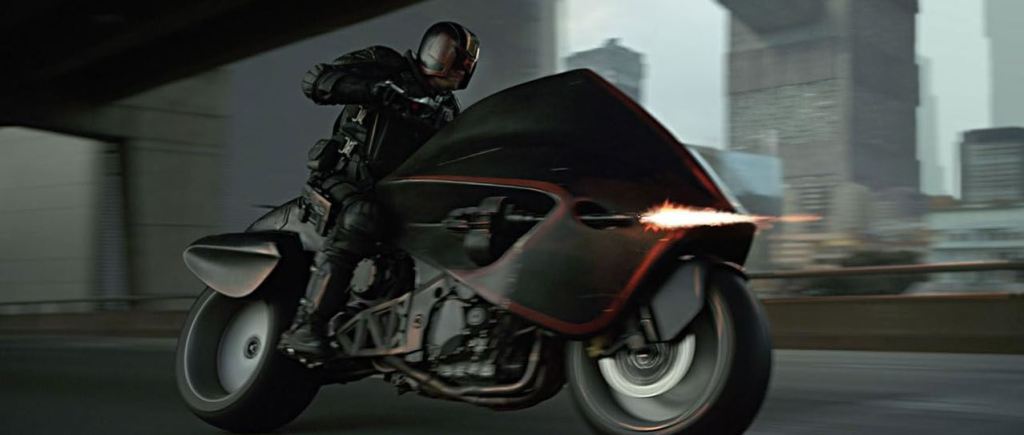
When my mother took me to see Judge Dredd on opening weekend in 1995, there was one other moviegoer in attendance. The guy got so bored he tried to read a book during the middle of the movie. Not that Judge Dredd was entirely without merit; I always thought it was a little better than most people cared to admit, Rob Schneider notwithstanding. While Karl Urban certainly has a better chin for Dredd, Sly had the more accurate body type; I may also slightly prefer the costumes and motorcycles of the 1995 film, too. That’s the only nice things I can say about that.
In Mega City One, one of the few cities left standing after nuclear war, Judges are cops, juries, judges, and executioners rolled into one. Despite its breakneck pace, this new adaptation of the 2000 AD character manages to paint a complete picture of its bleak and ultra-authoritarian setting in deft strokes of worldbuilding. We learn early on that Judges are spread so thin they can only respond to 6% of all crime in a city of 800 million people. With statistics like that, it’s a wonder why everyone doesn’t become criminals.
Batman ’66 vibes
The opening has Judge Dredd engaged in a high-speed pursuit with a street gang who’s stoned on slo-mo, a street drug that makes users perceive time at 1% of its normal speed. Dredd sentences the thugs to death, the last of which is dispensed in gruesome R-rated fashion. In the next scene, Dredd is assigned a new partner, Cassandra Anderson (Olivia Thirlby), who failed her aptitude tests, but may still get recruited for her uncanny psychic abilities… pending Dredd’s assessment, of course.
For her first day on the beat, Dredd lets Anderson pick which call to take. The rookie chooses to respond to a triple homicide in a two-hundred story slum, which happens to house a viscous crime lord known as Ma-Ma (Lena Headey, who’s even crueler in this than she is in HBO’s Game of Thrones). In a brief introduction, we learn Ma-Ma’s an ex-prostitute who “feminized” her former pimp before installing herself as the kingpin manufacturer of slo-mo. When Dredd and Anderson arrest one of her lieutenants, Ma-Ma hacks into the building’s security system, closes the blast doors, and places a bounty on their heads.
Lena Headey
That’s it. That’s the entire setup. The rest of the movie is Dredd and Anderson just trying to survive while they wait for backup. Movies like this are only as good as their villains and Dredd has a great one. She’s a believably nasty mother fucker to put it mildly.
Adults rarely have a good excuse to go see a genre movie, but Dredd’s one of the better ones. In 1995 it would have cleaned house. As of this writing, it hasn’t even recouped half of its modest budget. It’s a shame, too, because this is one of the rare franchises deserving numerous sequels. And that’s coming from someone who typically loathes sequels.
Emilio Estevez is a race car driver in the year 1991. He’s married to Rene Russo who has a killer set of legs. An early shot frames those legs against a messy bed. I distinctly remember this shot piquing my interest when I first saw it on Pay-Per-View as a 10 year old boy. Unfortunately, when the camera panned up, I was dismayed to discover it was not Russo at all, but the considerably boyish and oddly hairless Estevez, wearing a pair of whitey tidies.
One of the reasons I love B-movies is they’re often in a hurry to get to the good stuff. It’s not long before Emilio is racing his pink race car around the track while the music lets us know something bad is about to happen. Here’s what happens next in a dazzling (if not confusing) matter of seconds:
1. A closeup reveals a race car’s front tire has just rubbed Emilio’s back tire. Just before the camera cuts away, we see the tail end of Emilio’s car lift from the track.
2. An awkwardly inserted shot, one of pure cheese, zooms in on Russo wearing a dumb hat as she screams.
3. The camera cuts back to Emilio’s car, which is now sailing through the air (somehow) before it collides with an overpass and explodes in slow motion.
4. Emilio, sans car, falls on an operating table. The medical team waiting for him are dressed in silver hazmat suits, which A) lets us know this is the future and B) kind of makes them look like giant baked potatoes. One of the baked potatoes calls for “the lobotomy gun.”
5. Transient rebels (every 90s cyberpunk movie has ’em) attack the convoy… wait, did I forget to mention the operating table was housed inside a moving vehicle?
6. Mick Jagger acts… kind of.
7. The rebels’ missile launchers rock the vehicle Emilio’s in. He seizes the opportunity to swat away the lobotomy gun, which fires green lightning. One of the nurses screams, “We’ve got a freejack!”
8. Emilio escapes from the vehicle, which is somehow on its side now.
9. Mick Jagger instructs his henchmen to, and I quote, “Get the meat.”
10. Emilio, despite being the only person wearing a 90s jumpsuit, manages to evade the police of the future until he’s caught by a phone booth of all things. He’s a little slow, but eventually realizes he’s in the far-flung year of 2009, which is so far in the future, I frankly have a hard time imagining it.
The reason they set the bulk of the movie a few measly years later is so Emilio’s character can rekindle the flame with his wife, Russo, who’s barely aged a day. That’s all fine and dandy, but there’s talk of the “Ten Year Recession,” which means the movie was already dated eight years after it came out. Not that anyone involved with this turkey thought anyone but lame bloggers would be talking about it in the future.
So no, I won’t make fun of the dated stuff. What I will make fun of is the casting. The obvious mistake is Mick Jagger. I hoped he would be funny bad, but he’s just bad. And the problem with Emilio is he already looks eighteen years younger than Russo. I’m not saying Rene Russo looks old. I’m saying Emilio Estevez looks like the kind of guy who still gets carded at bars. (“Don’t you know who I am! Haven’t you seen Young Guns?“)
I have a lot of issues with this movie. One is the absurd lack of characters of color. One black man lives in Emilio’s old house, which is now a slum, another is Russo’s chauffeur, and the third is a bum. Movies about the future should have a good reason for only having white people in it and Freejack has no excuse.
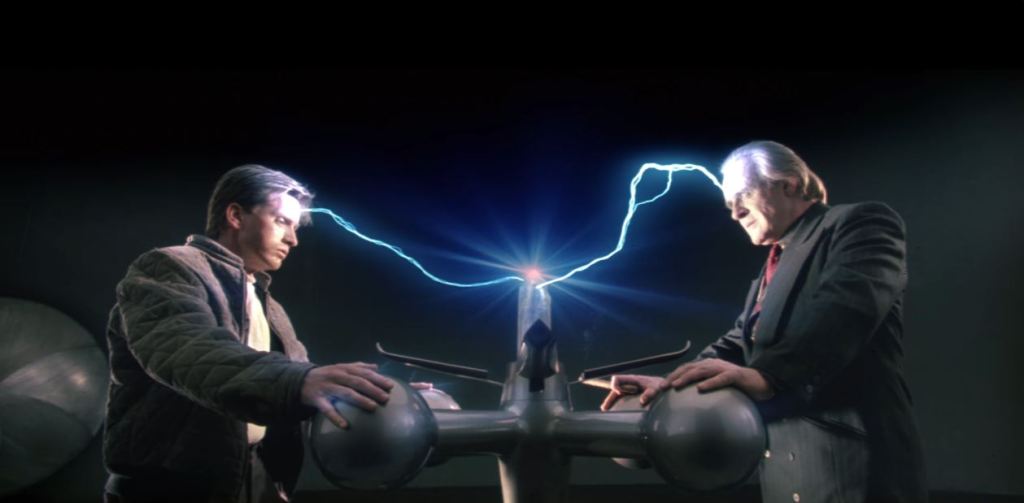
Anthony Hopkins is the bad guy, by the way, stumbling into the picture exactly as the Emperor was introduced in The Empire Strikes Back, hooded cloak and all. So we’ve got Hopkins and Russo, two great actors neutralized by Mick Jagger’s ability to ham up absolutely anything.
The most watchable part comes towards the end. There’s a fun sequence taking place inside the mind of Anthony Hopkins, though it’s nothing really new to the genre. Unfortunately, I’d been struggling to stay awake for so much of the movie, I finally fell asleep at that point and missed most of the good stuff. When I woke up, Mick Jagger had somehow turned into a good guy.
My biggest complaint is the lackluster romance between Emilio and Russo. When they’re reunited in 2009, Russo promptly turns him in to the authorities. When they’re reunited a second time, Emilio is inexplicably cruel. I don’t even remember if they ever kiss. The most they do is hold hands and speak to each other in whispers. What a dud.
Note: I haven’t read the Robert Sheckley novel Freejack was based on, but I admire Sheckley and I’m sure the book was better than this.










 The Goug' Blog