The Incredible Shrinking Ant-Man

Whenever someone makes fun of Superman’s red briefs, I roll my eyes. Are his red undies pointless? Maybe from a utilitarian point of view, but there’s a good reason they’re there: to provide contrast to the suit and to keep it from appearing boring. Visually, it’s perfect. Superman without his exterior underwear seems even more childlike to me, like a grown man wearing a pajama onesie. If everything must have a function, then why not ditch the cape while you’re at it? The trademark curl? Hell, why not just change his fucking name while you’re at it?

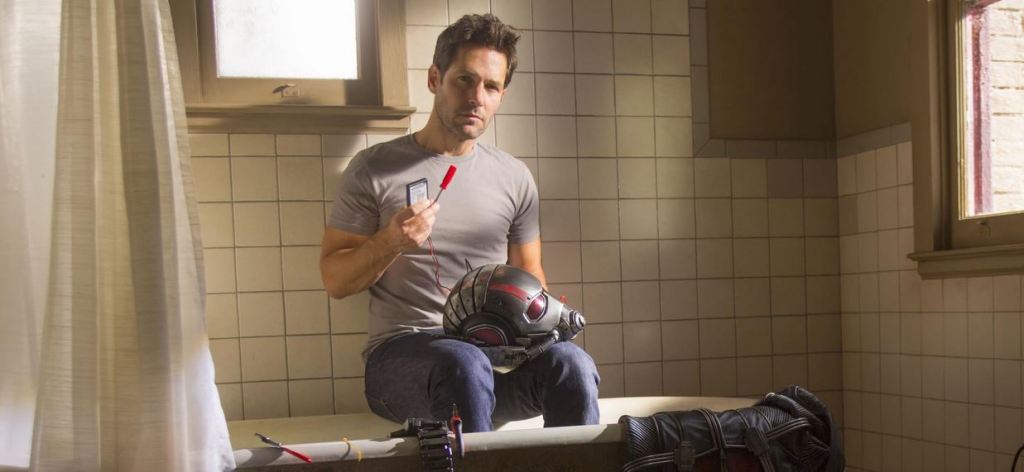
Ant-Man embraces the fact that its source material is an old comic book. Hank Pym (Michael Douglas) is the original Ant-Man who hangs up the shrink-suit early in the picture. In present times he discovers his villainous protégé, Darren Cross (Corey Stoll), has stolen his research and plans to sell it to shady individuals. This all sounds awfully standard on paper, but it’s tweaked just enough to function perfectly fine in a comic book movie.

Soon we meet Scott Lang (Paul Rudd), a former cat burglar who’s trying to go straight so he can be a good father. Yeah, we’ve seen that a million times before, so it’s best that the movie doesn’t dwell on it. The problem Lang is he’s supposed to be a kick-ass cat burglar, but he and his crew are depicted as bumbling idiots for comedic relief. It’s just kind of hard to believe Pym, a brilliant scientist, would pass the torch to somebody who gets captured by police so frequently.

If Ant-Man hadn’t been included in a double-feature at the drive-in, I would have skipped it. You can’t blame me, though, since we all assumed Disney was backtracking from the standard set by Guardians of the Galaxy after it had been announced Edgar Wright was removed from the director’s seat. There’s no doubt in my mind Wright would have made a (much) better movie, but his stamp of creativity is still here. The final product offers something much more imaginative than routine Marvel movies.

I don’t think there’s enough here to sustain the inevitable sequels, but I’m happy to report the initial outing is not a normal movie. Normal movies don’t have the audacity to make battlefields out of briefcases. Normal movies destroy entire cities, Ant-Man is content with destroying train sets. That kind of ingenuity is so good it hurts and it’s no doubt remnants from Wright’s time on the project.
The Death of "Superman Lives"

Two of my favorite subjects are terrible movies and movies which were never made. I always assumed we dodged a bullet when Tim Burton’s Superman Lives fell through, but I’m not so sure anymore. After watching the Kickstarted documentary The Death of “Superman Lives”: What Happened? I think Tim Burton’s Superman would have beaten Snyder’s fist-over-fist. At any rate, we can all agree it would have been better than Wild Wild West, which is the mega-flop Warner Bros. pivoted to after killing Burton’s passion project.

I know it’s popular today to hate comics of the 90s (I still like old school Spawn), but DC’s Death of Superman would have made an interesting movie, even if it did embody what was wrong with the era. I read Kevin Smith’s leaked script back in the AOL days: some of Smith’s dialogue was goofy and verbose (and never would have survived a rewrite), but it was an exciting read if you imagined Christopher Reeve in the part. According to the documentary, that’s exactly what Smith was going for when he wrote it.

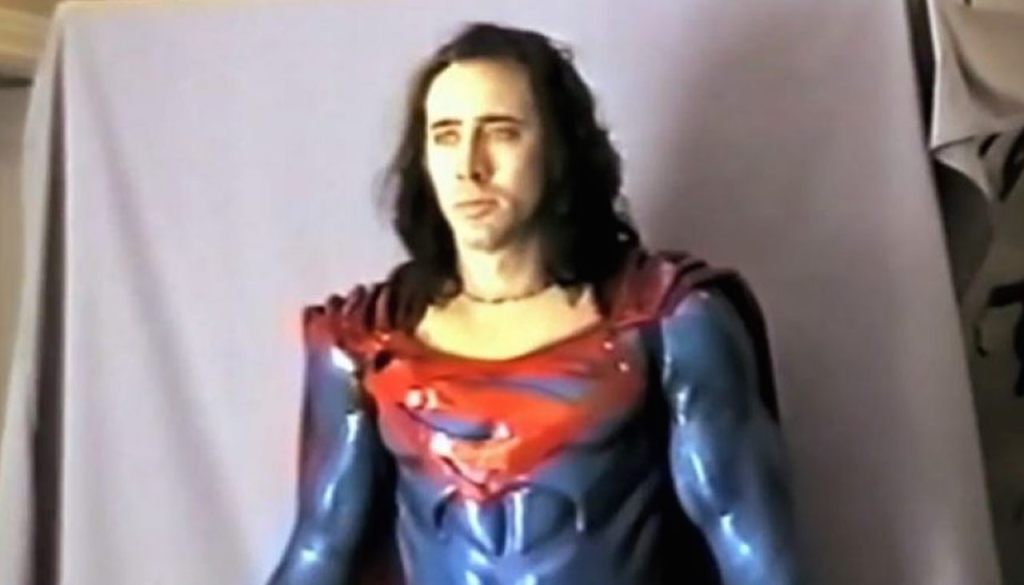
Since the movie was never made, The Death of “Superman Lives” uncovers a treasure trove of concept art, including some of Burton’s own drawings. The sheer variety of aliens they designed for Brainiac’s ship suggests we missed out on something special. Interestingly, the budget was initially estimated at $300 million. Comparatively, Waterworld cost $175 million and was the most expensive movie up until that point. Naturally, the studio ordered many cuts to the script.

When you see some of the more fantastical designs for Superman’s look, you can be forgiven for wondering what the hell the production was thinking. The documentary makes it clear Burton’s crew wasn’t taking liberties with Superman’s traditional look, but experimenting with suits he’d wear later in the movie, including a regeneration suit following his resurrection. Burton confesses it’s the reason he’s a lot more careful today about letting pre-production material get out: artists need time to experiment behind closed doors.

While I wouldn’t say it’s a great documentary, it does what great documentaries do: it changes my opinion. I now think Tim Burton’s Superman Lives may have been a fine picture.

Can The Wolverine make up for Wolverine: Origins?

A group of guards wave a metal detector over Logan’s body. His adamantium bones, of course, set the wand off.

“Hip replacement,” Logan explains.

That scene is about twenty minutes in. By then we’ve already seen the atomic bombing of Nagasaki, the cameo of a former X-Man, a bar fight, and a sword that can slice through beer bottles. The violence is so graphic you’ll wonder how they got away with a PG-13 rating. So there’s a lot happening in The Wolverine, but it works. With a darker tone and a more tasteful approach to casting, this Logan pic quickly atones for the sins of Origins.

Logan’s no longer with the X-Men. He’s living in the Canadian wilderness while perfecting his brooding face. Shortly after avenging the death of a grizzly (straight from the pages of Wolverine #1), Logan receives an invite to Japan. There, a man he saved in Nagasaki is on his death bed. The tech CEO offers Logan the gift of mortality: “You can get married, have a family, lead a normal life.” Logan’s tempted, but politely turns down the offer. The old man dies, yakuza attack, and ninjas spring from the shadows. Somewhere along the way Logan loses his healing abilities. He becomes vulnerable at that point, but his adamantium bones still shield his vitals from bullets.

Convoluted? Kinda. Awesome? Very. We’ve seen many action sequences on top of a moving train before, but this one sets the new standard. Logan’s so determined and unflinchingly violent it seems more like the a Schwarzenegger flick than a modern action movie. It’s been far too long since we had a ‘roided action hero fist-fighting his way through an army of nameless bad guys.

I do think the film’s villain, Viper, is perhaps the weakest link, but there are enough bad guys to make up for it. Sure, the plot teeters on the edge of preposterous, but it’s a comic book movie—isn’t that why we’re all here? I wasn’t exactly expecting the sophistication of Shakespeare when I purchased my ticket.

Slight spoiler ahead…

About the mid-credit sequence: we now have a solid link between this film and the much-anticipated Days of Future Past. I have to admit I was pretty skeptical about it when it was announced (Professor X is no longer dead and Magneto has reclaimed the powers he was robbed of in The Last Stand… or perhaps they’re ignoring that film entirely), but seeing Patrick Stewart and Ian McKellen return to the characters was exciting. No, it doesn’t explain their return, but a bigger question remains: Why the fuck would Wolverine even attempt to walk through airport security?

Superman Begins (to suck)

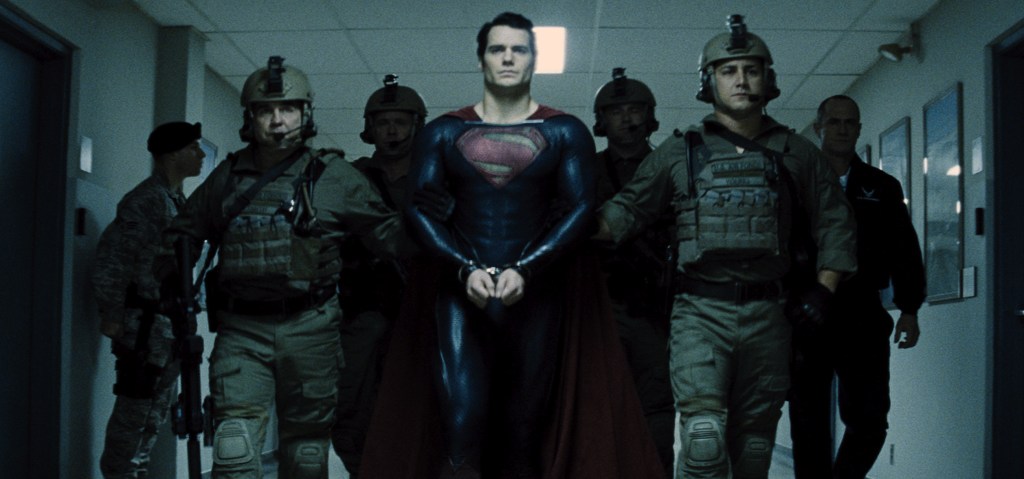
Man of Steel is what you get when too-cool-for-school movie director Zack Synder has too little confidence in a pop cultural icon who’s been around longer than anyone reading this. Give me old-fashioned Spandex and red briefs any day of the week. In due time, this blundered attempt at modernizing the hero will prove as dorky as elastic-cuffed jeans and fanny packs. If you want dark and gritty, here’s an idea: Don’t make a Superman movie, jackass.

Conversely, the trailers for Richard Donner’s Superman promised optimism: “You’ll believe a man can fly!” There was so much love poured into that 1979 film, it was bursting at the seams with magic. When Superman takes Lois on her first flight? That’s my favorite movie scene of all time. They made no attempt to modernize (read: dilute) the only thing fans wanted to see: the real Superman on the silver screen. Watching Man of Steel, which attempts to compensate for its weaknesses with exhausting action, one gets the sense the filmmakers would be embarrassed to be seen with the real Superman in public.

The film isn’t all bad—in fact, it’s far from the worst Superman movie. I’ve gotta hand it to the casting department: Henry Cavill would be the perfect Superman in a competent movie. Russell Crowe and Michael Shannon are best case scenarios for Jor-El and General Zod. Diane Lane is far too young and attractive to play Martha Kent, but great at what she does nonetheless. Meanwhile, Kevin Costner seems bored to be here… and when they have him needlessly murdered by a tornado of all things, can you blame him? (That scene will surely become as hotly debated as the door in Titanic.)

I am beyond sick of Hollywood retreading origin stories every American already knows, but the early scenes set on Krypton are fantastic. The special effects and the action there are breathtaking. The entire movie should have been taken place on Krypton as far as I’m concerned. After a sequence like that, the audience needs a breather. Instead, Snyder immediately throws more carnage and destruction at us two minutes later. I am not exaggerating that time frame.

This is all to say this movie is full of shit. You’ve got military jets and alien invasions and far too many shots of people running away from CGI destruction. Nothing about it feels like Superman, but I guess it’s the Superman we deserve when we keep voting for this shit with our wallets. The inevitable sequels really ought to focus on Martha and Lois a little bit more and Snyder really needs to chill the fuck out.

The X-Men Rises? (First Class review)

X-Men: First Class opens in a concentration camp. The boy who will one day become Magneto is separated from his parents by Nazis, which causes his mutant powers to unlock. Stricken with grief, he discovers he can bend metal with his mind. And you’re right: we have seen this exact scene before.

Around the same time, young Charles Xavier has learned he can read minds. He demonstrates the ability when he discovers a young and homeless Mystique rummaging in his kitchen. I don’t remember Professor X ever recognizing the shapeshifter in the films set after this one, but just go with it. You’ll have bigger challenges with this film, believe me.

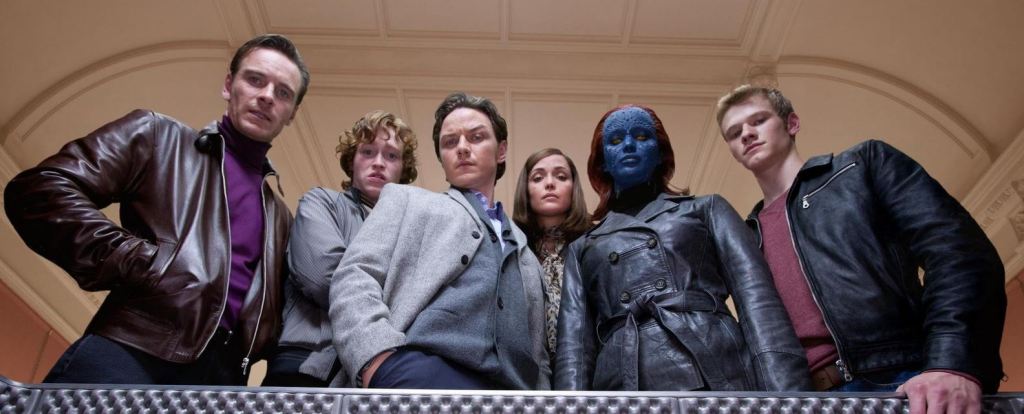
Fast forward a few years later and an adult Magneto (Michael Fassbender) is searching for Dr. Schmidt (Kevin Bacon), who cruelly studied his powers of magnetism and murdered his mother. We learn that adult Charles Xavier (James McAvoy) and adult Mystique (Jennifer Lawrence) have been hiding their mutant powers ever since they met. Mystique is forced to appear in her human form whenever they’re in public; she thinks men are unlikely to find her attractive in her natural blue form (um… sure).

Schmidt has escaped to America under the guise of Sebastian Shaw. During a stakeout, CIA agent Moira MacTaggert (Rose Byrne) learns Shaw is a mutant who plans to incite nuclear war. See, mutants were born of radiation so they will survive the nuclear winter (never mind the blasts). Most humans, on the other hand, will not. When you’ve got mutants as dangerous as Shaw, you can see why the government wants to track them all, but I digress. Again, there will be harder pills to swallow.

Charles and Mystique are recruited by the CIA to go after Shaw. Charles convinces Magneto to join him. They’re going to need a team, of course, so they scrape the absolute bottom of the barrel. See, for much of the original run of Uncanny X-Men, there was a problem: it was kind of a mediocre comic. It wasn’t until Giant-Size X-Men when the team got interesting. Which begs the question: Why bother making a film about the X-Men team no one, including Marvel itself, gave a shit about?

Look, all superhero movies are at least kind of goofy, but First Class takes the cake. Even the recognizable X-men are portrayed by younger actors with roughly half the gravitas of the old ones. Most of their powers are dull and useless. Worse, Magneto seems to exist in his own movie most of the time, a more serious movie, a darker movie, and a better movie. I would have much rather seen Magneto: Origins than this uneven mess.

Tonal shifts aside, it’s a well made movie made by an accomplished director whose first three movies I admired tremendously. It just isn’t exciting subject matter, unfortunately, and I hope he gets a chance to return to the less-Hollywood fare where he originally made a name.

Batman ends (I finally saw The Dark Knight Rises)

Batman and Bane set aside their differences and hold hands.

Most people who give a shit about Batman have probably already seen The Dark Knight Rises. I just feel no urgency to see a movie that’s going to make a billion dollars anyway and I’d rather give my money to Dredd any day of the week. Besides, going to the multiplex fills me with as much dread as getting up for work after a long night at the bar.

Speaking of dread (Have you seen Dredd?), I have a hunch that Nolan was burnt out on the idea of making another Batman movie this soon. If it took him so many years to write Inception (twelve, by his count), I can see how he may have felt pressured wrapping the series up, particularly after the serendipitous forces that made the previous film so unusually good. Nolan does a remarkable job, all things considered, but it’s not even as good as his first Batman picture.

The Dark Knight Rises opens with an airborne heist. We’ve seen that a million times, in a few James Bond films and Cliffhanger. Other than the introduction of Bane, the film’s powerhouse villain, there really isn’t a lot to discuss here. I mean, they’re not hijacking gold bars or anything as tired as like that, so it’s fresh enough and the photography is exceptional. There’s a punk rock energy to Tom Harden’s performance in the sense his version of Bane sounds absolutely ridiculous in the best (least commercial) way possible, as if telling the audience, “This is what I sound like. Don’t like it? Tough shit.”

Cut to a charity event at Wayne Manor. We learn it’s been eight years since Harvey Dent died and Batman disappeared, accused of murder. Gotham is mostly crime-free and Commissioner Gordon comes this close to telling a crowd of people that the district attorney turned into a raging psychopath at the end of the last picture. Bruce Wayne, it turns out, has become a Howard Hughes recluse whose knees are shot. That night, he catches a cat burglar (Anne Hathaway) stealing his mother’s pearls, but gets foiled by his old man cane. (Have you noticed all the franchise heroes are suddenly allowed to age lately? It’s an interesting trend, but a trend nonetheless.)

That’s where the movie lost me. Forget comparing Catwoman’s character to the other films—within the context of this film, the character is too goofy, too Hollywood, and too unbelievable. I’ve seen Schwarzenegger films with fewer one-liners. Catwoman in The Dark Knight Rises is like the ewoks in Return of the Jedi. The piece just doesn’t fit the puzzle. Hathaway is great with what she’s given, and predictably looks hot in the part, but this is one of the many reasons I think Nolan needed a little more time to let this one cook.

My second biggest complaint is Marion Cotillard, Wayne’s love interest, who you’ll remember from Inception. Movies in general could use a lot more Cotillard, as far as I’m concerned, but her character in this movie is pretty pointless until the point abruptly emerges. Then there’s Joseph Gordon-Levitt. I love this guy, but here he’s a little too run-of-the-mill. We all knew it when we saw the trailer, so let’s not even pretend this is a spoiler: he’s Robin, but don’t expect to see him suit up in his trademark underwear and leggings in the Nolanverse.

Then there’s the lighthearted comedy relief. It’s not as bad as, say, Johnny Knoxville in any non-Jackass movie he’s ever been in. It’s not even that bad, really… it’s just not right for this film. I know Rises was designed to be lighter than the last film (alluding to Dent’s speech about the night getting darkest before the dawn), but a second heist, and the ensuing car chase, struck me as a little too routine for Nolan. Meanwhile, the scenes where Batman and Catwoman fight side by side are reminiscent of Batman’s goofier days.

About halfway through the movie, Nolan drops blunt hints to the film’s conclusion. He wants us to know what happens in the end because there’s more to it than what you would expect. The ending is vague and it didn’t necessarily work for me at first. Thinking back on it, though… yeah, it works (I guess). As far as trilogy-caps go, Rises is among the best. That’s a rare honor even if the competition isn’t very thick.

You should give your money to Dredd instead.

Dredd (2012): Don’t Call It a Remake

Olivia Thirlby and Karl Urban

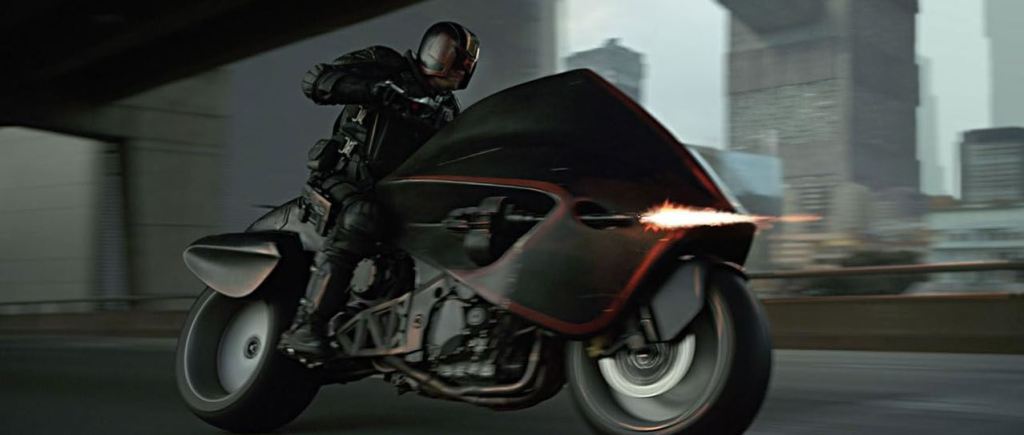
When my mother took me to see Judge Dredd on opening weekend in 1995, there was one other moviegoer in attendance. The guy got so bored he tried to read a book during the middle of the movie. Not that Judge Dredd was entirely without merit; I always thought it was a little better than most people cared to admit, Rob Schneider notwithstanding. While Karl Urban certainly has a better chin for Dredd, Sly had the more accurate body type; I may also slightly prefer the costumes and motorcycles of the 1995 film, too. That’s the only nice things I can say about that.

In Mega City One, one of the few cities left standing after nuclear war, Judges are cops, juries, judges, and executioners rolled into one. Despite its breakneck pace, this new adaptation of the 2000 AD character manages to paint a complete picture of its bleak and ultra-authoritarian setting in deft strokes of worldbuilding. We learn early on that Judges are spread so thin they can only respond to 6% of all crime in a city of 800 million people. With statistics like that, it’s a wonder why everyone doesn’t become criminals.

Batman ’66 vibes

The opening has Judge Dredd engaged in a high-speed pursuit with a street gang who’s stoned on slo-mo, a street drug that makes users perceive time at 1% of its normal speed. Dredd sentences the thugs to death, the last of which is dispensed in gruesome R-rated fashion. In the next scene, Dredd is assigned a new partner, Cassandra Anderson (Olivia Thirlby), who failed her aptitude tests, but may still get recruited for her uncanny psychic abilities… pending Dredd’s assessment, of course.

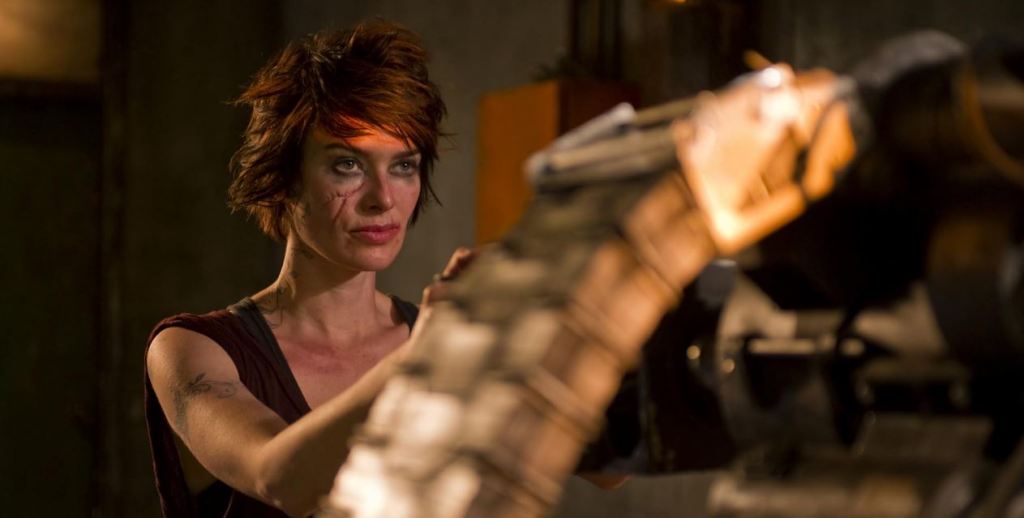
For her first day on the beat, Dredd lets Anderson pick which call to take. The rookie chooses to respond to a triple homicide in a two-hundred story slum, which happens to house a viscous crime lord known as Ma-Ma (Lena Headey, who’s even crueler in this than she is in HBO’s Game of Thrones). In a brief introduction, we learn Ma-Ma’s an ex-prostitute who “feminized” her former pimp before installing herself as the kingpin manufacturer of slo-mo. When Dredd and Anderson arrest one of her lieutenants, Ma-Ma hacks into the building’s security system, closes the blast doors, and places a bounty on their heads.

Lena Headey

That’s it. That’s the entire setup. The rest of the movie is Dredd and Anderson just trying to survive while they wait for backup. Movies like this are only as good as their villains and Dredd has a great one. She’s a believably nasty mother fucker to put it mildly.

Adults rarely have a good excuse to go see a genre movie, but Dredd’s one of the better ones. In 1995 it would have cleaned house. As of this writing, it hasn’t even recouped half of its modest budget. It’s a shame, too, because this is one of the rare franchises deserving numerous sequels. And that’s coming from someone who typically loathes sequels.