
Pumpkinhead (1988) | 31 Days of Gore

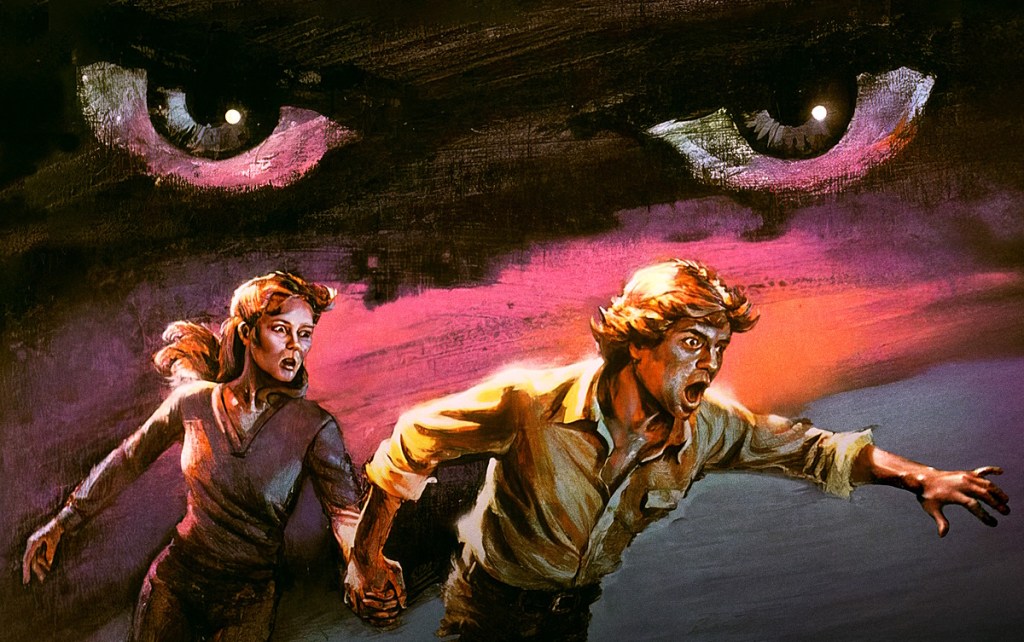
Pumpkinhead opens in a nondescript farm town in the 1950s. Hillbilly Clayton is being chased through the cornfields by something supernatural. He races to a cabin and pleads with a fellow farmer to let him in. The farmer shouts through the locked door, “I can’t risk my family for you, Clayton. Now get away before I have to shoot you!” When the monster attacks, we catch fleeting glimpses of a creature design that should have become a lot more iconic than it ultimately did.

Fast forward to the 80s and the farmer’s boy is all grown up. Played by Lance Henriksen, Ed Harley has a son of his own now. The two of them operate a small store on the side of the highway. When Harley leaves to run an errand, the boy is accidentally struck and killed by a dirt bike rider. Harley returns, finds his son’s dead body, and seeks out the witch who can awaken the titular monster.

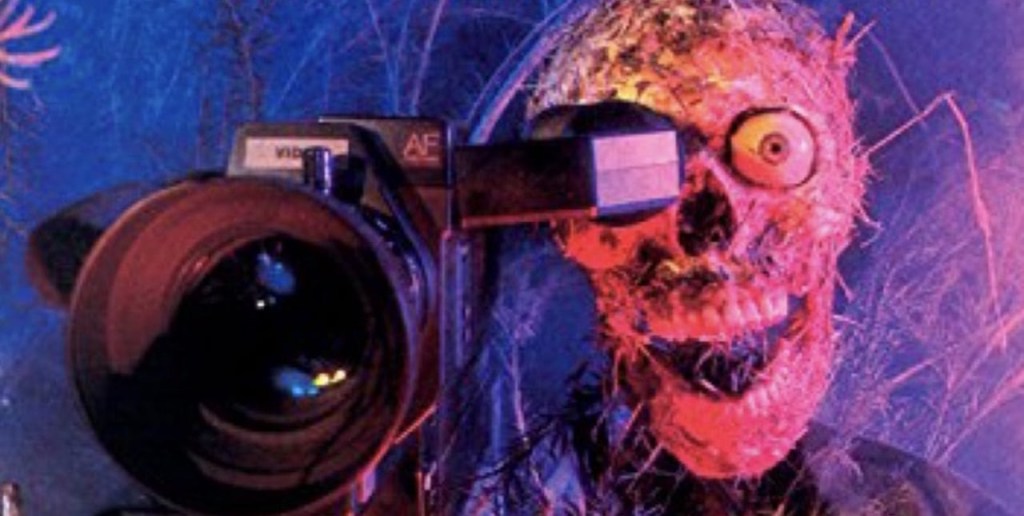
Do I need to point out that the witch’s makeup and the creature effects are fantastic? Pumpkinhead is the directorial debut of Stan Winston, possibly the most recognizable name in special effects ever. Unlike so many other movies I originally saw on VHS, Pumpkinhead doesn’t look worse under the magnifying glass of high definition. In fact, it looks better than ever. Stan Winston clearly shot the creature for the big screen, not consumer televisions of the time. Perhaps there are directors who know more about getting better performances out of their actors, but how many know more about photographing slimy creatures?

Speaking of the performances, they’re uneven but not bad by low budget standards. Henriksen goes big and is absolutely convincing more often than not. Buck Flower, though playing a hillbilly, isn’t cast for his usual comic relief and rises to the occasion. Flower’s son, played by Brian Bremer, has unusually strong screen presence; I had forgotten most of the movie since my last viewing, but his face seemed as familiar to me as the monster’s.

Pumpkinhead is a very fun movie despite its heart-attack seriousness. The monster’s sole purpose is to torment his prey like a cat toying with an injured mouse. It actually makes sense when he drags victims around like dolls instead of killing them swiftly. And the resolution reveals the film had a moral before leaving us with one final reveal. It’s an awesome movie that has only gotten better with age.

Tokyo Gore Police (2008) | 31 Days of Gore

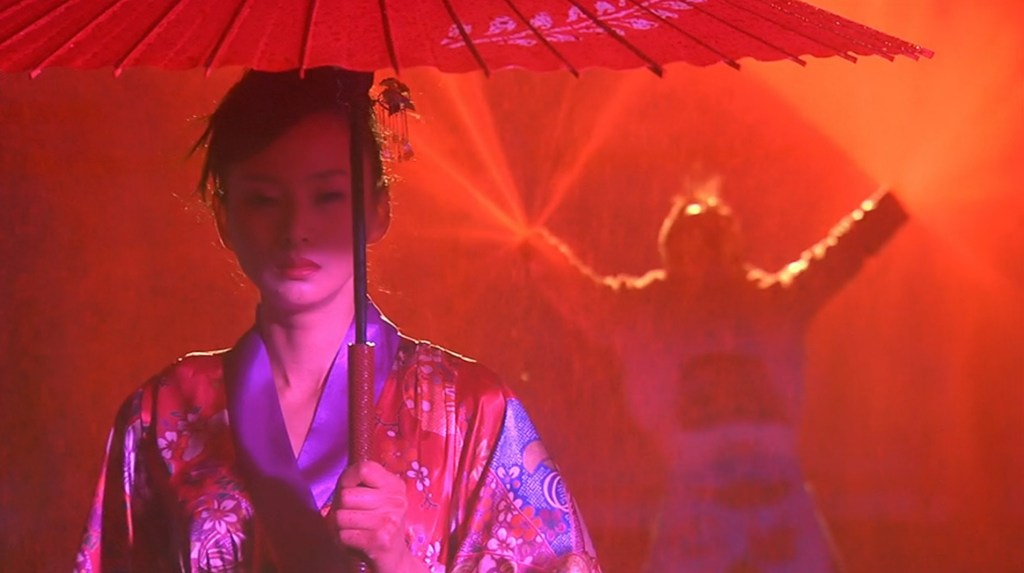
Tokyo Gore Police borrows shamelessly from Paul Verhoeven’s Robocop and 2000 AD’s Judge Dredd, presenting an absurdist/fascist Tokyo where the police force has become privatized and ultra-violent. A spunky reality TV host enthusiastically broadcasts the officers movements as they hunt down and execute criminals on live TV. The city’s worst criminals are the Engineers who are infected with a virus that causes their wounds to sprout Cronenberg-like weapons. Remember how the T-800 explained that the T-1000 was unable to produce complex weapons, only “knives and stabbing weapons”? Engineers, on the other hand, are capable of producing projectile weapons and chainsaws.

Guns have little effect on Engineers. While that won’t stop the police from pumping thousands of rounds into them, their ace in the hole is Ruka (Eihi Shiina). Ruka is highly proficient with a sword, which makes her the best Engineer hunter there is; the only way to kill an Engineer is to surgically extract the biomechanical key that is hidden somewhere in their bodies. On her free time, Ruka indulges in self-harm and broods over her murdered father.

I often complain about movies shot digitally. It’s not the medium itself I hate, but the kind of creators who adopted it early as an excuse to make terrible looking movies. There have been many digital productions that look undeniably great, from Michael Mann’s Collateral to the entirety of Better Call Saul. Yet, for the most part, the medium made far too many genre films of the 2000s nearly unwatchable. Thankfully, Tokyo Gore Police is an example of early digital done right. In fact, it’s amazing how often it avoids the usual trappings of its lazy contemporaries. In the world of early-2000s Japanese exploitation, there were many.

While I don’t hate digital photography, I do hate CGI blood. Karo syrup + red food coloring is the cheapest special effect there is (next to bare breasts, to paraphrase Jim Wynorski). There’s no excuse to cheat blood other than laziness. I dragged my feet on watching Tokyo Gore Police for nearly twenty years because I assumed it would be such an offender. So many movies around the time of its release had almost entirely turned their backs on practical effects—even Takeshi Kitano’s Blind Swordsman reboot had switched almost exclusively to digital blood.

Surprisingly, Tokyo Gore Police doesn’t follow the trend. There is some digital blood in it, but I’m going to give it a pass because I’m not sure how else you depict a man propelling himself through the air using the blood jetting from his freshly amputated legs. I honestly didn’t think I would like this movie, but I loved it. It’s so gory, I almost wish I had designed the gore meter to go up to five. If this isn’t one of the bloodiest enjoyable movie ever made, I don’t know what tops it. And yes, I have seen the director’s cut of Peter Jackson’s Dead-Alive/Braindead… it’s close.

* * *

So tomorrow is Halloween, which will bring this year’s 31 Days of Gore to a close. I always choose a banger for the final day—a movie I think is absolutely perfect for watching on Halloween night. Tune in tomorrow to see what I’ve picked. Same gore time, same gore station.

The Howling V: The Rebirth (1989) | 31 Days of Gore

Five hundred years ago, a Hungarian queen and a knight stand over the corpses of their castle’s inhabitants, strewn all over the banquet hall. The queen turns to the knight, begs her to drive his sword through her. He does and, after turning the sword on himself, a baby cries elsewhere in the castle. As he helplessly bleeds out, the man shouts, “A baby lives! We killed ourselves in vain!” An intriguing opening, especially compared to the dullness that opened The Howling IV.

Fast forward to 1989. The castle’s new count is throwing a grand reopening. He invites a large group of people with no apparent relation to each other (yeah, right) to come spend the night. After dining in the very room where so many people died in medieval times, the group disperses to explore the castle and check out their rooms. Damn near immediately the professor of the group gets himself killed when investigating noises coming from the maze of tunnels beneath the castle. Like most of the kills in this movie, the action takes place off screen.

About halfway through, the film becomes a werewolf whodunnit. The count himself is the prime suspect, but you’ll have your suspicions about other characters. Ten or fifteen minutes from the end, however, it becomes crystal clear who the werewolf is, long before the official reveal. I’d like to say it’s the journey that matters, not the destination, but in this movie getting there isn’t very fun either.

The Howling V is a dud any way you slice it. It opens with a promising 80s theme, you’ll recognize a couple more faces than you did in Howling IV, there’s a pretty decent decapitation near the end, and the screenwriters at least tried to make the dialogue cheeky and entertaining. The film is marginally superior to its immediate predecessor, but there are a few unforgivable crimes here. My biggest gripe is we don’t see a single werewolf transformation.

This time around, the opening credits claim the screenplay isn’t just based on one of Gary Brandner’s Howling novels, but all three of them. Does it really matter? The filmmakers are just paying for the name at this point. As much as I enjoyed the first three movies, I’m not going to bother with the sixth. Frankly, I need a nap after slogging through this one.

Butcher, Baker, Nightmare Maker (1981) | 31 Days of Gore

Seventeen year old Billy Lynch (Jimmy McNichol) has been raised by his aunt Cheryl (Susan Tyrrell) ever since his parents died in a horrific car crash. The banger of a scene was no doubt the cinematic inspiration for Final Destination 2’s famous opening. There’s a bit of an Oedipal thing going on between the boy and his mother-figure. She begins the movie utterly sane to the outside observer. Within fifteen minutes, it’s clear she’s losing it. Billy’s new girlfriend, Julie (Newhart’s Julia Duffy), is one of the catalysts. His plan to move away for college is another.

Faced with living in her house alone, Aunt Cheryl comes onto the television repairman a little too heavily. When the man finally relents, she stabs him to death with a kitchen knife. Billy witnesses the tail end of the act. The nosy neighbors walk in on the bloody aftermath. Aunt Cheryl tells them all the man tried to rape her. Billy and the neighbors believe her.

Who doesn’t believe her is Detective Joe Carlson (Bo Svenson) and Sergeant Cook (Britt Leach). Almost immediately, Detective Carlson spins a homophobic theory that Billy, who’s friendly with his closeted gym teacher, murdered the man out of jealousy and his aunt is covering for him. This results in the gym teacher losing his job. When the teacher asks Carlson, “What’s your problem?” Carlson says, “People like you.” Meanwhile, Aunt Cheryl kills again and again while the investigation focuses on Billy.

Here’s the second time this month I realized that I’ve already seen a movie on Joe Bob’s The Last Drive-In. Like I said the last time, I celebrate a little too hard whenever the show comes on. This time I won’t forget it. It’s a well-crafted thriller with a masterful build-up to the excitement at the end. The timing of that opening car crash, and the perfect pace throughout, makes it clear that directors William Asher and the uncredited Michael Miller know a thing or two about packing a punch.

I didn’t even mention that a young Bill Paxton rounds out the perfect cast as a high school bully who regrettably disappears from the film about halfway through. Susan Tyrrell and Bo Svenson both are pitch perfect for this kind of material, going big in delightful ways. Meanwhile, McNichol and Duffy anchor the production as believable teens. I suspect the reason the film works so well is because it’s not a prototypical slasher film. William Asher was known for television movies which, at the time, were often serious cinema with lite exploitation elements. In this film, he goes all the way with the kind of shameless entertainment that network television only hinted at.

Haute Tension (2003) | 31 Days of Gore

Alex is spending a weekend at her parents’ house, secluded in the French countryside. Tagging along is Alex’s best friend Marie, a closeted lesbian who’s secretly in love with Alex. While the two sleep in separate rooms, a man drives his delivery truck right up to the front step, rings the doorbell, and brutally murders Alex’s father. As the stranger attacks the rest of the family, Marie scurries about the house, slipping from one shadow to the next, searching for a phone or weapon.

The killer chains Alex up in the back of his truck and flees. Marie chases after them. This launches a cat and mouse game in which the killer is always one step ahead of Marie in exceedingly unlikely ways—not because he’s clever, but because he has to be or the movie would be over too soon. And that’s the entire movie: a monotonous game of hide and seek, padding out the runtime until it attempts one of the dumbest twist endings in movie history.

You know what? I’m being too kind to this movie. Twist endings that come this far out of left field are a cheat. It’s the second time this month that I’m calling Shenanigans, which I don’t do lightly. Flag on the field, insert-your-own-sport-cliche here, and fuck this crap for wasting nearly two hours of my time. The idiotic twist wouldn’t just fall apart on a second viewing, it does not compute on the first viewing. This is like playing a game of Imagination with the neighborhood kid who, upon losing fair and square, proclaims, “Nuh-uh! I was wearing an invisible force field! I put it on before you shot me!”

It’s unusual for me to hate a movie that looks this good… hell, look back at some of the other movies I recommended this month and you’ll agree it’s unusual for me to hate any movie. The acting isn’t the problem. The killer would have been the stuff of nightmares in a better movie. The ingredients are all here, but they over-measured the flour or under-baked the cake or… I’m running out of metaphors because I am dumber after seeing this.

I’ve seen the film revered as a gore masterpiece in some circles, but even that aspect left me scratching my head at times. When your movie takes itself as seriously as this one does, the killer shouldn’t be able to shove a piece of furniture into someone’s head and pop it clean off at the neck. This is a widespread problem among horror filmmakers: they need to learn just how resilient the human body is. Besides, it’s more effective when your killer has to work at dismembering his victims.

Video Violence 2 (1988) | 31 Days of Gore

I fully expect to be lambasted for enjoying this one, but to quote a famous Hollywood groomer’s wedding vows: “The heart wants what the heart wants.” I already featured an SOV (shot-on-video) flick this year, as is tradition, but that didn’t count because I had no idea it was shot on video until I started watching it. Besides, I prefer it when an SOV flick is shot on consumer grade camcorders. I want to see normal people (as in not in the movie business) shoot a movie that’s simply not fit for polite society.

The original film movie, which director Gary P. Cohen claims had a budget of six dollars, satirized the low budget gore movies which emerged to fill the shelves of budding video rental stores. Like Tobe Hooper, who doubled down on the humor of The Texas Chainsaw Massacre in its considerably goofier sequel, Cohen doubles down so that the satire is a little more obvious. Riffing on the fact that so many of these types of movies get off on torturing helpless starlets, Cohen at one point flips the script by having a trio of college girls call a pizza boy to party with them before hacking him up into pieces. It’s a little meta, a little refreshing, but kind of pointless when Cohen still indulges in those scenes in the very same movie.

My favorite kind of horror sequel gives us more of the same style in an entirely different setting. Video Violence 2 is one such example, trading the small town charm of the first movie for a pirate broadcast called The Howard + Eli Show. Howard and Eli, and their dimwitted electronic keyboardist, watch and review snuff tapes sent to them by viewers. The outlaw producers of the show supposedly overpower the local news signal, showing instead their uncensored gore, which includes underground commercials and the kind of punny stand-up comedy that could make even the Cryptkeeper roll his eyes.

So why, then, does the movie open with a vampire slaying that turns out to be a movie within a movie? Is it supposed to be one of the user submitted tapes to the show? I don’t know. Neither do I know why the ending devolves into a series of exceedingly confusing events—confusing not because they’re hard to follow, but hard to see how Cohen (or any human being) could conceive of them.

Though it’s not quite as charming as the original, it’s a worthy sequel, provided you like this kind of shit, and it’s got a bitchin’ box cover. 27 out of 10 stars. Fuck it.

Dark Angel: The Ascent (1994) | 31 Days of Gore

When I was a budding horror fan, I likened Full Moon Pictures to Cracked Magazine. I devoured every single issue of MAD and Fangoria as they came out, at first paging around, then ultimately reading them cover to cover. I would supplement those two publications with the occasional comic book, but when nothing else looked good on the newsstand, I would typically break down and grab the latest issue of Cracked to hold me over. Similarly, Full Moon wasn’t ever the sole reason I went to the video store, but when nothing else looked good, I’d roll the dice.

Today I rolled the dice on 1994’s Dark Angel, subtitled The Ascent presumably because the alternative title to I Come in Peace was also Dark Angel. The gamble paid off. Unlike today’s cocaine bears and meta anaconda films, there is no winking at the camera or purposefully jumping the shark. Many of Full Moon’s movies—the best ones, in fact—operated on the same principles set by Roger Corman: exploitation movies are serious business. There’s no reason to absolutely wallop the audience over the head with the fact that genre movies can also be funny.

Dark Angel opens with ambitious if unconvincing vistas of Hell. Veronica (Angela Featherstone) is a demon who’s growing tired of watching her elders torture the souls of those who end up in hell. When she informs her father (Nicholas Worth) that she dreams of visiting Earth, he decides to kill her. See, in this version of Hell, demons live in servitude to God and do whatever they can not to upset Him. They say grace before eating supper and pray to crucifixes even though touching one makes them burn. It’s not that demons take pleasure in causing eternal suffering, it’s just their civic duty.

Veronica and a German Shepard hellhound named Hellraiser escape their father’s wrath and crawl through a cavernous tunnel that inexplicably connects to a manhole in the middle of an unnamed city. Though the film kind of wants us to believe its set in America, the city’s architecture is clearly European and most of the actors are dubbed with American accents. If you’re wondering exactly where the movie was shot, I’m guessing it’s whichever country was willing to give producer Charles Band the best incentives at the time as he was equal parts showman and businessman. (Probably Romania as that’s where Full Moon was making the Subspecies films around the same time.)

Using magic, Veronica retracts her demonic claws, wings, and the nubbiest horns you’ll ever see on a minion of hell. The spell leaves her naked as she wanders the streets for several minutes, wondering why the locals are all staring (I’m too immature not to point out that there are at least two really good reasons for them to stare). Eventually, Hellraiser finds her a discarded long coat, which Veronica wears until she’s struck by a car. She awakens in the hospital, looked after by a hunky doctor who is instantly charmed by her constant bewilderment. Yes, it’s a fish out of water tale, but it feels fresh and fun because this fish brutally mutilates rapists and corrupt policemen.

I don’t know why I liked this movie so much. In fact, I probably laughed more watching this than any other movie this month. Perhaps my expectations were set too low, but I don’t think so. It’s just a well-rounded, fun little picture. I suspect screenwriter Matthew Bright (who wrote Full Moon’s hilarious Shrunken Heads) is the active ingredient in the secret sauce, but director Linda Hassani knew well enough to let the material be funny rather than try to enhance it.

At one point, the attending nurse in the hospital points out Veronica has the biggest feet she’s ever seen on a female. And when Veronica insists the doctor take her out to see her first movie, she chooses a hardcore porno, watching it with all the seriousness of a classic film. Think about how many actors have failed at making intentionally one-note performances work. Featherstone somehow brings the kind of engaging mojo Arnold Schwarzenegger brought to his performances as the terminator. It’s an impressive feat for a movie that probably only had a handful of days for rehearsals.

I don’t know how to justify my love for this movie. Yeah, I said it: I love this movie. It’s like Twilight for middle aged weirdo-dorks. It’s low key, unassuming, but oddly funny.

Severed Ties (1992) | 31 Days of Gore

Dang, I completely forgot about this one. From the moment I saw the Fangoria Films credit at the beginning, a core memory began to unravel. By the time the main character was ripping the tail off a mutant lizard (in the opening scene, no less), I was sure of it: I had seen this movie when I was a kid and I liked it very much. Then again, I liked literally anything with decent creature effects and Severed Ties has the decentest.

Harrison Harrison (Billy Morrissette) is a gene scientist who toils away in the basement laboratory beneath his mother’s mansion. Even though he’s an adult, he was never allowed to go to school or make friends, but that doesn’t seem to bother him much as he’s dedicated himself to continuing his late father’s work: trying to crack a serum that will regenerate lost limbs. His mother (Elke Sommer) and the corporate scientist crushing on her (Oliver Reed) have already made arrangements to sell the serum to an unethical corporation against Harrison’s wishes. Upon creating a successful batch, Harrison and his mother’s beau get into an altercation which results in Harrison losing an arm and hiding amongst the homeless community.

Fortunately, Harrison made off with the serum and injects it into his bloody stump. Unfortunately, because it was partially synthesized with reptile genes, the new arm has the instincts of a cold blooded killer. While getting used to the newly grown arm, Harrison meets a bum by the name of Stripes, played by SNL’s Garrett Morris. Morris frequently turned up in genre movies playing exactly this kind of character, but complaining about that would be like complaining that Groucho Marx never did Shakespeare. Morris’s involvement, as well as the involvement of veteran actors Sommer and Reed, is part of the reason the film works as well as it does.

Stripes says he was a combat veteran, though his claims are dubious at best. He’s also an amputee, missing one of his legs. (You can see where this is going, yes?) He introduces Harrison to a band of homeless misfits who live in the tunnels beneath an abandoned prison. The leader of the commune is a crazed preacher, played by rockabilly singer Johnny Legend, whose moonshine distillery will serve as the basis for Harrison’s second lab. Meanwhile, Harrison’s mother and the evil corporation are hard at work trying to replicate Harrison’s success while Harrison races to perfect it. Eventually the two camps will go to war.

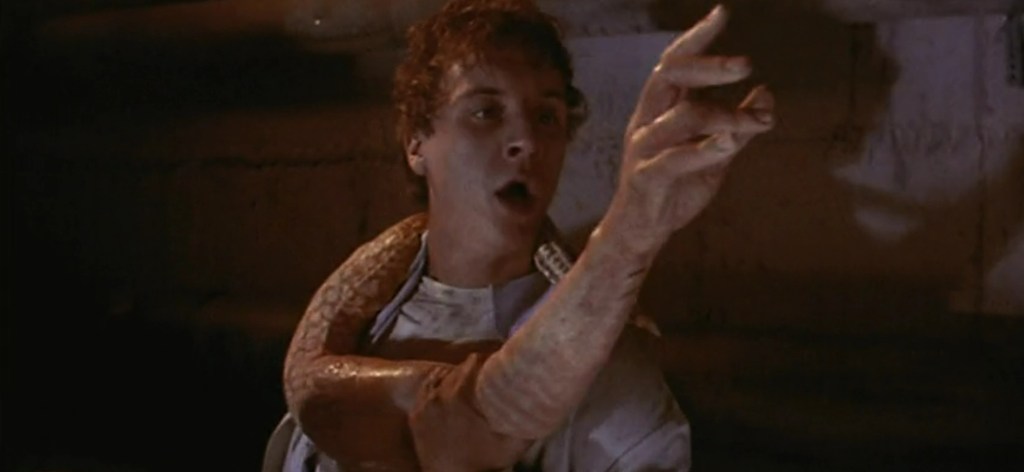
This a movie heavily influenced by The Re-Animator and the severed hand sequence in Evil Dead II. It has all the trappings of a cult classic, only falling a little short in the execution. It’s by no means a bad gore movie, just a lite one, and the death scenes have the annoying habit of starting a couple seconds too late or ending too soon. The creature effects are quite good, as one would expect from KNB EFX Group, and there’s some creative solutions for filming Harrison’s hybrid arm, which likes to detach from his body and wrap its tail (yes, it has a reptilian tail) around his neck for relaxation.

The strongest aspect of all is the writing. The story concludes with a deliciously nasty ending that would’ve made the film a lot more memorable if only it had been shot with the same verve of the guys who wrote it. I’ll give it a strong recommendation to those of you who love this kind of a stuff and a shrug to those of you who don’t. I’m certainly glad I discovered it again. You know what? I had pretty damn good taste as a kid, if I may say so myself.

Slime City (1988) | 31 Days of Gore

It’s traditional at 31 Days of Gore to feature a melt movie. This year’s selection is Slime City, in which twenty-something Alex Carmichael moves into a mediocre apartment in New York City. Upstairs is the penniless poet Roman, who only writes one line of his poem every year, and down the hall is Nicole, a baddie who likes to wear black lingerie. Shortly after settling in, Roman invites Alex up to his place for dinner, which consists of a gelatinous snack vaguely resembling green pudding and an “elixir” that looks suspiciously like absinthe.

From Roman’s place, Alex stumbles over to Nicole’s apartment, has sex with her, then has a black and white dream I can only describe as “playfully avant garde.” The following morning he wakes up with a helluva hangover and wanders the streets in the beginning stages of meltdown mode. A rockabilly soundtrack punctuates his descent into a melting killer (think: the chunky makeup effects in Nightmare City) as he murders a bum in an alleyway in a fit of rage. Following the murder, he discovers his skin has returned to normal and he later assumes it was all a hallucination from green stuff Roman served him the night before. It won’t be long, however, until he begins melting down again, which can only be alleviated by more killing.

Slime City is an acquired taste that I can only recommend to a certain type of moviegoer—those who already know if they could stomach such a thing—and to them I wholeheartedly recommend it. Do you like normal movies? If so, this movie isn’t for you. The acting, the camerawork, the special effects—none of it is what I would call good, but for my tastes, it’s pitch perfect. There are even scenes in which they failed to shoot the setup, such as when Alex shows up at an as-of-yet introduced character’s apartment with “the video tapes your mom wanted.”

Despite the fact the aforementioned special effects are more charming than technical, they are absolutely gross. In fact, this is probably the grossest movie I’ve ever featured for 31 Days of Gore, the phlegm scene in House IV notwithstanding. Your mileage may vary, but I must iterate that I don’t say this lightly: I can count the number of times I felt even remotely nauseated while watching a movie on one hand… hell, maybe even two fingers. This… this is something else. Something about the colors they use and the consistency of the slime… when a hooker slowly removes Alex’s Invisible Man bandaging, his face oozing the entire time, I couldn’t help but cringe in giddy anticipation.

This is bottom-of-the-barrel exploitation at its finest. There are no redeeming qualities, no forced edginess, and it has no agenda other than to entertain. The flaws, if you can even call them that, are what make the movie so endearing. It’s just a sloppy, gooey, lovable mess and I vibed like hell with it.

The Howling IV (1988) | 31 Days of Gore

I’ve been alive for nearly forty-three years and I suspect I’ve hated the dream fake-out for roughly forty of them. How do you keep an audience engaged? If you’re a hack screenwriter, simply throw a terrifying image at your starlet, have a hunky male shake some sense into her, and reveal that it was just a hallucination. Rinse and repeat until you’ve padded enough of your runtime.

Now contrast that method to a movie like Spontaneous Combustion, featured earlier this week, in which things don’t just happen for realsies, they actually have a lasting effect on the plot. When things happen in a movie, I want them to, you know, actually happen. If something exciting happens, why immediately reset the exciting development to zero? It’s like eating your cake and having it, too… meanwhile your starving audience has to watch you eat the fuckin’ thing right in front of ’em.

Marie Adams is a novelist. During a meeting with her agent, she has a hallucinogenic episode that’s so violent, she ends up in the hospital. (Her agent, by the way, has perhaps the deepest speaking voice I’ve ever heard in a movie… that is until her husband enters the picture with an inexplicably deeper voice. Perhaps the casting director had a voice kink? Beats me.) It’s obvious these visions are the result of some sort of supernatural phenomenon. Why are they happening to Marie specifically? What makes her so important? The only reason she’s the main character is because the filmmakers say so.

Marie and her husband decide to take an extended vacation at a cottage in the middle of the woods. While the husband makes up every excuse to go schmooze with an attractive shopkeeper, Marie is left alone with her endless hallucinations, haunted by the incessant howling that only she seems to hear. Eventually, one of Marie’s fans turns up on the doorstep of the cottage, looking for a missing nun. Okay, cool. So we have a mystery now. It’s still not an entertaining movie, though.

Once again it’s a sequel that has no overt connection to its predecessors. The required werewolf transformation doesn’t follow the rules we’ve seen before—this time it’s like something out of a melt movie. While I enjoyed the last three movies very much, I found too little to love about The Howling IV. Why make three far out movies just to reign in the wackiness for a bland outing? All the best stuff is crammed into a small sequence at the end. It’s not worth slogging through the first 80 minutes, mind you, but it’s got some pretty good visuals there.

My favorite part is when it’s revealed the werewolves can’t even claw through a convertible’s soft-top to kill the heroine. Now that’s incompetent.