

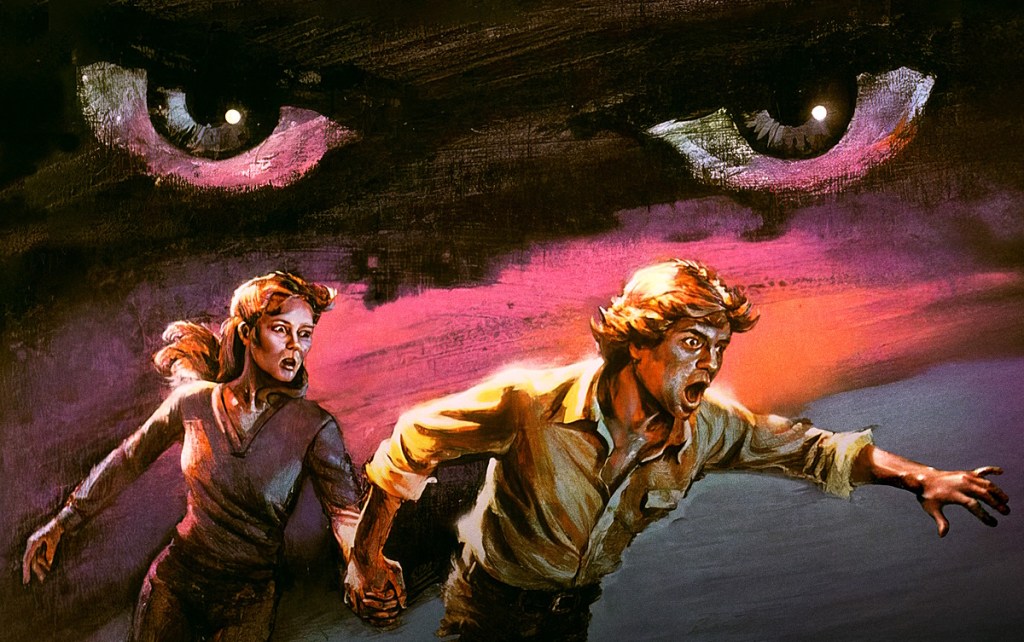
Seventeen year old Billy Lynch (Jimmy McNichol) has been raised by his aunt Cheryl (Susan Tyrrell) ever since his parents died in a horrific car crash. The banger of a scene was no doubt the cinematic inspiration for Final Destination 2’s famous opening. There’s a bit of an Oedipal thing going on between the boy and his mother-figure. She begins the movie utterly sane to the outside observer. Within fifteen minutes, it’s clear she’s losing it. Billy’s new girlfriend, Julie (Newhart’s Julia Duffy), is one of the catalysts. His plan to move away for college is another.
Faced with living in her house alone, Aunt Cheryl comes onto the television repairman a little too heavily. When the man finally relents, she stabs him to death with a kitchen knife. Billy witnesses the tail end of the act. The nosy neighbors walk in on the bloody aftermath. Aunt Cheryl tells them all the man tried to rape her. Billy and the neighbors believe her.
Who doesn’t believe her is Detective Joe Carlson (Bo Svenson) and Sergeant Cook (Britt Leach). Almost immediately, Detective Carlson spins a homophobic theory that Billy, who’s friendly with his closeted gym teacher, murdered the man out of jealousy and his aunt is covering for him. This results in the gym teacher losing his job. When the teacher asks Carlson, “What’s your problem?” Carlson says, “People like you.” Meanwhile, Aunt Cheryl kills again and again while the investigation focuses on Billy.
Here’s the second time this month I realized that I’ve already seen a movie on Joe Bob’s The Last Drive-In. Like I said the last time, I celebrate a little too hard whenever the show comes on. This time I won’t forget it. It’s a well-crafted thriller with a masterful build-up to the excitement at the end. The timing of that opening car crash, and the perfect pace throughout, makes it clear that directors William Asher and the uncredited Michael Miller know a thing or two about packing a punch.
I didn’t even mention that a young Bill Paxton rounds out the perfect cast as a high school bully who regrettably disappears from the film about halfway through. Susan Tyrrell and Bo Svenson both are pitch perfect for this kind of material, going big in delightful ways. Meanwhile, McNichol and Duffy anchor the production as believable teens. I suspect the reason the film works so well is because it’s not a prototypical slasher film. William Asher was known for television movies which, at the time, were often serious cinema with lite exploitation elements. In this film, he goes all the way with the kind of shameless entertainment that network television only hinted at.

 The Goug' Blog