
Missing game features is not a feature

Shortly after Grand Theft Auto 3 came out, a recurring topic on GTA message boards was, “Do you think we will be able to swim in the next one?” There was an aggressive group of players who reached for reasons why the ability to swim in a GTA game was “stupid” and “pointless.” (Never mind the franchise was hugely popular in part because it was seen by many as an “everything simulator.”) One side of the debate casually thought that such a mechanic would be cool. The other side took up arms as if such a suggestion was holy blasphemy, presumably because some people are hyper-defensive of anything they like. (Swimming was indeed introduced in San Andreas, and when Grand Theft Auto 5 released, the very first freeroam activity I engaged in was riding a Sea-Doo straight into the ocean and swimming off of it for no other reason than it was fun. Go figure.)

Similarly, the first time I played Perfect Dark Zero and witnessed the NPC combatants jumping over my bullets in the combat simulator, I logged into internet forums to see if the player-character was also capable of the same gymnastics. Perhaps you’ll notice a pattern emerging in one of the responses: “What are you? A circus clown or something? Why the hell would you want to leap around like a [insert expletive here]?” When Halo 2 released, I asked a forum why the sound design of the guns didn’t pack a satisfying punch on my surround sound system. The sole response was “no.”

More recently, I took to the Steam forums to ask those who had played the Mortal Kombat 1 beta to confirm or deny if there were any functions that relied solely on a right thumbstick (such as using Konsumable or navigating the Krypt in previous titles) because I was frustrated by not being able to play a fighting game solely on a fightstick, which has no right thumbstick. It was clear neither of the responses had actually played the beta, much less read my question past its title, but they had opinions nonetheless. One went so far as to suggest the Mortal Kombat moveset was “never really intended for joysticks…” as if I wasn’t there in the 90s when the first batch of games hit the arcade with—you guessed it—two big ol’ American-style joysticks.
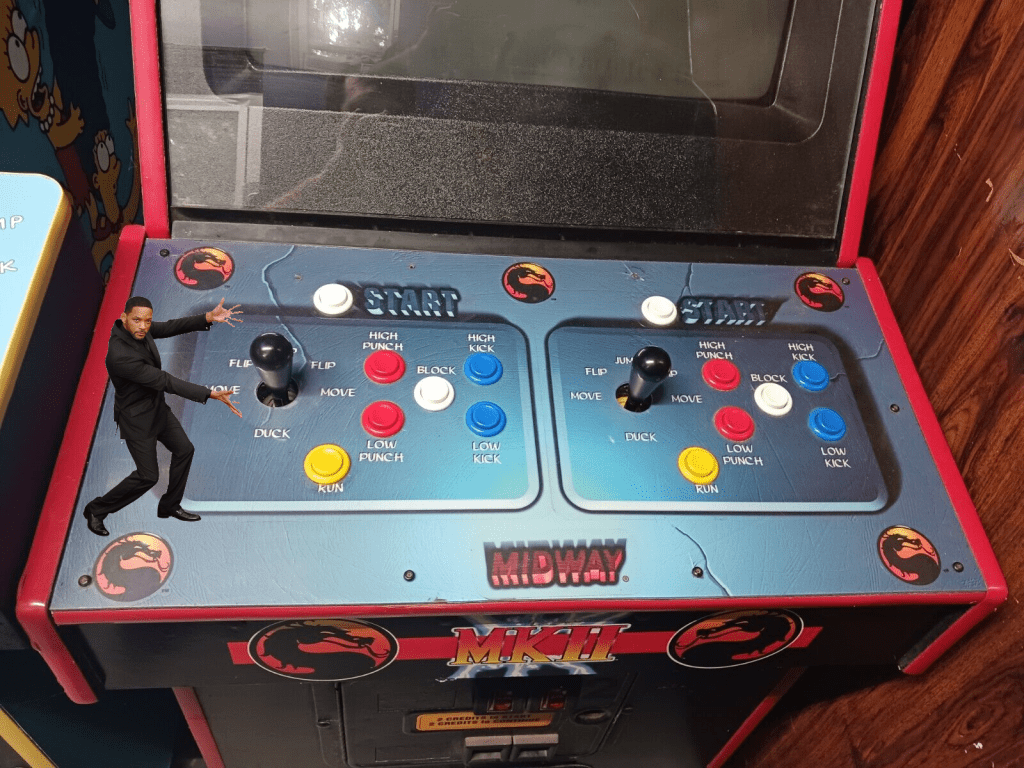
Have you ever been frustrated that the latest racing game doesn’t play nice with that expensive steering wheel you purchased? Well, according to the forum geniuses: that game (it doesn’t matter which game it is, there will be fanatics who blindly defend its oversights) is obviously more of an “arcade racer” and “arcade racers are exclusively designed for gamepads, not steering wheels.” Yet almost ever single racing game I’ve ever seen in the arcade has a steering wheel controller. So why does this community accept “arcade racers” that are uncontrollable by a steering wheel? Rather, why does the part of the community that doesn’t own steering wheels feel the need to voice an opinion on the matter at all?

A current hot topic seems to be: “Why does travel in Starfield rely so much on menus and fast traveling?” Those of us who expected space travel to operate more like No Man’s Sky or Elite Dangerous have been told exactly why we’re absolute morons for wanting that extra step of immersion that many find boring. I get it. Not everyone has dual flightsticks and a penchant for roleplaying deep space isolation. Not everyone lit up upon hearing Sean Murray’s pre-release promise that if you see a star in No Man’s Sky you can visit it. But I certainly did and so did millions of others. It’s now a genre standard that’s eight years old, set by indie game studios. And while there are definitely assholes on my side of this issue (any issue, really), it seems to me that those who are staunchly aligned against such a mechanic are doing the same thing the anti-swimming GTA players did: reaching for any reason why Starfield is absolute perfection.

(For the record, I have close to 50 hours logged in Starfield as of this writing so I don’t want to give the impression that I dislike it. My disappointment in the lack of tooling around a galaxy has more or less melted in lieu of what the game does right. On the other hand, it does plenty wrong, too, and I suspect the chorus of 9/ and 10/10 reviews are very much on a runaway hype train. Compare it to Baldur’s Gate 3 and you will see it is very much not a next generation title… it’s not even as good as Fallout 4, but I digress.)

We can have it both ways, you know. In fact, previous Bethesda games did just that: gave the player the option to fast travel or travel to a destination in “real time.” (Quotations because the term is relative to its science fictional setting.) Obviously players can’t spend the actual time required to travel to a destination that’s lightyears away, but Elite Dangerous and NMS both found clever ways around those limitations that didn’t require the use of an awkwardly placed loading screen. What I find most hilarious is that the people defending Bethesda’s omission are the ones who got their way and they’re still angry.

They (Still) Live

As I can’t imagine anyone reaching this blog without having already seen They Live before, I play fast and loose with spoilers.

I recently saw They Live as part of a 35th anniversary screening put on by Fathom Events. Oddly enough, it’s not the first time I’ve seen it on a big screen in the 21st century—the last time was at a double feature in a friend’s backyard, projected onto an inflatable screen and paired with Roddy Piper’s vastly inferior (but somewhat entertaining) Hell Comes to Frogtown. As real life political corruption and Joe Schmoe stupidity in the United States reaches hilariously depressing extremes, They Live hits harder than ever before. It could be my generation’s Dr. Strangelove or: How I Stopped Worrying About Inequality and Learned to Idolize the Wealthy.

I rank John Carpenter movies as follows: The Thing is his best, Escape from New York is stylistically his coolest, and They Live would be his most entertaining if not for the stupendously wild Big Trouble in Little China. Part of the reason They Live is so fun is “Rowdy” Roddy Piper, whose theatrical wrestling background translates into an endearing screen presence that’s simultaneously relatable and larger than life. When he initially discovers aliens have infiltrated and control every level of government, he chuckles in defeat. “It figures it’d be something like this.”

This pessimism comes shortly after he delivers a “I believe in America” speech that would seem contradictory to his character if you don’t detect the indifference in his tone. His only pal, a laid-off steel worker played by Keith David, openly berates the idea of the American dream—he hasn’t seen his family in months because he has to go wherever the scant opportunity to work takes him. The character points out that when the steel companies were in trouble, the workers pulled through for them, but when the workers were in trouble, the executives gave themselves bonuses. “The Golden Rule,” he says, “is he who has the gold makes the rules.” David is easily the most skilled and believable actor in the entire production, at times delivering reams of dialog while Piper mostly plays the silent type.

Midway through the movie, when you would normally expect a boringly routine love interest to be introduced, Carpenter instead pairs his hero with Meg Foster. Foster plays an oddly detached woman who immediately knocks his ass out of a tall window in an attempt to kill him. Later, she shows up to apologize in what appears to be a meet-cute moment. Here’s a detail I’ve never noticed before now: during their reunion, one of the background characters is instructing members of the resistance to attempt to befriend and gain the trust of their enemies as a means of infiltration… which is exactly what Foster is doing to Piper. It reminds me of that part in The Sixth Sense when the boy is explaining that some dead people don’t even realize they’re dead while the camera lingers on Bruce Willis’s face. Another detail my girlfriend pointed out: Meg Foster is the one who led the police to the resistance’s hideout in the first place.

I believe the famous five-minute fight in the alleyway still holds the cinematic record for the longest of its kind. I’ve always thought of it as a welcome indulgence of little import, but this time I reconsidered Carpenter’s intentions. Consider how many lower class men and women are in David’s shoes, helplessly preoccupied with their own struggles to make an honest living in a system they know is rigged. People like that know that hard work isn’t all it takes and yet they work hard anyway so as not to lose any ground. Getting them to release their tenuous grip on the status quo that shuns them would very well require a knockdown, drag-out fight of the caliber exhibited here.

Salient details that are easy to miss: not all the cops in Carpenter’s dystopia are aliens in disguise, but they all serve the elite. And not all of the elite are aliens, either, as greedy humans work with the aliens despite knowing that the endgame will result in a planet that’s uninhabitable for their own species. One of the downtrodden drifters (Buck Flower) from the beginning of the movie finds himself sipping champagne by the end, rubbing elbows with the economic overlords who just ordered the police force to bulldoze his homeless encampment. “We all sell out everyday,” he reasons. “Might as well be on the winning team.”

I haven’t even mentioned the iconic sunglasses. Created by scientists in the resistance, the special sunglasses let the wearers see the world in literal black and white. It turns out every form of mass media and all consumer goods are hypnotizing people to continue consuming, reproducing, and not questioning authority. The satire is sharp, but the metaphors are blunt. You can feel Carpenter’s rage against the inevitably destructive corporate machine oozing out of every pore of the screen.

I see a lot of old genre flicks screened for modern audiences. I love watching these movies with a group of strangers, but a lot of the time they laugh at the movie rather than with it. Curiously, They Live is one of the only times I’ve seen a modern audience laugh strictly at all the right parts. That’s some unusual staying power there.

Screenshots sourced from Movie-screencaps.com.

Starfield: 3 Hours In

Let’s get this out of the way quick: Starfield appears to be a great game and I suspect everyone who’s even a little interested in it should probably try it. So far, all of my complaints are nitpicks. Let this post serve as a spoiler-free indicator of what to expect. I’ll either temper your expectations or kick your hype train into overdrive.

I’d heard two reports that the game was more like “Red Dead Redemption 2 in space” rather than a traditional Bethesda title. My brief time in the game conflicts with that statement. The music of the title screen immediately gave me Skyrim vibes. These vibes strengthened as the game faded into a cutscene that had me expecting one of the characters to say, “Hey, you… you’re finally awake!” Soon after coming into contact with the game’s MacGuffin, your character develops temporary amnesia, at which point the character editor is unlocked as you “remember” who you are, Fallout style.

The character editor has one strength: characters look better than they’ve ever looked in a Bethesda game. Unfortunately, the editor has many weaknesses, too. Recent titles like Street Fighter 6 and Diablo IV offered enough options for me to create fairly accurate replications of Brandon Lee’s The Crow (I don’t know why that’s my go-to character lately). Starfield’s character editor isn’t even close to being robust enough for that kind of detail. It offers you around thirty presets, maybe thirty hairstyles, and lets you change the oddly similar (and oddly familiar) faces within some pretty rigid parameters. Instead of having control over ear height, eye separation, etc., you decide if the preset face is round, square, thin, etc… that’s it.

As someone who has countless hours in No Man’s Sky and Elite: Dangerous (not to mention over a hundred games in my Steam library with the “space” tag), I was disappointed the first time I climbed aboard the starter ship to fly to another planet. There’s a short but rousing cutscene as the ship takes off, but then the game clumsily enters a loading screen. The next thing you know, you’re suddenly in space. In retrospect, I shouldn’t have expected an immersive sim from what could very well be the year’s best seller, but as a staunch fan of seamless ground-to-space transitions, this is my biggest disappointment so far.

Speaking of boundaries, on the first planet I visited after leaving the starting planet, I completed a main objective and was told to go back to my ship to continue the story. I decided to ignore said message and started walking to see if I could find any invisible walls. I set my sights on a distant piece of scenery that was so far removed from my landing spot that I was certain I would reach some sort of invisible wall or at least a warning to turn around. Not only did I not find any such boundaries, I saw a point of interest blip on my radar much farther away than my initial destination. I will experiment on this more when I play again, but so far (and I admit my sample size is relatively small) it looks like the explorable areas of planets might be absolutely huge. Though, I must confess my walk was quite boring.

Having recently played the new System Shock, I feel like I’m in familiar territory: so far, Starfield feels less like a next-gen defining game and more like a highly polished next-gen remake of a previous gen-game. So much of The Elder Scrolls and Fallout’s DNA is in this, which is to be expected and even desired, but some of the Bethesda aspects that have started to show signs of their age are present, too.

At any rate, I am absolutely hyped to play again and spend more time in the combat and checking the dialogue out with NPCs.

I’ll post more thoughts as I progress.