
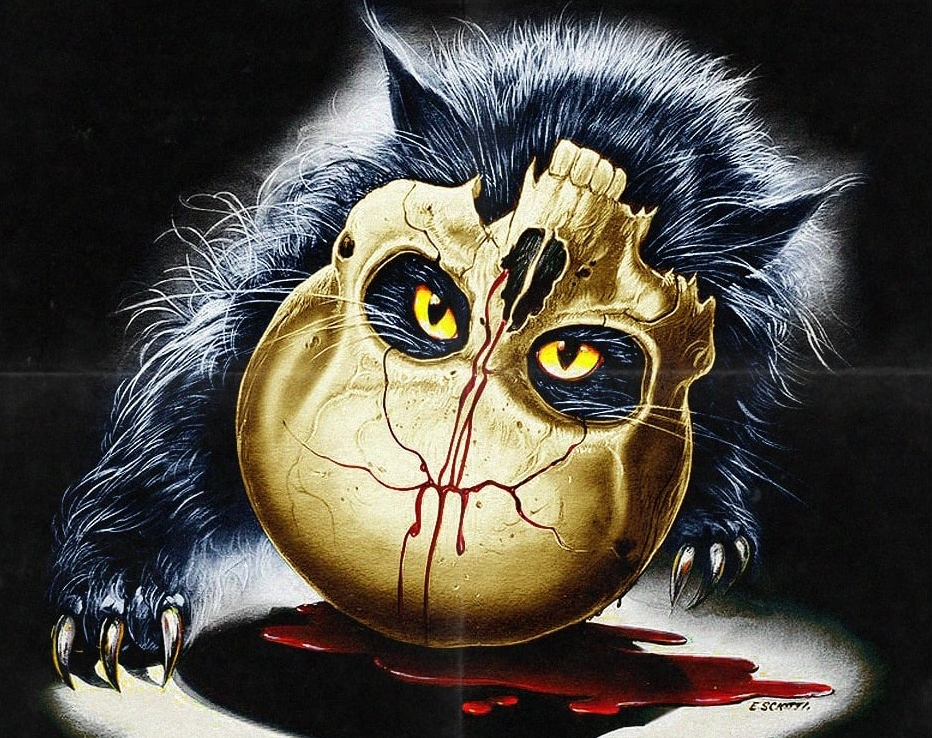
Midnight Movie: A Cat in the Brain (1990)

“A lot of Italian genre directors are animal lovers. Mario Bava loved cats, Riccardo Freda loves horses, and Dario Argento loves himself.” — Lucio Fulci

Fade in: An aerial shot of a man, sitting at his desk, writing frantically. We hear him muttering like a lunatic. His scribbling pen can barely keep up with the ideas boiling out of him: “A throat torn out by a maddened cat… burned alive… buried alive… tortured… scalded…!” Meanwhile, the camera pushes in close to his head and the perspective enters his skull. There’s a cat in there, which munches on his brain like a vulture on roadkill.

Cut to: A cold body lying on a medical table. A section of the rump is missing. The body is then ripped apart by a chainsaw as the camera lingers.

Cut to: A man frying meat in a pan. He sits down in front of a television screen and cuts into his meal with a knife and fork. On the television, an actress seductively informs the viewer, “I love you so much I could eat you.” The man raises his fork and proclaims, “Just what I’m about to do!”

Lucio Fulci’s A Cat in the Brain (aka Nightmare Concerto) is gleeful insanity. This is Fulci’s version of 8 1/2, but instead of casting a movie star surrogate, Fulci casts himself in the lead role. Like many of Fulci’s movies, the camerawork and acting are dreamlike, but this time used to comedic effect. Meta-horror is often lame, especially when there are movies inside the movie (this time it’s stock footage from Fulci’s own films), but this one isn’t. It took me a while to get the joke—all of fifteen minutes. This isn’t Fulci ripping off Fellini; it’s Fulci making fun of Fellini as well as filmmaking in general. Being a horror director must be one of the strangest jobs in the world, which is especially apparent (and hilarious) when Fulci’s fictional shrink reviews some of his actual films.

Here are some of the things you’ll see in A Cat in the Brain: a Nazi using a woman’s vagina as a billiards pocket, a hilariously psychopathic psychiatrist, and a literal cat inside a man’s head. Fulci is one of the unlikeliest likable protagonists.
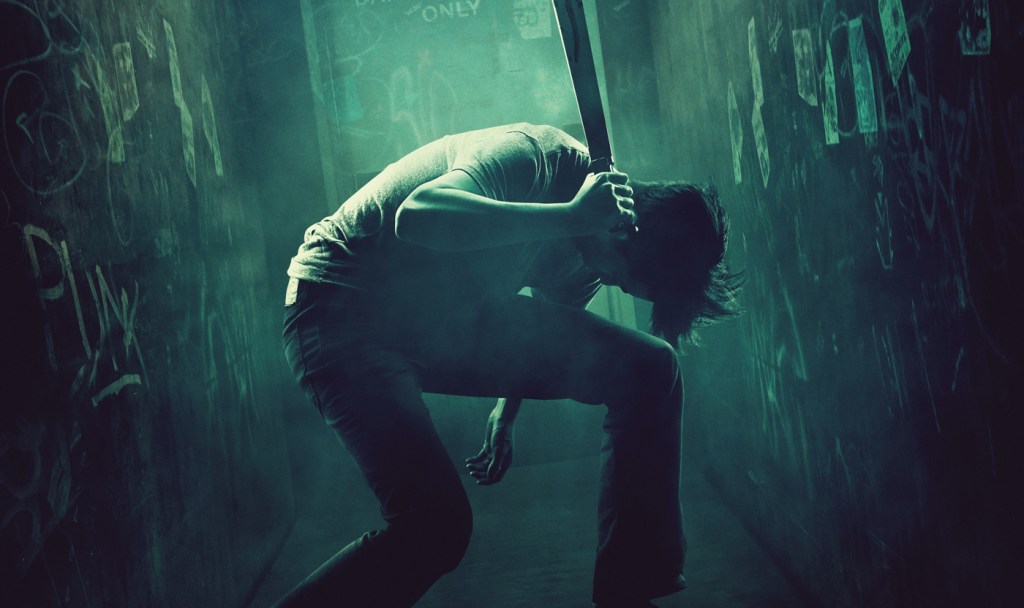
Green Room (2016)

You could argue Green Room is more thriller than horror, but bones are broken, throats are torn out, and faces are mauled. The camera rarely cuts away as the imagery shocks and awes. There’s no supernatural element—not that that’s a requisite for horror—but the skinheads here are effectively monsters because they’re depicted not as cannon fodder, but three-dimensional humans. The things that happen in Green Room are, to put it mildly, horrific. And if I were to make a list of the best movies of the twenty-first century, I’d rank it extremely high.

A wandering punk band is hard up for cash. They reluctantly end up taking a gig at a rundown neo-Nazi joint in the middle of nowhere. In true punk fashion, the band decides to rile up the crowd with a cover of “Nazi Punks Fuck Off.” That goes over about as well as you might expect. Fortunately, the rest of their set is played hard enough to win the skinheads over by the end. After the show, the band heads back to the green room and accidentally discover the venue’s operators are covering up the murder of a young woman.

While the skinheads scramble to come up with a plan, the band is locked in the green room with a psychopath. He subtly mentions his revolver only holds five cartridges, “because they’re so fucking big that’s all that can fit in the cylinder.” Meanwhile, the neo-Nazis outside the room call Darcy Banker, their leader and the owner of the property. Banker is played by Patrick Stewart, whose performance is neither too cold or too hot. He’s not a man who relishes his villainy. His only motivation is to get the witnesses off his property as quickly as possible so he can murder them elsewhere.

The simple plan complicates quickly. Banker, who’s always failing to keep the situation from escalating, comes up with one idea after another to flush the band members out of the green room. He approaches the problem matter-of-factly, as if coordinating the extermination of rodents. To him, it’s just another problem in the life of a businessman, albeit an amoral one. Another interesting choice is the skinheads aren’t caricatures; when Banker loses his cool and humiliates one of his men, he promptly apologizes for his transgression. His henchmen aren’t expendable in his mind, they’re family.

There’s no fantasy violence here. There are no characters who do unbelievably heroic or villainous things. The good guys are gonna take a licking. Some of the bad guys are gonna take a licking, too. We all hate movies in which stupidly written characters do stupid things, but here’s a rare example in which smartly written characters do stupid things. After all, they’re young, immature, and panicking in a realistic way.

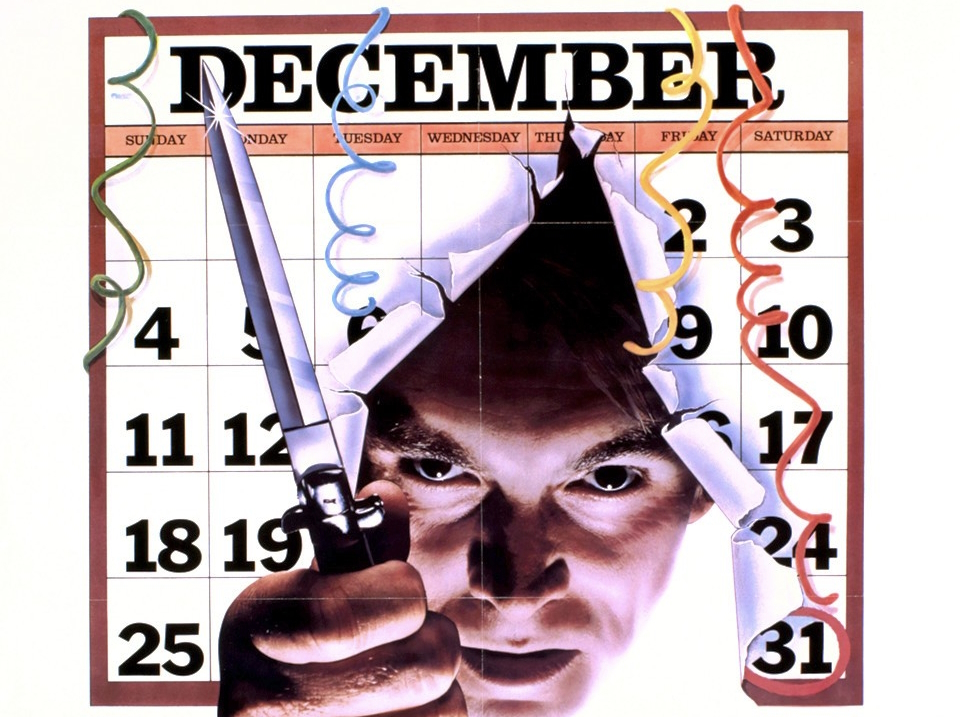
New Year’s Evil (1980)

“Shhhh… I can hear your heart beating. I don’t like that.”

Roz Kelly (Pinky Tuscadero from Happy Days) plays Blaze Sullivan, the VJ-like host of a televised New Year’s Eve bash. During one of the show’s call-in segments, a modulated voice promises to kill someone very close to her. The police quickly discover it’s not just a prank call: someone’s already dead. The man responsible refers to himself as Evil and he intends to murder someone every hour, on the hour, as each timezone in the United States welcomes the new year.

As per Cannon Film Group’s philosophy, everything in New Year’s Evil has been cranked up to 11. This ensures even the mundane scenes are sensational as absolute anyone in the picture might be packing a switchblade. Right off the bat we see a group of punk rockers drinking and driving down a Hollywood street in a convertible that’s pushing capacity. The televised party they’re heading to hosts a gaggle of similar delinquents as one presumably real life band after another plays fantastic-shitty 80s music.

Meanwhile, the killer paroles mental institutions and bars for his victims. Remember: his plan is to kill someone every hour on the hour until the clock strikes twelve. He’s capable of getting an awful lot done between attacks, including: finding his victims, arranging their dead bodies for cinematic reveals, changing disguises, sneaking into guarded buildings, and calling into the TV show. At one point he even gets into a traffic accident with a biker gang that leads to a foot chase through a drive-in movie. Yet he still manages to get to his next appointment on time.

Unless you’ve never seen a movie in your life, you’ll figure out the twist ending: the killer is actually Blaze’s oft-mentioned but curiously missing-in-action husband. Even if the repeated “Where’s Dad?” line doesn’t clue you in, you’ll start to suspect it the moment their son pulls his mother’s pantyhose over his head and pierces his ear with a needle. Here’s the best part: during a wonderfully cheesy soliloquy he looks into the mirror and tells himself, “I think I have a mental disorder.”

Don’t worry: there’s yet another twist at the end which I won’t spoil. Unfortunately, you’ll see that one coming from a mile away, too. Oh well, it’s still a fun picture.

Midnight Movie: Deadly Friend (1986)

Paul, the teenage hero of Wes Craven’s Deadly Friend, not only designs advanced robots, but he teaches college courses, dissects human brains, and somehow finds the time to hang out with his friends. The robot he’s created, “BB,” looks like a robot from any other 80s movie. It can crack locks, shoot hoops, and move heavy furniture. The only thing his robot can’t do is dodge shotgun spray, which we learn when it ding-dong ditches the neighborhood crazy lady, played by Anne Ramsey from The Goonies and Throw Momma from the Train. Don’t you just love her?

Paul’s love interest (Kristy Swanson in her first leading role) is repeatedly abused by her alcoholic father. In one of the film’s three or four dream sequences, which are filmed Nightmare on Elm Street style, she stabs her dear old dad with a broken flower vase. What follows is a jarringly bloody scene. Jarring because watching Deadly Friend is like getting thirty minutes into Short Circuit before discovering it’s an R-rated horror movie.

And here’s where my objectiveness flies out the window. I love killer robot movies. Terminator, Runaway, Chopping Mall, Screamers… I can’t get enough of this shit. What’s disappointing about Deadly Friend is they dispense with the actual robot twenty minutes in. The movie then goes the Donovan’s Brain/Frankenstein route: after Swanson’s father accidentally kills her, Paul transplants BB’s brain to her body. As expected, the world’s first robo-girl doesn’t come in peace. How she got superhuman strength isn’t explained nor is it entirely important in a movie like this.

This is an 80s movie, through and through, no doubt conceived by coked-up movie executives who wanted a gorier E.T. The Extraterrestrial. I mention E.T. because that’s exactly what Deadly Friend’s plot structure seems to mimic. Genre movies back then simply moved at a different pace than they do now. While most “slow-burn” horror films bore, this one has a pleasant pace. It really takes its time, but never takes more than we’re willing to give it. It makes the absurd climax, which is cram-packed with unintentional laughs, all the more entertaining.

J.J. Abrams said he got the name for one of his The Force Awakens characters from Phantasm. I’m beginning to wonder if he lifted BB-8’s name from this movie.

Midnight Movie: The Vagrant (1992)

The Vagrant stars Bill Paxton, Michael Ironside, Marshall Bell, and Collen Camp. Killer cast, right? Unfortunately, each supporting character is compartmentalized. If you don’t see them interacting with the main character, you don’t see them interacting at all.

Paxton plays Graham Krakowski, which is pronounced “Crack-house-ski” by some characters. He has a stable yet mind-numbing job, which allows him to buy a fixer-upper from his nymphomaniacal real estate agent (Camp). Soon he’ll learn there’s a vagrant in the neighborhood (Bell) who’s squatting on a nearby lot. Krakowski takes out a second mortgage and fortifies the property with the best security money can buy, including a perimeter fence, stadium lights, and an automatic music player that makes intruders think someone’s at home when he’s away.

After spending every dime on this worthless stuff—worthless because it doesn’t stop the vagrant from letting himself into Krakowski’s house—he realizes he should have bought furniture instead of Pentagon-level security. So he has the inside of the house decorated at his girlfriend’s insistence and puts it all on his credit cards. Now that he’s ensured he’ll spend the rest of his life in debt, the vagrant’s antics drive him crazy, he loses his job, and an over-the-top homicide detective (Ironside) is trying to finger him for a murder the vagrant actually committed.

Did I mention this is supposed to be a comedy? I love horror-comedies, but this one isn’t scary and it isn’t very funny, either. The concept was ripe to become a cult classic and I’m a fan of all these actors. This is actually my second viewing and I was hoping I would notice satirical complexities I was too young to pick up on the first time around. Nope. It’s shallow and intentionally cheesy and pretty incompetent to boot.

The Vagrant isn’t a terrible movie, just mediocre, but it does entertain here and there.