

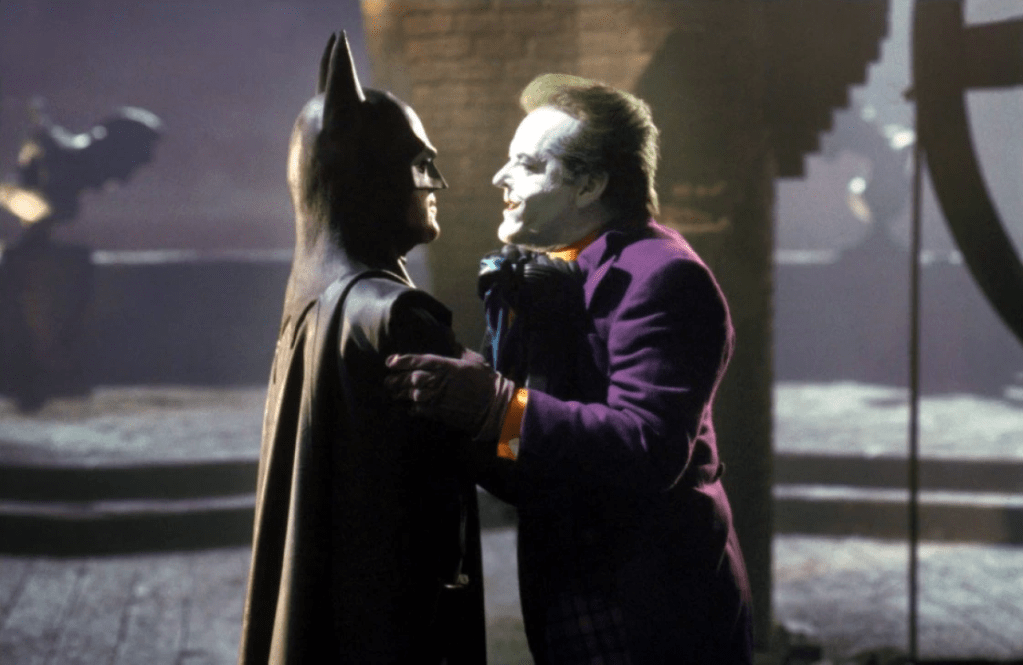
1989 was a massive year for movies, the kind of year that only comes around every decade or so. We got a third Indiana Jones, a second Lethal Weapon, a fifth Freddy Krueger, and an eighth Jason Voorhees. Batman was the biggest moneymaker of them all by a large margin. You couldn’t peek into a classroom without seeing at least one bat logo on a kid’s tee.
My parents had taken me to see it at the theater on opening weekend. I found myself a little less interested than I was in the aforementioned movies—perhaps it was exhaustion from the constant stream of movie-going that year. This is probably the first time I’ve seen the movie in over twenty years. It’s okay.
Long before Hollywood became obsessed with telling (and re-telling) the superhero origin story, Bruce Wayne is already Batman at the beginning of his first silver screen adventure. He’s already fighting crime, too, but has yet to establish the trust and cooperation of Police Commissioner Jim Gordon. When a shootout ensues at the local chemical plant, mobster Jack Napier (Jack Nicholson) falls into a vat of acid, which sets the character down the path of becoming the Joker. Christopher Nolan explores the idea a little more in his own Batman/Joker picture: the creation of a superhero naturally begets the creation of a supervillain. Wayne would have to feel at least a little bit responsible in a film more thoughtful than this.
It’s easy to warm to the idea of Michael Keaton as Batman, but the Bruce Wayne scenes are a slog. (Director Tim Burton greatly improves this mediocrity in the vastly superior sequel, Batman Returns, by reducing both Bruce Wayne’s and Batman’s screen time.) There’s a scene early on in which Batman-obsessed journalist Vicki Vale (Kim Basinger) goes on a date with Bruce Wayne. You’d think a guy who’s worth a billion dollars could afford to take his love interest to a nice restaurant, but instead they stay home for an impersonal dinner at a mile-long table. (Later, the Joker manages to take Vicki on a much more exciting date.) If Burton is trying to communicate that Bruce Wayne’s personal life is suffering because of his latex-clad alter ego, something got lost in translation.
It’s no wonder Nicholson gets top billing (and a significantly larger paycheck) as he has all of the greatest lines. “Honey, you’ll never believe what happened at the office today” is my favorite. There’s just something about the way Nicholson says it, and the circumstances leading up to it, that makes the throwaway line one of the more effective gags. (I can’t help but wonder if Jack Palance would have made a good Joker as he’s great in his scenes. Perhaps he chews the scenery quite a bit, but is that really a crime in a movie like this?)
One thing Burton nails is the look of Gotham City, achieved mostly with miniatures, which is so arresting it more or less carries over to the embarrassing Schumacher sequels. Unfortunately, the interiors seem to belong to a much cheaper movie (which is another one of the aspects improved on in Returns). Gotham is justifiably dark yet complimentary to Burton’s more fantastical leanings. When combined with the cartoonish villains, however, the world-building doesn’t always gel.
Two-hour movies really aren’t the place to tell the Batman/Joker mythos. The relationship would be better explored in long-form television, á la Superman’s Smallville. Call it Gotham, if you will. Warner Brothers, you can just send the check in the mail.
 The Goug' Blog