

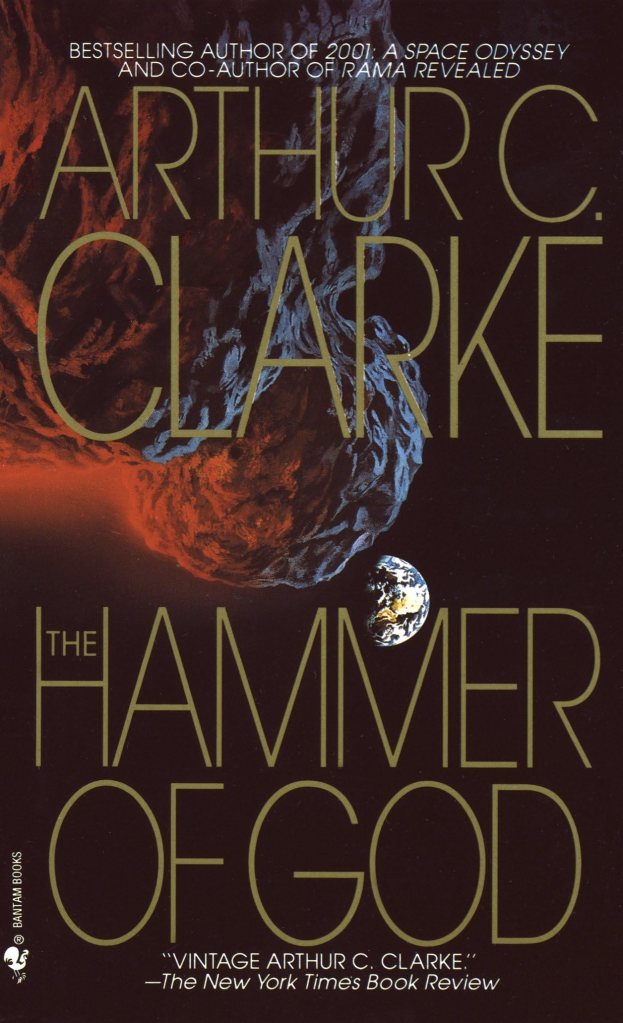
In Arthur C. Clarke’s The Hammer of God, which takes place in 2109, humans are living not just on Earth, but on the moon and Mars. One of the world’s fastest growing religions combines Christianity and Islam into something new. When Earth receives what appears to be a radio signal from another star system, Chrislamists preach it’s a message from God. In the same way paranormal investigators unwittingly construct tools to give themselves false positives, Chrislamists employ similar methods of woo to ensure they can interpret the signal in any way that supports their agenda. More on these bozos later.
In this future, 90% of all asteroids and comets in the solar system have been successfully cataloged by SPACEGUARD and a wildly imaginative idea involving the use of a space-detonated nuclear bomb. If SPACEGUARD sounds familiar, it’s because Clarke initially made the program up in Rendezvous with Rama, but in the years between that novel and this one, the initiative became a reality. Curiously, for all the backstory Clarke takes the time to weave about SPACEGUARD, it’s an amateur astronomer living on Mars who detects the titular asteroid that’s on a collision course with Earth.
Fortunately, there’s a spacecraft within rendezvous distance of the doomsday rock, which scientists dub Kali, after the goddess of destruction. Astronauts plan to touchdown on the asteroid and attach a thruster system known as ATLAS, which will nudge Kali out of its current trajectory. Easy peasy.
ATLAS, however, requires a mind-boggling amount of fuel, which takes a month to acquire. By the time they get it, Kali has entered the orbit of Mars—frighteningly close to humanity’s home world. No worries, though, because things are smooth sailing once they get their fuel. The astronauts land on Kali, attach ATLAS, turn the system on and—surprise-surprise: it’s been sabotaged by Chrislamists. It turns out the fundamentalist assholes believe only God should decide whether or not the asteroid collides with Earth.
This is when the book gets good and I mean really good. The astronauts devise one plan after another, only to encounter unforeseen issues left and right. The scientists and politicians back on Earth decide to take out an insurance policy: a hastily constructed nuke which they plan to fire at the asteroid when all is lost. If the astronauts succeed, the scientists will simply send a deactivation signal. If the astronauts fail, they’ll allow the nuke to continue as planned. As you can imagine, things won’t be as simple as that when the time to make the decision comes.
The latter half of the novel is exciting stuff, but Clarke crams too many of his ideas into the front half to make it engaging (I haven’t even mentioned the life-extension technology, artificial intelligence, chaos theory and detailed economics he writes about at length). I caught glimpses of the world-building that made Rendezvous with Rama such a compelling read, but for the most part it’s a meandering slog until things finally go tits up. I think Clarke could have cut as much as 50% out of the earlier sections, but even with all its filler, it’s an unusually short novel.
I’m tempted to tell readers to skip the first half because it’s the second half that likely interested Steven Spielberg when he optioned the book into a movie. Why his production company made the criminally boring Deep Impact instead, I’ll never know.
 The Goug' Blog